Do these 3 things before closing this tab:
1Repair Windows errors before they cause bigger problems2Fix the driver behind crashes, sound loss and screen glitches3Clear out junk files and repair common Windows errorsTimber lasts when its treatment is specified for the exposure it will actually face. Lonza’s published Wood Protection overview describes industrial pre-treatment and surface-protection technologies, including copper-azole preservative technology, but it does not establish one universal formulation or a guaranteed service life. The reliable method is to define the timber’s use conditions, select the applicable standard and approved treatment, then control design, installation, inspection and maintenance.
Durability starts with the building’s exposure, not a brand name
“Treated timber” is not a complete performance specification. A board inside a dry, heated building has a different biological and moisture risk from a post in permanently wet ground, a glulam beam under a leaking roof, or decking exposed to driving rain. The treatment, retention, penetration, species, product dimensions and quality checks must match that risk.
As an Amazon Associate I earn from qualifying purchases.
Long-term performance normally means controlling several failure mechanisms at once:
- Decay fungi: repeated wetting and slow drying can create conditions for fungal decay.
- Insects: termite or other insect risk varies with geography and exposure.
- Moisture movement: swelling, shrinkage, checking and corrosion around connections can damage a member even when biological attack is controlled.
- Fire: a fire-retardant treatment addresses a different performance objective from a decay preservative.
- Surface staining and mould: these affect appearance and, in some circumstances, indicate persistent moisture.
Lonza’s corporate Wood Protection overview says its business has included industrial preservatives, copper-azole technology, fire retardants, water repellents, mould inhibitors, sapstain-control chemicals, pole-climbing enhancers, and pressure and non-pressure treatments. That is a description of a roughly decade-old corporate source, not a current catalogue for every country. Current product names, formulations, approvals and supply must come from the technical documentation applicable to the project’s region.
#1 Best Overall

- It is easy to use
- It is highly durable
- Manufactured in United States
- Model number: 1904A
The same overview describes intended resistance to termites, fungi, mould, fire and moisture. Those are vendor-stated protection objectives, not independent proof that a particular treated member will last a stated number of years in your building. No verified service-life figure for a currently named Lonza product in a specified application is established here.
Define the service conditions before choosing treatment
Write the exposure assumptions into the design brief. If the assumptions change, the timber specification must be reviewed rather than carried forward unchanged.
Exposure questions to answer
- Where is the timber? Record whether it is indoors, outdoors above ground, in contact with soil, exposed to freshwater, or exposed to a marine environment.
- How often will it become wet? Consider rain, splash, condensation, plumbing leaks, snow, wash-down, and humidity. Note whether the member can dry quickly.
- Is the wetting intermittent or continuous? A sheltered external beam and a post held in wet ground are not equivalent conditions.
- What biological hazards exist locally? Confirm termite pressure and the fungi or insects relevant to the project’s geography.
- What is the structural role? Identify joists, columns, posts, beams, roof members, glulam, decking, cladding and non-structural trim. Structural members may require treatment processes that preserve strength, connection performance and dimensional stability.
- What fire performance is required? A fire-retardant system may be needed in addition to, or instead of, a decay-preservative objective. Check the project’s fire strategy and test classification.
- How will the timber be maintained? Establish access for inspection, the finish or coating schedule, drainage cleaning and the response to damaged coatings or standing water.
These answers provide the basis for an AWPA Use Category selection. They also give the treatment supplier enough information to confirm whether its product approval covers the actual end use.
The Tool Desk
Outbyte PC Repair FREERepair Windows errors before they cause bigger problemsFix Now →Outbyte Driver Updater FREEFix the driver behind crashes, sound loss and screen glitchesFind Drivers →Use AWPA’s specification sequence
The American Wood Protection Association (AWPA) identifies U1 as its primary standard for preservative-treated wood products. Its Use Category System starts with expected service conditions and then addresses product type, species and preservative. Those choices determine treatment and inspection requirements. AWPA standards are updated annually, so obtain the current edition and check local building and environmental requirements before issuing a specification.
1. Select the use category
Choose the category that describes the member’s exposure and function, rather than selecting a category because a familiar product is available. A timber supplier or treating plant should be able to state the category covered by its current approval. If a member has more than one exposure—for example, a column partly above ground and partly embedded—specify the most demanding relevant condition or use separate details and products.
Rank #2

- Many Uses - This product is suitable for new home construction, renovation projects, and more and has been tested for many different jobs.
- High Quality Appearance - Every piece meets the stamped grading standards for strength and high quality appearance. They are also strong and durable.
- Versatile - Our Lumber can be primed and painted or sealed and stained. It has many uses and can do many jobs while having a high-quality appearance.
- Meets High Standards - Every stud meets the stamped grading standards for strength and highest quality in appearance. Framing studs are ideal for a wide range of uses from framing of houses to basic interior structural applications. Studs come in several widths for structural framing, structural walls, interior and protected exterior walls or can be used for a variety of craft and non-structural projects.
- Farm Plastic Supply - Farm Plastic Supply offers premium lumber products for all uses and jobs. Our lumber products are quality and are very durable. Our Lumber is very dependable and has been a favorite among many of our customers.
2. Identify the product type
State whether the material is sawn lumber, a pole, plywood, glulam or another engineered product. Treatment rules are not interchangeable between product types. Incising, end-grain treatment, machining allowances and permissible post-treatment operations can differ, particularly for structural members.
3. Confirm the species
Species affects treatability, penetration and the approved treatment process. Do not assume that a retention established for one species transfers to another. AWPA homeowner guidance uses Southern pine examples, but those retentions are examples for the stated species and use categories, not universal values for all timber.
Quick wins for a faster PC:
Fix the driver behind crashes, sound loss and screen glitchesFind Drivers →Repair Windows errors before they cause bigger problemsFix Now →Scan for outdated or missing drivers - takes under a minuteDriver Scan →4. Specify the preservative system and required retention
The preservative must be approved for the selected use category, product type and species. The specification should identify the required retention and penetration, any end-treatment requirement, and whether the treatment is pressure or non-pressure. Do not substitute a generic statement such as “Lonza treated” for these technical requirements.
5. Define inspection and evidence
Require treatment records, plant identification, charge or batch information where applicable, and evidence that the product was treated to the current applicable standard. Confirm how penetration and retention are measured, who performs inspection, and what happens when a load fails inspection. Keep the records with the project’s material certificates.
| Specification element | Question it answers | Evidence to request |
|---|---|---|
| Use category | What exposure and biological hazard will the timber face? | Current standard reference and supplier confirmation for the stated end use |
| Product type | Is the treatment approved for this form of timber? | Product-specific treatment and machining instructions |
| Species | Can the preservative penetrate and be retained in this wood? | Species-specific approval or treating-plant statement |
| Preservative | Which hazard is being addressed? | Current technical data and approval scope |
| Retention and penetration | Was enough active ingredient placed in the required zone? | Inspection results and treatment certification |
| Handling and finishing | Will site work undo the protection? | Cut-end, drilling, storage and coating instructions |
What Lonza’s published overview does—and does not—tell you
The Lonza overview is useful for understanding the range of technologies associated with industrial wood protection. It describes pre-treatment and surface-protection chemistry and lists systems intended to address decay organisms, insects, moisture, fire, mould and sapstain. It does not identify a single treatment suitable for every timber product or climate.
Rank #3

- By Crafters, For Crafters: Crafting and building with wood is our number one priority. Bringing you more of the wood craft supplies you love is our job. Please dont hesitate to get in touch
- Versatile Wooden Sticks and Lumber: These wooden pieces take paint, stain, and other embellishments well. Short lengths are suitable for many projects - from DIY decks to framing
- Pre-Cut and Pre-Sanded: Tired of cutting sanding and measuring your lumber? We've done it for you with less then a 1/64 inch tolerance. The lumber we produce comes pre-sanded and pre-cut to 12 inch sizes - craft ready. For Smaller than 12" pieces, you can easily cut them
- Quality Construction Material: Our wood and lumber are made from beautiful, quality wood - only the best for our woodworkers and DIYers! These are cut and prepared in the usa
- Sustainably Sourced Wood: All of our wood comes from sustainable forests. This insures that every tree is replaced and regrown for future generations
Because the overview is old, do not use it to infer that a named formulation is currently sold in your country, approved for your species, or available from a particular treating plant. Ask for a current technical data sheet, safety information, label or approval document, and a written statement of the end uses covered. Check revision dates and the geographical scope.
A product claim such as “resists fungi” is also narrower than a service-life guarantee. Performance depends on the timber’s exposure, design, workmanship, inspection and maintenance. The treatment supplier should define the conditions under which its test data and approval apply.
Design and construction protect the treatment’s investment
Preservative treatment is a supplement to sound detailing, not a replacement for it. The APA technical note on preservative-treated glulam, last revised July 1, 2013, explains that treatment may help when proper design and construction techniques cannot adequately protect members. Its detailed prescriptions are dated; verify current standards and project requirements before relying on them.
Keep timber dry where the design allows
- Provide falls, drip edges and flashing so water leaves the member rather than sitting on it.
- Separate end grain from standing water and use suitable caps, shoes or drainage details.
- Prevent concealed cavities from trapping moisture; provide ventilation and inspection access.
- Keep cladding, membranes and gutters maintained so leaks do not become chronic wetting.
Protect cut and drilled surfaces
On-site cutting, notching, boring and end trimming can expose untreated wood inside a treated envelope. Follow the current treatment supplier’s instructions for field-applied end or cut-surface protection. Do not assume that a decorative coating restores preservative penetration.
Coordinate connections and finishes
Confirm fastener and connector compatibility with the preservative and the exposure. Specify corrosion-resistant hardware where required by the current treatment documentation and building conditions. If a water-repellent or film-forming finish is used, verify that it is compatible with the treated timber and that the maintenance interval is practical.
Rank #4
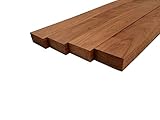
- Beautiful Grain
- Perfectly Kiln Dried
- Two sides sanded to 3/4" thickness
Compare treatment approaches by the job they perform
There is no defensible “best” system without the project conditions. Use the following comparison to frame questions for an approved supplier.
| Approach | Typical role | What must be verified | Important limitation |
|---|---|---|---|
| Industrial pressure treatment | Deep, controlled preservative application for specified end uses | Use category, species, product type, retention, penetration and inspection scheme | Protection can be compromised by later cutting, poor detailing or an exposure outside the approval |
| Industrial non-pressure treatment | Surface or shallow protection for uses covered by the product approval | Permitted exposure, application rate, preparation and re-treatment requirements | Not automatically equivalent to pressure treatment for severe wet or structural exposure |
| Water repellents | Reduce water uptake or improve surface performance | Compatibility, weathering performance and maintenance schedule | They do not by themselves establish decay protection or structural durability |
| Fire retardants | Address a specified fire-performance objective | Test classification, substrate, thickness, application process and coating requirements | Fire performance is a separate objective from fungal or insect protection |
| Mould or sapstain control | Limit staining or mould during manufacture, storage or early exposure | Approved use, duration of protection and moisture-control requirements | They do not replace a preservative specification for long-term decay hazard |
Apply the UK approval lens when relevant
For UK projects, the Wood Protection Association (WPA) describes approved products as being defined at minimum by end use or use class, species and service life. Its Benchmark scheme evaluates laboratory and field-test evidence and treatment processes. That approval context is geographic: a WPA approval or supplier certificate should not be presented as automatic evidence of compliance in another jurisdiction.
Check the current certificate, its expiry or revision status, the covered species and the exact end use. A treatment label without that scope does not prove that the timber is suitable for your application. WPA’s industrial Wood Preservation Manual is available as a free reference, but the project still needs current, product-specific approval information.
A practical procurement and installation workflow
- Prepare an exposure schedule. List each timber element, location, wetting pattern, biological hazards, structural role and required fire performance.
- Set the governing standard. Identify the current AWPA, UK or other local standard and the inspection scheme required by the contract.
- Issue a product-specific enquiry. Ask treating plants or suppliers to confirm approved use category, product type, species, preservative, retention, penetration and permitted machining.
- Review current documentation. Check technical data, approval certificates, safety information, revision dates and regional availability. Do not rely only on an old corporate overview.
- Write acceptance criteria. State markings, certificates, moisture condition, visible defects, treatment tolerances and the procedure for rejected loads.
- Control delivery and storage. Keep timber off the ground, ventilated and protected from standing water. Prevent mud, salt and construction chemicals from contaminating the treated surfaces.
- Inspect before installation. Match delivery records to the specified product and examine cuts, splits, incisions, excessive checking and damaged ends.
- Protect site alterations. Record every cut or drilled surface and apply the approved field treatment where required.
- Commission a maintenance plan. Set inspection intervals, drainage cleaning, coating renewal and repair procedures before handover.
Failure modes to avoid
Using a generic lifespan claim
A statement such as “this treatment lasts 25 years” is incomplete without the product, species, retention, exposure, test basis and maintenance assumptions. No verified number of years is established for a current named Lonza product and specified application in the available evidence, so specify conditions and evidence instead.
Treating a label as universal approval
Approval is tied to end use, use class, species, product type and service-life conditions. Obtain the scope document and make sure the installed timber matches it.
Best Value

- Ready-to-Use Copper Naphthenate 17% (contains 2% copper as metal), meets the AWPA M4 Standard
- Required by building codes (IBC 2303.1.9 & IRC R317.1.1) on end-cuts of all pressure treated lumber
- Low VOC (<350g/L) and 100% domestically sourced from recycled copper and reclaimed by-products.
- Labeled for General Use, and wood treated with Tenino maybe discarded in local landfill
- Water repellant and both toxic and repellant to termites and other wood destroying insect
Choosing the preservative before the detail
If water is trapped by a detail, a stronger chemical claim may only postpone failure. Correct drainage, ventilation, flashing and access first, then select treatment for the residual exposure.
Mixing standards without checking equivalence
AWPA categories, UK use classes and other national schemes are not interchangeable labels. Ask the responsible designer or certification body to confirm equivalence rather than translating categories informally.
Ignoring post-treatment work
Cutting, planing, drilling, sanding or coating can change the protected zone. Include those operations in the purchase specification and method statement.
What a defensible Lonza-based specification looks like
A robust specification names the timber element and exposure first, then states the governing standard, use category, product type, species, preservative system, retention and penetration, inspection evidence, handling rules and field-treatment requirements. Lonza can be considered where a current approved product and treating process meet those conditions. The brand name is supporting information; the end-use approval and verified process are what make the timber suitable.
Finally, retain the certificates and maintenance records with the building documentation. Recheck the current standard and regional approvals whenever the species, supplier, treatment plant, detail or intended exposure changes. That disciplined chain—from service conditions to approved treatment to maintained construction—is the practical route to long-term timber performance.
Quick Recap
Product prices and availability are accurate as of the date/time indicated and are subject to change. Any price and availability information displayed on Amazon at the time of purchase will apply.

