To solder an RCA plug, connect the cable’s inner signal conductor to the plug’s center pin or tip terminal, and connect the shield or return conductor to the outer sleeve or ground terminal. Install the connector shell and strain-relief parts on the cable before soldering, use shielded cable, and verify continuity and shorts with a multimeter before connecting the cable to equipment.
What the RCA terminals do
A standard RCA plug has two electrical connections:
As an Amazon Associate I earn from qualifying purchases.
| RCA part | Function | Typical cable connection |
|---|---|---|
| Center pin, center tab, or tip terminal | Signal or “hot” conductor | Inner conductor |
| Outer sleeve, barrel, or ground tab | Signal reference, common, or shield | Braid, shield, or return conductor |
The center contact is the signal connection and the barrel is normally ground or common in an unbalanced RCA connection, as shown in Extron’s RCA wiring documentation. Avoid describing the outer connection simply as a speaker “negative” terminal. RCA line-level common is not automatically the negative output of a speaker amplifier.
Tools and materials
- Solderable RCA plug with a cable clamp or other strain relief
- Shielded two-conductor audio cable or suitable coaxial cable
- Temperature-controlled soldering iron with a small chisel or conical tip
- Rosin-core electronics solder
- Wire stripper and small diagonal cutters
- Helping hands, vise, or connector holder
- Digital multimeter with continuity and resistance modes
- Heat-shrink tubing, if compatible with the connector
- Electronics flux, brass wool or a damp sponge, and fine tweezers
- Eye protection and ventilation or fume extraction
Do not use acid-core plumbing solder or plumbing flux. Those materials are intended for other applications and can damage electronics. Wash your hands after handling solder, particularly if it contains lead.
#1 Best Overall

- Product Name : RCA Male Connector,Soldering Type
- Material : Metal
- High quality, low signal loss
- Compatible Wire Size: 6.2mm
- Package Included 5 Black and 5 Red Plugs
Choose the cable and RCA plug
For a normal audio interconnect, use shielded cable: one inner signal conductor surrounded by a braid, foil, drain wire, or return conductor. Shielding reduces pickup of hum and electromagnetic interference. Ordinary unshielded speaker wire may work for a very short experimental connection, but it is generally a poor choice for a line-level RCA cable because it offers less protection from noise.
Match the plug to the cable before starting. RCA plugs vary in cable-entry diameter, terminal shape, shell design, and strain relief. For example, the cited Switchcraft 3502A is specified for shielded cable up to 0.290 inch (7.366 mm), while Cardas solderable models use different cable-opening sizes. Check the manufacturer’s dimensions rather than assuming every RCA plug fits the same cable.
For stereo, each RCA plug carries one channel. Red is commonly right and white or black is commonly left, but colors are conventions rather than proof. Verify the cable conductors and the equipment markings. For composite video, use suitable coaxial cable when the run is long or the signal requirements are demanding; an RCA connector alone does not make an audio cable electrically equivalent to a video cable.
The Tool Desk
Outbyte Driver Updater FREEScan for outdated or missing drivers - takes under a minuteDriver Scan →Outbyte PC Repair FREEClear out junk files and repair common Windows errorsFree Scan →Prepare the plug before soldering
The most common avoidable mistake is forgetting to install the shell first.
- Unscrew or slide off the RCA shell.
- Remove the strain-relief spring, insulating sleeve, boot, and cable clamp if they are separate parts.
- Slide every rear component onto the cable, facing the correct direction for reassembly.
- Leave the parts far enough back that they cannot interfere with soldering.
- Secure the bare connector in a vise or helping-hands fixture.
Manufacturer instructions such as the Switchcraft soldering handout likewise place the connector handle on the cable before the terminals are soldered.
Prepare a shielded two-conductor cable
- Cut the cable cleanly.
- Remove only enough outer jacket to reach the sleeve and center terminals comfortably.
- Separate the shield or return conductor and twist its strands neatly.
- Strip a short length of insulation from the center conductor.
- Twist stranded conductors so they do not fray.
- Lightly tin the center conductor and, if appropriate for the terminal, the shield or drain wire.
- Trim stray strands and excess wire.
Do not treat 3/8 or 1/2 inch as a universal strip length. Plug designs differ, and excessive exposed wire increases the chance of a short. Strip only enough conductor to fill the terminal; no bare wire should extend beyond the solder cup or tab after the joint is complete.
Prepare coaxial cable
With coaxial cable, the center conductor goes to the RCA center terminal. The braid, foil-and-drain connection, or designated shield goes to the outer sleeve terminal.
Do these 3 things before closing this tab:
1Repair Windows errors before they cause bigger problems2Fix the driver behind crashes, sound loss and screen glitches3Clear out junk files and repair common Windows errorsRank #2

- SOLDERLESS RCA MALE PLUG: Do not need solder, make speaker wire installation a breeze, Spring-style strain relief prevents cables from pulling out.
- COMPATIBLE: Suitable for cables up to 6.2mm in diameter, use for the connection between A/V receivers, VCD, DVD, TV, tape recorder, cd and audio, power amplifier, mixer and transmit their audio signals.
- DURABLE AND NO SIGNAL LOST: 24k Gold Plated Connectors to resist corrosion, no signal lost. Features a metal connector body, perfect for professional installers or home theater enthusiasts who want to make their own custom length premium RCA cables.
- EASY IDENTIFICATION: the connector collar is color-coded for polarity identification. easy to maintain proper polarity because of the color-coded black/red rings.
- APPLICATION: Applicate to analog video/audio (AV interface (three-color cable)), digital audio (S/PDIF) and color difference component (color difference interface) transmission, etc. Widely used in recording studios, stage audio, video, and audio systems.
- Remove the outer jacket without cutting into the braid or foil.
- Fold the braid back or form it into a compact pigtail, following the plug’s design.
- Expose only a short length of the center conductor.
- Do not nick the dielectric around the center conductor.
- Keep braid and foil strands contained so none can reach the center terminal.
If the plug includes a clamp or crimp feature, use it for mechanical support. The solder joint should not be responsible for carrying cable pull.
Solder the RCA plug
Inspect the connector and identify the center terminal and sleeve terminal before heating anything. If the terminals are bare solder cups or tabs, pre-tin each with a small amount of solder.
1. Solder the shield or return
- Place the shield, braid, drain wire, or return conductor on the outer sleeve terminal.
- Touch the clean, tinned iron tip to both the wire and terminal at the same time.
- Feed solder into the heated joint, not directly onto the iron tip.
- Use only enough solder to wet the wire and terminal fully.
- Remove the solder, then remove the iron.
- Hold the cable still until the joint solidifies.
The finished joint should be smooth, compact, and firmly attached. Remove loose strands and check that no shield wire can touch the center terminal.
2. Solder the center conductor
- Position the tinned center conductor on the center pin or center tab.
- Heat the conductor and terminal together.
- Add a small amount of solder until it flows around both surfaces.
- Remove the solder and then the iron.
- Allow the joint to cool without movement.
Avoid holding heat on the connector longer than necessary, especially near plastic insulation. There is no universal RCA soldering temperature or dwell time: terminal mass, plating, insulation, and connector construction differ. Follow the plug manufacturer’s assembly instructions where available. Product-specific figures, such as those in Hirose’s assembly guide, should not be treated as universal rules for RCA plugs.
What’s actually slowing this PC down?
Pick the symptom - the matching free tool is one click away.
Inspect the joints and secure the cable
Before closing the shell, inspect both connections under good light. A good joint is well wetted, firm, and not excessively bulky. Watch for:
- Dull, cracked, or grainy solder
- Loose strands
- Exposed conductor beyond the terminal
- Solder bridging the center and sleeve terminals
- Melted insulation or a bent terminal
Engage the connector’s strain relief over the outer cable jacket. It should grip the jacket without crushing it, cutting into it, or pulling on the inner conductors. The Switchcraft 3502A product information illustrates the importance of matching the cable diameter to the clamp.
If you use heat-shrink tubing, install it where it cannot interfere with the connector’s threads, insulating sleeve, or clamp. Confirm that the sleeve is in its proper position, then screw the shell on firmly without overtightening. If the shell will not fit, do not force it; a bulky joint, oversized cable, missing sleeve, or incorrectly positioned part is usually the cause.
Rank #3
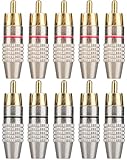
- SOLDERLESS RCA MALE PLUG: Do not need solder, make speaker wire installation a breeze, Spring-style strain relief prevents cables from pulling out.
- COMPATIBLE: Suitable for cables up to 6.2mm in diameter, use for the connection between A/V receivers, VCD, DVD, TV, tape recorder, cd and audio, power amplifier, mixer and transmit their audio signals.
- DURABLE AND NO SIGNAL LOST: 24k Gold Plated Connectors to resist corrosion, no signal lost. Features a metal connector body, perfect for professional installers or home theater enthusiasts who want to make their own custom length premium RCA cables.
- EASY IDENTIFICATION: the connector collar is color-coded for polarity identification. easy to maintain proper polarity because of the color-coded black/red rings.
- APPLICATION: Applicate to analog video/audio (AV interface (three-color cable)), digital audio (S/PDIF) and color difference component (color difference interface) transmission, etc. Widely used in recording studios, stage audio, video, and audio systems.
Test the finished cable with a multimeter
Disconnect the cable from every piece of equipment before testing.
Free tools Windows power users keep installed
One-click scans. No signup required.
Center-conductor continuity
Touch one probe to the center pin at one end and the other probe to the corresponding center pin at the other end. The meter should show continuity or very low resistance.
Shield continuity
Touch one probe to the outer shell at one end and the other probe to the outer shell at the other end. The meter should again show continuity or very low resistance.
Check for a short
Probe the center pin and outer shell on the same plug. The expected result is no continuity or very high resistance. Repeat at the other end. A short usually indicates a stray shield strand, excessive solder, melted insulation, or a bent terminal.
Perform a flex test
While monitoring continuity, gently flex the cable near each plug. An intermittent reading points to a cracked joint, broken conductor, damaged cable, or inadequate strain relief.
Quick wins for a faster PC:
Fix the driver behind crashes, sound loss and screen glitchesFind Drivers →Repair Windows errors before they cause bigger problemsFix Now →For stereo cables, test left and right separately and confirm that the channel colors match the equipment inputs. Do not join the two signal conductors, and do not connect separate channel shields together unless the cable and equipment design specifically requires it.
Independent reader supportYour contribution helps us test, update, and keep practical guides available for everyone.Troubleshooting
| Symptom | Likely causes | What to check |
|---|---|---|
| No audio | Open center conductor, signal wire on the sleeve, cold joint, damaged cable, wrong input, or reversed channel | Run the continuity test from center pin to center pin and inspect each terminal |
| Loud hum or buzz | Disconnected shield, shield strand touching signal, unshielded cable, cable routed near power wiring, or a system ground-loop problem | Check shield continuity and shorts first; if wiring is correct, investigate the wider audio system |
| Sound cuts out when moved | Weak solder joint, fractured conductor, poor strain relief, or clamp damage | Perform the flex test and inspect the cable jacket and clamp |
| Short between signal and ground | Stray braid strand, excessive solder, melted insulation, or bent terminal | Inspect with magnification and resolder only after removing the cause |
| Shell will not reinstall | Shell omitted before soldering, bulky joint, oversized cable, missing sleeve, or incorrectly positioned clamp | Compare the assembly with the manufacturer’s drawing and check cable diameter |
| Connector deforms during soldering | Excessive heat, long dwell time, or heat transferred into the insulator | Use a clean tip, minimize heating, and follow the connector manufacturer’s instructions |
A correctly wired RCA plug cannot necessarily cure hum caused by multiple equipment grounding paths, power wiring, or poorly designed unbalanced equipment. First distinguish a connector wiring fault from a system-level ground-loop problem.
Rank #4
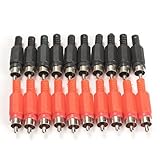
- 100%Brand New and High Quality
- Quantity: 20 pcs,With black and red color(10PCS for each color)
- RCA male plug, solder type
- RCA Plug Male Audio Video Adapter
- Precise and professional made, stable performance
When replacing the cable is better
Soldering is worthwhile when the cable is otherwise sound, the connector is damaged, the required length is unusual, or a repair is more practical than replacement. Replace the entire cable when the shielding is corroded or badly frayed, several sections are damaged, the cable is inexpensive and sealed, or the plug is molded and not designed to open. In high-vibration or safety-critical work, use a professionally assembled cable or a connector system designed for that environment.
For a replacement plug, prioritize cable fit, a genuine strain relief, accessible terminals, adequate clearance between signal and shield, and a serviceable shell. Locking designs such as the Supra PPSL may suit projects needing additional mechanical retention, while a conventional solder-cup plug is usually simpler for a basic repair. Connector plating or premium materials should not be treated as a guaranteed sound-quality improvement; correct wiring, shielding, and mechanical support matter more for this job.
Frequently Asked Questions
Which RCA terminal is positive?
The center pin or center tab is the signal/hot terminal. The outer sleeve is the common or shield connection. This is not the same as identifying a speaker amplifier’s negative output.
Does red wire always go to the center pin?
No. Red is a common convention for signal or the right stereo channel, but wire colors are not guaranteed. Verify the cable construction and terminal markings.
Can speaker wire be used for an RCA cable?
It can work for a very short experimental connection, but ordinary speaker wire is usually unshielded and more vulnerable to hum and interference. Shielded cable is the better normal choice.
Can I solder an RCA plug without a vise?
Yes, but a helping-hands fixture, vise, or connector holder makes it easier to keep the plug and cable still while the joint cools.
Recommended Free Tools
Why does a repaired RCA cable still hum?
Check shield continuity, stray strands, and cable routing first. If the plug wiring is correct, the hum may be caused by a ground loop or another system-level fault.
Can an RCA plug be used for composite video?
RCA connectors are commonly used for composite video, but cable suitability depends on impedance, construction, signal frequency, and length. Use appropriate coaxial cable for demanding or longer runs.
Quick Recap
Product prices and availability are accurate as of the date/time indicated and are subject to change. Any price and availability information displayed on Amazon at the time of purchase will apply.

