Quick wins for a faster PC:
Scan for outdated or missing drivers - takes under a minuteDriver Scan →Clear out junk files and repair common Windows errorsFree Scan →Choose the largest biscuit that fits the joint without breaking through a face, edge, or end of the workpiece. For most 3/4-inch panels and ordinary edge-to-edge glue-ups, that means a #20. Use a #10 for medium-width or thinner components, and a #0 when working with narrow rails, small frames, or thin stock.
The number alone is not enough. Before cutting, check the workpiece thickness, the width of the part, the distance to exposed edges, and the biscuit joiner’s depth setting. A test cut in scrap is the quickest way to prevent an otherwise invisible slot from becoming a visible breakout.
The three standard biscuit sizes at a glance
| Size | Approximate nominal size | Good starting point | Principal limitation |
|---|---|---|---|
| #0 | About 1-7/8 × 5/8 × 5/32 in., depending on brand | Narrow rails, small frames, picture frames, and thin stock | Less embedded area and less tolerance for poor positioning in broad assemblies |
| #10 | About 2-1/8 to 2-3/32 × 3/4 × 5/32 in. | Cabinet parts, medium-width stock, general furniture, and many miters | Can be too large for very narrow or thin components |
| #20 | About 2-1/4 to 2-3/8 × 7/8 to 1 × 5/32 in. | 3/4-inch-and-thicker panels, edge-to-edge joints, and larger assemblies | Needs sufficient thickness and clearance from both faces and the ends |
These are useful working dimensions, not universal measurements. Manufacturers vary slightly: for example, Lee Valley lists different nominal dimensions from some other suppliers, while the size numbers remain consistent. Match the biscuit size to your joiner’s depth stop rather than assuming that every brand has exactly the same length and width.
As an Amazon Associate I earn from qualifying purchases.
The Tool Desk
Outbyte Driver Updater FREEScan for outdated or missing drivers - takes under a minuteDriver Scan →Outbyte PC Repair FREEClear out junk files and repair common Windows errorsFree Scan →If you are buying supplies for varied projects, a mixed biscuit joiner assortment containing #0, #10, and #20 biscuits is the most practical starting point. It lets you make the joint fit the material instead of forcing every project into one size.
Choose by stock thickness—but check the actual joint
As a starting guide:
- #0: approximately 5/16- to 1/2-inch stock, especially when the part is narrow.
- #10: approximately 1/2- to 5/8-inch stock and many cabinet or furniture components.
- #20: approximately 3/4-inch-and-thicker stock, provided the slot can be centered with adequate material above and below it.
These ranges overlap because thickness is only one constraint. A wide 1/2-inch panel may accept a #10, while a narrow 3/4-inch rail may require a #0. The correct question is not simply “How thick is the board?” but “Can this biscuit sit fully inside the joint with safe material remaining around the slot?”
DEWALT’s current biscuit-joiner instructions state the general rule clearly: the largest biscuit that physically fits is normally the appropriate choice. The manual identifies #20 as suitable for most applications, except situations such as narrow face frames, picture frames, and stock around 1/2 inch or thinner. Bosch gives the same broad recommendation in its current guidance.
#1 Best Overall
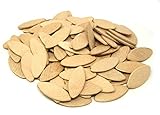
- #20 sized biscuits measure in at 56 by 23 by 4 mm
- Made from birch wood with diagonal-running wood grain
- Expands on contact with water-based glues for maximum reinforcement
- Maximize joint strength and squareness in lumber, plywood, composite board, and more
- Includes 100 woodworking biscuits in a resealable bag
Why the largest suitable biscuit is usually best
A larger biscuit places more compressed beech inside the joint and generally gives a broader bearing area for alignment and reinforcement. It is particularly useful on long panel joints, where several biscuits help keep the faces flush while the glue cures.
Recommended Free Tools
But “largest” must always be qualified by “suitable.” A biscuit slot that comes too close to a visible face can break through during cutting or sanding. A slot too close to an end can weaken the material or split it. A biscuit that physically enters the slot is not necessarily a biscuit that fits safely.
As a practical clearance check, Bosch recommends keeping the biscuit slot at least 3/16 inch from either face. For end locations, Bosch recommends placing biscuit centers at least 2 inches from the workpiece ends. Follow the instructions for your particular joiner, because cutter geometry and machine adjustments can differ.
Which size suits each type of joint?
Edge-to-edge panel joints
For ordinary 3/4-inch solid wood, plywood, MDF, or particleboard panels, start with a #20 if it can be centered safely. Use multiple biscuits along a long joint to improve alignment and distribute the jointing effect. A typical spacing guideline is about 6 to 10 inches on center; Bosch suggests beginning near the center and adding locations approximately 6 to 8 inches apart, while DEWALT gives a 6- to 10-inch range.
Keep the end biscuits away from the ends—roughly 2 to 3 inches to the biscuit center is a useful starting range—and adjust the pattern if a location would leave too little material or conflict with a visible feature. The exact spacing depends on panel width, grain direction, joint stresses, and whether the joint will be exposed.
Free tools Windows power users keep installed
One-click scans. No signup required.
Rank #2

- VERSATILE SELECTION: This variety pack includes biscuits in three sizes (No. 0, 10, 20), giving you options for different jointing applications.
- STURDY JOINING: Die-cut beechwood biscuits expand with the application of PVA glue to create a strong, durable joint.
- MULTIPLE USES: Compatible with hard and softwoods, plywood, and composition board, these biscuits are ideal for a wide range of projects.
- THREE CONVENIENT SIZES: Choose from No. 0 biscuits (1-7/8" x 5/8" x 5/32"), No. 10 biscuits (2-3/32" x 3/4" x 5/32"), and No. 20 biscuits (2-3/8" x 29/32" x 5/32") to suit your needs.
- MANAGEABLE PACK SIZE: This wood biscuits pack contains 100 Biscuits: 30 x No. 0 Biscuits, 30 x No. 10 Biscuits, and 40 x No. 20 Biscuits, making it easier to store in your workshop.
Standard biscuits are intended for wood and wood-based materials, including plywood, chipboard, and MDF. Bosch describes its standard biscuits as suitable for edge-to-edge, face-to-edge, and miter joints. For a repeated 3/4-inch panel workflow, a pack of #20 beech biscuits is usually the sensible size-specific refill after you have confirmed that #20 fits your work.
Cabinet and furniture components
#10 is often the most convenient middle-ground size for cabinet parts, medium-width rails, shelves, and general furniture work. It offers more bearing area than a #0 but is easier to place safely in narrower components than a #20.
Move up to #20 when the material is thick enough and the component is broad enough to preserve the required face and edge clearances. Move down to #0 when the part is narrow, the slot would approach an exposed edge, or a larger biscuit would leave too little material around the cut. Woodcraft’s general guidance places #0 in small projects, #10 in medium applications such as cabinets, and #20 in larger panels and heavier work.
Miter joints
#10 and #20 biscuits are common in mitered cases, boxes, and frames, but the correct choice depends on the width of the mitered members and the angle of the joint. The angled surface can make a biscuit appear to fit when its slot would actually approach a face or corner after assembly.
What’s actually slowing this PC down?
Pick the symptom - the matching free tool is one click away.
Lay out the joint carefully, confirm the biscuit will remain inside both members, and test the setup on offcuts cut at the same angle. A biscuit joiner’s size setting changes the slot depth to match the selected biscuit; it does not eliminate the need to check the available material. Rockler’s miter-joint guidance also notes that #10 and #20 are frequently used for this work.
Picture frames and narrow face frames
Use a #0 when a #10 or #20 would leave insufficient material around the slot. This is where the largest-fitting rule most often changes the answer: the workpiece may be thick enough for a larger biscuit but not wide enough to hide the slot safely.
Rank #3

- CONSISTENT FIT FOR RELIABLE JOINTS: Manufactured to a tight thickness tolerance to ensure a snug and stable fit in biscuit slots, helping prevent movement during glue up and assembly
- PRECISE ALIGNMENT FOR CLEAN RESULTS: Designed to support accurate edge to edge alignment, mitre joints, and panel assembly, helping achieve flush finishes across woodworking and cabinetry projects
- BEECHWOOD FOR STRONG GLUE BONDING: Made from compressed beech that absorbs adhesive and expands slightly during glue up, helping create a secure and durable joint in a wide range of materials
- SUITABLE FOR MULTIPLE MATERIALS: Compatible with hardwood, softwood, plywood, MDF, and chipboard, making them a versatile choice for furniture making, carcassing, and general joinery work
- BULK PACK FOR WORKSHOP USE: Supplied as a 1000 piece box, ideal for frequent use in trade and DIY workshops, helping keep projects moving without the need for constant reordering
Small face-frame or specialty biscuits may require a different blade and a joiner whose plunge mechanism supports that system. Do not assume that any small-diameter blade fits any machine. Rockler’s biscuit-joiner information warns that compatibility is tool-specific.
Set the joiner correctly
- Select the biscuit size. Most standard portable biscuit joiners use settings for #0, #10, and #20.
- Set the matching depth stop. The #0, #10, and #20 markings correspond to the biscuit size, not merely to a general shallow, medium, or deep cut.
- Check the fence and reference face. Mark the face of each workpiece so the slots are cut from consistent reference surfaces.
- Cut a scrap test. Use material of the same thickness and, for a miter, the same angle. Insert a dry biscuit and confirm that it fits fully without forcing.
- Inspect the clearances. Look at both faces, the edges, and the ends. A centered slot on one piece may not be centered on a narrower mating piece.
- Clear the slot. Dust left in the groove reduces the available depth and can prevent the biscuit from seating fully.
- Dry-fit before applying glue. Confirm that every biscuit enters its slot and that the parts close without excessive pressure.
- Glue and clamp promptly. Water-based woodworking glue will begin swelling the compressed beech biscuit, so assembly should follow soon after glue is applied.
DEWALT specifically emphasizes the scrap test because a slot that is not deep enough may not accept the biscuit completely during assembly. Current DEWALT and Bosch joiners both list support for #0, #10, and #20 sizes; nevertheless, verify the manual for your exact model before buying specialty cutters or connectors.
How biscuits work inside the joint
Standard wood biscuits are made from compressed beech. They are deliberately dry and compressed when supplied. When exposed to moisture from water-based woodworking glue, they expand inside the slot. That expansion helps fill the joint and lock the parts in position while the adhesive cures. Bosch and Bear Wood describe this swelling behavior for their standard biscuits.
Keep biscuits dry in storage. Moisture absorbed before use can cause premature swelling, make insertion difficult, and reduce the useful tolerance between the biscuit and the slot. Store opened packs sealed and away from damp workshops or unheated areas where condensation is common.
Spacing biscuits along a joint
For a long edge-to-edge joint, begin by marking the center of the assembly and work outward. A 6- to 10-inch on-center spacing is a reasonable starting point for many panel joints. Keep the outer biscuit centers roughly 2 to 3 inches from the ends, or at least the minimum distance specified by your joiner’s manufacturer.
Rank #4

- VERSATILE SELECTION: This variety pack includes biscuits in three sizes (No. 0, 10, 20), giving you options for different jointing applications.
- STURDY JOINING: Die-cut beechwood biscuits expand with the application of PVA glue to create a strong, durable joint.
- MULTIPLE USES: Compatible with hard and softwoods, plywood, and composition board, these biscuits are ideal for a wide range of projects.
- THREE CONVENIENT SIZES: Choose from No. 0 biscuits (1-7/8" x 5/8" x 5/32"), No. 10 biscuits (2-3/32" x 3/4" x 5/32"), and No. 20 biscuits (2-3/8" x 29/32" x 5/32") to suit your needs.
- LARGE PACK QUANTITY: This wood biscuits bulk pack contains 1000 Biscuits: 250 x No. 0 Biscuits, 250 x No. 10 Biscuits, and 500 x No. 20 Biscuits, making it an economical choice for the workshop.
Spacing is not a rigid formula. Use fewer biscuits where the panel is short, and avoid locations that would put a slot too near a knot, thin edge, exposed end, fastener, or other weak area. More biscuits do not automatically compensate for poor fit, contaminated surfaces, inadequate clamping, or misaligned reference marks.
Do these 3 things before closing this tab:
1Fix the driver behind crashes, sound loss and screen glitches2Repair Windows errors before they cause bigger problems3Scan for outdated or missing drivers - takes under a minuteWhat to buy
If you are new to biscuit joining
Buy a mixed #0/#10/#20 wood biscuits assortment. It covers the three standard sizes and lets you test which size suits the material you use most often. After several projects, replenish the size that your work actually consumes rather than assuming one size is universal.
If you mainly join 3/4-inch panels
Buy #20 compressed-beech joining biscuits in a size-specific pack once you have confirmed that your joiner, material thickness, and layout provide safe clearance. A 100-count pack is a common format, but pack size and availability vary by brand and market.
If you do not yet own a joiner
A standard biscuit joiner that explicitly supports #0, #10, and #20 biscuits is the most flexible choice. Tool selection is secondary to biscuit selection here: first determine the joints and materials you expect to make, then confirm that the machine has the required size settings, fence adjustments, and replacement parts.
Supporting supplies
A sharp, model-compatible biscuit joiner replacement blade helps produce clean, accurately sized slots, while a suitable PVA wood glue for biscuit joints supplies the water that allows standard beech biscuits to swell. Check the joiner manual for blade compatibility rather than buying by diameter alone, and follow the glue manufacturer’s open-assembly and clamping guidance.
Specialist suppliers such as Rockler, Woodcraft, Lee Valley, Infinity Tools, and Bear Wood also publish biscuit and joinery supplies. Their availability, product ranges, and any partner-program status can change, so compare the exact biscuit dimensions and material before ordering.
Best Value

- #0 sized biscuits measure in at 47 by 15 by 4 mm
- Made from birch wood with diagonal-running wood grain
- Expands on contact with water-based glues for maximum reinforcement
- Maximize joint strength and squareness in lumber, plywood, composite board, and more
- Includes 100 woodworking biscuits in a resealable bag
Important compatibility limits
Most standard portable biscuit joiners are built around #0, #10, and #20 biscuits. Lamello identifies sizes 10 and 20 as matching the original wood-biscuit sizes, but specialty Lamello connectors such as Clamex and Tenso are different products. Do not substitute a specialty connector simply because it uses a similar groove; confirm the machine, cutter, connector, and installation method as a complete system.
Likewise, do not assume that biscuits from different manufacturers have identical dimensions, or that a small specialty blade will fit every joiner. Use the manufacturer’s published specifications and make a scrap test whenever the biscuit brand, blade, or machine setup changes.
Quick selection checklist
- Is the stock approximately 3/4 inch or thicker and broad enough for safe clearances? Start with #20.
- Is the part medium-width, around 1/2 to 5/8 inch thick, or a typical cabinet component? Start with #10.
- Is the part narrow, thin, or a picture-frame or face-frame member? Start with #0.
- Will the slot remain at least about 3/16 inch from each face?
- Will end biscuits remain at least about 2 inches from the ends, or meet your machine’s specified minimum?
- Does the joiner have the matching #0, #10, or #20 depth setting?
- Did you make a test cut in matching scrap?
- Are the slots clean and deep enough for the biscuits to seat fully?
- Have the dry biscuits been kept away from moisture until glue-up?
Biscuits are excellent for alignment and useful reinforcement, but they are not automatically stronger than every alternative. Depending on the design and loading, a dado, rabbet, dowel, mortise-and-tenon, or another traditional joint may be more appropriate. Rockler notes that biscuit joints can be weaker than dado or rabbet joints in some applications, and they should not be treated as a universal replacement for structural joinery.
Frequently Asked Questions
What is the most common biscuit size for 3/4-inch wood?
A #20 is normally the first choice for 3/4-inch solid wood, plywood, MDF, or particleboard when the workpiece is wide enough to leave safe material above and below the slot. Test the setup and check face and end clearances before cutting the finished parts.
Can I use a #20 biscuit in 1/2-inch stock?
Usually not as a general recommendation. A #20 may leave too little material around the slot in 1/2-inch stock. Consider a #10 or #0 based on the part’s width and the required clearance from each face and edge.
Are #0, #10, and #20 biscuits interchangeable between brands?
They are standardized size categories, but nominal dimensions vary slightly between manufacturers. Use the matching depth setting on the joiner, check the manufacturer’s specifications, and make a test cut when changing brands.
How far apart should biscuits be placed?
For many edge-to-edge panel joints, begin with approximately 6 to 10 inches on center. Keep the end biscuit centers roughly 2 to 3 inches from the ends, subject to the joiner manufacturer’s minimum clearance and the strength and appearance requirements of the project.
The Bottom Line
Use #20 for most broad, 3/4-inch-and-thicker work; #10 for medium cabinet and furniture components; and #0 for narrow frames, face frames, and thin stock. The final decision is controlled by clearance: choose the largest biscuit that fits completely without risking breakout, then match the joiner setting and verify the cut in scrap before applying glue.
Quick Recap
Product prices and availability are accurate as of the date/time indicated and are subject to change. Any price and availability information displayed on Amazon at the time of purchase will apply.

