The most dependable way to stop cooking smells spreading through an open-plan home is to capture them at the hob: run a correctly installed range hood that exhausts outdoors while you cook and for 10–20 minutes afterward. Keep its grease filter and nearby surfaces clean, use rear burners when practical, and choose a quieter fan so the hood is used consistently. If outdoor exhaust is not available, conditional outdoor-air ventilation plus a properly sized, ozone-free air cleaner can reduce the remaining pollution, but neither replaces source capture.
For noise, first identify whether the problem is reverberation inside the room or sound entering through walls, windows or floors. Rugs, curtains, upholstered furniture, bookshelves and acoustic panels reduce reflections and make an open-plan room feel calmer; they do not soundproof the building. The sections below set out an installation-safe plan for both problems.
As an Amazon Associate I earn from qualifying purchases.
Use this order of attack
- Capture at the stove. Switch on an outdoor-vented hood before cooking, use rear burners where possible, and leave the fan running for 10–20 minutes after you finish.
- Make the hood usable. Address excessive noise, poor capture, dirty filters and duct problems rather than simply selecting a higher airflow setting.
- Control what escapes. When outdoor exhaust is unavailable, ventilate with outdoor air only when weather, security and air quality are suitable. Add an ozone-free portable cleaner sized for the entire open-plan area and an HVAC filter your system can handle.
- Treat room sound separately. Add absorption for echo and reflections. Use building-envelope or construction changes only when the sound is actually travelling through windows, walls, ceilings or floors.
- Check combustion safety. A large exhaust fan can depressurize a tight house and backdraft a fuel-burning appliance. Have a qualified professional assess high-capacity installations or any uncertain situation.
Why open-plan homes spread both smells and sound
A kitchen, dining area and living room share one air volume in an open plan. Warm, buoyant cooking plumes rise above a pan, then move with supply-air currents and people walking through the room. Once the plume has mixed into that larger volume, a filter has to process far more air than a hood positioned directly over the pan. Grease and smoke residues can also settle on cabinets, walls, textiles and nearby appliances and release odour again when heated.
Recommended Free Tools
The same lack of partitions lets sound reflect across hard floors, ceilings, counters and glazing. A dishwasher, extractor fan or conversation may therefore seem louder and last longer than it would in a room with soft finishes. Reflection is an acoustic problem; noise passing through a closed window or floor is a transmission problem. The remedies, and their costs, are different.
#1 Best Overall

- 【Stainless Steel Range Hood】Our kitchen hood is made of 430 grade stainless steel with brushed finish, simple, classic, and easy to clean. It is equipped with a built-in bright energy-saving LED light to evenly illuminate your cooking area,allowing you to clearly see while cooking.
- 【Improves Kitchen Air Quality】Our under cabinet range hood 30 inch provides a MAX 230 CFM performance to quickly remove smoke and greese in your kitchen while keeping the noise low, and the 2-speed rocker switch allows for quick fan adjustments.
- 【TWO-WAY VENTING】This range hood comes with vertical (top venting) an exhaust pipe is required(NOT included), and horizontal (rear venting). lf you don't have an outlet to the outside, you can choose to install it as ductless installation. A Carbon filter # CF-3976 is inclued in this vent hood.
- 【Ultra Slim Design】Product Dimensions: 29.9" W×17.5" L×4.7"H, which is slimmer than most other range hoods.Our under cabinet range hood is designed for small kitchens.The compact size fits your cabinet perfectly and saves space.Perfect for condos and apartments.
- 【ONE YEAR LIMITED WARRANTY】SNDOAS under cabinet 30 inch range hood (hard-wired WITHOUT plug, Purchase Part # PCK-GF3976) with 1x aluminum mesh filter with carbon cotton composite, 1x round air outlet,1x indoor baffle (required for airexhaust outside, not required when exhausting inside), 1x user manual. If you have any problems with this range hood, please kindly contact our customer service.
Capture cooking emissions at the source
Choose outdoor exhaust whenever feasible
The U.S. Environmental Protection Agency (EPA) identifies cooking as a source of moisture, odours and particles and recommends a range hood that captures emissions and exhausts directly outdoors. A recirculating hood returns air to the room after passing it through a filter; it does not provide outdoor exhaust. It may remove some grease, but it cannot remove the moisture and gases that a ducted system sends outside.
Capture depends on more than the fan’s headline airflow. The hood must overlap the cooking area, sit at an effective height, and connect to a duct that is correctly sized, as short and straight as the installation allows. Elbows, long runs, undersized ducts, leaks and a hood that is too shallow can all reduce the amount of plume captured before it enters the room.
Understand the 100-cfm reference figure
EPA remodeling guidance relays an ASHRAE and Home Ventilating Institute recommendation of 100 cubic feet per minute (cfm) for a typical range. This is a general reference, not a design result for every appliance. The appropriate airflow depends on the range type and heat output, hood geometry, duct path, local code and how well the hood captures the plume. A qualified designer or installer should size the complete system rather than treating 100 cfm as an automatic minimum or maximum.
Rank #2
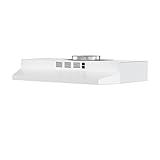
- WORK EFFICIENTLY RANGE HOODS: Under cabinet range hood 30 inch with 2-speed exhaust fan quickly remove greese and smoke in your kitchen,small profile are very suitable small kitchen about condos and apartment. Range hood is hard-wired without plug
- QUALITY KITCHEN HOOD: Under cabinet range hood constructed with high-quality steel for exceptional resistance to corrosion and rust. 30 inch range hood with Multi-layers aluminum filter ( charcoal filter sold separately, model: FGS-TF39-LW) trap grease and oil efficiently
- EASY OPERATION VENT HOOD: Rocker button control, simple operate. Easy to turn on and off, Low/ High Speed button suitable for different cooking method. 2W LED offer enough brightness to meet your cooking need.Quiet operation keeps noise level less than 57dB at high speed
- EASY INSTALLATION AND GREAT LOOK: Easy to install with the instruction manual and the installation guide video. Stylish and simple appearance, kitchen exhaust fan suitable for both modern kitchen and old style. Product Dimensions: 29.9 in. (W) x 17.5 in. (D) x 4.7 in. (H)
- PACKAGE INCLUDES: Including a under cabinet range hood, recirculation sheet, air outlet, manual, installation instruction, multi-layer aluminum filter without charcoal filter and hard-wired without plug ( plug sold separately, model: FGS-TF39-DYX)
Higher airflow also increases the possibility of depressurizing the house. In a home with a gas, oil or other fuel-burning appliance, negative pressure can draw combustion products down a flue instead of up it. Make-up-air requirements vary with the building and jurisdiction. Ask a qualified professional to assess combustion appliances, interlocks and make-up air before installing a high-capacity fan.
Compare hoods by the details that affect real use
| Feature | What to verify | Why it matters in an open plan |
|---|---|---|
| Outdoor exhaust | Whether the hood connects to a duct terminating outdoors; recirculating mode alone is not equivalent. | Only an outdoor path removes cooking moisture and contaminated air from the home. |
| Capture coverage | Hood width and depth relative to the hob, mounting height and the position of burners. | Better overlap intercepts the plume before it drifts toward the living area. |
| Airflow | Rated cfm and the appliance, duct and installation conditions behind that rating. | A large number cannot compensate for poor capture or a restrictive duct. |
| Noise | Sound rating in sones, fan speed at the setting you will use, and whether the fan is remote-mounted. | A hood that is too loud is likely to be switched off, defeating its purpose. |
| Fan location | Hood-integrated motor versus an appropriately installed remote motor. | Moving the motor away from the room can reduce perceived noise, but duct design still governs performance. |
| Grease filtration | Accessible, washable filters and clear replacement or cleaning instructions. | Clean filters preserve airflow and reduce odour-producing residue. |
| Pressure and combustion | Make-up-air provisions and interaction with fuel-burning appliances. | Excessive negative pressure can create a dangerous backdraft. |
Operate and maintain the hood for consistent results
- Start early. Turn the hood on before a pan becomes hot or food begins to smoke. Early capture is easier than removing a plume that has already crossed the room.
- Use rear burners when practical. They place the plume closer to the hood and are specifically recommended by EPA guidance. Do not compromise safe pan handling or the manufacturer’s instructions just to use a rear burner.
- Select the lowest effective speed. Increase speed for searing, frying or visible smoke, then reduce it when the plume subsides if capture remains adequate. Lower noise encourages regular use.
- Continue after cooking. EPA cooking-particle guidance recommends leaving the hood on for 10–20 minutes after cooking so residual airborne particles can be removed.
- Clean the grease filter routinely. Follow the hood maker’s interval and method; washable metal filters normally need degreasing, while disposable filters require the specified replacement. A loaded filter restricts airflow and can hold old odours.
- Wipe nearby surfaces and appliances. Remove grease from the underside of cabinets, backsplash, hob, microwave or oven exterior and other places where residue accumulates. Residue that is reheated can create a smell even when no food is cooking.
- Avoid deliberate indoor charring. EPA guidance advises reducing heat where practical and choosing oils with higher smoke points for high-temperature cooking. If food starts smoking, lower the heat and use the hood rather than allowing a sustained smoky plume.
When a noisy hood is the reason it stays off
EPA specifically advises choosing a quiet or remote-mounted fan so noise does not stop you using the hood every time you cook. Check the fan’s sone rating, but also investigate a rattling motor, loose housing, vibration against cabinetry, a dirty filter, a crushed or undersized duct, and sharp duct bends. Those faults can make a fan both louder and less effective.
Do not solve noise by automatically selecting the largest available fan. More airflow can require make-up air and may increase backdraft risk, while a restrictive duct can turn extra motor power into turbulence rather than useful capture. An installer can inspect the duct route, isolate vibration, verify terminations and determine whether a remote motor is appropriate.
Rank #3

- 【SLIM & SPACE-SAVING】: Range Hood dimensions: 17.5"L*29.9" W*4.7" H. This SNDOAS cabinet range hood at only 4.7 inches thick, its slim design not only saves valuable kitchen space but also adds a modern touch to your kitchen decor.
- 【USER FRIENDLY】: The rocker-type switch makes the SNDOAS Cabinet Range Hood easy to use. The built-in energy-efficient LED light bulbs provide a brighter lighting environment to illuminate your cooking area.
- 【TWO-WAY INSTALLATION】: The SNDOAS Cabinet Range Hood features a pre-drilled hole on the top and the back that can be used for ducted installation( Need to purchase the related ductwork accessories separately). Please decide which installation method you need before installation, once the exhaust hole cover plate is pried open, it cannot be restored.Or use the carbon cotton composite filter included can be used for ductless installation.
- 【MODERATE SUCTION POWER】: With a 230 CFM Airflow, the SNDOAS Cabinet Range Hood delivers moderate ventilation performance that is suitable for single apartments or small households that require efficient air filtration.
- 【ACCESSORY INCLUDES】: Each package contains 1 pc aluminum mesh & carbon cotton composite filter, user manual, and a one-year warranty.Please note that: This is a hardwire range hood, plug in is NOT included. We have Optional power cord kit, can convert your range hood from hardwire to plug-in. (Purchase Part # PCK-GF3976).If you encounter any issues, simply contact us and our professional customer service team will provide top-notch support and assistance promptly.
If there is no effective outdoor-vented hood
Ventilate with outdoor air only under suitable conditions
Open windows or doors, or run a wall or window exhaust fan, when doing so is safe and outdoor temperature, weather and air quality permit. Keep security, rain, wind and vulnerable occupants in mind. Outdoor ventilation is not automatically beneficial during smoke, high pollution, extreme heat or extreme cold; in those conditions it can bring contaminants or an uncomfortable moisture load indoors.
Use the exhaust fan so air moves from cleaner parts of the home toward the kitchen and out, rather than simply opening an opening on the opposite side and hoping for capture. Close the openings when cooking ends or outdoor conditions change. A recirculating hood can still be used to collect some grease, but treat it as a supplement, not an outdoor exhaust system.
Add a portable air cleaner as a supplement
EPA recommends a portable air cleaner that is sized to the space and does not intentionally produce ozone. In an open plan, size it for the whole connected area it is expected to serve, taking ceiling height into account, rather than relying on the square-foot figure for a small closed bedroom. Look for a stated clean-air delivery or room-size rating and operate the unit at a speed people will tolerate for long periods.
Rank #4

- FINGERPRINT RESISTANT STAINLESS FINISH: PrintGuard technology introduces a fingerprint resistant, stainless finish range hood that wipes clean with ease, seamlessly matches other stainless appliances, and is scratch resistant
- MADE IN THE USA: Proudly manufactured in the USA by the Leaders in Residential Indoor Air Quality with foreign and domestic components
- BREATHE CLEANER AIR: The flexbile installation design and 2-speed blower that quickly pulls smoke and odors from the air and through a aluminum filter to cleanse the air, makes this hood vent the perfect addition to your kitchen
- DISHWASHER SAFE: Keep your kitchen spotless and air clean with a removable, dishwasher-safe filter, and replaceable parts help this product last years to come
- DIMENSIONS: This kitchen ventilation tool measures 17.5" L x 30" W x 6" H
| Air-cleaner check | What to look for | Limitation to understand |
|---|---|---|
| Area served | The complete open-plan floor area and ceiling height. | A rating for one small room may understate the volume the unit must process. |
| Particle performance | Documented clean-air delivery and a particle filter appropriate to the task. | Particles can be reduced; source capture is still more effective at the stove. |
| Odour-gas control | Amount and type of activated-carbon or other sorbent media, not just a marketing claim. | A thin carbon sheet may have limited capacity for strong cooking gases and will eventually saturate. |
| Ozone | No intentional ozone production; avoid ionizer or ozone features when their safety is unclear. | Ozone is itself an indoor pollutant and is not a substitute for ventilation. |
| Noise | Sound at the fan setting you can actually leave running. | A unit that is quiet only on its lowest setting may deliver little cleaning air. |
| Filters | Replacement availability, compatibility and recurring cost. | Neglected filters lose performance and can become an odour source. |
Place the cleaner where its intake is not blocked and where it can draw air from the kitchen-living circulation path. It should not be so close to a hob that heat, grease or splashes damage it. Run it during and after cooking according to the manufacturer’s instructions, and replace filters when their condition or indicator requires it.
Use the central HVAC system carefully
EPA recommends an HVAC filter rated MERV 13, or the highest rating the actual system can accommodate. Confirm compatibility with the furnace or air-handler manufacturer; a filter that is too restrictive can reduce airflow, increase fan load or cause faults. A central filter mainly helps with airborne particles as air circulates. It does not capture a rising plume as directly as a hood and does not remove all cooking gases or odours.
What’s actually slowing this PC down?
Pick the symptom - the matching free tool is one click away.
Reduce kitchen and living-room noise without confusing absorption with soundproofing
Find out whether the problem is echo or transmission
Stand in the room while the source operates. If a hand clap, speech or appliance sound lingers and seems to bounce between hard surfaces, the issue is reverberation. If you hear traffic through a closed window, footsteps from above or voices through a wall, the issue is transmission through the building envelope or structure. Open-plan rooms often have both, but an absorptive treatment addresses only the first.
Best Value

- Fresh Air & 3 Speeds: Elegant Under Cabinet Range Hood with 3 –speed exhaust fan provides you fresh air, while keeping the noise low.
- Dual Installation Mode & Ideal Size: The stainless steel thin bodies and ideal sizes fit your cabinet perfectly and save space, and it can be installed in exhaustion mode and recirculation mode
- 5-Layer Reusable Aluminum Filter: The 5-layer aluminum filter effectively removes grease and cooking odors. Also, being easily detached and dishwasher safe, it can always sustain its optimal efficiency.
- Durable Stainless Steel Body & Intuitive Control: The stainless steel body is resistant to high temperature & salt corrosion, and you can clean it with a gentle wipe. Also, you can press intuitive control to change the suction power easily.
- Easy Installation: Humanized design makes your installation process easy. You can follow the step-by-step instructions in the user manual or reference the Comfee installation videos.
| Symptom | Likely mechanism | Useful response |
|---|---|---|
| Conversation feels harsh and prolonged. | Reflections from hard floors, ceilings, counters and glazing. | Add distributed absorption: rug, curtains, upholstery, bookshelves and acoustic panels. |
| Extractor or dishwasher seems to fill the room. | Source noise plus reflections. | Maintain or isolate the appliance, select quieter equipment, and add absorption around—not against—heat and moisture sources. |
| Traffic remains loud with windows shut. | Sound transmission through glazing and gaps. | Improve seals or glazing and consult a building-acoustics professional; room absorbers alone will not block it. |
| Footsteps or voices arrive through a floor or wall. | Structure-borne or airborne transmission. | Consider construction changes such as sealing, added mass or decoupling, designed for the specific path. |
Add absorption that suits a kitchen environment
- Rugs and runners: Cover a meaningful portion of hard flooring, using a non-slip pad and a material that can be cleaned safely around food.
- Curtains or lined window treatments: They soften reflections from glass; keep fabrics clear of hobs and follow fire-safety guidance.
- Upholstered seating: Sofas, dining chairs and banquettes provide broadband absorption while serving a practical purpose.
- Bookshelves and filled storage: Irregular, partly open surfaces scatter and absorb some sound better than a large bare wall.
- Purpose-designed acoustic panels: Use products with tested absorption data, place them at major reflection points and choose finishes that tolerate kitchen dust and cleaning. Keep them away from direct heat, steam and grease.
Spread absorption across the connected kitchen, dining and living zones instead of placing all treatment on one wall. The goal is a shorter, less reflective sound field, not a silent room. Absorbers do not seal a window, stop a footfall through a floor or prevent sound travelling through a partition.
A practical plan for common open-plan situations
There is a ducted hood, but smells still reach the sofa
- Confirm the fan is switched on before cooking and left on for 10–20 minutes afterward.
- Test rear burners and a higher setting during smoky cooking.
- Clean the grease filter and nearby surfaces.
- Inspect whether the hood covers the full cooking area and whether the duct has leaks, severe bends or an undersized section.
- Have an installer verify actual capture and airflow rather than assuming the rated cfm is being delivered.
The hood works, but nobody uses it because of noise
- Record when the noise occurs and whether it is airflow, vibration or a mechanical rattle.
- Clean the filter and check for loose panels or cabinetry contact.
- Ask an installer to inspect duct restriction and fan mounting.
- Compare sones at the operating speed you need; consider a quiet or remote-mounted fan where the duct and structure permit.
- Check make-up-air and combustion-appliance implications before increasing capacity.
There is only a recirculating hood
- Use the hood during cooking and maintain its grease filter.
- When conditions are safe, create controlled outdoor exhaust with a window or wall fan.
- Run an ozone-free portable cleaner sized for the entire open-plan volume.
- Use the highest compatible HVAC filter rating, up to MERV 13.
- Reduce smoke generation by lowering heat, avoiding indoor charring and selecting suitable oils.
The room is loud even when appliances are quiet
- Listen for the characteristic linger of reflections versus sound entering through a window, wall or floor.
- Add a washable rug, curtains and upholstered furnishings first; reassess before buying panels.
- For persistent transmission, investigate seals, glazing or construction with an acoustics professional rather than adding more decorative absorption.
Safety checks before changing ventilation
- Fuel-burning appliances: If the home has gas, oil, solid-fuel or other combustion equipment, obtain professional advice before installing a high-airflow exhaust fan. Backdrafting can bring combustion products indoors.
- Make-up air: Larger exhaust systems may require a designed supply of replacement air. Requirements depend on local rules, building tightness and appliance arrangement.
- Duct termination: Exhaust should discharge outdoors through a suitable, sealed termination—not into a loft, wall cavity or another enclosed space.
- Electrical and fire safety: Follow the hood and fan installation instructions, maintain clearances and use qualified tradespeople where wiring or structural alterations are involved.
- Outdoor-air decisions: Do not open windows or run an intake path during outdoor smoke or poor air-quality events merely to remove an indoor smell.
- Filter compatibility: Verify that the HVAC blower and filter cabinet support the selected MERV rating.
If you are unsure whether an appliance is backdrafting, notice combustion smells, see staining around a flue, or cannot establish a safe duct and make-up-air arrangement, stop the installation and have a qualified professional assess it.
How to judge whether the changes worked
Use the same cooking task and room arrangement for a simple before-and-after check. Note whether odour reaches the living area, whether visible haze remains, how long the smell persists after the hood is switched off, and whether the hood noise is acceptable at the speed you need. For acoustics, listen at the sofa and dining table for speech clarity and the length of a hand clap’s decay. These observations do not replace professional airflow, combustion or acoustic testing, but they reveal whether the measures are solving the right problem.
A successful open-plan strategy is therefore layered: outdoor capture at the hob, disciplined operation and cleaning, conditional outdoor ventilation, supplemental particle filtration, and room absorption where reflections are the nuisance. Treat transmission, combustion safety and major duct changes as separate design questions rather than expecting one appliance or one panel to solve all of them.
Quick Recap
Product prices and availability are accurate as of the date/time indicated and are subject to change. Any price and availability information displayed on Amazon at the time of purchase will apply.

