Capture dust at the cut, keep people out of the work area, and choose controls for the material. An oscillating multitool can create a concentrated cloud of fine dust when it cuts wood, plasterboard, composite board or masonry. A short cut is not automatically harmless, and a vacuum connected somewhere in the room is not the same as effective source capture.
Before starting, reduce the amount of cutting, isolate the room, use a tool-compatible extractor where one is available, check the hose and filter system, and wear suitable respiratory protective equipment (RPE) when the task or surroundings call for it. Wood dust and silica-containing masonry dust require different hazard assessments; do not transfer controls from one material to the other without checking the applicable guidance.
As an Amazon Associate I earn from qualifying purchases.
What is the most effective way to reduce dust?
The hierarchy is straightforward: avoid unnecessary cutting, contain the work, capture dust at its source, maintain the extraction system, and use RPE as an additional control. Source control matters because once fine particles become airborne they can spread beyond the immediate cut and remain suspended, especially in a small or poorly ventilated room.
PC Slower Than It Used to Be?
A free scan shows the junk files, broken settings and background clutter dragging Windows down - then fixes them in one click.Free scan · Windows 10 & 11Outdated Drivers Are Slowing You Down
One free scan finds every outdated or missing driver and matches the right update for your exact hardware.Free scan · exact hardware match- Plan the cut. Use pre-cut or pre-finished material where it is suitable, mark the cut accurately, and avoid trial cuts that create avoidable dust.
- Separate the work. Keep other people away, close doors or use suitable barriers, and provide a dedicated work area rather than cutting throughout an occupied building.
- Capture at the tool. Use an extraction hood or attachment that is specifically designed for the tool, accessory and cutting application, connected to an extractor with appropriate airflow and filtration.
- Control your technique. Keep the blade engaged only as long as necessary, avoid forcing the tool, and stop if the capture system is leaking or losing airflow.
- Clean safely. Vacuum or use wet-brushing methods suited to the material; do not dry-sweep settled dust into the air.
- Add RPE when indicated. RPE does not replace extraction or enclosure, but it can reduce inhalation exposure when cutting lasts longer, the room is enclosed, or residual dust cannot otherwise be controlled.
These measures work together. Opening a window while allowing dust to escape through the rest of the building is not source control, and an apparently powerful vacuum cannot compensate for a hood that does not fit the tool.
#1 Best Overall

- Dual-mode Operation for Versatile Cleaning: This wet/dry shop vacuum switches between standard vacuum mode for everyday messes and dust extractor mode for connecting to power tools during woodworking
- Power Tool Activation (PTA): The shop vac automatically starts when the connected power tool turns on—ideal for sanders, saws, planers, and more—helping capture debris as you work for a cleaner workspace
- Hands-Free Filter Cleaning: Featuring semi-automatic filter cleaning, a dust-full indicator and a HEPA filter, this shop vac helps resolve clogging and maintain strong suction for tough job
- Safety and Durability: The anti-static hose helps reduce electrostatic buildup, while the sturdy 8-gallon stainless steel tank ensures long-lasting durability and portability. A built-in drain port makes it easy to empty liquids and debris
- Accessories Included: 10 ft anti-static hose (1), extension wands (2), floor nozzle (1), universal adapter (1), crevice nozzle (1), round brush (1), disposable filter bags (3), HEPA filter (1), utility nozzle (1), foam filter (1)
Why an oscillating multitool can produce a significant dust hazard
The blade removes material at a rapidly moving edge. With wood and board products, that action produces fine particles as well as visible chips. Fine dust can travel on clothing, settle on ledges and remain airborne after the tool stops. The UK Health and Safety Executive (HSE) advises that power-tool cutting and sanding can create significant wood-dust exposure and recommends on-tool extraction with a suitably classified extractor.
Short duration is not a reliable safety test. The amount inhaled depends on the material, cutting rate, enclosure, ventilation, distance from the source and effectiveness of capture. HSE reports that carpenters and joiners are four times more likely to develop asthma than other UK workers. That statistic concerns the occupation as a whole; it does not quantify the risk from one particular multitool cut.
Dust also creates a contamination problem. Particles can be carried into adjacent rooms, vehicles and homes, where other workers or occupants may encounter them later. Treat the work area as a controlled zone until visible dust has been removed and airborne dust has had time to clear.
Plan the job before switching on the tool
Reduce the amount of cutting
Measure twice, use factory-cut components when practical, and choose a sequence that avoids repeated trimming. If a component can be prepared in a workshop or an unoccupied area with better controls, that may remove the indoor exposure altogether. Planning also prevents rushed cuts, which tend to produce more debris and increase the chance of a poor connection between the tool and extraction hose.
Identify the material
Decide whether you are cutting ordinary wood, a composite or coated board, plasterboard, plastic, or a material containing crystalline silica. The dust hazard, required controls and disposal arrangements can differ substantially. If the material is unknown, identify it before cutting rather than assuming it is ordinary timber.
Rank #2
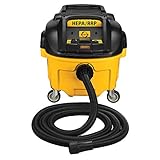
- Automatic Filter Clean of the dust extractor pulses every 30 seconds for continuous operation without stopping to clean filter
- 15-amp motor of DEWALT dust extractor delivers 150 CFM of airflow
- Power Tool Actuation controls the On/Off operations of the vacuum with a power tool
- Meets the EPA Lead Related Renovations, Repair and Painting (RRP) Rule for Hepa Vacuums only when DWV9330 Filters are used
- Universal hose connector provides a secure connection with swivel capability
Choose a controlled work area
HSE guidance recommends dedicated work areas to minimise the spread of wood dust. Remove unnecessary items that would collect dust, protect surfaces that cannot be moved, and plan how waste will be bagged or transferred without shaking dust back into the air. Keep occupants and other trades out while cutting and during the initial clearance period.
Contain dust inside the room
Restrict access
Close the room where possible and post a clear warning. If the room has to remain connected to occupied areas, use barriers and maintain a clean route for people who must pass nearby. Do not rely on a verbal warning alone; dust can move beyond the operator’s line of sight.
Do these 3 things before closing this tab:
1Fix the driver behind crashes, sound loss and screen glitches2Clear out junk files and repair common Windows errors3Scan for outdated or missing drivers - takes under a minuteManage ventilation deliberately
Ventilation should support containment, not simply push contaminated air into another part of the building. Consider where replacement air enters and where extracted air leaves. In an enclosed space, fine dust can remain suspended, so allow adequate clearance before removing barriers or permitting re-entry.
Protect adjacent work
Cover or remove equipment that cannot tolerate dust, seal gaps that lead to clean areas, and keep the extractor and hose inside the controlled zone where practical. Avoid dragging a dusty hose or tool through finished spaces after the cut.
Use on-tool extraction that matches the cutting task
Source capture is normally the most useful engineering control for an indoor cut. The hood or shroud must sit close enough to the cutting action to intercept dust, and the extractor must maintain suitable flow for that tool and material. A general room vacuum placed several feet away may collect settled debris but will not reliably capture the cloud at the blade.
Rank #3

- POWER: With strong airflow and suction power, the BOSCH VAC090AH dust collector delivers a maximum 150 cubic feet of air per minute rate (CFM), with a sustainable maximum 97 in. static water lift
- COMPATIBLE: With power tool activations, these vacuum cleaners let users utilize the power tool's switch to turn vacuum on and off; the Power Broker dial will match the suction force to application
- OSHA COMPLIANT: Featuring BOSCH PRO plus GUARD, an end to end dust collection system to help users move toward OSHA Silica Table 1 dust compliance
- AUTO CLEANING: With automatic filter cleaning, the BOSCH dust extractor VAC090AH cleans the filter every 15 seconds to help maintain maximum suction power
- PERFORMANCE: This vacuum includes a HEPA filter that captures 99.97 percent of particles at 0.3 microns or larger, while the included fleece filter bag helps to protect the filter and provides the optimal containment of dry dust and debris
Check compatibility before buying or fitting an attachment
Ask four questions:
- Is the attachment designed for cutting, rather than only sanding?
- Does it fit the exact multitool body, blade position and accessory system?
- Does the hose connection match the extractor without an improvised, leaky adapter?
- Do the attachment and extractor instructions approve the material and application?
Do not infer cutting capability from a product photograph or from the fact that an attachment accepts a vacuum hose. Bosch’s OSC005 is a useful warning: the manufacturer states, “Designed for sanding only – cannot be used with cutting, grinding or scraping accessories and applications.” It should not be used as evidence of a cutting solution.
Recommended Free Tools
Make the hose connection airtight
Inspect the connection before every dusty job. The hose should lock or seat securely, remain attached when the tool moves, and have no visible split or gap. A loose joint can release dust directly beside the operator even if the extractor motor is running. Avoid excessive hose length, sharp bends and crushed sections that reduce flow.
Match the extractor to the material
For wood dust, HSE recommends an H- or M-class extraction unit selected for the work. Check the extractor’s classification, rated airflow, filter arrangement and instructions rather than assuming that a household vacuum or ordinary shop vacuum provides equivalent protection. A HEPA filter may be an appropriate component, but filtration alone does not prove that the complete setup captures dust effectively.
For silica-containing materials, use controls specified for that material and task. NIOSH guidance cited for silica dust collection discusses masonry cut-off saws, including source capture, HEPA filtration and prefilter or cyclone arrangements. That evidence is specific to cut-off saws and must not be presented as a tested specification for an oscillating multitool. Do not transplant a cut-off-saw airflow figure, including the 70 cfm value reported in that context, as a universal multitool requirement.
How to set up and operate the extraction system
- Inspect the hood or shroud. Confirm that it is intact, correctly positioned and intended for the cutting accessory you are using.
- Inspect the hose. Look for splits, crushed sections, blocked ends and loose cuffs.
- Check the extractor. Verify the correct filter and collection arrangement, empty or replace the container as instructed, and confirm that warning indicators are working.
- Connect before cutting. Start the extractor according to the manufacturer’s sequence, then run the multitool only after you have confirmed that suction is present.
- Keep the capture point close. Hold the tool so the hood remains near the cut. Do not pull the hose sideways until it lifts the hood away from the blade.
- Stop if flow falls. A blocked filter, full container, kinked hose or failed seal can turn a controlled cut into an uncontrolled release. Shut down, isolate the tool and correct the fault.
- Recheck after the cut. Inspect the connection and surrounding area before moving to the next location.
Maintenance checks that prevent dust leaks
Extraction performance degrades gradually, so a running motor is not proof that the system is working. Before and during the job, check:
Rank #4

- HEPA Certified: HEPA filtration, adjustable high performance turbine. Capture dust without interruptions due to generous capacity of the 3.96 gallon (15L) container.
- Cleaning Tools Included: For the CT 15, the crevice and upholstery nozzle cleaning accessories are included and stored within the mobile dust extractor. The flat top of the storage means that work materials and other tools are always within reach.
- High quality: Robust design for a long service life, compact and stable footprint and a chassis with steel axles. Supported by the Festool 3 year comprehensive warranty including wear and tear.
- Ideal for use on the go thanks to compact dimensions, low weight, and robust chassis.
- Touch operation for intuitive control of the mobile dust extractor.
- hood openings for chips or hardened residue;
- hose cuffs, clamps and adapters for looseness;
- the extractor’s airflow or filter warning;
- filter loading and the condition of prefilters or cyclones where fitted;
- the collection bag or container level; and
- any unusual noise, heat or loss of suction.
Follow the extractor’s cleaning and disposal instructions. Emptying a dusty container in the work area can recreate the exposure you were trying to prevent. If the system cannot maintain the required flow, stop cutting until it is repaired or replaced.
When respiratory protection is needed
RPE is an additional layer, not a substitute for source capture, enclosure and good housekeeping. HSE says RPE is likely to be needed in many cases of sanding or longer-duration wood cutting, particularly in enclosed spaces. It gives FFP3 as an example of RPE with a minimum assigned protection factor of 20 for many cutting and sanding operations.
Fit matters
A tight-fitting mask must seal against the face. HSE says tight-fitting masks require fit testing, and the test must correspond to the specific mask model and wearer. Facial hair, glasses, sweat and movement can compromise the seal. A mask that is uncomfortable or repeatedly adjusted during a cut may not provide the expected protection.
Use RPE in the right sequence
Put on the required RPE before entering the dusty zone, keep it on while dust may be airborne, and remove it only after leaving the zone or completing the required clearance. Continue using extraction even when wearing RPE; relying on a mask alone leaves other people and surfaces exposed.
Quick wins for a faster PC:
Clear out junk files and repair common Windows errorsFree Scan →Fix the driver behind crashes, sound loss and screen glitchesFind Drivers →Wood dust versus silica-containing masonry dust
| Issue | Wood and wood-based boards | Silica-containing masonry |
|---|---|---|
| Primary control emphasis | On-tool extraction with a suitably classified H- or M-class unit, secure connections and correct airflow. | Material- and task-specific silica controls; do not assume wood-dust arrangements are sufficient. |
| Evidence relevant to this tool | HSE guidance addresses wood-dust exposure from power-tool work. | NIOSH material cited here concerns masonry cut-off saws, not oscillating multitools. |
| RPE context | HSE identifies FFP3 as an example for many cutting or sanding operations and requires fit testing for tight-fitting masks. | Use the RPE and exposure controls required by the applicable silica rules for the actual material and task. |
| Cleanup | Vacuuming or wet brushing is preferred to dry sweeping. | Prevent resuspension and follow the material-specific disposal and decontamination requirements. |
If a coating, adhesive, cement board or old building product is involved, stop and establish what it contains before cutting. A multitool’s small blade does not make a hazardous material non-hazardous.
Best Value

- Dual-mode Operation for Versatile Cleaning: This shop vac switches between standard vacuum mode for everyday messes and dust extractor mode for connecting to power tools during woodworking.
- Power Tool Activation (PTA): The vacuum automatically starts when the connected power tool turns on—ideal for sanders, saws, planers, and more—helping capture debris as you work for a cleaner workspace.
- Hands-Free Filter Cleaning: Featuring semi-automatic filter cleaning, a dust-full indicator and a HEPA filter, this shop vac helps prevent clogging and maintain strong suction for tough job
- Safety and Durability: The anti-static hose helps reduce electrostatic buildup, while the sturdy 8-gallon polymer tank ensures long-lasting durability and portability. A built-in drain port makes it easy to empty liquids and debris.
- Accessories Included: 10 ft anti-static hose (1), extension wands (2), floor nozzle (1), universal adapter (1), crevice nozzle (1), round brush (1), disposable filter bags (3), HEPA filter (1), utility nozzle (1), foam filter (1)
Cutting in an enclosed room or occupied building
Enclosure increases the concentration of airborne dust and slows clearance. It also increases the chance that another person will enter before the air is clean. For an enclosed cut:
- schedule the work when occupants are absent;
- seal or barrier the work zone and control entry;
- run source extraction for the entire cutting operation;
- keep contaminated tools and hoses inside the zone until cleaned;
- allow dust to settle or be extracted before removing the barrier; and
- inspect nearby horizontal surfaces for settled dust before handing the area back.
Do not use a fan to blow visible dust toward a doorway or corridor. That changes the location of contamination rather than reducing it.
Cleaning after the cut without putting dust back into the air
Switch off and isolate the multitool before cleaning the blade, hood or work surface. Use an extractor suitable for the dust, or use wet-brushing methods where the material and surface permit. HSE specifically contrasts dry sweeping with vacuuming or wet brushing as ways to avoid raising dust.
What’s actually slowing this PC down?
Pick the symptom - the matching free tool is one click away.
Clean from the controlled area outward, keeping clean clothing and equipment separate from dusty items. Bag waste carefully, avoid shaking disposable covers, and follow the extractor and material-specific instructions for emptying filters and containers. If dust has reached an adjacent room, extend the cleaning boundary rather than assuming that the visible work area is the only contaminated location.
Can you attach a vacuum to an oscillating multitool?
Sometimes, but the answer depends on the exact tool, attachment and application. A hose can be physically connected and still fail to capture dust if the hood is intended for sanding, the opening is too far from the blade, the extractor cannot maintain suitable flow, or the joint leaks.
Confirm all of the following in the manufacturer’s instructions:
- the attachment is approved for cutting;
- your multitool model is listed as compatible;
- the hose diameter and adapter are supported;
- the extractor’s classification and airflow suit the dust; and
- the setup is approved for the material you intend to cut.
If any item is unclear, treat the attachment as unverified rather than improvising. A general-purpose household vacuum may collect coarse chips while allowing fine dust to escape through the tool, hose or filter.
The Tool Desk
Outbyte Driver Updater FREEScan for outdated or missing drivers - takes under a minuteDriver Scan →Outbyte PC Repair FREEClear out junk files and repair common Windows errorsFree Scan →Common mistakes and how to correct them
| Mistake | Why it fails | Correction |
|---|---|---|
| Starting with no extraction because the cut is small | Short jobs can still create a concentrated cloud. | Use source capture for every dusty cut that the setup supports. |
| Using a sanding-only hood for a blade | The hood may not surround or approach the cutting point correctly. | Use a cutting-rated attachment or choose a different controlled method. |
| Relying on a loose hose adapter | Leaks release dust beside the operator. | Use a secure, compatible connection and replace damaged cuffs or hoses. |
| Assuming HEPA alone makes the job safe | Filtration cannot correct poor capture, inadequate flow or leaks. | Check the complete tool, hood, hose and extractor system. |
| Dry sweeping after the work | Settled fine dust becomes airborne again. | Vacuum or wet-brush using methods suitable for the material. |
| Wearing a tight-fitting mask without a fit test | A poor face seal undermines the assigned protection. | Arrange fit testing and use a compatible, correctly worn respirator. |
| Applying masonry-saw numbers to a multitool | The cited NIOSH evidence is for a different machine and task. | Use task-specific silica guidance and do not claim an untested airflow specification. |
A practical pre-cut checklist
- Have I reduced or relocated the cutting that can be avoided?
- Do I know exactly what material and coating I am cutting?
- Is the room isolated, with other people kept out?
- Is the hood designed for cutting and listed for this multitool?
- Is the extractor’s classification and airflow appropriate?
- Are the hose, filter, container and warning indicators in good condition?
- Will I use RPE where duration, enclosure or residual dust makes it necessary?
- Do I have a vacuum or wet-cleaning method ready instead of a dry broom?
- Is there a safe way to dispose of the collected dust?
For UK wood-dust work, HSE guidance was updated on 12 January 2026. Its recommendations cover source control, classified extraction, work-area management, RPE and cleaning. For US silica controls, the NIOSH page cited here was last reviewed on 12 July 2018 and addresses masonry cut-off saws. Check the rules that apply to your jurisdiction, employer and material rather than treating either source as universal instructions for every multitool task.
Quick Recap
Product prices and availability are accurate as of the date/time indicated and are subject to change. Any price and availability information displayed on Amazon at the time of purchase will apply.

