Prevent roller defects by matching the rolling pattern to the mix’s workable temperature window, securing a stable and properly tacked surface, and stopping or changing the operation when the mat begins to move. Roller marks, shallow “checking” cracks, and shoving do not have one universal cure. Each can result from a different combination of mix stability, temperature, density target, substrate condition, roller settings, and operator technique.
The practical sequence is to confirm the project’s mix-specific temperatures and acceptance criteria, establish a coordinated rolling pattern, monitor mat temperature and density, and diagnose movement instead of adding passes blindly. The typical handbook ranges of 275–310 °F (135–155 °C) for starting compaction and 175–180 °F (80–82 °C) for cessation are useful context, not specifications for every job.
As an Amazon Associate I earn from qualifying purchases.
What the defect is telling you
Start by identifying the visible symptom and when it appears. A longitudinal crease left behind by a roller points you toward pass timing, cooling, equipment settings, or mix stability. Shallow cracks that open under the drum are “checking” in the terminology used by the Asphalt Paving Handbook; they are a construction-stage distress caused by a tender mat moving under load, not a diagnosis for every type of asphalt cracking. Shoving is displacement of the mixture, either in front of the roller or later under traffic.
The Tool Desk
Outbyte PC Repair FREERepair Windows errors before they cause bigger problemsFix Now →Outbyte Driver Updater FREEScan for outdated or missing drivers - takes under a minuteDriver Scan →| Observed condition | Most useful first checks | Immediate operating response |
|---|---|---|
| Longitudinal roller marks or creases | Required passes completed, mat temperature during each pass, density results, roller speed and pattern, mix stability | Keep the pattern coordinated with the paver while the mat remains workable; do not assume extra finish passes will erase a cause that is still active |
| Shallow cracks opening under the drum (“checking”) | Mat movement, structural deflection, mix design, temperature zone, drum type and sequence | Do not continue steel-wheel rolling through a moving, checking mat; pause or alter the operation under the approved project procedure |
| Mixture pushing ahead of the roller or moving sideways | Mix stability, binder or moisture, aggregate grading, excessive temperature, substrate cleanliness and tack, sudden reversals | Reduce the displacement-producing action and diagnose the mix, temperature, bond, and operation before resuming |
| Washboard or corrugated surface | Vibratory amplitude, frequency, roller speed, lift thickness, stopping and reversing technique | Check settings and technique against the project guidance before making more passes |
| Dark or light pneumatic-tire shadows with no measurable depression | Whether the marks are cosmetic, density-related, or actual indentations | Verify density and profile; handbook guidance notes that some tire shadows disappear after opening to traffic |
Set up the mat before the first roller pass
Compaction problems are often created before the roller arrives. The paving team, plant, quality-control staff, and roller operators need a common plan for the actual job-mix formula and lift. A plan that works for one binder, aggregate structure, or weather condition can fail on another.
#1 Best Overall

- Effortless Pothole Repair: Fix potholes fast with no mixing or special tools. Liquid Rubber Asphalt Patch is a ready-to-use solution—just scoop, spread, and tamp down. Ideal for homeowners or pros tackling driveways, parking lots, or road repairs
- All-Weather Application: Designed to work in rain, shine, heat, or cold. Whether you're fixing damage in the middle of summer or patching during fall weather, this patch performs year-round with a strong bond and reliable hold
- Built to Last: Formulated for strength and flexibility, it resists cracking and shrinking over time. Creates a smooth, durable finish that holds up to foot traffic, cars, and harsh weather conditions
- Trusted by Pros for 20+ Years: With over 1 million gallons sold, Liquid Rubber Asphalt Patch is a proven performer. Whether you’re patching your first pothole or maintaining a commercial lot, you’re backed by decades of performance and support
- Clean Application, Easy Cleanup: No mess, no stress. Apply directly from the pail and clean up with simple tools and baby oil or mineral spirit
Confirm the mix and project requirements
- Use the approved job-mix formula and the project’s specified density, air-void, temperature, and smoothness requirements.
- Ask the responsible mix-design and plant personnel whether the mixture is expected to be tender, unusually stiff, or sensitive to temperature.
- Confirm the required rolling sequence, roller types, pass counts or coverage requirements, and any limits on vibratory operation.
- Define how density and temperature will be measured and recorded. A handheld infrared thermometer may help with field checks, but it does not replace the project’s required quality-control methods or instruments.
As the handbook puts it: “Asphalt binder quality and content, aggregate properties and characteristics, and mix temperature all play a significant role in the workability and stability of the asphalt material under the compaction equipment.” Treat that as a troubleshooting principle: a roller cannot compensate indefinitely for an unstable or poorly proportioned mixture.
Inspect and prepare the underlying surface
For an overlay, inspect the existing pavement for dust, loose material, moisture, contamination, and movement. A dirty surface can allow the new layer to slip, which may appear as shoving during rolling or later traffic. Clean the surface and apply the specified tack coat where the contract documents require it. Allow the tack to reach the condition required by the project before placing the mix.
Also check the support beneath the lift. Excessive structural deflection can make a fresh mat move under the roller even when the rolling pattern is otherwise reasonable. If the base, existing pavement, or joint area is yielding, escalating roller force can enlarge the defect rather than improve density.
Plan for cooling, wind, and production interruptions
Cold ambient temperatures and wind remove heat quickly. Coordinate truck spacing, paver speed, roller locations, and haul timing so that the breakdown, intermediate, and finish operations can reach their required coverage before the mat leaves its workable range. Record interruptions such as a stopped paver, a delayed truck, or a roller waiting outside the active lane; these events can turn a satisfactory pattern into an under-compacted, marked surface.
Rank #2

- Effortless Pothole Repair: Fix potholes fast with no mixing or special tools. Liquid Rubber Asphalt Patch is a ready-to-use solution—just scoop, spread, and tamp down. Ideal for homeowners or pros tackling driveways, parking lots, or road repairs
- All-Weather Application: Designed to work in rain, shine, heat, or cold. Whether you're fixing damage in the middle of summer or patching during fall weather, this patch performs year-round with a strong bond and reliable hold
- Built to Last: Formulated for strength and flexibility, it resists cracking and shrinking over time. Creates a smooth, durable finish that holds up to foot traffic, cars, and harsh weather conditions
- Trusted by Pros for 20+ Years: With over 1 million gallons sold, Liquid Rubber Asphalt Patch is a proven performer. Whether you’re patching your first pothole or maintaining a commercial lot, you’re backed by decades of performance and support
- Clean Application, Easy Cleanup: No mess, no stress. Apply directly from the pail and clean up with simple tools and baby oil or mineral spirit
Use a project-specific temperature and density window
There is no universal asphalt rolling temperature. The Asphalt Paving Handbook gives typical starting compaction temperatures of about 275–310 °F (135–155 °C) and a typical cessation temperature of about 175–180 °F (80–82 °C). Those figures are general handbook context, not automatic limits for every binder, mix, lift, weather condition, or specification. Establish the actual rolling zone with the supplier, approved mix design, and project requirements.
| Temperature information | How to use it | What can invalidate a simple rule |
|---|---|---|
| 275–310 °F (135–155 °C) typical starting range | Use as a starting point for planning and discussion, then verify against the actual mix and specification | Binder grade, aggregate, lift thickness, weather, wind, plant-to-paver haul time, and project procedures |
| 175–180 °F (80–82 °C) typical cessation range | Use as general handbook context for when routine compaction may be ending | The job may set a different limit; density may already be unattainable, or a tender mix may require a different approved response |
| Temperature readings during the pass sequence | Show whether breakdown and finish passes are occurring while the mix is workable | A single reading does not describe the entire lane; shaded, windy, thin, and edge areas can cool at different rates |
Do not chase a temperature number while ignoring behavior. A mat that is visibly moving, checking, or shoving needs diagnosis even if its measured temperature appears to be within a typical range. Conversely, a mat that is cooling rapidly may require faster, better-coordinated coverage rather than a higher vibratory setting.
Build and verify the rolling pattern
The objective is to obtain the specified density while the mixture remains stable and workable, not to maximize the number of passes. Establish the pattern on a controlled trial area or the approved start-up procedure when the project requires one, then verify density and surface condition before extending it.
Free tools Windows power users keep installed
One-click scans. No signup required.
- Coordinate with the paver. Set roller positions and communication signals so the breakdown roller receives freshly placed material without repeatedly waiting or crossing a cold seam.
- Define the pass sequence. Identify the direction, overlap, number of coverages, vibratory or static mode, and the point at which each roller hands the lane to the next operation.
- Control speed. Match roller speed to paver production and the time available before the mat cools. Excessive speed can reduce effective compaction; abrupt slowing or stopping can create marks.
- Maintain consistent overlap. Inconsistent tracking leaves strips with a different density or texture. Keep the drum path and lane edges within the project’s required coverage.
- Monitor temperature and density together. A pass that looks smooth is not proof of achieved density. Use the required gauges, cores, or other approved methods and record the corresponding mat temperature.
- Observe the mat after every change. Look for displacement, checking, washboarding, tearing, or drum pickup. A new symptom after a speed, amplitude, or direction change is evidence that the operation needs adjustment.
- Stop at the approved endpoint. Once the target density and coverage are reached, unnecessary passes can damage the surface, create marks, or move a tender mix.
Prevent and diagnose roller marks
Why marks remain
Longitudinal marks or creases can remain when the required passes are not completed, when the rolling pattern is poorly coordinated, or when the mat cools before target density is reached. A tender mix may not support a finish roller at first; by the time it can support the drum, the material may have cooled so far that the required density is no longer attainable. Simply adding finish passes at the end does not reliably correct either condition.
Rank #3
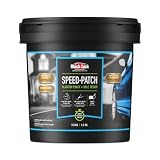
- ASPHALT PATCHING COMPOUND: Repair your old, cracked asphalt or patch potholes with Black Jack Speed-Patch Blacktop Crack and Hole Repair.
- SMOOTH FINISH: This heavy duty sand/asphalt mix spreads to a smooth finish and dries black to match existing asphalt pavements.
- DURABLE, LONG-LASTING REPAIR: This blacktop crack filler is fortified with latex to provide a durable, long-lasting repair for small holes and cracks up to 3” wide and 3” deep.
- EASY TO APPLY: This ready-to-use sand and asphalt crack sealer is easy to apply. Follow all directions on packaging for application. Packaged in a 10-pound container.
- QUALITY PRODUCTS SINCE 1913: Founded in 1913, Black Jack has been making quality roofing and driveway products for more than 100 years. When professionals want reliable results, they turn to Black Jack.
What to review in the field
- Compare the actual pass sequence with the approved pattern and density results. Look for missed strips, excessive overlap, or a roller arriving too late.
- Check mat temperatures at the breakdown, intermediate, and finish stages rather than relying on the truck or plant temperature.
- Review paver speed, truck supply, roller speed, and delays that shortened the workable window.
- Check mix stability and workability with the responsible materials personnel if the same marks recur across multiple loads or lanes.
- Inspect drum cleanliness and water application according to the project procedure; pickup or uneven release can imprint the mat.
A finish roller is a smoothing and final-compaction tool, not an eraser for instability. If the mat is still tender or is already outside the effective temperature window, continuing to chase a mark can lower density or produce additional displacement.
Washboard marks and vibratory settings
Washboarding or a corrugated profile can indicate incorrect vibratory amplitude, frequency, or roller speed for the lift and mixture. Check the equipment settings against the project guidance, confirm that the operator is not driving too fast for the selected frequency, and review abrupt starts, stops, and reversals. Change one operating variable at a time where practical so the effect can be identified.
Pneumatic-tire shadows
Dark tire shadows are not automatically a pavement failure. The handbook notes that some pneumatic-tire roller shadows are cosmetic and may disappear after the lane opens to traffic. Distinguish a temporary appearance from a measurable indentation, density deficiency, or profile problem using the project’s acceptance checks before ordering corrective work.
Prevent checking cracks during compaction
What “checking” means
In the handbook’s terminology, checking is shallow cracking formed when a tender mat moves beneath a roller drum and the surface is pulled apart as the pavement structure deflects. It is a construction-stage compaction distress. Do not use this explanation as a general diagnosis for reflective cracking, thermal cracking, fatigue cracking, or cracks that develop in an aged pavement; those mechanisms require different evaluations.
Rank #4

- Each Bag Covers 7 Sq. Ft. - 35% More Per Lb Than Most other Products!
- Environmentally friendly natural asphaltic rock with zero VOC's
- No need to square edges of hole, simply sweep area clean, pour in material, tamp or drive over to compact
- Permanent contractor grade repair, material binds to surrounding asphalt and concrete, naturally infused oil binds the product together
- 1 minute application, no mixing or special equipment required, apply in hot or cold temperatures, wet or dry weather, ready for traffic immediately
Primary causes
The handbook identifies excessive structural deflection and mix-design deficiencies as primary causes. A weak or moving support, an unstable or tender mixture, or an unsuitable temperature can all make the surface unable to carry the drum without tearing. Rolling a moving, checking mat with a steel-wheel roller can decompact it: the drum displaces material instead of increasing density.
Field response
- Recognize movement early. Watch for the mat opening behind the drum, rippling, or moving laterally instead of tightening under the pass.
- Pause or alter the operation under the approved procedure. Do not continue steel-wheel passes blindly through a checking area. The project’s responsible paving or quality personnel should direct the response.
- Check support and bond. Investigate structural deflection, a moving existing surface, inadequate tack, contamination, or moisture where an overlay is involved.
- Review mix and temperature. Have qualified mix-design and plant personnel assess binder content and quality, aggregate structure, production temperature, and any load-to-load change.
- Re-establish a safe pattern only after the cause is addressed. More passes over a moving mat can reduce rather than improve compaction.
Prevent shoving and mixture displacement
What shoving indicates
Shoving is longitudinal displacement during compaction or under traffic. The broad cause is an unstable mixture, but the instability can be triggered or exposed by several factors: excess binder or moisture, aggregate grading and properties, excessive temperature, roller operation, and a dusty or dirty underlying surface that permits slippage.
Check the mixture
- Review binder quality and content against the approved job-mix formula.
- Check aggregate grading, shape, texture, and other properties that contribute to internal stability.
- Investigate excess moisture or fluid in the mix and production or storage conditions that could have changed workability.
- Compare the problem load with adjacent loads. A sudden change may point to production or haul conditions rather than the roller alone.
Do not improvise a mix-design change at the paving train. Adjustments to binder, aggregate, or gradation require evaluation and approval by the responsible project and materials personnel.
Recommended Free Tools
Check temperature and support
Excessive temperature can make an unstable mixture especially mobile. A surface that is inadequately cleaned or tack-coated can also slip beneath the new lift. Confirm the project’s temperature limits, inspect the underlying surface, remove dust and loose material, and apply the specified tack coat when required. If the support is deflecting, rolling harder will not create the internal stability that the mat lacks.
Best Value

- Aquaphalt 4.0 Black Water-Based Asphalt and Concrete Patch: The Aquaphalt 4.0 Black Water-Based Asphalt and Concrete Patch is a revolutionary permanent asphalt and concrete repair material for pothole repair, pavement repair, utility cuts, walkways, tennis courts, and driveway repair
- Use for: Minimizes roadway disruption with no need for special preparations
- Easy to Use: Aquaphalt is laid directly from its container—no need to mobilize large crews and equipment
- One-Time Fix: Pre-mixed and permanent Aquaphalt is a one-time fix
- Eco-Friendly: Eco-friendly binder reacts and hardens with only water, leaving no toxic solvents
Change the operation
Sudden reversals are a direct, actionable check. Reverse smoothly, avoid abrupt braking, and keep the drum from pushing a wave ahead of it. Review roller speed, mode, amplitude, frequency, and the direction of travel. If the mix is tender, follow the approved procedure for adapting compaction rather than forcing a standard sequence. The objective remains density without displacement; a slower or different sequence is useful only if it is authorized and verified by density and surface results.
Balance density with mix stability
Compaction has two failure modes. Inadequate compaction leaves excessive air voids, allowing a more permeable mat and reducing durability. Excessive compaction or excessively low air voids in a dense-graded mixture can contribute to shoving and rutting. Therefore, “more passes” is not a universal cure.
The Asphalt Paving Handbook, 2025, states that a one percent increase in density has been found to conservatively increase pavement service life by 10 percent. The handbook is the source of that figure, and the underlying study is not identified in the available material; treat it as a handbook-attributed relationship, not a guaranteed result for every project. Use the contract’s density and acceptance criteria, not that figure, to accept or reject a lane.
Crashes, No Sound, or Screen Glitches?
Random freezes, missing sound and display glitches usually trace back to one bad driver. Find and replace yours safely.Free scan · under a minuteWindows Errors? Fix Them Before They Spread
Repair common Windows errors and clear accumulated junk for a smoother, more stable PC - no reinstall needed.Free scan · no reinstall| If results show | Likely concern | Review before changing passes |
|---|---|---|
| Low density with no movement | Insufficient coverage or a cooling window that was missed | Paver and roller coordination, temperature timing, speed, lift thickness, and equipment availability |
| Target density with roller marks | Surface texture, drum interaction, or pass consistency rather than simply inadequate compaction | Drum cleanliness, finish-pass timing, tracking, speed, and whether marks are cosmetic |
| Movement, checking, or shoving | Tender or unstable mix, weak support, unsuitable temperature, or displacement-producing operation | Mix properties, substrate bond and deflection, temperature, reversals, and vibratory settings |
| Very low air voids or rutting tendency | Over-compaction or an unstable dense-graded mix | Acceptance limits, mix design, temperature, and whether continued passes are damaging the mat |
A field troubleshooting sequence
Use this sequence when a defect appears during a live paving operation:
Quick Recap
- Protect the evidence. Note the station, lane, load, time, mat temperature, roller position, mode, speed, and visible symptom. Mark the area if the project procedure requires it.
- Decide whether the mat is moving. If it is checking or shoving, do not keep applying the same steel-wheel action while trying to make the symptom disappear.
- Separate surface appearance from acceptance. Check density, profile, and specified smoothness before treating a shadow or mark as a failure.
- Compare adjacent areas. A defect limited to one load, one roller, one direction, or one substrate condition narrows the diagnosis.
- Check temperature timing. Determine whether the breakdown and finish passes occurred inside the approved project window and whether wind, cold air, thin lift, or delay accelerated cooling.
- Check the bond and support. Look for dust, moisture, inadequate tack, loose material, or structural deflection.
- Escalate recurring symptoms. Have the responsible mix-design, plant, paving, and quality personnel review material and production variables before changing the job-mix formula or abandoning the approved pattern.
Daily prevention checklist
- Confirm the approved mix, lift, density target, air-void or other acceptance limits, and mix-specific starting and cessation temperatures.
- Inspect, clean, and prepare the existing surface; apply the specified tack coat for an overlay where required.
- Coordinate paver speed, truck supply, roller locations, pass direction, overlap, and communication signals.
- Record mat temperatures and density results at the locations required by the project.
- Check roller speed, vibratory amplitude, frequency, static or vibratory mode, drum cleanliness, and reversal technique.
- Watch for movement, checking, shoving, washboarding, pickup, or uneven texture after every operational change.
- Distinguish cosmetic pneumatic-tire shadows from measurable indentations or density problems.
- Pause and obtain the approved response when a tender mat moves or checks under steel-wheel rolling.
- Review recurring defects with qualified mix-design and plant personnel instead of adding passes or changing materials informally.
Product prices and availability are accurate as of the date/time indicated and are subject to change. Any price and availability information displayed on Amazon at the time of purchase will apply.

