Quick wins for a faster PC:
Clear out junk files and repair common Windows errorsFree Scan →Scan for outdated or missing drivers - takes under a minuteDriver Scan →Repair Windows errors before they cause bigger problemsFix Now →Plan a commercial or industrial microgrid as a complete, site-specific power system—not as a purchase of solar panels or batteries. Start by defining the electrical boundary, business objectives, critical loads, outage consequences, operating modes, and performance requirements. Then collect interval load and utility data, compare generation and storage architectures, coordinate interconnection and permitting, and only afterward procure equipment and begin detailed engineering.
The U.S. Department of Energy (DOE) defines a microgrid as “a group of interconnected loads and local energy resources within clearly defined electrical boundaries that acts as a single controllable entity with respect to the grid.” See the DOE Microgrid Systems definition. A workable design must operate when grid-connected and deliberately transition to, sustain, and leave islanded operation.
As an Amazon Associate I earn from qualifying purchases.
What you must decide before choosing equipment
Equipment choices follow the operating problem. A microgrid may be intended to keep a production line safe, preserve refrigeration, maintain data or communications services, reduce exposure to utility outages, manage energy costs, support emissions goals, relieve a capacity constraint, or combine several of these objectives. Each objective changes the loads, controls, economics, and acceptable operating behavior.
Set the electrical boundary
Draw the proposed boundary on a one-line diagram. Show the utility point of common coupling, service transformers, switchgear, feeders, existing generators, candidate distributed energy resources (DERs), and the loads that could be islanded. Decide whether the microgrid covers one building, a campus, a process area, or multiple services. The boundary determines what the controller can observe and operate, which protection devices must coordinate, and what remains energized during an outage.
#1 Best Overall

- Controls high-voltage energy storage areas: Clearly identifies locations containing battery energy storage systems (BESS) where high voltage electrical hazards are present and restricted access is required.
- Improves hazard awareness: Bold DANGER header and clear warning message provide immediate recognition of high voltage energy storage equipment to prevent accidental entry.
- Designed for utility and solar installations: Ideal for battery containers, inverter stations, grid storage sites, solar farms, and electrical equipment yards.
- Built for demanding environments: Made from rust-resistant aluminum with UV-resistant printing for long-term outdoor and indoor durability in heat, rain, and harsh industrial conditions.
- Made by CGAP Safety: CGAP Safety is an American safety manufacturer producing durable, professional-grade facility and jobsite signage.
Turn business goals into measurable requirements
Write requirements that a designer and contractor can test. Examples include:
- Which loads must remain energized and which may be shed.
- How the system should behave during a utility interruption, including acceptable transfer behavior.
- How long critical loads must be sustained under specified operating conditions.
- Whether parallel operation with the utility, export, or zero-export operation is required.
- What conditions permit islanding, resynchronization, maintenance bypass, or a controlled shutdown.
- How performance, fuel use, emissions, and availability will be measured.
The DOE/NREL planning process places project team formation, priority missions and loads, risks, goals, and performance requirements at the beginning of development. Its process graphic is available in Microgrids, SmartGrids, and Resilience Hardware 101.
Build the planning team and decision record
A microgrid crosses disciplines. Include facility operations, electrical engineering, finance and procurement, IT or controls, safety, and executive decision-makers. Add production, facilities, environmental, security, and emergency-management representatives where their decisions affect the loads or operating procedures.
Recommended Free Tools
Record assumptions and ownership
Assign an owner to every major assumption: load forecast, outage scenario, utility requirement, fuel availability, tariff, permitting path, controls integration, cost estimate, and operating responsibility. Record the date and source of each assumption. Mark items that require confirmation by the serving utility, authority having jurisdiction, insurer, fire official, or equipment supplier.
Define who can operate the system
Decide early who will authorize islanding, who responds to alarms, who maintains protection settings, and who can approve changes to controller logic. A system that no one is trained or authorized to operate is not a resilient system, even if its equipment is correctly sized.
Collect the site and utility data
Do not size a microgrid from a monthly utility bill alone. Assemble data that shows electrical behavior, operational priorities, infrastructure limits, and the consequences of interruptions.
Load and process information
- Total site demand at an interval suitable for the design study, with demand peaks and seasonal variation.
- Critical-load demand over time, including starting currents, motor starts, inrush, step changes, and process peaks.
- Loads that can be interrupted, delayed, curtailed, or restarted in a defined sequence.
- Power quality sensitivities, ride-through equipment, and loads that require an orderly shutdown rather than immediate transfer.
- Operating schedules, production states, maintenance periods, and unusual conditions that change the load.
Separate “important” from “critical.” A load belongs in the islanded design because its outage consequence is unacceptable under a defined scenario, not simply because a department prefers it to stay on. Quantify consequences such as lost production, spoilage, safety hazards, equipment damage, or loss of essential services.
Free tools Windows power users keep installed
One-click scans. No signup required.
Electrical infrastructure
Collect current one-line diagrams and verify them in the field. Inventory service ratings, transformers, switchgear, breakers, protective relays, grounding, feeder routes, transfer equipment, and the point of common coupling. Identify available space, cable paths, ventilation, access for maintenance, and locations where new equipment could be installed without compromising safety or operations.
Existing and potential energy resources
Document existing generators, photovoltaic systems, batteries, thermal systems, and fuel systems. For each, record nameplate ratings, actual operating history, controls, maintenance condition, fuel storage and delivery, emissions equipment, and ability to operate in parallel or independently. Identify candidate locations for new resources and any limits on noise, exhaust, heat rejection, fire separation, or structural loading.
Rank #2

- 8V Deep-Cycle Flooded Battery – The Trojan T-875 delivers long runtime and consistent discharge performance for golf carts, renewable energy banks, marine systems, and industrial equipment.
- Flooded Lead-Acid Design – Built with Alpha Plus paste and thick lead plates for extended cycle life and deep discharge capability.
- Durable Polypropylene Case – The maroon housing is impact-resistant and designed to tolerate vibration and demanding use.
- Serviceable Wet-Cell Construction – Removable vent caps allow for standard watering and long-term maintenance.
- Ideal for Multi-Battery Systems – Commonly used in 48V golf cart banks, off-grid storage, commercial vehicles, and floor machines.
Controls, communications, and cybersecurity
Map the supervisory control and data acquisition (SCADA), building-management, industrial-control, metering, protection, and communications networks. Note protocols, ownership, remote-access arrangements, time synchronization, alarm routing, and cybersecurity requirements. A controller must receive reliable measurements and issue commands to resources, loads, breakers, and protection systems; an undocumented communications dependency can prevent a planned island.
Utility, cost, and reliability data
Collect tariff components, demand charges, time-varying energy prices, standby or export provisions, interconnection records, and historical outages. Ask the serving utility for its current interconnection process, protection and operational requirements, export limits, metering rules, and required studies. Exact requirements depend on the utility and location; they cannot be inferred from a generic microgrid diagram.
The Tool Desk
Outbyte PC Repair FREERepair Windows errors before they cause bigger problemsFix Now →Outbyte Driver Updater FREEFix the driver behind crashes, sound loss and screen glitchesFind Drivers →DOE’s industrial microgrid case illustrates the value of keeping the utility involved during analysis, but that project dates to 2017 and should not be treated as current policy. See Industrial Microgrid Analysis and Design for Energy Security and Resiliency for the historical example.
Identify the loads the microgrid must support
Critical-load selection is the central resilience decision. Create a load register with the feeder, equipment, normal demand, starting or peak demand, operating schedule, restart dependency, and consequence of loss for every candidate load.
Build operating cases
Model at least the conditions that could change the answer:
- Normal grid-connected operation at low, typical, and peak site demand.
- Utility outage during the highest critical-load period.
- Utility outage during a low-load or overnight period.
- Loss of a major generator or storage resource while islanded.
- Fuel delivery delay, reduced solar production, or a prolonged outage.
- Planned maintenance when one resource or feeder is unavailable.
For each case, specify which loads are served, which are shed, the sequence for starting resources, and the minimum acceptable service. Resilience is a duration and service question: define what must keep running, quantify the consequence of interruption, and test how long the candidate system can sustain that load. DOE discusses this approach in Resilience Planning and Valuation.
Compare microgrid architecture and resource options
Develop more than one conceptual alternative. The comparison should cover electrical architecture, generation, storage, controls, communications, site constraints, technical performance, economics, and utility interaction. Solar PV, batteries, combined heat and power (CHP), generators, and other DERs are building blocks—not a standard bill of materials.
| Resource | Potential contribution | Questions to resolve |
|---|---|---|
| Solar PV | On-site generation that may reduce grid purchases and support daytime loads. | Can it operate during an outage with the proposed controls and other grid-forming equipment? Is there adequate roof or ground area, and how does variable production affect island duration? |
| Battery energy storage | Fast power response, load shifting, peak management, and energy for islanded operation. | What power and usable energy are required for critical-load steps, dispatch, reserve, degradation, thermal management, fire protection, and resynchronization? |
| CHP or other fuel-based generation | Dispatchable electric output and, where applicable, useful thermal output. | Is fuel available during an extended outage? What are the emissions, noise, heat-rejection, maintenance, permitting, and minimum-loading constraints? |
| Other site-appropriate DERs | Additional generation or controllable demand tailored to the facility. | Can the resource be controlled, protected, fueled, permitted, and maintained within the proposed boundary? |
Grid-connected value and islanded value are different
A resource can reduce energy cost while grid-connected yet contribute little to outage resilience, or it can provide excellent island support while having limited economic value under the tariff. Evaluate both modes separately. Include normal dispatch, charging or fuel costs, demand management, export behavior, and the ability to start and support other resources during an outage.
How to size a battery for the microgrid
Battery sizing has two distinct dimensions: power, the instantaneous output needed to start and serve loads, and usable energy, the amount available over the required island duration. A design that meets one but not the other will fail its operating requirement.
Rank #3
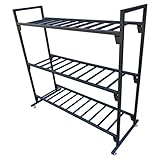
- Holds up to 12 batteries on 3 sturdy shelves, supporting 300 lbs, for heavy-duty storage.
- Compact 34" x 10" x 32" design fits seamlessly into tight spaces while maximizing battery organization.
- Durable black powder-coated metal construction resists corrosion, built to last for years.
- Tool-free assembly with adjustable feet ensures stability on uneven surfaces for hassle-free setup.
- Perfect for mechanics and DIYers, offering space-saving storage that keeps batteries secure and accessible.
- Define the critical-load profile. Use interval demand, motor-start requirements, step changes, power factor, and the proposed load-shed sequence. Include the worst credible operating case rather than an average day.
- Set the island-duration requirement. Base it on outage consequences, business continuity objectives, fuel-delivery assumptions, and the ability of other resources to operate. State the required service and conditions, not just a battery-hours label.
- Describe how the battery will be dispatched. Specify reserve energy, charging sources, minimum state of charge, peak management, solar curtailment, black start or grid-forming duties, and the response needed when a generator starts or a load changes.
- Model resource interactions. Test solar variability, generator minimum output, fuel limits, load shedding, battery efficiency, temperature limits, degradation assumptions, and maintenance outages. Include the loss of a resource while islanded.
- Run a site-specific sizing analysis. DOE identifies REopt as a tool that can evaluate technology sizing, battery dispatch, energy costs, and critical-load survival time. Use the actual load, tariff, resource, and outage assumptions rather than a generic battery calculator.
- Verify safety and interconnection constraints. Confirm location, clearances, ventilation or thermal management, fire protection, emergency response, protection settings, metering, and utility operating requirements before fixing the final capacity.
Specify both the guaranteed deliverable power and usable energy under defined conditions. Require the supplier to state how capacity changes with temperature, state of charge, operating reserve, degradation, and warranty limits. The commercial battery energy storage system is a procurement category, not a universal size or chemistry recommendation.
PC Slower Than It Used to Be?
A free scan shows the junk files, broken settings and background clutter dragging Windows down - then fixes them in one click.Free scan · Windows 10 & 11Outdated Drivers Are Slowing You Down
One free scan finds every outdated or missing driver and matches the right update for your exact hardware.Free scan · exact hardware matchDesign controls, protection, and operating modes
The microgrid controller and protection scheme are enabling functions. They coordinate resources, loads, breakers, measurements, and communications in both grid-connected and islanded operation.
Define the operating state machine
Document normal parallel operation, detection of a utility disturbance, transition to islanded operation, load shedding, resource start-up, steady island operation, reconnection checks, resynchronization, and return to normal service. Define manual overrides, permissives, interlocks, alarms, and the conditions that block a transition.
Coordinate protection
Recalculate fault levels and protection coordination for each material source and operating mode. Islanding changes available fault current and current direction. Confirm breaker ratings, relay settings, grounding, anti-islanding behavior where applicable, transfer schemes, and the treatment of maintenance conditions with the utility and qualified protection engineers.
Make communications dependable
Identify which measurements and commands are essential to safe operation and what the system does when a network link, meter, controller, or time source fails. Define local fallback behavior, alarm escalation, access control, backups, and change management. These requirements should appear in the performance specification, not be left to an informal controls integration task.
Use a conceptual design to make the investment decision
A conceptual design should produce enough information to compare alternatives and authorize the next phase. For each alternative, document:
- Electrical boundary, one-line architecture, and operating modes.
- Critical-load coverage, load-shed sequence, transition behavior, and island duration.
- Resource ratings, dispatch logic, fuel or energy assumptions, and major equipment locations.
- Controls, communications, metering, protection, and utility interface.
- Site constraints, construction outages, safety concerns, permitting issues, and environmental requirements.
- Capital and operating cost assumptions, lifecycle economics, and sensitivity to key risks.
- Interconnection studies, procurement steps, schedule, and regulatory issue list.
Compare alternatives using the same scenarios and assumptions. The most useful decision categories are critical-load coverage and duration; reliability and transition performance; technical feasibility; lifecycle economics; fuel availability and operating requirements; and utility or market interaction. Technology labels alone do not identify a winner.
Value outage consequences locally
If resilience drives the project, establish a site-specific baseline for lost production, spoilage, safety impacts, service interruption, recovery time, and contractual consequences. Do not substitute a generic outage-cost average for the facility’s own exposure. DOE’s resilience guidance provides a framework for valuation, but the inputs must come from the site.
Keep costs qualified
The available DOE materials do not establish a universal microgrid cost, payback period, savings figure, or outage-value number. Present estimates with their scope, date, assumptions, ownership model, and recurring operating costs. Evaluate financing and acquisition strategy at the same time as the technical concept.
What’s actually slowing this PC down?
Pick the symptom - the matching free tool is one click away.
Rank #4

- Commercial Grade - Designed to accommodate a single group 4D battery, including automotive, marine, RV, and other commercial batteries.
- Rugged Design - Four corner fastening system and captive lid for easy installations, large cable entry holes for large gauge cables, full flow ventilation for releasing battery gases, and a battery acid reservoir.
- Designed for Rugged Environments - Impact-resistant down to minus 40 degrees Fahrenheit, withstands acid, gas, oil, and other contaminants, and immune to UV exposure.
- Keeps your Battery Safe - Limits water entry, effectively collects battery acid, allows adequate ventilation, and protects against accidental contact of battery terminals.
- Certified and Tested - Meets United States Coast Guard (USCG) Code of Federal Regulations 183.420 and American Boat and Yacht Council (ABYC) E-10.7 specifications.
Coordinate utility, permits, and regulatory workstreams
Engage the serving utility before the architecture is fixed. Ask for current requirements covering interconnection studies, protection, operating coordination, metering, export, standby service, tariffs, and communications. Obtain written confirmation where a requirement affects equipment or schedule.
Review local approvals
With qualified local advisers and the authority having jurisdiction, review:
- Electrical, building, zoning, and construction permits.
- Air-quality and noise requirements for combustion equipment.
- Fire protection, emergency response, and building-code requirements for storage.
- Fuel storage, delivery, spill control, and environmental obligations.
- Applicable incentives, demand programs, export rules, and market participation.
- Insurance, worker safety, hazardous-energy control, and emergency procedures.
These are issues to investigate, not universal requirements. Location, technology, system size, ownership, and utility territory determine what applies. DOE’s Microgrid System Project Development Checklist, dated April 7, 2025, organizes project planning through implementation and links to battery-storage procurement and distributed-energy interconnection resources.
Plan procurement and contractor selection
Choose the acquisition and operating model before issuing a request for proposals (RFP). Decide who owns the assets, who supplies fuel or energy, who operates the controller, who carries performance risk, and how upgrades will be approved.
Write a performance-based specification
State required outcomes rather than only equipment names. Include the electrical boundary, critical-load cases, island duration, transition and resynchronization behavior, resource availability, power and usable-energy guarantees, protection and controls integration, communications, cybersecurity, safety, noise and emissions limits, testing, training, documentation, warranties, and operations support.
Evaluate proposals consistently
Use a common scenario set and require bidders to identify exclusions, assumptions, degradation, fuel limitations, maintenance outages, and utility dependencies. Check the proposed team’s experience with commercial or industrial microgrids, protection studies, controls integration, commissioning, and long-term service. Separate guaranteed performance from modeled or optional performance.
Move from design to construction and commissioning
- Complete detailed engineering. Finalize one-lines, protection studies, equipment layouts, grounding, cable schedules, controls narratives, network design, fire protection, and permit drawings.
- Coordinate construction. Plan outages, temporary power, equipment access, safety boundaries, factory testing, and interfaces with production or tenants.
- Perform functional testing. Test meters, communications, alarms, interlocks, breaker operation, protection settings, load-shed logic, resource start-up, and controller responses.
- Test real operating scenarios. Demonstrate grid-connected operation, intentional islanding, critical-load service, resource loss, load shedding, fuel or energy limits, resynchronization, and controlled shutdown. Record measured results against the specification.
- Commission and hand over. Deliver as-built drawings, settings files, software backups, operating procedures, training records, spare-parts lists, maintenance schedules, permits, warranties, and emergency contacts.
DOE’s development checklist and process materials treat procurement, engineering, construction, testing, commissioning, and operations as connected stages. Do not accept equipment as complete merely because it starts in a factory test; the integrated site behavior is what the owner needs.
Prepare the operations and maintenance program
Assign responsibility for daily monitoring, alarm response, fuel management, battery and generator maintenance, protection testing, controller updates, cybersecurity, spare parts, and utility coordination. Define inspection intervals and the conditions that require a controlled shutdown.
Measure what the project promised
Track critical-load availability, islanding and resynchronization events, resource output, battery state of charge, fuel consumption, load shedding, alarms, maintenance completion, and energy-cost performance. Review results after outages and planned tests. Update operating procedures when production, tariffs, equipment, or utility rules change.
Planning tools and reference material
The DOE’s Microgrid Design Toolkit is a free decision-support resource for examining topology, performance, reliability, and cost trade-offs. Use it alongside site measurements and engineering judgment; a tool cannot supply missing load, utility, permitting, or operating information.
For project organization, use the DOE commercial-scale checklist, the DOE/NREL process graphic, and the DOE resources on resilience valuation and distributed energy resources. The DOE page on Distributed Energy Resources for Resilience discusses DERs as resilience options that must be evaluated against site requirements.
Quick Recap
Common planning failures and how to prevent them
- Starting with a technology. Prevent it by approving the boundary, objectives, critical loads, and operating cases first.
- Using an average load. Prevent it by modeling time-varying total and critical demand, starts, peaks, and restart sequences.
- Calling every desirable load critical. Prevent it by documenting outage consequences and a ranked load-shed plan.
- Ignoring utility review until late design. Prevent it by requesting interconnection, protection, metering, export, and tariff requirements at concept stage.
- Sizing only for energy or only for power. Prevent it by checking battery output, usable energy, reserve, operating temperature, degradation, and step loads together.
- Treating the controller as an accessory. Prevent it by specifying control narratives, communications, fail-safe behavior, cybersecurity, and integrated tests.
- Assuming fuel or sunlight is always available. Prevent it by modeling delivery delays, weather, maintenance, resource loss, and extended outages.
- Using generic economics. Prevent it by building a site-specific outage baseline and stating all cost and financing assumptions.
- Stopping at installation. Prevent it by funding commissioning, operator training, spare parts, maintenance, recurring testing, and performance measurement.
A decision checklist before issuing an RFP
- The electrical boundary and point of common coupling are shown on a verified one-line diagram.
- Objectives, outage threats, critical loads, load-shed priorities, island duration, and transition behavior are approved.
- Total and critical-load profiles include peaks, starts, schedules, and operating cases.
- Existing infrastructure, generation, controls, communications, fuel systems, and site constraints are documented.
- At least two conceptual alternatives are compared using common technical and economic assumptions.
- Battery power, usable energy, dispatch, reserve, degradation, safety, and interconnection requirements are explicit where storage is proposed.
- The utility has been engaged on current interconnection, protection, metering, export, operating, and tariff requirements.
- Permitting, fire, building, air, noise, environmental, insurance, and safety issues have named owners.
- Ownership, financing, procurement route, performance guarantees, commissioning tests, and O&M responsibilities are defined.
- The RFP requires integrated site testing, operator training, documentation, and measured acceptance criteria.
Product prices and availability are accurate as of the date/time indicated and are subject to change. Any price and availability information displayed on Amazon at the time of purchase will apply.
Do these 3 things before closing this tab:
1Repair Windows errors before they cause bigger problems2Scan for outdated or missing drivers - takes under a minute3Clear out junk files and repair common Windows errors
