A safe home-renovation detour starts with a scaled site plan, a separate pedestrian route, and a delivery route designed around the actual vehicle. First determine whether the work stays on your property or affects a sidewalk, curb, parking lane, or street. Private-site changes may be managed with your contractor; public-space impacts can require a permit, an approved traffic-control plan, advance notice, qualified traffic controllers, and accessibility provisions from the authority that controls the road.
Walk the site before ordering materials or closing an entrance. Mark what will be blocked, for how long, where people and vehicles will move, and who can change the arrangement if conditions shift. The plan should keep people out of reversing and loading areas, preserve emergency access, and give every resident, worker, and driver one unambiguous route.
As an Amazon Associate I earn from qualifying purchases.
1. Decide whether the detour is private or public
This decision controls nearly every later requirement. A detour entirely on your driveway, yard, or other private land is usually a site-management matter, although property, safety, accessibility, and fire rules can still apply. A detour that occupies or alters a sidewalk, curb, parking lane, bicycle facility, road, or public verge is a right-of-way activity. Contact the road or public-works authority before placing signs, barriers, skips, vehicles, or materials there.
Private-property work
Examples include routing a delivery through a second gate, temporarily closing your own driveway, moving vehicles to a private parking area, or creating a marked walkway around an excavation inside the lot. Agree the arrangement with the principal contractor and tell affected occupants and neighbors. Keep the route on land you are authorized to use, maintain sight lines, and do not let private cones or tape imply that a public road is closed.
#1 Best Overall
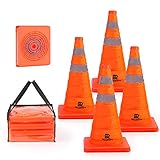
- Highly Visible: The bright orange safety color and 360 degree reflective collars make the parallel parking cones visible from a long distance during day or night
- Easy to Store: This set of collapsible traffic cones can be easily folded to a height of 0.9 inches, which is very easy to store, and there is a storage bag inside, so you can stack them when you don't need to use them, which is convenient for you to carry
- Stable: The base of cones is 9.6" X 9.6" and the weight of each road cone is 0.7 lbs, meaning that they'll stay put exactly where they need to be. Whether you're trying to control driveway traffic or keep footfall in order at a festive event
- Widely Use: These road cones can collapse up to 18 inches tall, and each cone with 2 reflective collars means people are unlikely to miss them, suitable for parking lots, driving Training, building construction, warning areas
- Sturdy PVC: We construct every tall traffic cone in this 4 pieces set from orange oxford fabric and sturdy PVC. This material is a very strong type of plastic
Public-space work
If a sidewalk, curb, parking space, lane, or street is blocked or narrowed, ask the controlling authority whether you need a traffic-control plan (TCP), a right-of-way permit, a parking suspension, public notice, a trained traffic controller, or an emergency-access plan. Requirements vary by road owner and jurisdiction. Seattle, Sydney, British Columbia, and England use different approval systems, so none of their procedures should be treated as a universal homeowner rule.
2. Survey the site and draw a usable plan
Do a physical walk-through with the contractor and, for a large delivery, the carrier. Measure rather than guessing: a route that fits a passenger car may fail for a rigid truck, trailer, crane, or concrete mixer. Record the dimensions and turning needs supplied by the carrier or contractor.
Record these features
- The renovation footprint, fencing, scaffolding, excavations, material stacks, dumpsters, portable toilets, and equipment.
- The driveway, gates, sidewalk, curb, parking spaces, street edge, alternate entrances, and any shared access rights.
- Overhead wires, tree branches, low eaves, bridges, utility covers, drainage channels, soft ground, steep grades, and narrow turns.
- Where a vehicle can stop, turn, reverse, load, and leave without trapping another vehicle or crossing a walking route.
- Fire hydrants, fire lanes, ambulance access, neighboring driveways, school routes, bus stops, and sight-line restrictions.
- The expected start and finish of each blockage, including short deliveries that may need a different arrangement from a multi-week closure.
Show the information a driver and pedestrian need
Draw the work-zone boundary, vehicle path, pedestrian path, bicycle path where relevant, loading point, staging area, signs and barriers, alternate property access, and any vehicle restrictions or spotters. Seattle’s Applicant Guide 1005 identifies these as typical TCP content. A simple scale drawing with measurements and photographs is more useful than a verbal promise that “there will be room.”
3. Separate pedestrians from vehicles
Vehicle movement and walking should be physically separated wherever possible. The UK Health and Safety Executive (HSE) states that inadequate planning and control is the root cause of many construction-vehicle accidents. Its guidance calls for suitable walkways, visible and signed crossings, managed access, and storage planned so delivery vehicles do not have to cross the site unnecessarily.
Rank #2

- Highly Visible: The bright orange safety color and 360 degree reflective collars make the parallel parking cones visible from a long distance during day or night
- Easy to Store: This set of collapsible traffic cones can be easily folded to a height of 1.7 inches, which is very easy to store, and there is a storage bag inside, so you can stack them when you don't need to use them, which is convenient for you to carry
- Stable: The base of cones is 11.4" X 11.4" and the weight of each road cone is 1.45 lbs, meaning that they'll stay put exactly where they need to be. Whether you're trying to control driveway traffic or keep footfall in order at a festive event
- Widely Use: These road cones can collapse up to 28 inches tall, and each cone with 2 reflective collars means people are unlikely to miss them, suitable for parking lots, driving Training, building construction, warning areas
- Plastic Base: The cone part of our traffic cone is made of Oxford cloth, the base is made of plastic, and the base size is 11.4 inches X 11.4 inches. NOTE: the base is made of plastic, please be careful not to be crushed by cars when using it
Build the walking route first
- Choose the shortest practical route that stays outside reversing, loading, plant-swing, and excavation areas.
- Make the surface firm, stable, level enough for its users, and free of hoses, cords, debris, mud, and stored materials.
- Provide a visible crossing where a person must cross a vehicle path; keep the crossing perpendicular and keep drivers’ sight lines clear.
- Use barriers or rails where a person could fall into an excavation or be struck by moving equipment. Do not rely on warning tape alone for a physical hazard.
- Light the route and its entrances when people may use it in darkness, while avoiding glare that blinds drivers.
- Check that gates, temporary ramps, and doorways remain usable by people with mobility, vision, or hearing disabilities.
If an existing path closes, identify a nearby temporary route rather than sending people into the roadway. Caltrans construction guidance directs agencies to provide a temporary pedestrian access route and inspect it against applicable requirements, including ADA compliance. That is an agency requirement in its setting, not a specification that automatically governs every private driveway; use it as a strong planning principle and confirm your local accessibility rules.
Control crossings and reversing
Keep pedestrians away from reversing zones. If a crossing cannot be eliminated, schedule movements for quieter periods and use a trained spotter or traffic controller when the approved plan or site risk assessment requires one. A spotter must have a clear view, a defined position, and authority to stop the vehicle; a person standing behind a truck without a communication plan is not a control system.
4. Fit the route to the delivery vehicle
Obtain the vehicle type and dimensions before you finalize the detour. Ask for overall length and width, height, turning radius, axle or ground-loading limits, tail-swing, unloading method, and whether the driver needs to reverse. Include the vehicle’s approach and departure, not just the point where it parks.
PC Slower Than It Used to Be?
A free scan shows the junk files, broken settings and background clutter dragging Windows down - then fixes them in one click.Free scan · Windows 10 & 11Outdated Drivers Are Slowing You Down
One free scan finds every outdated or missing driver and matches the right update for your exact hardware.Free scan · exact hardware matchGive the carrier one written instruction
- Delivery date, arrival window, and a call-ahead requirement.
- Permitted approach and exit, with a map or marked photograph.
- Maximum vehicle dimensions and any low-clearance, weight, width, or turning restrictions.
- Exact loading or unloading position and whether the driver must remain in the cab.
- Where the vehicle may wait without blocking a public lane, hydrant, driveway, or pedestrian route.
- Name and mobile number of the on-site contact who can open a gate, stop work, or redirect the driver.
- Instruction not to enter if the route is occupied, muddy, flooded, or different from the agreed plan.
Confirm the arrangement again on the morning of delivery. A changed scaffold bay, parked neighbor’s car, or rain-softened verge can make yesterday’s route unsafe.
Rank #3

- Highly Visible: The bright orange safety color and 360 degree reflective collars make the parallel parking cones visible from a long distance during day or night
- Easy to Store: This set of collapsible traffic cones can be easily folded to a height of 0.9 inches, which is very easy to store, and there is a storage bag inside, so you can stack them when you don't need to use them, which is convenient for you to carry
- Stable: The base of cones is 9.6" X 9.6" and the weight of each road cone is 0.7 lbs, meaning that they'll stay put exactly where they need to be. Whether you're trying to control driveway traffic or keep footfall in order at a festive event
- Widely Use: These road cones can collapse up to 18 inches tall, and each cone with 2 reflective collars means people are unlikely to miss them, suitable for parking lots, driving Training, building construction, warning areas
- Sturdy PVC: We construct every tall traffic cone in this 2 pieces set from orange oxford fabric sturdy PVC. This material is a very strong type of plastic
5. Choose the least disruptive arrangement
Preserve existing access when it can be done safely. If full use cannot continue, maintain continuous passage through a safe temporary route or provide an alternate entrance. Caltrans traffic guidance uses this continuity principle for highway work; residential projects can apply the principle without importing Caltrans’ technical highway standards.
Compare the workable options
| Option | Advantages | Questions to resolve |
|---|---|---|
| Keep the existing driveway or path open | Least change for residents, neighbors, and emergency access. | Can people and vehicles be separated from the work zone, and can the largest delivery vehicle turn safely? |
| Use a second private entrance | May avoid public-space permits and keep construction traffic away from residents. | Do you have legal permission, adequate width and clearance, a firm surface, and a gate that can be managed? |
| Create a temporary on-site walkway | Maintains access while the normal path is occupied. | Is it level, protected, lit, accessible, and outside plant and loading movements? |
| Schedule timed deliveries | Reduces the duration of vehicle conflict and can avoid peak pedestrian periods. | Can the carrier meet the window, and who will hold the route clear? |
| Use a public-road or sidewalk detour | May be necessary when no private route exists. | Which authority owns the space, and what permit, TCP, notice, accessibility, parking, and qualified-person requirements apply? |
Evaluate every option against six tests: private versus public land, pedestrian separation and accessibility, fit for the actual vehicle, effects on neighbors and emergency access, duration and timing, and approval obligations. No universal cost or approval lead time applies; obtain those figures from the local authority and contractor for your location.
6. Check approvals before occupying public space
Call the authority early, ideally before the contractor books a delivery or orders a closure. Describe the exact frontage, dates, dimensions, work activity, and whether digging, lifting, parking, or pedestrian diversion is involved. Ask for the application name, drawings, notice period, inspection, fees, insurance, traffic-control qualifications, and emergency contact requirements.
What local examples show
- Seattle: The Seattle Department of Transportation says work that affects the right of way may require a TCP and an approved permit before work begins where a TCP is required. Its Applicant Guide 1005 says on-site signs are important 72 hours before certain detours or closures take effect. That 72-hour statement is Seattle-specific, not a general notice rule.
- Sydney: The City of Sydney has an approval process for specified minor construction works using the public way. Intrusive digging in a public road or footpath is handled through a road-opening application. The applicable application and qualifications depend on the activity and location.
- British Columbia: A highway-use access permit can apply where an access connects to a provincial highway. Road ownership and location determine whether that process is relevant.
- England: Department for Transport street-works permit guidance applies from 10 April 2026 and reflects 2026 amendments. Permit schemes and coordination requirements are for the authorities and undertakers covered by that guidance; they are not a universal home-renovation permit timetable.
These examples demonstrate why copying a neighboring project’s signs or notice period is unsafe. The controlling authority may be a city, county, state or provincial department, transport agency, or private road owner.
Rank #4

- Collapse design and Easy storage: Each collapsible traffic cone can collapse up to 28 " and collapses down to 1.7 " in height for easy storage which only takes a small space in your car or garage. Carry the traffic cones conveniently. ATTENTION: Fragile when crushed by vehicles.
- Sturdy materials: The Collapsible traffic cones are made of orange oxford fabric and PVC material for the basis. Dry quickly and does not fade easily when exposed to the sun. The bright orange safety color and a 360 degree reflective strip make the traffic cones visible from a long distance during the day or nightht
- Stable: The large base size of Collapsible traffic cones is 11.4 " X11 " and the weight of each road cone is 1.45 lb which makes the collapsible traffic cones stay firmly in the road
- Multiple uses: Perfect for emergency personnel, maneuverability driver training, equine courses, Camping, and car rider line in school. Block off areas for the parking lot in church, sideways, or any public areas to prevent the car from being scratched. Create caution areas in your driveway or mark off safe places for people to play in the driveway or street
- Storage bag: There is a storage bag inside, which is convenient for you to carry the collapsible traffic cone
7. Prepare a traffic-control plan when one is required
A TCP explains how people, vehicles, and the public will move past the work. Your contractor or a qualified traffic-management professional may need to prepare it. At minimum, be ready to provide:
- A plan-view drawing with dimensions, work limits, staging, and access points.
- Pedestrian and bicycle routes, crossings, ramps, barriers, and any temporary accessible route.
- Vehicle approach, loading, turning, reversing, and exit movements.
- Signs, cones, barricades, channelizing devices, lighting, and their locations.
- Lane, parking, driveway, or sidewalk restrictions and the hours they apply.
- Spotter or traffic-controller positions, communication method, and stop-work authority.
- Emergency access, resident access, transit or school-route considerations, and a contact for changes.
- Installation, inspection, maintenance, removal, and response arrangements for weather or damage.
Do not submit a sketch that shows a route you cannot physically maintain. Walk it with the person responsible for setup and with the carrier if a large vehicle is involved.
8. Install and maintain the detour
Before the first closure
- Obtain written approval and satisfy every permit condition for public-space work.
- Brief residents, workers, subcontractors, delivery companies, and neighbors who rely on the access.
- Mark the private-site routes and loading point; place barriers so they guide movement without blocking sight lines or accessible width.
- Inspect the walking surface, ramps, gates, lighting, and vehicle path.
- Confirm the emergency route remains open and that someone can remove an obstruction immediately.
During the work
- Keep materials, waste, and parked vehicles inside the planned staging area.
- Remove mud, standing water, ice, cords, and debris from the pedestrian route.
- Check signs and barriers at the start of each shift and after wind, rain, impact, or a layout change.
- Prevent drivers from improvising a shortcut through the work zone.
- Record changes and send one updated map or instruction to every affected party.
- Stop a movement if a person enters the vehicle path, the spotter loses sight of the driver, or the route no longer matches the approved plan.
For public right-of-way controls, use only the devices, placement, hours, and personnel authorized by the permit and approved plan. Private cones cannot substitute for required signs, barriers, permits, or trained traffic control.
Quick wins for a faster PC:
Repair Windows errors before they cause bigger problemsFix Now →Scan for outdated or missing drivers - takes under a minuteDriver Scan →Clear out junk files and repair common Windows errorsFree Scan →9. Use simple private-site markers correctly
Portable traffic cones can help mark a temporary route on private property when they are visible, stable, and placed so they do not narrow the walking path or obstruct drivers’ sight lines. They are a limited site-marking aid, not a public-road closure system. Consumer cones do not replace a permit, an approved public-right-of-way TCP, compliant barriers, or trained traffic control.
Best Value

- 6 Packs Safety Cones Set:You will receive 6 Safety Cones, can basically meet the daily needs. The height of the Safety Cones is 18 inches, the base is 9.5*9.5 inches, and the height after storage is 1.5 inches. It takes up little space and is very convenient to use
- Premium Material:The Traffic Cones are made of durable Oxford fabric waterproof material, which can effectively waterproof and last for a long time; The stable base is made of thick material, which is not easy to be knocked over, allowing the Safety Cones to stand well and endure wind and rain tests. There are bearings made of premium materials inside the Traffic Safety Cones, which are easier to store, and can withstand the challenges of various weather or road conditions
- Foldable Storage:The Traffic Cones 18 inch have a foldable design, which can be easily stored and takes up little space. It can be unfolded when in use and stored when not in use. The 18'' size of the road cone can be easily folded down to just 1.5 '' height for convenient storage
- Wide Application:The Orange Cones have a wide range of applications and can be used for RVs, private cars, parking lots, roadsides, etc. Traffic Safety Cones are suitable for emergency responders, schools, municipal landscaping, building construction, warn areas, road safety, hazard marking, and other places where you want to apply
- IMPORTANT – WIND STABILITY NOTE:This is a collapsible/portable traffic cone designed for temporary use (parking spots, driveways, garages, event marking). It is NOT a heavy-duty construction cone.For outdoor use in windy conditions, we strongly recommend adding weight to the base (sandbag, water bag, or placing a heavy object on the base).
10. Communicate with neighbors and emergency services
Give neighbors the dates, hours, alternate entrance, delivery windows, and a contact number. Tell them where not to park and how to report an obstruction. If the work could affect a fire lane, hydrant, ambulance approach, school route, or shared private road, ask the responsible emergency or road authority what clearance and notification they require. Do not assume a “short” closure is harmless: a blocked driveway can delay an emergency even when no construction vehicle is moving.
11. Troubleshoot common failures
The truck arrives and cannot turn
Stop the delivery before the driver commits to the route. Do not ask the driver to mount a curb, reverse blind, or cross the pedestrian path. Move the loading point, use a smaller vehicle, reschedule for a controlled window, or obtain a revised approved arrangement if public space is involved.
The temporary walkway is blocked
Stop the activity creating the obstruction, restore a firm and accessible route, and notify users of the change. If restoration is not immediate, provide a clearly communicated alternate route that has been checked for the same hazards.
A neighbor parks in the planned loading area
Use the agreed communication channel and the lawful parking-control process for your location. Do not tow, block, or place unauthorized signs on public land. If the area is public, follow the permit’s parking-suspension or enforcement procedure.
Weather changes the route
Reinspect after heavy rain, snow, ice, high winds, or flooding. Close a route that has lost stability or visibility, protect the hazard, and issue a revised instruction before the next movement.
The work expands into the street
Pause the expansion and contact the road authority. A private-site plan does not authorize occupation of a sidewalk, curb, parking lane, or street. Obtain the required approval and update signs, barriers, pedestrian access, and notice before proceeding.
12. Print-ready planning checklists
Homeowner checklist
- Have I identified every public and private surface affected?
- Have I measured the largest vehicle and its turning route?
- Is there a firm, visible, accessible pedestrian route separate from vehicles?
- Where will materials, waste, and waiting vehicles be staged?
- Can emergency vehicles and residents pass at all times?
- Which authority controls the affected road or sidewalk?
- Have I confirmed permits, TCP, notice, parking, inspection, and qualified-person requirements?
- Does every contractor and carrier have the same map, timing, and contact?
- Who inspects the route each shift and after weather or layout changes?
Delivery call-sheet checklist
- Vehicle type, dimensions, height, weight, and turning requirements.
- Approach, exit, gate, clearance, and surface conditions.
- Arrival window and call-ahead time.
- Loading position, unloading method, and waiting location.
- On-site contact and backup contact.
- Instruction to stop and call if the route differs from the map.
Bottom line
Plan the detour as a movement system, not as a line of cones. Keep pedestrians on a protected, accessible route; keep vehicles out of that route; design around the real delivery vehicle; preserve emergency access; and obtain local approval before using public space. A short site walk, a measured drawing, and one coordinated set of instructions prevent most avoidable conflicts.
What’s actually slowing this PC down?
Pick the symptom - the matching free tool is one click away.
Quick Recap
Product prices and availability are accurate as of the date/time indicated and are subject to change. Any price and availability information displayed on Amazon at the time of purchase will apply.

