Ultra-low-cement concrete is made by designing the whole mixture around performance—not by deleting cement from a conventional recipe. The reliable workflow is to set strength, durability and construction requirements first; characterize the actual materials; pack the aggregate blend tightly; use only the paste needed for coating, cohesion and consolidation; replace part of Portland cement with suitable supplementary cementitious materials (SCMs); control the water-to-cementitious-materials ratio (w/cm); and prove the mixture with trial batches and specified tests.
Published studies show that very low Portland-cement contents can work in particular materials and conditions. They do not establish one safe ratio of cement, water, sand and stone for every slab, beam, pavement or precast product. The final mixture must satisfy the governing code, exposure class, construction method and acceptance tests for the actual project.
As an Amazon Associate I earn from qualifying purchases.
What “ultra-low cement” means
In concrete discussions, cement normally means Portland cement. Cementitious materials or binder means Portland cement plus reactive additions such as fly ash, slag cement or silica fume. Replacing Portland cement with an SCM lowers Portland-cement content, but it may leave total binder content unchanged or even increase it. A claim about “low cement” is incomplete unless it states both quantities.
Outdated Drivers Are Slowing You Down
One free scan finds every outdated or missing driver and matches the right update for your exact hardware.Free scan · exact hardware matchWindows Errors? Fix Them Before They Spread
Repair common Windows errors and clear accumulated junk for a smoother, more stable PC - no reinstall needed.Free scan · no reinstallStrength is only one acceptance criterion. A mixture can reach its specified compressive strength and still be too permeable, lack freeze-thaw resistance, shrink excessively, set at the wrong rate, or be impossible to pump and finish. Ultra-low-cement design therefore means reducing Portland cement while preserving the complete performance envelope.
#1 Best Overall
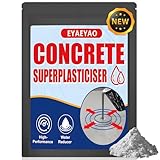
- 8 Ounces High-Performance Super plasticizer Concrete Additive – Superior Strength, Workability & Durability – Ideal for Ready-Mix, Precast, & High-Strength Concrete Projects
- Boosts concrete strength & durability with advanced superplasticizer formula, ideal for long-lasting, resilient structures in all climates Reduces water usage by up to 30%, maintaining high concrete strength and density for stronger, more reliable results
- Enhances workability & flow, enabling easier, smoother pouring for professional-grade concrete finishing on any project size Perfect for high-strength, precast, and ready-mix applications, ensuring flexibility and reliability in various construction needs
- Minimizes cracks, shrinkage, and segregation, improving concrete stability and structural integrity for safer, more durable builds Compatible with most cement types, this superplasticizer concrete additive delivers consistent performance in challenging environments
- Concrete additive-Water reducer-Super plasticizer - High-performance super plasticizer for cement based construction materials. Super plasticizer is especially optimized for plastification and water reduction of cementitious construction materials.
Set the performance constraints before changing proportions
Write a project-specific performance brief before selecting a replacement percentage or aggregate blend. The required test age matters: a 28-day strength target and a 56- or 90-day target can lead to different SCM choices and curing requirements.
Define the required outcomes
- Strength: specified compressive strength, test age, strength class and allowable statistical variation.
- Durability: exposure to chlorides, carbonation, sulfates, freezing and thawing, abrasion, alkali-silica reaction or other project hazards.
- Fresh behavior: slump or slump flow, air content, temperature, setting time, pumpability, segregation resistance and finishing window.
- Placement: member geometry, reinforcement congestion, delivery distance, pump line, vibration or self-consolidating placement, and surface-finish requirements.
- Curing: available curing method, duration, temperature and protection from drying or freezing.
- Compliance: the adopted concrete code, project specification, approved cement and SCM types, aggregate requirements and local transportation-agency rules.
Do not choose a low-cement target until these constraints are documented. The same nominal strength can require different mixtures for a cast-in-place wall, a pumpable deck, a precast product and a low-slump pavement.
Characterize the actual materials
Ultra-low-cement mixtures are sensitive to material variation because there is less excess paste to hide changes in grading, moisture or admixture response. Test the materials that will actually be used in production.
Binder materials
- Identify the Portland-cement type and its setting and strength-development characteristics.
- Record each SCM source, classification, fineness, chemical properties and supply consistency.
- Confirm that the SCM is permitted by the governing specification and accepted by the relevant authority.
- Check cement–SCM–admixture compatibility rather than assuming a dosage from another project will transfer.
The National Academies identifies fly ash, slag cement and silica fume as commonly used SCMs. Their effects depend on source, proportion, curing and exposure; regional availability and acceptance practices differ.
Aggregates and water
- Measure sieve gradation for every size, specific gravity, absorption, unit weight and deleterious-material content.
- Record stockpile moisture daily enough to calculate the water contributed or absorbed by the aggregates.
- Check particle shape, texture and cleanliness. Angular or rough particles can increase paste demand even when the sieve curve looks acceptable.
- Verify mixing-water quality and account for all water in liquid admixtures.
Use these measurements to calculate absolute volumes and to adjust batch water. A low w/cm based on incorrect aggregate moisture is not actually low.
Rank #2

- STRONG AND SECURE BONDING — Add as a bonding grout or admixture to cement, concrete, or mortar for increased adhesion and impressive tensile strength
- DURABLE IN THE ELEMENTS — This acrylic concrete fortifier resists damage from repeated freezing and thawing for a more stable bond, reducing the need for upkeep and maintenance
- PERFECT FOR MANY PROJECTS OR JOBS — Simple to use and stores easily for home DIYers and professionals. No dilution is needed, so preparation work is quick
- FORMULATED FOR PERFORMANCE — Made with an acrylic-polymer latex that turns into a hardened concrete with 500 psi bond strength. You get superior reliability and a better overall performance
- VERSATILE AND HIGH QUALITY — Use as a cement bonding adhesive or as an acrylic coating primer for grout. It won't produce a vapor barrier and achieves a denser, tougher surface
Optimize aggregate packing before cutting paste
Aggregate occupies most of concrete’s volume. A well-graded blend of coarse and fine particles leaves fewer voids, so less paste is needed to fill those voids and provide a lubricating layer around the particles. A poorly packed blend forces the designer to add paste simply to make the concrete move.
Build a combined gradation
- List the available aggregate sizes and their measured gradations.
- Blend trial proportions to reduce gaps in the combined particle-size distribution while preserving the required maximum size and finish.
- Measure void content or packing density of each candidate blend using a consistent procedure.
- Check the blend in a small mortar or concrete batch for segregation, finishability and pump behavior; the mathematically densest blend is not automatically the most constructible.
- Select the blend that meets the packing objective without blocking reinforcement, damaging the surface finish or exceeding equipment limits.
The 2023 Low-Carbon Concrete Pilot Program describes particle-size-distribution and packing-degree approaches for reducing paste. It also states that additional strength and global-warming-potential work was needed before drawing a conclusive performance/carbon correlation.
Free tools Windows power users keep installed
One-click scans. No signup required.
Use paste to fill voids and coat particles
Aggregate packing does not eliminate paste. Paste must fill the aggregate voids, coat the particles, provide cohesion and allow consolidation around reinforcement. The FHWA-sponsored 2012 study found a minimum workability paste requirement related to aggregate voids. In the tested materials, a rule of thumb was approximately 1.5 times the aggregate-void paste for minimum workability. The value is a study finding, not a universal design limit; determine voids with local aggregates and confirm workability by batching.
Reducing paste below the amount needed for consolidation can create honeycombing, trapped air and weak interfaces. Those defects can reduce measured strength even when the calculated w/cm looks favorable.
Choose paste volume and cementitious content deliberately
After selecting the aggregate blend, reduce excess paste in controlled increments. Keep a record of the paste volume, total cementitious content, water, admixture dosage and fresh results for every trial.
Understand the strength threshold
In the same FHWA-sponsored study, 64 mixtures were tested with w/c values from 0.35 to 0.50 and cementitious contents from 400 to 700 lb/yd³. At a fixed w/c, strength did not improve significantly after a critical minimum cementitious content had been provided. The report related that threshold to approximately twice the aggregate-void content for its experimental materials. This does not mean every project should use twice its measured voids; it means that adding binder beyond a sufficient threshold may not buy strength if w/c and consolidation are already controlled.
Quick wins for a faster PC:
Repair Windows errors before they cause bigger problemsFix Now →Scan for outdated or missing drivers - takes under a minuteDriver Scan →Clear out junk files and repair common Windows errorsFree Scan →Interpret very low published contents correctly
A 2023 volume-based design study reported that simultaneous paste-volume control and sand proportioning could enable a cement content around 200 kg/m³. That is a reported research possibility, not an approved structural recipe. It can only be considered after checking the specific aggregate system, binder, exposure, placement method, curing and governing specification.
Rank #3

- STRONG AND SECURE BONDING — Add as a bonding grout or admixture to cement, concrete, or mortar for increased adhesion and impressive tensile strength
- DURABLE IN THE ELEMENTS — This acrylic concrete fortifier resists damage from repeated freezing and thawing for a more stable bond, reducing the need for upkeep and maintenance
- PERFECT FOR MANY PROJECTS OR JOBS — Simple to use and stores easily for home DIYers and professionals. No dilution is needed, so preparation work is quick
- FORMULATED FOR PERFORMANCE — Made with an acrylic-polymer latex that turns into a hardened concrete with 500 psi bond strength. You get superior reliability and a better overall performance
- VERSATILE AND HIGH QUALITY — Use as a cement bonding adhesive or as an acrylic coating primer for grout. It won't produce a vapor barrier and achieves a denser, tougher surface
A 2021 Construction and Building Materials study examined 30–80% cement replacement while varying binder-powder contents of 250 and 350 kg/m³ under different consistency conditions. Those values describe the study matrix. They are not universal allowable replacement rates or a recommendation for an arbitrary pour.
Replace Portland cement with the right SCM
SCMs can reduce Portland cement and alter fresh, hardened and durability properties. Select them for the required performance and local approval, not simply for the largest replacement percentage.
| SCM | Potential contribution | Design questions to resolve |
|---|---|---|
| Fly ash | Can improve workability and later-age strength or durability in a suitable mixture. | What source variability, early-strength requirement, temperature and curing conditions apply? |
| Slag cement | Can contribute to later-age strength and durability and reduce Portland-cement demand. | How will grade, temperature, curing and setting time affect the placement schedule? |
| Silica fume | Can refine pore structure and support high-performance durability when properly dispersed. | Can the mixture maintain workability, resist stickiness and meet finishing requirements? |
SCM replacement changes more than chemistry. It can change water demand, setting, slump retention, heat development, early strength and curing sensitivity. Keep Portland cement content, total binder content, SCM type, replacement proportion and source separate in the mix record so that a later comparison is meaningful.
What’s actually slowing this PC down?
Pick the symptom - the matching free tool is one click away.
Control w/cm without adding water
The Florida Department of Transportation states: “The strength of the concrete is affected mainly by the ratio of water to cementitious materials (w/cm).” Use that ratio as a project constraint, not as a reason to add water at the truck. Extra water raises w/cm, increases bleeding and shrinkage risk, and can erase the strength and durability benefit sought by reducing cement.
Use admixtures to preserve workability
Water-reducing admixtures (WRAs) and high-range water-reducing admixtures (HRWRAs) can improve flow while retaining a low w/cm. ACI guidance for Type IL cement specifically points to WRAs or HRWRAs and warns that mixing procedure, slump loss and retardation require attention. The dosage must be established with the actual cement, SCM, aggregate, water temperature and delivery time.
Rank #4

- FOR EASY REPAIRS — It's the ideal concrete patch repair mix, neatly fixing cracks and spalls so your property looks like new. It's even textured for a more seamless blend with the existing structure
- TOUGH AND DURABLE — Formulated to avoid shrinking or cracking, the ready-to-use premixed cement patch offers good adhesion and high strength so your slabs, walls & walkways/sidewalks perform as good as ever
- EASY CLEANUP — Sika concrete patch is acrylic-based, so once application is done, it cleans up using only water. No need for special cleaners and chemicals
- GREEN — It follows regulations concerning the use of volatile organic compounds (VOC), helping to keep the air we breathe cleaner and fresher
- A BREEZE TO USE — Minimal prep is required, since it comes premixed. Just use a putty or trowel to spread where repairs are needed. It takes only a few hours to set and about a day for a full cure
A 2026 ACI Concrete Abstracts Portal entry reports promising results for low-cement concrete with high HRWR dosage, but abstract-level evidence does not establish a universal dosage, slump-retention period or strength result. Treat it as a reason to trial-batch, not as permission to copy a number.
Account for fresh-concrete timing
- Measure slump or slump flow immediately after mixing and again at the expected placement time.
- Record air content, temperature, density and yield at the same intervals.
- Observe whether the mixture loses flow rapidly, sets late, becomes sticky or segregates after admixture addition.
- Never correct a low slump by adding unrecorded water; adjust the approved admixture strategy or redesign the mixture.
Trial-batch the complete mixture
A laboratory calculation is a starting point. Qualification requires batches made with production-intent materials, equipment and procedures.
- Calculate absolute volumes. Enter measured specific gravities, aggregate moisture, water, Portland cement, each SCM, admixtures and air.
- Select a controlled baseline. Use the project aggregate blend and a binder composition that meets specification before reducing paste.
- Vary one design factor at a time. Compare paste volume, SCM proportion, w/cm or aggregate blend in a planned matrix so the cause of a change is visible.
- Use the planned mixing sequence. Document charging order, mixing energy and duration; these affect HRWR activation and slump retention.
- Measure fresh properties. Record slump or slump flow, air, temperature, density, yield, segregation, bleeding and time-dependent workability.
- Cast strength specimens. Use the specified specimen type, consolidation method, curing and test ages.
- Run durability tests required by the project. Choose tests for the actual exposure rather than treating compressive strength as a durability surrogate.
- Inspect placement behavior. Pump, vibrate, finish or self-consolidate a representative trial section when those operations control the risk.
- Check variability. Repeat promising batches on different days or with realistic material-moisture changes to determine whether the margin is robust.
- Freeze the approved mixture only after review. Record tolerances, adjustment rules, admixture limits, curing requirements and acceptance criteria in the project submittal.
Qualify strength, durability and constructability separately
| Category | What to verify | Why it matters |
|---|---|---|
| Fresh concrete | Slump or slump flow, air, temperature, density/yield, bleeding, segregation, setting and slump retention. | Low paste and high admixture can make placement or finishing sensitive to timing. |
| Strength | Specified-age compressive strength, strength development and batch-to-batch variation. | A single high test result does not establish production reliability. |
| Durability | Exposure-specific permeability, freeze-thaw, sulfate, chloride, abrasion or other specified tests. | Strength does not prove resistance to the project’s deterioration mechanisms. |
| Construction | Pumping pressure, reinforcement passing, consolidation, finish, curing response and surface defects. | A laboratory mixture can fail when the field process changes. |
| Compliance | Approved materials, maximum w/cm, minimum paste or binder provisions, air limits and agency acceptance. | Local rules can override an otherwise attractive low-cement design. |
Florida Department of Transportation work illustrates this last point: its 2021 report identified minimum paste-volume values of 22.5%, 25.0%, 25.0% and 27.5% for four Florida concrete classes. Those are Florida-specific findings, not general minimums for other jurisdictions, aggregate systems or exposure classes.
Compare candidate mixtures on the variables that actually change performance
When choosing between a conventional mixture, an SCM-rich mixture and an aggregate-packing design, compare the complete systems rather than Portland-cement kilograms alone.
| Comparison axis | Questions to ask |
|---|---|
| Portland cement and total binder | How much Portland cement is removed, and does total cementitious material also change? |
| SCM details | Which SCM, what replacement proportion, what source, and is supply reliably approved? |
| w/cm and admixtures | What w/cm is required, what WRA or HRWRA dosage is used, and how stable is workability? |
| Aggregate packing and paste | What combined gradation and void content are used, and how much paste remains for coating and consolidation? |
| Fresh and construction behavior | Can the concrete be transported, pumped, placed, consolidated and finished within the available time? |
| Strength and durability | Which tests, test ages and curing conditions demonstrate the required performance? |
| Acceptance and environmental accounting | Does the jurisdiction accept the materials, and has project-level environmental impact been calculated for the defined mixture? |
Troubleshoot common failures
The mixture is harsh or will not consolidate
First check aggregate voids, particle shape, fine-aggregate proportion and paste volume. Do not immediately add water. Increase paste only in a controlled trial, or adjust the combined gradation and approved admixture strategy while keeping w/cm within the limit.
Best Value

- AIR ENTRAINING ADMIXTURE: Adds air to your mix for increased strength
- ACRYLIC FORTIFIER: Improves resistance to salt, ice and other deicing chemicals
- PLASTICIZER: Helps prevent spalling, segregation and bleeding
- VERSATILE: Ideal for exterior, interior, concrete or masonry projects
- ADDITIVE: Add to your mix, not intended to be used alone
Slump disappears before placement
Measure the time profile and verify admixture compatibility. Review mixing sequence, water temperature, delivery duration and SCM characteristics. A higher HRWR dosage may help, but only a trial with the actual materials can establish a safe dosage and setting response.
Do these 3 things before closing this tab:
1Scan for outdated or missing drivers - takes under a minute2Clear out junk files and repair common Windows errors3Fix the driver behind crashes, sound loss and screen glitchesEarly strength is too low
Check curing temperature and moisture, SCM type and proportion, cement characteristics, w/cm and test procedure. A later-age strength gain cannot compensate for a project that requires early stripping, opening or loading. Redesign the binder or schedule rather than adding unapproved water.
Strength passes but durability or finish fails
Separate the failed requirement from compressive strength. Review air system, permeability-related tests, curing, paste volume, shrinkage risk, segregation and surface finishing. Meeting strength alone does not validate the mixture.
Production results vary
Audit aggregate moisture, stockpile segregation, weighing, admixture calibration, mixing energy and curing. Low-paste mixtures have less tolerance for batching error, so tighten controls before increasing cement content as a blanket response.
What the evidence does—and does not—say about carbon reduction
Reducing Portland cement can reduce an important source of concrete emissions, but no general percentage reduction is established by the cited studies. The 2023 low-carbon pilot report explicitly indicated that additional strength and global-warming-potential determination was needed for a conclusive correlation. Calculate environmental impact for the defined project mixture, including cement and SCM production, transport, aggregate processing, admixtures, curing and expected service life.
Recommended Free Tools
A practical decision rule
Approve an ultra-low-cement mixture only when all of the following are true:
- The specified strength and test age are met with production-intent materials and realistic variability.
- The exposure-specific durability requirements are met independently of compressive strength.
- The combined aggregate blend provides adequate packing without sacrificing placement or finish.
- Paste volume is sufficient for coating, cohesion and consolidation.
- w/cm remains within the project limit without uncontrolled water additions.
- Admixture dosage, slump retention, setting and curing are documented and repeatable.
- The cement, SCMs, aggregates and admixtures are permitted and available for the project.
- The final submittal satisfies the adopted code, owner specification and jurisdictional requirements.
The strongest low-cement design is therefore not the one with the smallest cement number. It is the mixture that removes unnecessary Portland cement while retaining measurable margins for strength, durability, workability, curing and production control.
Quick Recap
Product prices and availability are accurate as of the date/time indicated and are subject to change. Any price and availability information displayed on Amazon at the time of purchase will apply.

