The safest way to dry a flooded home is to establish electrical and structural safety first, remove standing water and wet contents, clean hard surfaces, and force thorough drying as soon as conditions allow. The U.S. Environmental Protection Agency (EPA) recommends cleaning and drying the house and belongings within 24–48 hours if possible. If that did not happen, assume mold may already be growing, including in concealed spaces.
Do not re-enter or begin cleanup until local officials or qualified professionals have confirmed that the building is safe. Floodwater can contain sewage, chemicals, and other biological hazards. A flooded home may also have unstable walls, contaminated materials, or energized electrical equipment. The sequence below is based on U.S. EPA guidance; local emergency orders, building codes, insurance rules, and professional requirements can differ.
As an Amazon Associate I earn from qualifying purchases.
1. Make sure the home is safe to enter
Safety comes before speed. Wait for an all-clear from emergency authorities or a qualified professional who can assess structural, electrical, gas, and other hazards. Do not enter standing water near outlets, appliances, service panels, wiring, or other electrical equipment. Never touch wet electrical equipment while standing in water.
The Tool Desk
Outbyte PC Repair FREEClear out junk files and repair common Windows errorsFree Scan →Outbyte Driver Updater FREEScan for outdated or missing drivers - takes under a minuteDriver Scan →Floodwater can carry sewage, fuel, pesticides, solvents, and other contaminants. A building can look intact while floors, ceilings, stairs, and foundations are weakened. EPA guidance recognizes that some cleanup is too difficult or dangerous for a homeowner; hiring qualified help is the correct decision when hazards cannot be controlled.
#1 Best Overall

- Semiconductor dehumidifiers use thermoelectric cooling to remove moisture from the air. They create a drier, more comfortable environment by reducing humidity and improving air quality.
- Our home dehumidifier features intelligent auto-shutoff, automatically powering down when the water tank is full. Set it and forget it, knowing your dehumidifier is working efficiently and safely, giving you true peace of mind.
- Our dehumidifier features a captivating 7-color ambient light, allowing you to bathe your room in a spectrum of soothing hues. Choose from a calming blue, energizing green, romantic red, and more – easily select the perfect color to create your desired atmosphere and enhance your living space. Dehumidify in style and set the perfect mood, every time.
- Sleep Mode creates the perfect sleep sanctuary. The dehumidifier's atmosphere lights automatically turn off, and noise fades to a whisper. Experience truly undisturbed dehumidification for a night of perfect rest.
- Elevate your home's comfort and style with our sleek and compact dehumidifier. Designed to seamlessly blend into any space, from the living room and bedroom to the bathroom, basement, and even your RV. Its modern aesthetics and space-saving footprint make it the perfect dehumidification solution for every corner of your home.
Wear appropriate protective equipment
For a cleanup that has been declared safe, wear protective gloves, an N95 respirator, and goggles that seal without holes. Add long sleeves, long pants, and boots or work shoes. Keep contaminated clothing and footwear away from clean living areas, and wash exposed skin after work.
Children, pregnant people, people with weakened immune systems, and people with chronic breathing conditions such as asthma should not participate in flood cleanup. Anyone with breathing problems or a weakened immune system should stay away from moldy sites.
Document the loss before disturbing it
If it is safe, photograph and video rooms, waterlines, damaged systems, and belongings before moving or discarding anything. Contact your insurer promptly and ask what documentation, emergency mitigation, and disposal procedures it requires. Keep receipts and a dated record of work, equipment rental, debris removal, and professional inspections.
Do these 3 things before closing this tab:
1Scan for outdated or missing drivers - takes under a minute2Clear out junk files and repair common Windows errors3Fix the driver behind crashes, sound loss and screen glitches2. Stop additional water and plan the work area
Prevent more water from entering before you invest effort in drying. Secure temporary weather barriers against additional rain when they can be installed safely. Do not climb on damaged roofs, enter unstable areas, or work near downed utility lines.
Decide where contaminated materials will be placed, how clean items will be protected, and how workers will enter and leave without tracking floodwater through unaffected rooms. Isolate children and pets from the work area.
Electricity and generators
Turn off electricity only when doing so is safe. If the service panel is wet, surrounded by water, or inaccessible, wait for a qualified electrician or utility professional. A wet/dry vacuum, pump, fan, or dehumidifier is not safe merely because it is designed for water; the outlet, cord, plug, and surrounding floor must also be safe.
If a portable generator is needed, operate it outdoors at least 20 feet from buildings and away from doors and windows. Carbon monoxide can enter through openings even when a generator appears to be outside. Never run one in a garage, basement, crawlspace, porch, or other partially enclosed location.
Free tools Windows power users keep installed
One-click scans. No signup required.
3. Remove standing water and wet contents
Remove standing water only after electrical and structural conditions are controlled. The right method depends on the depth, contamination, available power, and whether the water is still entering. Extensive or sewage-contaminated flooding generally calls for qualified restoration assistance rather than improvised pumping.
Rank #2

- 【80 Pint Capacity for Up to 5,000 Sq.Ft Spaces】Quickly removes excess moisture from basements, bathrooms, bedrooms, RVs, and other large living areas, delivering 80 pints per day (95°F, 90% RH).conditions. Designed as a powerful dehumidifier for basement, home, and large spaces, it helps eliminate damp air, condensation—and pet-related odors caused by excess humidity. Even during humid seasons, it works continuously to maintain a dry, comfortable, and healthier indoor environment.
- 【90° Auto Swing Airflow for Even Coverage】Distributes dry air evenly across the room, helping cover every corner and reduce uneven humidity levels. The 90° auto swing function enhances air circulation and drying efficiency, bringing a level of airflow distribution typically not available in standard models. It delivers balanced airflow without direct drafts, creating a more comfortable indoor environment.
- 【30%–80% Smart Humidity Control for Flexibility】 Unlike many standard dehumidifiers limited to a minimum of 40% RH, this unit can reach as low as 30%, offering a wider and more flexible control range. Engineered with advanced technology, it adapts to real-world conditions and maintains a stable, comfortable humidity level across different environments—including basements, bathrooms, bedrooms, closets, RVs, and other high-humidity areas.
- 【Energy Star Certified for Efficient Operation】Engineered for consistent, real-world performance, this ENERGY STAR certified dehumidifier delivers reliable results across everyday conditions—not just controlled test settings. It helps minimize unnecessary energy use while maintaining strong dehumidification efficiency, supporting lower operating costs over time.
- 【AI-Smart Protection System for Reliable Performance】Equipped with intelligent sensing technology, this dehumidifier detects frost buildup and abnormal operation in real time. It automatically activates auto defrost and overload protection to maintain stable performance and help prevent potential damage. With AI-assisted monitoring, it optimizes operation to reduce unnecessary energy use while ensuring reliable performance in low-temperature and extended-use environments.
Move items that can be salvaged
Take wet furniture, boxes, rugs, clothing, and other contents to a safe, ventilated location. Separate items that can be thoroughly cleaned and dried from materials that are porous, contaminated, or too damaged to restore. Do not leave wet belongings stacked together; trapped moisture slows drying and encourages mold.
Remove drawers and shelves where practical. Open interior doors, cabinets, and closets so air can reach hidden surfaces. Lift furniture from wet floors when possible, but do not move heavy or unstable items without help.
Discard materials that cannot be cleaned and dried
Anything that cannot be thoroughly cleaned and dried should be removed. Floodwater source matters: a clean-water plumbing leak is not the same as sewage or exterior floodwater, and the salvage decision also depends on depth, duration, construction, and contamination. Do not apply a universal rule to every carpet, wall, insulation product, or piece of furniture.
Drywall, insulation, underlayment, and some flooring assemblies may need removal or professional assessment. Bag or contain contaminated debris according to local disposal requirements. Photograph items before disposal if the insurer requires proof.
4. Clean hard surfaces before drying them
Wash hard, nonporous surfaces with water and detergent, then dry them completely. This includes suitable portions of framing, masonry, metal, plastic, and finished surfaces that are not damaged by the cleaning method. Follow the product label and provide ventilation that is safe for the site.
Never mix cleaning products or add bleach to another chemical. Combining products can release dangerous gases. Keep cleaners in their original containers and follow local instructions for contaminated waste and wastewater.
Visible mold changes the order of operations
If mold is already visible, gently clean it at least once before starting fans or dehumidifiers. Air movement can spread mold particles from a contaminated surface to other rooms. Do not direct a fan at visible mold or use high-velocity air to “blast” it away.
Recommended Free Tools
Extensive mold, mold in an HVAC system, sewage contamination, or work that aggravates breathing symptoms is a strong reason to stop and use qualified remediation help. People with asthma, other breathing problems, or weakened immune systems should not work in moldy areas.
Rank #3
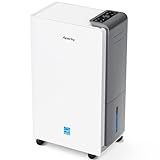
- 【ENERGY STAR 25 ≠ ENERGY STAR Most Efficient 2025】Don't fall for competitors' word games. With only 2.6% of ENERGY STAR models earning "Most Efficient 2025" title, these options are exceptionally rare on the market. RHEA-001 is one of the few to truly hold this top-tier certification. Many brands use misleading phrases like "Energy Star Efficient 25" or "Energy Star 25" to imply a standard they haven't met. Choosing them is a risk.With AEOCKY, you get verified performance and the peace of mind of authentic, top-tier efficiency.
- 【True ENERGY STAR Most Efficient 2025 Compressor Dehumidifier for homes (5500 sq.ft)】80 pint/day in the humid Mid-summer (95℉, 95%RH); 56 pint/day in the warm, damp basement (86℉, 80%RH)! Among all ENERGY STAR dehumidifiers, only an elite 2.6% earn the ENERGY STAR "Most Efficient 2025" certification. It is this top-tier capability that allows the RHEA-001 to completely outperform its competitors in both performance and energy efficiency.(Dehumidification capacity≠Water Tank Volume)
- 【Top-Rated Efficiency - Save More Energy】Breaking industry barriers, one of the first brands to achieve ENERGY STAR Most Efficient 2025. Compared to non-Energy Star inefficient products,RHEA-001 efficiency is increased by ≤50%, saving ≤1000 on electricity bills annually (running 24/7 year-round). Energy efficiency is the domain of absolute dominance for our RHEA-001. This relentless pursuit of technological innovation in efficiency is the ironclad moat that has established AEOCKY as the leading dehumidifier brand.
- 【Powered by Exceptional Core Components】AEOCKY utilizes Cutting-Edge High-Efficiency Rotor Compressor Pro+ to RHEA-001, whose core components evaporator and condenser adopt“3+2”structure with one more row than others. Never use aluminum tubes, we unswervingly use 7mm diameter high-tooth internal thread pure copper pipes.We also equipped with advanced blue hydrophilic aluminum foil, achieving breakthrough heat exchange efficiency meeting the most rigorous energy efficiency standards in history.
- 【Cutting-Edge Smart Humidity Control for Unprecedented Precision】Newly designed architecture breaks industry's decade-long lack of innovation, enabling it have high-performance chip. Millisecond-level dynamic detection keep humidity within ideal range,with full-stack proprietary humidity compensation algorithm ensuring RHEA-001 exceeds industry standard for humidity accuracy.Exclusive power-off memory function can be used with smart socket, automatically resuming function after power restoration, suitable for smart home or special area like RV.
5. Dry the house rapidly and completely
EPA’s practical target is to clean and dry the home and its contents within 24–48 hours if possible. This is a goal, not a guarantee that mold will not develop. EPA advises assuming mold growth if the flooded home, furniture, and belongings could not be dried within that period.
Use ventilation when it is safe
When there is no visible mold being disturbed, and outdoor conditions are favorable, open doors, windows, cabinets, and drawers. Cross-ventilation can remove moist air. Stop opening windows if outdoor humidity, rain, smoke, or security conditions make the building wetter or unsafe.
Use fans, dehumidifiers, and heat appropriately
With safe power available and visible mold cleaned, fans can move air across wet surfaces and dehumidifiers can remove moisture from indoor air. A dehumidifier is a drying aid, not a substitute for removing soaked drywall, insulation, carpet, or standing water. Empty its reservoir safely or connect drainage only where the electrical and wastewater arrangements are appropriate.
Crashes, No Sound, or Screen Glitches?
Random freezes, missing sound and display glitches usually trace back to one bad driver. Find and replace yours safely.Free scan · under a minutePC Slower Than It Used to Be?
A free scan shows the junk files, broken settings and background clutter dragging Windows down - then fixes them in one click.Free scan · Windows 10 & 11Heat may accelerate evaporation, but adding heat without removing the resulting moisture can raise humidity and drive damp air into cooler cavities. Use heating equipment only when it is approved for the setting, operated safely, and paired with ventilation or dehumidification. Keep combustible materials away from heaters.
Track humidity
Keep indoor relative humidity below 60%, with an ideal range of 30–50%, according to EPA guidance. Check multiple rooms, especially basements, closets, rooms with exterior walls, and areas around plumbing. Humidity in the room can fall while wall cavities, subfloors, insulation, or foundation spaces remain wet.
A consumer moisture meter may help identify changes in some building materials, but EPA guidance does not establish one universal reading that proves a flooded house is ready for reconstruction. Use qualified assessment when concealed materials, a slab, crawlspace, or foundation must be judged before replacement work.
6. Keep HVAC equipment off during cleanup
Do not restart the heating, ventilation, and air-conditioning (HVAC) system until cleanup is complete and needed repairs and remediation have been addressed. A contaminated system can distribute debris or mold particles through unaffected rooms. Have the system assessed and serviced when floodwater, mud, sewage, or mold may have reached ductwork, air handlers, insulation, or controls.
Portable fans and dehumidifiers can be used independently only when their placement, power supply, and effect on mold spread are safe. Do not use the HVAC system as a shortcut for drying a contaminated building.
Rank #4

- Compact Moisture Control – This Wi-Fi enabled dehumidifier removes up to 8 pints per day at 80°F, 60%RH (24 pints MAX at 95°F, 90%RH), keeping spaces up to 1,800 sq ft comfortably dry.
- Space-Saving & Ultra-Quiet – Designed for small spaces, this 38dB whisper-quiet dehumidifier keeps humidity under control without disruption, ideal for bedrooms, nurseries, and home offices.
- Hassle-Free Drainage – Includes a 3.3ft drain hose for continuous drainage, so you never have to empty the tank manually. Perfect for long-term use in basements, laundry rooms, and storage areas.
- Energy-Efficient & Smart Control – Energy-saving design reduces electricity costs. Wi-Fi-enabled for remote control via app or voice assistants. Set humidity levels, timer, and auto mode with ease.
- Safe & Easy to Maintain – Features auto shut-off to prevent overflow, a removable water tank, and washable filters for long-lasting performance. Portable handle for easy movement.
7. Decide what must be removed or opened
Water can remain behind baseboards, inside wall cavities, beneath flooring, under cabinets, and around foundation edges. Open or remove components only as far as necessary and safe to expose trapped moisture. Structural members, wiring, gas lines, and plumbing may be hidden behind finishes, so demolition in a damaged building can create new hazards.
Walls and flooring
Do not replace walls or flooring until the entire assembly and the spaces beneath or behind it are completely dry. A dry surface does not prove that the subfloor, insulation, slab edge, or wall cavity is dry. Where the water was contaminated or drying is slow, obtain a qualified inspection before closing the building back up.
Foundations, slabs, and crawlspaces
Foundations and slabs can retain moisture after visible water is gone. Crawlspaces may need separate ventilation, pumping, cleaning, and inspection. EPA guidance does not provide a universal moisture-meter threshold for declaring a foundation ready for new flooring. Have a qualified professional verify conditions when the decision affects reconstruction or could trap moisture permanently.
8. Know when professional restoration is the safer choice
Call qualified flood-restoration or mold-remediation professionals when any of the following applies:
- The building has structural, electrical, gas, or contaminated-water hazards.
- Standing water is extensive, deep, or still entering.
- Sewage, chemicals, fuel, or other hazardous contamination is involved.
- Mold is extensive, returns after cleaning, or may be inside the HVAC system.
- Drywall, insulation, flooring assemblies, or concealed cavities remain wet.
- The work is too physically difficult, stressful, or dangerous to perform safely.
- Anyone in the household has asthma, another serious breathing condition, or a weakened immune system.
What to ask a restoration company
Ask whether the company is licensed or otherwise qualified in your location, has experience with the type of water contamination involved, and can provide a written scope of work. The scope should identify demolition, cleaning, drying equipment, monitoring, disposal, and repairs rather than promising a generic “mold treatment.”
Ask how drying will be verified, which areas will be checked for concealed moisture, and how the company will coordinate with your insurer. Compare the proposed process and documentation, not just the number of machines or the first price quoted. Local credentials and insurance requirements vary, so verify them with the relevant authority.
9. A first-day checklist
- Wait for clearance: Confirm that authorities or qualified professionals have addressed structural, electrical, gas, and other immediate hazards.
- Protect people: Keep vulnerable household members, children, and pets away; put on gloves, an N95 respirator, sealed goggles, long clothing, and boots.
- Document and notify: Photograph damage and contact the insurer before disposal or major demolition, if safe.
- Stop more water: Install safe temporary weather protection and address active leaks.
- Make power safe: Do not touch wet electrical equipment; use a generator only outdoors at least 20 feet from buildings.
- Remove water and wet contents: Use equipment only in safe conditions, separate salvageable items, and remove materials that cannot be cleaned and dried.
- Expose hidden surfaces: Open cabinets and interior doors; remove drawers and shelves where practical.
- Clean hard surfaces: Use water and detergent, avoid chemical mixtures, and gently clean visible mold before using fans.
- Start controlled drying: When safe, ventilate and use fans or dehumidifiers; monitor humidity and aim for below 60%, ideally 30–50%.
- Leave HVAC off: Wait until cleanup, repairs, and necessary remediation are complete.
10. Common mistakes that increase mold risk
- Entering too soon: Drying is not worth an electrical shock, collapse, carbon-monoxide exposure, or contact with contaminated water.
- Running fans at visible mold: Airflow can distribute mold particles. Clean gently first or obtain professional help.
- Closing walls too early: A painted or apparently dry surface can conceal wet insulation, framing, or subfloor.
- Relying on room humidity alone: Indoor air can reach a target while cavities and foundations remain damp.
- Turning on HVAC immediately: The system can spread debris or mold particles through the building.
- Mixing cleaners: Bleach and other chemicals can create hazardous fumes when combined.
- Assuming every material is salvageable: Contamination, porosity, time underwater, and construction determine whether cleaning and drying are realistic.
- Using a generator indoors or near openings: Carbon monoxide can accumulate inside even when the generator is outside a door or window.
How long will a flooded home take to dry?
There is no reliable universal duration. The time depends on the amount and source of water, weather, building materials, ventilation, equipment, power, and whether hidden cavities were opened. The important benchmark is EPA’s 24–48-hour goal for cleaning and drying. If the home could not meet that target, proceed on the assumption that mold may be present and investigate concealed dampness rather than waiting for an odor or visible growth.
Quick wins for a faster PC:
Scan for outdated or missing drivers - takes under a minuteDriver Scan →Clear out junk files and repair common Windows errorsFree Scan →Fix the driver behind crashes, sound loss and screen glitchesFind Drivers →How can you tell whether the house is ready for repairs?
Do not use a single room-humidity reading, a dry-feeling floor, or a consumer meter result as proof that reconstruction can begin. Before replacing walls or flooring, confirm that visible and concealed areas are dry, contaminated materials have been removed or properly cleaned, and needed electrical, structural, HVAC, and plumbing repairs are complete. Where the foundation, slab, crawlspace, or wall cavities are uncertain, use qualified local assessment and retain the drying documentation for the insurer and contractor.
Quick Recap
Product prices and availability are accurate as of the date/time indicated and are subject to change. Any price and availability information displayed on Amazon at the time of purchase will apply.

