Outdated Drivers Are Slowing You Down
One free scan finds every outdated or missing driver and matches the right update for your exact hardware.Free scan · exact hardware matchWindows Errors? Fix Them Before They Spread
Repair common Windows errors and clear accumulated junk for a smoother, more stable PC - no reinstall needed.Free scan · no reinstallRainwater can be used for concrete curing, but not automatically. Collect it from a controlled, clean catchment; reject the dirtiest first runoff; store it in a covered, opaque, clearly labeled nonpotable tank; filter it; and qualify the water against the project specification before it reaches fresh concrete. Visually clear water can still contain chlorides, sulfates, alkalis, dissolved solids or other impurities that affect concrete.
The system must also deliver water at a suitable temperature and keep the concrete surface continuously moist without erosion, washout, staining or thermal shock. The engineer of record and the local authority having jurisdiction should approve the source, tests, plumbing arrangements and curing method before installation.
As an Amazon Associate I earn from qualifying purchases.
Can rainwater be used to cure concrete?
Often, yes—provided the water and the collection system meet the project’s requirements. Curing water is placed on or against hardened or newly finished concrete to maintain moisture and temperature so cement hydration and related reactions can continue. It is not enough for the water to look clean or to have fallen recently.
Do these 3 things before closing this tab:
1Clear out junk files and repair common Windows errors2Scan for outdated or missing drivers - takes under a minute3Repair Windows errors before they cause bigger problemsThe American Concrete Institute states: “Any water that is potable (drinkable) is acceptable as mixing water. Some water that is not potable may also be suitable for concrete.” ACI also warns that impurities can change setting time, strength, appearance and resistance to degradation. Salt water must not be used as mixing water in steel-reinforced concrete. Those principles make a rainwater assessment essential for reinforced-concrete curing, especially where runoff could carry salts, metals, oils, organic matter or construction residues.
#1 Best Overall

- 50-Gallon Capacity: Provides ample storage for harvested rainwater, ideal for watering gardens, lawns, and plants.
- Durable Construction: Made from UV-resistant polyethylene for long-lasting durability and protection from the elements. Made of 100% Recycled plastic.
- Overflow Valve: Built-in overflow valve for managing excess water and the option to connect multiple barrels for increased storage.
- Convenient Spigot: Easy-to-use plastic spigot for quick and efficient water retrieval.
- Low Maintenance: Easy to install and maintain, offering a simple, sustainable solution for homeowners.
ASTM C1602/C1602M addresses compositional and performance requirements for concrete mixing water. It permits potable and nonpotable sources when they are qualified and tested, with optional limits for chloride, sulfate, alkalis and total solids. A project may apply those criteria to curing water or specify another acceptance route. The Federal Highway Administration says curing water should be potable or meet ASTM C94 requirements. Follow the contract documents when they are more restrictive.
What the main standards do—and do not—cover
| Reference | Practical relevance | Important limitation |
|---|---|---|
| ASTM C1602/C1602M | Composition and performance qualification for concrete mixing water, including optional chemical limits and concrete strength and set comparisons. | It is not a complete rainwater-catchment or tank-design standard; the project must define how its criteria apply to curing. |
| ASTM E2727-24 | Assessment practice for rainwater quality, including catchment and site conditions that can change quality. | It assesses intended-use quality; it does not prescribe a particular tank, pump or treatment layout. |
| 2021 International Plumbing Code | Addresses nonpotable rainwater storage and requires treatment where the intended use needs it. Tank inlets should minimize turbulence and avoid agitating stored contents. | Local adoption and amendments control what must be permitted on a specific site. |
| ACI curing guidance | Defines curing as maintaining moisture and temperature; identifies ponding, sprinkling, wet coverings, plastic sheeting and membrane-forming compounds. | Project specifications can restrict or replace water curing, particularly for mass concrete. |
| FHWA guidance (2005) | Curing water should be no more than 10 °C cooler than the concrete surface and should be potable or meet ASTM C94 requirements. | A contract or owner may impose a stricter temperature differential. |
Start with approval, not hardware
Before buying a rainwater storage tank, obtain a written direction from the engineer of record and ask the authority having jurisdiction which rules apply. Confirm all of the following:
- Whether collected rainwater is allowed for the specified concrete and curing method.
- Which chemical tests, concrete performance tests and sampling frequency are required.
- Whether a nonpotable plumbing permit, backflow protection, stormwater approval or environmental permit is needed.
- Whether the project prohibits water curing for mass concrete, architectural concrete or a particular finish.
- What backup water source is required if the tank is empty, contaminated or rejected.
Keep the approval, water-quality results, tank identification and curing records with the concrete quality documentation. A temporary site installation still needs a clear owner, inspection schedule and shutdown procedure.
Choose a catchment that will not contaminate the water
Use the cleanest practical roof or temporary canopy. Record the roof or canopy material, age, coatings, drainage path and nearby activities as part of the rainwater assessment. A catchment exposed to fuel, oils, solvents, pesticides, treated timber leachate, bird concentrations or uncontrolled construction dust is a poor source even if the tank water later appears clear.
Preferred surfaces
- A clean, intact roof or temporary canopy dedicated to the collection system.
- Drainage runs that do not pass through vehicle-maintenance, refueling or chemical-storage areas.
- Surfaces that can be inspected and cleaned without introducing workers to fall or traffic hazards.
Surfaces and conditions to exclude
- Roofs or tarpaulins contaminated by fuel, hydraulic oil, release agents, solvents or paint.
- Areas receiving runoff from treated timber, waste storage, concrete batching or aggregate stockpiles.
- Catchments with heavy bird fouling or dust that cannot be removed before collection.
- Any surface whose coating or material is unknown and cannot be evaluated by the project team.
Isolate suspect downpipes rather than hoping a later filter will remove every contaminant. Document the reason for the selected catchment and re-evaluate it when site activities, roofing materials or nearby storage change.
Install leaf screening and a first-flush diversion
Rainwater quality is usually worst at the beginning of a storm because the first runoff carries accumulated dust, bird waste, roof debris and residues. Fit a coarse leaf and debris screen at the inlet, followed by a first-flush diversion device that sends the initial dirty volume away from the storage tank.
First-flush arrangement
- Capture runoff from the selected roof or canopy in a screened gutter or header.
- Route the initial runoff to a diversion chamber or standpipe rather than the tank.
- Provide a drain or controlled discharge for the diverted water so it cannot flow toward foundations, material stores or pedestrian routes.
- Allow the diverter to reset after the dirty volume has been discharged and make its internals accessible for cleaning.
- Inspect the screen and diverter after dusty work, storms and long periods without rain.
The project team must determine the diverted volume from the catchment and the site’s contamination risk; do not assume that a generic diverter setting is adequate. Screens and first-flush devices are pretreatment, not proof that the stored water meets a concrete-water specification.
The Tool Desk
Outbyte Driver Updater FREEScan for outdated or missing drivers - takes under a minuteDriver Scan →Outbyte PC Repair FREEClear out junk files and repair common Windows errorsFree Scan →Specify the storage tank for construction conditions
Use an opaque, UV-resistant, covered tank on a stable base protected from vehicles, lifting operations and falling materials. The tank should be sized for the planned curing demand and expected rainfall, with usable volume separated from the freeboard needed for overflow control. The design should also allow cleaning and inspection without entering the tank.
Rank #2
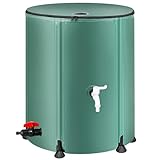
- 【Leak-Proof Design】Unlike typical rain barrels, our product features an integrated design with a straightforward screw-in faucet, eliminating the hassle of assembling multiple parts. This thoughtful construction guarantees a leak-proof system and simple installation
- 【Durable and Sturdy】Our collapsible rainwater collection system is made from premium three-layer PVC material, providing exceptional strength to endure even the toughest conditions. To enhance stability, the rain barrel includes circular footpads, effectively preventing any wobbling or tipping
- 【Easy to Store and Transport】 In contrast to bulky traditional wooden barrels, our rain barrel is foldable, making it easy to carry and store. Say goodbye to heavy, cumbersome containers and embrace convenience. Order our collapsible rain barrel today for effortless water conservation!
- 【Filtering Design】The top of our water storage container is equipped with a mesh design that prevents overflow and keeps leaves and debris out of your clean water. Rainwater collected through the faucet or overflow kit is clearer and can be reused for gardening, farm irrigation, car washing, and more—ideal for eco-conscious individuals
- 【Simple Installation and Exceptional Service】If you encounter any missing or damaged parts during installation, please contact us. We are dedicated to providing prompt replacements to ensure a worry-free experience for our customers
| Tank feature | Why it matters on a job site |
|---|---|
| Opaque, UV-resistant shell | Limits algae growth and reduces sunlight-driven deterioration. |
| Covered, lockable access opening | Excludes debris and unauthorized access while permitting inspection and sludge removal. |
| Screened vent | Allows air exchange without admitting insects or large debris. |
| Low-turbulence inlet | Reduces agitation of settled solids and follows the 2021 International Plumbing Code approach for nonpotable tanks. |
| Overflow routed away from work areas | Prevents flooding, erosion, slippery surfaces and undermining near foundations. |
| Bottom drain or scour outlet | Permits controlled removal of sediment and cleaning water. |
| Level indication | Shows whether sufficient water remains for the next curing shift and exposes unexpected losses. |
| Protected, stable foundation and anchorage | Resists settlement, overturning and impact as the tank fills or empties. |
| Visible NONPOTABLE—DO NOT DRINK labels | Prevents accidental use for drinking, hand washing or connection to potable fixtures. |
Keep every outlet, hose and spray manifold labeled, not just the tank. Physically prevent cross-connections with potable water; do not rely on a tag alone. If a potable backup line is connected, use the backflow protection and air-gap arrangement required by the authority having jurisdiction.
Control sediment, algae and biological growth
Allow heavy particles to settle before the pump intake where the layout permits, then pump through a maintainable sediment or cartridge filter. Select the filter for the pump’s flow, pressure and the smallest passage in the sprinklers or nozzles. A filter that protects a pump but clogs the spray pattern is not an adequate curing system.
Filter and tank practices
- Install isolation valves and a pressure or flow indication so a blocked element can be identified without dismantling the system.
- Keep spare elements on site and record each cleaning or replacement.
- Keep the tank shaded and inspect for sludge, odor, algae, insects, floating contamination and unusual color.
- Remove settled material through the drain before it is stirred into the supply.
- Clean or disinfect only with products approved for the intended nonpotable use and permitted by the authority.
- Never add a treatment chemical that could leave a residue affecting concrete without written project approval and verification.
Filtration removes particles; it does not automatically remove dissolved salts or guarantee acceptable pH, conductivity, chloride, sulfate, alkali or total-solids levels. Those questions require testing.
Free tools Windows power users keep installed
One-click scans. No signup required.
Test and qualify the water before it touches concrete
Establish a sampling plan for both incoming rainwater and stored water. Sample after the first-flush system has operated, after unusual contamination events and at the frequency required by the contract. Identify the tank, catchment, weather event and sample date so a rejected batch can be traced.
Field screening
A field check can include pH, conductivity or total dissolved solids, turbidity, odor and visible contamination. These checks are useful for detecting a sudden change, but they do not replace laboratory or concrete-performance testing where the specification requires it.
Laboratory and performance testing
Obtain the tests named by the project specification. Depending on the concrete and standard being used, this may include chloride, sulfate, alkali and total-solids analysis, plus concrete strength and setting-time comparisons required under the accepted qualification procedure. Ask the testing laboratory to report the method, detection limit, sample identity and pass/fail basis.
| Check | What a result can tell the site team | Action if it changes unexpectedly |
|---|---|---|
| pH | Signals a chemical change that may affect concrete or indicate contamination. | Hold the water, investigate the catchment and obtain the specified laboratory assessment. |
| Conductivity or total dissolved solids | Indicates a rise in dissolved ionic material, often after contaminated runoff or tank concentration. | Compare with the project limit and previous results; do not release the batch on appearance alone. |
| Turbidity and visible solids | Shows suspended material that can clog nozzles or stain concrete. | Stop delivery, settle or filter as approved, clean the tank and resample. |
| Chloride, sulfate, alkali and other specified chemistry | Addresses chemical limits selected by ASTM C1602/C1602M or the contract. | Quarantine water until the engineer or testing authority disposes of the result. |
| Concrete strength and set comparison | Demonstrates performance where the qualification procedure calls for it. | Use only after the required acceptance criteria are documented. |
Record the date, tank, catchment, recent weather, field readings, laboratory results, sampler, disposition and any corrective action. A tank with no current accepted result should be treated as unqualified, not presumed acceptable because an earlier sample passed.
Quick wins for a faster PC:
Fix the driver behind crashes, sound loss and screen glitchesFind Drivers →Clear out junk files and repair common Windows errorsFree Scan →Scan for outdated or missing drivers - takes under a minuteDriver Scan →Deliver the water without damaging the concrete
Choose the delivery method for the placement, finish and access conditions. Start only after finishing is complete and the concrete specification permits curing. The aim is continuous moisture control—not a high-pressure wash.
Rank #3

- RELIABLE LONG-LASTING VERTICAL WATER STORAGE: The Elkhart Plastics 1500 Gallon Water Container is designed for a wide range of applications; Vertical tanks are versatile for bulk water, well water storage, rainwater collection, and fire suppression
- EASY TO USE: 2 16" Manway lids on the water tank give flexibility for top-down plumbing, filtrated catchment, and access; 1.5" fitting at highest point for optimized fill, 2" fittings at lowest point for maximum drainage; Air bleeds allow for max fill
- SAFE FOR DRINKING WATER: UV-resistant HDPE protects against the sun; Dark-colored tank will obstruct light from entering for pure, safe drinking water; Made from virgin polyethylene and compliant with FDA and NSF/ANSI 61 standards
- DURABLE WATER COLLECTION: Banded body and reinforced top make this tough water barrel sturdy and ready for a long service life; Built-in gallon indicators provide easy fill level identification; Rotomolded build is resistant to rust, chips, and cracks
- DELIVERY AND INSTALL: Tank is delivered via freight and may not fit in garage or through small gates; Recommended to sit on reinforced concrete block or pad for stability; Diameter: 72", Height: 94"
| Method | Useful when | Controls required |
|---|---|---|
| Continuous sprinkling | Large exposed slabs or areas where uniform spray coverage is practical. | Use clean, maintained nozzles; verify overlap and prevent erosion, washout and atomized overspray onto adjacent work. |
| Ponding | Flat, bounded surfaces that can retain a shallow, stable layer of water. | Confirm the surface and edges can withstand the water; prevent leakage, settlement and unsafe walking conditions. |
| Wet burlap or cotton mats | Irregular shapes, vertical surfaces or areas where sprinklers cannot cover evenly. | Keep the coverings continuously wet and prevent them from drying or staining the concrete. |
| Plastic sheeting | Where a sealed moisture barrier is permitted and can remain in close contact. | Seal laps and edges, prevent wind lifting, and avoid trapped water patterns or discoloration. |
| Membrane-forming curing compound | Where the specification approves a non-water curing method or water is unsuitable. | Use only the specified product and application rate; confirm compatibility with later finishes, coatings or joints. |
Lay out pumps, hoses and manifolds so workers do not drag equipment across fresh concrete. Use a low-pressure, uniform flow and inspect the surface for dry spots, erosion, washout, staining and unintended standing water. Keep a backup supply or an approved alternate curing method available for pump failure or an empty tank.
Independent reader supportYour contribution helps us test, update, and keep practical guides available for everyone.Control curing-water temperature
The FHWA guidance from 2005 cites a maximum difference of 10 °C between curing water and the concrete surface, with the water no more than 10 °C cooler. Measure both temperatures before starting and during curing when conditions change. Follow a stricter project limit if one is specified.
ACI identifies internal relative humidity above 80% and temperatures above 10 °C (50 °F) as favorable for hydration-related strength development. Low water-cement-ratio mixtures can need added water because their internal moisture is consumed quickly. These points do not authorize uncontrolled flooding: the approved curing plan still governs timing, duration and method.
Mass concrete requires extra caution
In mass concrete, cold curing water can cool the surface faster than the interior and create a thermal gradient that contributes to cracking. ACI warns of this risk, and project specifications may prohibit water curing in favor of sheets or curing compounds. Check the thermal-control plan before connecting a tank to mass-concrete work; warming water or changing the curing method may be necessary.
Step-by-step installation and commissioning workflow
- Confirm the governing documents. Obtain engineer and authority approval, identify required tests, permits, backflow protection and restrictions on water curing.
- Map the catchment. Record roof or canopy material, drainage routes, nearby contamination sources and the area that will feed the tank.
- Install isolation and diversion. Fit a leaf screen, first-flush device, drain and accessible cleanout before the storage inlet.
- Set the tank safely. Prepare the stable base, anchor the tank, provide freeboard, screened vent, lockable cover, overflow, drain, level indication and low-turbulence inlet.
- Label and segregate. Mark the tank, outlets, hoses and manifolds NONPOTABLE—DO NOT DRINK and verify that no potable cross-connection exists.
- Add sediment control and filtration. Provide settling where practical, then install a serviceable filter compatible with the pump and curing nozzles.
- Commission without concrete. Flush the collection lines, inspect for leaks, verify overflow discharge, test the pump and confirm uniform spray or delivery at the farthest outlet.
- Sample and qualify. Take incoming and stored-water samples, complete field screening and obtain the specified laboratory or performance results. Hold the system until accepted.
- Begin curing under inspection. Measure water and concrete-surface temperatures, start only at the permitted time, and document coverage, tank level, nozzle condition and corrective actions each shift or at the contract frequency.
Inspection and maintenance checklist
Assign one person to sign the inspection record. At the required frequency, verify:
- Catchment is free of new fuel, oil, chemical, waste or heavy bird contamination.
- Leaf screens and first-flush devices are clear and reset.
- Tank cover, vent screen, lock, labels and access points are intact.
- Water level, odor, color, floating material, algae and sludge are acceptable.
- Overflow and drain routes are open and not eroding the site.
- Filter pressure, element condition, pump operation and hose connections are normal.
- Spray pattern or wet-covering coverage has no dry spots or damaging jets.
- Curing-water and concrete-surface temperatures meet the approved differential.
- Any rejected water is isolated, tagged and prevented from reaching concrete.
Clean the tank and filter on a planned schedule and after a contamination event. Dispose of sludge and cleaning water under the site environmental plan; do not send it into a storm drain or onto unprotected ground without approval.
Common failures and corrective actions
| Symptom | Likely cause | Corrective action |
|---|---|---|
| Water is cloudy or nozzles clog | First flush was bypassed, sediment was stirred up or filtration is undersized. | Stop curing delivery, inspect the inlet and tank, settle or remove solids, service the filter and resample before release. |
| Algae, odor or insects appear | Light enters the tank, the cover or vent is compromised, or stored water is stagnant. | Shade or replace the tank, repair screening, remove contamination and clean or disinfect only with approved products. |
| Conductivity or dissolved solids rise | Contaminated runoff entered the tank or evaporation concentrated dissolved material. | Quarantine the water, identify the source, test against the project limit and obtain an engineer’s disposition. |
| Concrete surface dries in patches | Blocked nozzles, inadequate flow, wind, poor overlap or coverings that are not kept wet. | Restore uniform delivery, clean nozzles, adjust the manifold or coverings and document the interruption. |
| Surface erosion, washout or staining occurs | Pressure is too high, curing began before finishing was complete, or dirty water is being used. | Stop the offending flow, protect the surface, correct timing or pressure and investigate water quality. |
| Cracking or thermal distress is suspected | Curing water is too cold relative to the concrete or water curing conflicts with the mass-concrete thermal plan. | Measure both temperatures, notify the engineer, and switch to the approved thermal-control method. |
| Tank empties during a curing shift | Demand exceeded usable volume, rainfall was insufficient or a leak/overflow was missed. | Use the approved backup supply or alternate curing method immediately; repair the system and revise the water-balance plan. |
Keep concrete wash water out of the curing system
Rainwater intended for curing must be physically separated from truck-wash and equipment-wash water. Concrete-contaminated wastewater is a different, regulated stream and can carry high-pH solids that invalidate the tank and create environmental hazards.
In England, Environment Agency Regulatory Position Statement RPS 287 (2024) requires secure containment, 10% freeboard, treatment by filtration, settlement or dewatering, pH monitoring and no more than 30 m³ of concrete-containing water at one location. Other jurisdictions impose different controls, so use the local environmental requirements rather than importing the English limits to another site.
Equipment list for a basic compliant system
- Clean roof or temporary canopy catchment with screened gutters.
- Leaf/debris screen and accessible first-flush diverter.
- Opaque, UV-resistant, covered nonpotable rainwater storage tank with stable base and anchorage.
- Screened vent, lockable access cover, level indicator, low-turbulence inlet, overflow and drain.
- Nonpotable transfer pump, isolation valves, hoses, manifold and curing sprinklers or wet-covering equipment.
- Serviceable sediment or cartridge filter sized for the pump and nozzles, with spare elements.
- Temperature thermometer or data logger for water and concrete surface.
- Field water-quality test kit for the project’s screening parameters.
- NONPOTABLE—DO NOT DRINK labels, tags and barriers to prevent cross-connections.
- Sampling containers, inspection forms and a secure place for test records.
Equipment selection does not replace engineer approval, ASTM or contract testing, local permitting, backflow protection or environmental controls. The simplest acceptable system is the one that can be inspected, cleaned, tested and operated consistently throughout the pour and curing period.
Quick Recap
Release checklist before the first pour
- The catchment and contamination assessment are documented and approved.
- First-flush diversion, screens, tank, overflow and drain have been tested.
- Tank and every outlet are labeled nonpotable, with no potable cross-connection.
- Filter, pump and delivery pattern have been commissioned under operating flow.
- Required water chemistry and concrete-performance results are accepted.
- Concrete and curing-water temperatures can be measured and recorded.
- The curing method, inspection frequency, backup supply and shutdown contacts are written into the pour plan.
- Concrete wash-water containment is separate and compliant with local environmental rules.
Product prices and availability are accurate as of the date/time indicated and are subject to change. Any price and availability information displayed on Amazon at the time of purchase will apply.

