Quick wins for a faster PC:
Clear out junk files and repair common Windows errorsFree Scan →Scan for outdated or missing drivers - takes under a minuteDriver Scan →The safest default is simple: let the pan cool, remove excess grease, wash it with warm water and mild dish soap, and use a soft sponge or nylon brush. Soak or briefly simmer water for stuck-on food, use baking soda for burnt residue, and wipe rainbow heat tint or mineral spots with white vinegar. For baked-on oil, use a dedicated non-chlorine stainless-steel cookware cleanser exactly as its label directs. Rinse thoroughly and towel-dry the pan immediately.
Before using any method, confirm that the cooking surface is actually uncoated stainless steel. A stainless exterior with a nonstick, ceramic, anodized, painted, or decorative interior requires different care.
As an Amazon Associate I earn from qualifying purchases.
First, identify what the pan is made of
Cleaning advice for an uncoated stainless-steel interior does not automatically apply to every pan described as “stainless steel.” Check the manufacturer’s care instructions, especially if the pan is older, unbranded, clad with several metals, or has a coated interior.
- Uncoated stainless-steel interior: The cleaning methods in this guide generally apply.
- Nonstick, ceramic, or hard-anodized interior: Use mild dish soap and a soft sponge only unless the manufacturer specifically approves another product. Do not use abrasive powders, steel wool, or aggressive scrubbing.
- Exposed aluminum or an aluminum-bottom pan: Avoid products whose labels prohibit aluminum. In particular, do not use caustic oven cleaner unless both the pan manufacturer and the exact product label permit it.
- Copper-bottom or decorative cookware: Follow the care instructions for each exposed material. A mirror-polished or specialty finish may require softer tools and cleaning in a particular direction.
- Lids and handles: Glass, silicone, painted, bonded, or hollow components may have different dishwasher and thermal-shock limits from the steel cooking surface.
For example, All-Clad separates its stainless and nonstick care instructions, and notes that care can vary by material and collection. When the construction is unknown, use the least aggressive method: warm soapy water, soaking, and a soft sponge.
#1 Best Overall

- Bar Keepers Friend Cookware Cleanser & Polish is a stainless steel cleaner and degreaser for pots, pans, and bakeware; This product's powerful grease remover cuts through oil, baked on food, mineral deposits, and rust stains; Safe for use on all stainless steel cookware, including All-Clad stainless steel pots and pans, and glass lids; This versatile cleaner is also safe to use for cleaning stainless steel sinks, porcelain sinks, steel grills, and other surfaces
- Remove stains, tarnish, rust & lime
- BKF products clean without bleach- better for stainless steel
- Clean cookware, kitchen & bathroom surfaces
The everyday cleaning method
Clean the pan after it has cooled enough to handle, preferably while food residue is still fresh. Do not put a blazing-hot pan under cold running water or into cold soaking water. A sudden temperature change can warp cookware; manufacturer care guidance warns against this thermal shock.
- Remove excess grease. Pour off or wipe away a thick layer of oil and fat before adding water. A paper towel can remove grease, but let the pan cool enough that it will not scorch the towel or burn you.
- Add warm water and mild dish soap. A small amount of ordinary dishwashing liquid is sufficient for normal residue.
- Wash with a soft sponge, microfiber cloth, or nylon brush. Use a nylon scouring pad only if the cookware manufacturer permits it.
- Rinse thoroughly. Soap residue can leave streaks, dullness, or a film.
- Towel-dry immediately. Drying prevents water spots and reduces mineral deposits, particularly in hard-water areas. Worldstainless recommends soft tools and wiping stainless steel dry, and Cuisinart also advises drying cookware after washing.
If the pan contains useful browned bits, or fond, do not mistake them for damage. Add a little liquid while the pan is warm but safe to handle, loosen the fond with a wooden or silicone utensil, and use it to make a sauce. Once the cooking is finished, wash away any remaining residue normally.
Removing stuck-on food: soak first, then simmer
Ordinary stuck food usually needs heat and time, not a harsh chemical. Start with a soak or a short simmer.
Option 1: soak for about 15 minutes
- Fill the pan with hot water until the stuck area is covered.
- Add a small amount of dish soap.
- Let it stand for approximately 15 minutes.
- Loosen the softened food with a soft sponge, nylon pad, wooden spatula, or silicone utensil.
- Wash, rinse, and dry the pan.
This approach follows Euro Inox’s stainless-steel cleaning guidance.
Option 2: simmer a shallow layer of water
- Add about ½ inch of water, or enough to cover the residue.
- Add a small amount of dish soap if desired.
- Bring the water to a simmer for roughly two to three minutes.
- Turn off the heat and loosen the food with a wooden or silicone spatula. Keep your hands and face away from the hot water and steam.
- Pour out the water, then wash, rinse, and dry the pan.
This shallow-water, two-to-three-minute method is recommended by Tramontina. Comparative testing from America’s Test Kitchen also found that boiling plain water for about three minutes can release ordinary stuck-on food without requiring vinegar or baking soda.
If the residue remains, repeat the soak or simmer once before escalating. Do not gouge at the pan with a knife or metal edge.
Burnt food, black residue, and baked-on grease
“Burnt” residue is not always one problem. A loose layer of rice, pasta, or starch can often be released with water. A hard black carbonized deposit may need repeated treatments. A smooth, sticky brown or amber film is often polymerized oil or cooking-spray residue and may require a dedicated cookware cleanser rather than more dish soap.
What’s actually slowing this PC down?
Pick the symptom - the matching free tool is one click away.
For burnt food: use baking soda
- Sprinkle baking soda over the affected area.
- Add enough water to make a slurry, or add water and approximately a tablespoon of baking soda to the pan.
- Bring the mixture to a boil or simmer.
- Let it work briefly, then loosen the residue with a wooden utensil.
- Wash with dish soap, rinse very thoroughly, and dry.
All-Clad recommends boiling water with baking soda for burnt food, while Tramontina recommends adding about a tablespoon of baking soda to simmering water for particularly stubborn residue. You can also make a baking-soda-and-water paste, apply it to the mark, allow it to work, and scrub gently with a non-abrasive sponge.
Repeat the treatment rather than immediately using a harsher chemical or applying enough force to scratch the surface.
Rank #2
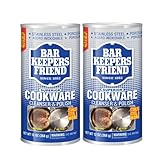
- Remove Stains & Tarnish: Bar Keepers Friend Cookware Cleanser & Polish is a kitchen stainless steel cleaner and degreaser for pots, pans and bakeware. This stain remover and glass cleaner cuts through heavy oil, hard baked-on food and rust stains
- Restores Shine: This cleaner & polish will leave your aluminum or stainless steel pans with a streak-free shine. With BKF cookware cleaner, you can easily remove burnt food and oily residue, all without scratching your cookware, utensils, sink or grill
- Safe On All Surfaces: Bar Keepers Friend multipurpose cleaning powder contains no harsh chemicals. It can be used as a stainless steel polish, oven cleaner, rust remover & sink cleaner. Our kitchen cleaning supplies are gentle and won't damage cookware
- Once Tried, Always Used: Bar Keepers Friend Cookware Cleanser & Polish is a gentle and highly effective metal and stainless steel cleaner. Once you've used Bar Keepers Friend for your kitchen tools, cookware & bakeware, you'll never look back
- America's Trusted Cleaning Products Since 1882: Trusted by homeowners and professionals for over 100 years, we are proud to offer a wide range of home cleaning supplies that are tough on stains and gentle on surfaces to help keep your home looking pristine
For baked-on grease: use a dedicated stainless cookware cleanser
When the pan is clean but still has a brown, sticky, or baked-on oil film, a purpose-made stainless-steel cookware cleaner is usually more appropriate than a thick layer of soap. Choose a non-chlorine product and follow its label.
For the specific Bar Keepers Friend Cookware Cleanser & Polish product, the current directions are:
Do these 3 things before closing this tab:
1Repair Windows errors before they cause bigger problems2Scan for outdated or missing drivers - takes under a minute3Clear out junk files and repair common Windows errors- Wet the pan.
- Sprinkle on a small amount of cleanser.
- Rub gently with a wet cloth or sponge.
- Rinse thoroughly within one minute.
- For a difficult stain, make a paste and leave it for no longer than one minute.
- Wipe the pan dry.
The product lists a glass-oxide abrasive, oxalic acid, and surfactant. Reapply if necessary instead of leaving it on longer or scrubbing harder. Different products in the Bar Keepers Friend range may have different directions, so do not transfer the one-minute instruction to another formula without checking its label. The manufacturer also says to rinse food-contact surfaces thoroughly and never mix its products with bleach, ammonia, or other cleaners.
Removing rainbow, blue, purple, or gold discoloration
Rainbow, blue, purple, and gold coloration is usually heat tint: a thin oxide layer created by heating the stainless steel. On an otherwise intact, uncoated pan, it is generally cosmetic and does not mean the cookware is unusable.
- Wash the pan normally to remove grease and food residue.
- Dampen a soft cloth or sponge with white vinegar.
- Wipe the discolored area gently.
- Rinse away the vinegar and any loosened residue.
- Dry the pan immediately.
All-Clad recommends wiping blue or rainbow discoloration with white vinegar. Tramontina likewise describes the discoloration as harmless heat tint and suggests vinegar for light marks. If the color persists, use a dedicated stainless cookware cleanser according to its label.
Do not confuse a smooth change in color with pitting, deep corrosion, a sharp gouge, or damage to a coating. Those are different conditions.
Free tools Windows power users keep installed
One-click scans. No signup required.
Removing white, cloudy, chalky, or dull spots
Cloudy white marks and chalky spots are commonly hard-water minerals or limescale left behind after washing. They are deposits on the surface, not necessarily damage to the steel.
Start with a diluted white-vinegar solution:
- Wipe a light mark with vinegar or a diluted vinegar solution on a soft cloth.
- For a more stubborn deposit, allow the solution brief contact, then wipe it away.
- Wash the pan normally, rinse thoroughly, and towel-dry.
Manufacturer recommendations vary. All-Clad specifically recommends boiling a 1:1 solution of white vinegar and water for cloudy hard-water spots. Euro Inox gives 25% vinegar as a limescale treatment, followed by cleaning, rinsing, and drying.
These are not universal requirements for every cookware construction. Begin with the milder dilution and shortest contact time permitted by the manufacturer, especially if the pan has exposed aluminum, decorative metal, or an unusual finish. Do not leave vinegar sitting in the pan for hours.
Tools and cleaners: what is safe?
Preferred tools
- Soft sponge.
- Microfiber cloth.
- Nylon brush.
- Nylon scouring pad, when permitted by the manufacturer.
- Wooden or silicone spatula for loosening food.
- The sponge recommended for the specific cookware cleanser.
Tools to use only with qualification
A stainless-steel scouring pad may remove heavy discoloration from some bare stainless cookware, but it can leave scratches. If a manufacturer permits one, it should be a stainless-steel pad—not ordinary carbon-steel wool—and it should be used gently. Because manufacturer guidance differs, a nylon pad is the safer default.
The Tool Desk
Outbyte PC Repair FREERepair Windows errors before they cause bigger problemsFix Now →Outbyte Driver Updater FREEScan for outdated or missing drivers - takes under a minuteDriver Scan →Rank #3

- 12 oz (340g) Powder Cleaner for Stainless Clad Pots and Pans
- Makes Clean-Up Easy - The Made In non-toxic Stainless Steel Cookware Cleaner instantly removes even the most stubborn burnt-on food
- Looks Brand New - Effectively cleans Made In Stainless Clad Cookware to remove stains and restore shine
- Industrial-Grade Cleaning - Tough enough for the most stubborn messes, returning your cookware to its shining glory with just a sprinkle and splash of water
- Multi-Purpose Use - Suitable for the Stainless Clad bottom of our Non-Stick Cookware, but not for cleaning the cooking surface
What to avoid
- Ordinary steel wool or carbon-steel scouring pads: They can scratch stainless steel and leave iron particles that create orange or reddish transfer marks. Worldstainless warns about this contamination, and All-Clad specifically says not to use steel wool or steel scouring pads.
- Chlorine bleach and hypochlorite products: Chlorides can stain and pit stainless steel. Do not use them as routine pan cleaners.
- Harsh abrasive powders: Avoid them on coated, polished, painted, anodized, or decorative surfaces. Even on bare stainless steel, use the least abrasive method that works.
- Routine oven cleaner: It is caustic and product labels vary. Do not use it unless the pan manufacturer and exact label both permit it.
- Mixed cleaners: Never mix cleaners. In particular, do not combine Bar Keepers Friend with bleach or ammonia, and never combine vinegar with bleach. Rinse the pan completely before changing products.
- Cold water on a very hot pan: Rapid cooling can warp cookware.
Why oven cleaner is usually the wrong recommendation
Oven cleaner should not be part of the standard stainless-pan cleaning procedure. Some coverage treats it as a last resort for the stainless exterior of a severely blackened pan, but manufacturer instructions conflict. All-Clad says not to use oven cleaners on its cookware. Meanwhile, the Easy-Off Heavy Duty label permits use on stainless steel but prohibits aluminum and identifies the product as corrosive and containing sodium hydroxide.
The safe general rule is to avoid oven cleaner unless the pan manufacturer and the exact product label both approve it. Never use it on nonstick, ceramic, aluminum, painted, anodized, plated, or unknown surfaces. If a manufacturer-approved last resort is ever used, follow the label’s ventilation, protective-equipment, contact-time, and rinsing instructions exactly.
Can stainless-steel pans go in the dishwasher?
The answer is model-specific, not a universal yes or no.
- Many stainless-steel pans are labeled dishwasher-safe.
- Several manufacturers still recommend handwashing to preserve shine and finish.
- Dishwasher detergent is stronger than ordinary dish soap and repeated cycles can dull stainless steel, increase spotting, or stress handles and other components.
- Rinse or briefly soak food residue before loading the pan.
- If the pan is not clearly labeled dishwasher-safe, handwash it.
- Do not infer dishwasher safety from the stainless cooking surface alone; the handle, rim, coating, lid, and bonded construction may have different limits.
Cuisinart says to verify dishwasher status by model. Calphalon says stainless cookware is typically dishwasher-safe but recommends handwashing to preserve luster, and Zwilling similarly recommends handwashing despite dishwasher compatibility for its stainless cookware.
Handwashing is the conservative choice for preserving the finish, especially for pans with an unsealed or exposed rim. It does not mean that one dishwasher cycle will necessarily damage every pan; construction and the manufacturer’s instructions matter.
How to prevent food from sticking
Uncoated stainless steel is not nonstick. Food commonly sticks when the pan is not adequately preheated, the food is wet, there is too little oil, the pan is overcrowded, or the cook tries to move the food before it has browned and released.
- Preheat over medium heat. A few water droplets should bead and glide rather than immediately evaporate. This is a practical heat check, not a reason to heat the pan until it is smoking.
- Dry proteins before cooking. Pat meat, fish, tofu, and other wet foods dry.
- Add oil after preheating. Let the oil heat briefly, then add the food and spread the oil across the cooking surface.
- Let food release naturally. Meat, fish, and eggs often cling at first and release as their surface browns. Do not force them up immediately.
- Avoid overcrowding. Too much food lowers the pan temperature and encourages steaming and sticking.
- Do not dry-fry. Use enough fat or cooking liquid for the recipe and pan.
- Add salt at the right time. To reduce the risk of salt-related pitting, add salt after liquid has boiled or after food begins cooking rather than leaving salt crystals in standing water.
Cuisinart’s guidance emphasizes preheating, oil, and allowing food to release, while worldStainless covers heat control, oil, food release, and burnt cooking-spray residue. You do not need the oversimplified explanation that stainless steel has literal “pores” that close. The useful sequence is preheat, add oil, dry the food, and wait for natural release.
When a sticky surface remains after washing
If the pan looks clean but still feels tacky, the likely causes include polymerized oil, aerosol cooking-spray residue, or an invisible film of food residue.
Rank #4

- Powder cleanser for stainless and aluminum cookware
- Can be applied to brushed or polished exteriors
- Made of natural minerals and environmentally safe ingredients
- Water proof plastic container with press-close sealing cap facilitates clean storage
- Not for use on hard anodized, copper or nonstick cookware
- Wash again with warm water and mild dish soap.
- If the tackiness remains, treat it as baked-on oil rather than adding more soap.
- Use a dedicated non-chlorine stainless cookware cleanser according to its label.
- Rinse especially thoroughly and dry.
Worldstainless notes that burnt-on oils and food residues can affect later food release. A sticky film is not evidence that the steel has become permanently defective.
Vinegar and baking soda: use them for different jobs
Vinegar is useful for mineral deposits and heat tint. Baking soda is useful for food residue and mild abrasion. They are not automatically more effective when combined.
When vinegar and baking soda are mixed, they fizz because an acid-base reaction produces carbon dioxide, water, and sodium acetate; the American Chemical Society explains the reaction. The fizz may agitate a surface, but it also consumes the ingredients’ separate cleaning properties. For ordinary stuck-on food, America’s Test Kitchen reports that plain boiling water performed as well as vinegar or baking-soda mixtures in testing.
Use one ingredient according to the problem instead of treating the combined fizz as a universal formula. Never add bleach to either vinegar or baking soda.
Windows Errors? Fix Them Before They Spread
Repair common Windows errors and clear accumulated junk for a smoother, more stable PC - no reinstall needed.Free scan · no reinstallOutdated Drivers Are Slowing You Down
One free scan finds every outdated or missing driver and matches the right update for your exact hardware.Free scan · exact hardware matchStains, scratches, rust marks, pits, and warping: what is actual damage?
| What you see | Likely explanation | Can cleaning remove it? | What to do |
|---|---|---|---|
| Smooth rainbow, blue, purple, or gold color | Heat tint | Usually reducible; generally cosmetic | Wipe with white vinegar, rinse, and dry. Use a stainless cookware cleanser if needed. |
| White, cloudy, or chalky film | Hard-water minerals or limescale | Usually yes | Use diluted vinegar briefly, rinse thoroughly, and towel-dry. |
| Brown or black raised residue | Burnt food or baked-on oil | Usually yes | Soak, simmer, use baking soda, then escalate to a dedicated cookware cleanser. |
| Orange or reddish surface mark | Iron transfer, rust contamination, chloride damage, or corrosion | Superficial transfer may be removable | Try a non-chlorine stainless cleaner. Stop if the mark is pitted or the surface is rough. |
| Small depression or cavity | Pitting corrosion | No; metal has been removed | Cleaning cannot restore it. Assess whether the pan remains safe and serviceable. |
| Superficial scratch on bare stainless steel | Abrasion | No, though polishing may reduce its appearance | Usually cosmetic. Avoid creating more scratches. |
| Rocking or visibly uneven base | Warping, often from thermal shock | No cleaning method repairs it | Stop using it if it rocks on the cooktop or heats unevenly; consult the manufacturer. |
| Peeling or damaged coated interior | Coating failure | No | Do not use bare-stainless cleaning methods. Follow the manufacturer’s replacement guidance. |
Tiny white dots or pits
Small white dots may be mineral deposits, but if they are actual depressions in the metal, they are pits rather than stains. All-Clad links pitting to adding salt before liquid boils. Chlorides from salt, bleach, and some cleaners can also contribute to staining and pitting; the British Stainless Steel Association explains the role of chloride exposure.
Do not keep scrubbing indefinitely. Established pits cannot be cleaned back into flat metal and may require mechanical refurbishment or replacement. A pan with minor pitting may still cook normally, but its appearance and local corrosion resistance can be affected.
Orange or reddish marks
Orange marks may be iron contamination transferred by ordinary steel wool, a rusty utensil, or a dishwasher rack. They may also indicate chloride damage or actual corrosion. A non-chlorine stainless cleaner containing an oxalic-acid treatment may remove superficial iron staining, but it will not repair pits. If the surface is rough, cratered, or continuing to corrode, consult the manufacturer rather than using progressively stronger abrasives.
Warping
Cleaning cannot flatten a warped pan. Prevent it by allowing the pan to cool before washing, avoiding cold water in a very hot pan, and following the maker’s instructions for oven, broiler, and induction use. If the pan rocks on the cooktop, has a visibly uneven base, or heats unpredictably, stop using it and ask the manufacturer whether it can be replaced.
Recommended Free Tools
A practical escalation ladder
- Warm water, mild dish soap, and a soft sponge.
- A hot-water soak for about 15 minutes.
- A shallow-water simmer for two to three minutes.
- Baking soda in the simmering water or as a paste.
- A dedicated non-chlorine stainless cookware cleanser used according to its label.
- Repeat the appropriate treatment rather than increasing contact time or scrubbing pressure.
- Stop and consult the manufacturer if the pan has a coating, exposed aluminum, unusual plating, severe pitting, a damaged rim, or a warped base.
Quick troubleshooting guide
| Problem | First choice | Escalation | Main caution |
|---|---|---|---|
| Light residue | Warm water, mild soap, soft sponge | Nylon brush | Rinse and dry afterward. |
| Fond or stuck food | Simmer water for two to three minutes | Baking soda in the water | Do not thermally shock a hot pan. |
| Burnt food | Baking-soda slurry or simmer | Cookware cleanser | Repeat rather than scrub aggressively. |
| Brown baked grease | Non-chlorine cookware cleanser | Manufacturer-approved stronger method | Formulas and contact times vary. |
| Rainbow or blue tint | White-vinegar wipe | Stainless cookware cleanser | Usually cosmetic heat tint. |
| White chalky spots | Diluted vinegar | 1:1 vinegar-and-water boil if the manufacturer permits | Rinse and dry completely. |
| Rust-colored transfer | Stainless cleaner | Manufacturer or service advice | May be iron contamination, not rusting steel. |
| Actual pits | Do not keep cleaning | Professional refurbishment or replacement | Cleaning cannot replace missing metal. |
| Nonstick interior | Mild soap and soft sponge | Manufacturer-specific method | No abrasives or cookware cleanser unless explicitly approved. |
| Aluminum exterior | Mild soap and soft sponge | Product-specific guidance | Avoid caustic oven cleaners. |
Frequently asked questions
Can I use Bar Keepers Friend on a stainless-steel pan?
On an uncoated stainless-steel cooking surface, the manufacturer’s Cookware Cleanser & Polish directions say to wet the surface, apply a small amount, rub gently, and rinse thoroughly within one minute. A paste for difficult stains should remain for no longer than one minute. Reapply if necessary. Check the pan’s care instructions first, and do not assume other Bar Keepers Friend formulas have identical directions. Never mix it with bleach, ammonia, or another cleaner.
Best Value

- 【Upgraded Design with Handle for Safe & Effortless Cleaning】 Say goodbye to messy hands and wasted pads! Our innovative steel wool scrubber features a comfortable handle, offering a secure grip and protecting your hands from grease and debris. This stainless steel scrubber is the ultimate replacement for traditional, unwieldy metal scrubber pads, making tough cleaning tasks simple and hassle-free.
- 【Heavy-Duty Cleaning Performance on Stubborn Grime】 Effortlessly tackle baked-on food, tough grease, and rust! This metal sponge is engineered to restore your cookware without excessive scrubbing. It's the perfect steel scrubber for dishes, pots, and pans, quickly cutting through stubborn messes and leaving surfaces shining like new.
- 【Durable & Rust-Resistant Construction】 Crafted from high-quality stainless steel wires, our steel scrubber is built to last. The tightly woven mesh is rust-resistant, sturdy, and won't fall apart during use. Unlike ordinary pads, this stainless steel sponge maintains its integrity, ensuring a long service life and reliable cleaning power.
- 【Versatile for Whole-House & Outdoor Use】 A true all-purpose cleaning tool! This stainless steel scrubber is indispensable in the kitchen for sinks, range hoods, and faucets. It's also tough enough for outdoor use on grills and garden tools. From delicate glass stovetops to rugged cast iron skillets, this metal scrubber is your go-to solution for a spotless home.
- 【Complete Set with Ample Replacements & Support】 This value-packed set includes 1 handled steel wool scrubber and 3 replacement pads, ensuring you're always equipped for any cleaning challenge. We stand behind our products. If you have any questions, our dedicated support team is ready to assist you promptly.
Can I use baking soda?
Yes, baking soda is a suitable escalation for burnt food on uncoated stainless steel. Use it as a water slurry or add approximately a tablespoon to simmering water, loosen the residue with a wooden utensil, then wash and rinse thoroughly.
Can I boil vinegar in a stainless-steel pan?
Some manufacturers specifically recommend boiling a 1:1 vinegar-and-water solution for cloudy hard-water spots. Use that method only when it is compatible with your pan’s construction, begin with brief contact, and rinse and dry afterward. Do not leave vinegar sitting for prolonged periods, and be especially cautious with exposed aluminum or decorative finishes.
Can I use steel wool?
Ordinary carbon-steel wool is best avoided because it can scratch the pan and leave iron particles that cause reddish staining. Some bare stainless cookware may tolerate a stainless-steel pad, but it can still scratch and manufacturer recommendations differ. A soft sponge or nylon pad is the safer starting point.
Can I put stainless-steel pans in the dishwasher?
Only if the specific model is labeled dishwasher-safe or the manufacturer confirms it. Even when allowed, handwashing generally preserves shine and finish better. Handles, rims, lids, coatings, and bonded components may have different dishwasher limits from the stainless cooking surface.
Why does food stick to stainless steel?
Common causes are insufficient preheating, wet food, inadequate oil, overcrowding, or trying to move food before it has browned and released. Preheat over medium heat, add oil, dry the food, avoid overcrowding, and be patient before turning it.
Are rainbow stains dangerous?
A smooth rainbow, blue, purple, or gold mark on intact uncoated stainless steel is generally heat tint and usually cosmetic. Vinegar can reduce it. That reassurance does not apply to pits, deep corrosion, sharp damage, or a deteriorating coating.
What are the tiny white dots?
They may be hard-water deposits, which vinegar can remove, or they may be pits in the metal. A pit feels or looks like a depression and cannot be cleaned away. Salt added before liquid boils is one manufacturer-identified cause.
Do these 3 things before closing this tab:
1Scan for outdated or missing drivers - takes under a minute2Repair Windows errors before they cause bigger problems3Fix the driver behind crashes, sound loss and screen glitchesCan a badly burnt stainless-steel pan be saved?
Often, yes. Use the escalation ladder: soak, simmer, baking soda, and then a dedicated stainless cookware cleanser. A hard black deposit may require more than one treatment. Stop if the pan is coated, aluminum, warped, deeply pitted, or has a sharp damaged rim.
How do I clean the outside bottom?
Start with warm soapy water and a soft sponge. For brown baked grease or discoloration on bare stainless steel, use a non-chlorine cookware cleanser according to its label. Do not use abrasives on a coated, painted, anodized, or decorative exterior. Avoid oven cleaner unless both the cookware manufacturer and exact product label approve it.
What if the pan has pits?
Do not treat pits as removable stains. Cleaning can remove deposits around them but cannot restore missing metal. Minor pits may not prevent cooking, but extensive pitting, a rough interior, a sharp rim, or continuing corrosion warrants manufacturer advice, professional refurbishment, or replacement.
What if the pan is stainless steel outside but nonstick inside?
Treat it as nonstick cookware. Use mild dish soap and a soft sponge, and do not use baking-soda scrubbing, abrasive powders, steel wool, or stainless cookware cleanser on the coated interior unless the manufacturer expressly approves the product.
The Bottom Line
For most stainless-steel pans, the winning approach is controlled escalation: cool the pan, wash gently, soak or simmer stuck food, use baking soda for burnt residue, vinegar for heat tint or mineral spots, and a labeled stainless cookware cleanser for baked-on grease. Avoid steel wool, chlorine, cleaner mixtures, routine oven cleaner, and thermal shock. Rinse every product away completely, towel-dry the pan, and distinguish cosmetic discoloration from irreversible pitting, warping, or coating damage.
Quick Recap
Product prices and availability are accurate as of the date/time indicated and are subject to change. Any price and availability information displayed on Amazon at the time of purchase will apply.

