Do these 3 things before closing this tab:
1Scan for outdated or missing drivers - takes under a minute2Clear out junk files and repair common Windows errors3Fix the driver behind crashes, sound loss and screen glitchesTo remove dishwasher buildup and soap scum, clean the filter and spray arms first, wipe the gasket and dispenser, then run the right treatment for the residue. Use a dishwasher cleaner for grease, food residue, odors, and detergent buildup. Use a dedicated descaler—or a manufacturer-approved citric-acid procedure—for hard-water film and limescale. Always check the owner’s manual before removing parts or adding vinegar or any chemical cleaner.
The safest way to clean a dishwasher is to match the treatment to the buildup. Start with the removable filter, spray arms, gasket, door edges, and accessible tub surfaces. Then run either a dishwasher cleaner for grease, food residue, detergent buildup, and odors—or a dedicated descaler for white mineral film and limescale. Do not assume vinegar, bleach, baking soda, or one “natural” recipe is safe for every dishwasher.
As an Amazon Associate I earn from qualifying purchases.
Before removing any part or adding a cleaning product, check your dishwasher’s Use and Care guide. Filter locks, spray-arm fasteners, approved cleaners, cycle requirements, and maintenance intervals vary by model.
Free tools Windows power users keep installed
One-click scans. No signup required.
Identify the buildup before you clean
| What you see or smell | Most likely source | Best first treatment |
|---|---|---|
| Food odor, grease, or visible particles | Dirty filter, pump-area debris, gasket residue, or interior film | Clean the filter and seals, then run a dishwasher cleaner |
| Undissolved detergent or slippery soap scum | Detergent residue, low water temperature, overloading, or interior buildup | Hand-clean the dispenser and tub, then use a dishwasher cleaner |
| White, chalky, or milky film | Hard-water minerals, detergent interaction, or—if permanent—glass etching | Use a dishwasher descaler or an approved citric-acid procedure |
| Weak spray or dirty dishes | Blocked spray-arm jets, filter restriction, loading problem, or a mechanical fault | Clean the filter and spray arms; investigate further if performance remains poor |
| Standing water | Blocked filter, pump area, drain hose, or air gap | Clean the filter and inspect accessible drainage components; arrange service if it persists |
| Red, pink, or orange staining | Often tomato-based food residue | Remove the source and clean normally; citric acid may not remove these stains |
What you need
- Your dishwasher’s owner’s manual
- Warm water
- Mild dish soap
- A soft cloth or nonabrasive sponge
- A soft nylon cleaning brush for the filter and small openings
- A dishwasher-specific cleaner, if the problem is grease, odor, detergent residue, or general buildup
- A dishwasher descaler or manufacturer-approved citric acid, if the problem is mineral scale
Avoid wire brushes, abrasive scouring pads, aggressive tools, and chlorine-based cleaners on stainless-steel dishwasher surfaces. If you use a product, follow its label for dosage, placement, cycle, temperature, and whether an additional rinse is required.
#1 Best Overall

- HELPS POWER AWAY SMELLS created by odor causing bacteria, foggy limescale and mineral deposits hiding deep inside the dishwasher’s pump, filter, tub, valve, drain, washer arms and recirculation hoses to help optimize appliance performance.
- USE WITH OR WITHOUT DISHES. Unlike other brands, affresh dishwasher cleaner is safe to use while running a full load.
- TRUSTED BY APPLIANCE EXPERTS. Backed by over 100 years of appliance innovation, affresh is the dishwasher cleaner brand recommended by Whirlpool, Maytag, KitchenAid, Amana, and JennAir.**
- SAFER FOR PEOPLE. SAFER FOR PLANET. Affresh dishwasher cleaner is EPA Safer Choice Certified and is septic safe.
- NO MESSY POWDERS OR LIQUIDS. Affresh tablets are clean, convenient and powerful.
Step-by-step: clean the dishwasher
1. Empty the dishwasher and make it safe
Remove all dishes, utensils, and the lower rack if it obstructs access. If there is standing water, do not put your hands into it until you have considered the possibility of broken glass or another sharp object. Wear protective gloves if appropriate, and use tongs or another safe method to remove sharp debris.
Pick out large food particles, paper labels, broken glass, and other obstructions from the bottom of the tub. Do not disassemble the pump or reach into an inaccessible area unless the manual specifically permits it.
2. Remove and wash the filter
Most modern dishwashers have a removable filter, but the release method differs. Some twist out; others have a separate cylindrical filter and flat screen. Follow the model-specific removal instructions rather than forcing the part.
The Tool Desk
Outbyte Driver Updater FREEFix the driver behind crashes, sound loss and screen glitchesFind Drivers →Outbyte PC Repair FREERepair Windows errors before they cause bigger problemsFix Now →- Remove the lower rack.
- Release the filter according to the manual.
- Rinse it under running water.
- Wash away grease and residue with warm water, mild dish soap, and a soft brush.
- Inspect the mesh for tears, warping, or damage.
- Clean the surrounding filter seat and accessible pump-cover area without forcing tools into the mechanism.
- Reinstall the filter and any screen exactly as directed. Lock it firmly into place.
A soft dishwasher filter brush can help loosen residue from mesh without the damage that a wire brush or abrasive pad may cause. A damaged or worn filter should be replaced with the exact part for your dishwasher model—not a universal-looking filter that merely fits the opening.
Filter frequency depends on the machine and household. Heavy use, food left on dishes, and very hard water call for more frequent cleaning. Some Whirlpool guidance indicates that water hardness above 15 grains can justify monthly filter cleaning. Other manufacturers describe cleaning every few months or provide intervals based on load frequency and scraping habits. Your manual takes precedence.
3. Check the spray arms and clear their jets
Inspect the upper and lower spray arms for trapped food, mineral deposits, or detergent residue. Remove them only if your manual allows it. Rinse them under running water and gently clear blocked openings with a paper clip or tweezers when the manufacturer’s instructions permit that approach.
Do not enlarge the holes, scrape them aggressively, or force a tool through an opening. A damaged spray arm can change the water pattern and reduce cleaning performance. Reattach each arm securely and confirm that it spins freely before replacing the rack.
Rank #2

- Wide Compatibility - ACTIVE Dishwasher Cleaner is suitable for Most Residential or Commercial Automatic Dishwashing Units. Compatible with GE, Bosch, Frigidaire, LG, Samsung, Whirlpool, Kitchenaid, Kenmore, Maytag, Amana models, all styles including plastic & stainless steel. To ensure proper cleaning, we recommend to monitor your dishwasher during cycle. If you see any foam or water leaking from the machine, stop dishwasher and allow foam and water to drain before continuing
- Deep Descaling Formula - Make your dish washing appliance shine. Removes hardwater, lime, scale, grime, grease, stain and more with a simple citric acid powder diswasher cleaning agent. Removes gunk spot and can help prevent clog and clear out foam in jet, tubes, and filter area.
- Fresh Odor Eliminator - Dual action freshener booster tablet for smelly dishwashers. ACTIVE Dishwasher cleaner's Natural Lemon-citrus Scent leaves your dishwaser smelling and looking good.
- Monthly Maintenance Solution - Keep your dishmachine cleaned with ACTIVE kitchen cleaning supplies. Use single or 2 treatment tabs per month. Place pod inside empty disheasher, run a self clean or regular dishwash to restore your machine. If extra cleaning is needed, always perform two separate cleaning cycles with a single tablet each, adding more cleaner can result in excess foam that effects function.
- Bulk 24 Count Kit - Contains 24 ACTIVE Dishwasher Cleaning Tablets - You're set for a year or more. That's our Best Value Promise - Compare to product with less tablet or single-use liquids.
4. Wipe the gasket, door, dispenser, and tub
Use a soft cloth or sponge dampened with warm water and mild soap. Clean:
- The folds and lower edge of the door gasket
- The inside door edge and corners
- The detergent and rinse-aid dispenser area
- The bottom corners of the tub
- The lip beneath the door, where residue can remain out of the main spray pattern
- Accessible stainless-steel surfaces
Rinse the cloth frequently so you do not spread loosened grease back over the seal. Avoid abrasive sponges and chlorine-based products on stainless steel. Do not remove the gasket unless the manual provides a removal procedure.
5. Run a dishwasher cleaner for grease, soap scum, and odor
For recurring odor, grease, undissolved detergent, food residue, or general interior film, use a product specifically labeled as a dishwasher cleaner. This product category is different from a descaler: a cleaner is intended for organic and detergent-related residue, while a descaler is intended primarily for mineral deposits.
Place the cleaner in the location and amount stated on its label. Many products are designed for an empty dishwasher, although the label controls. Run the specified hot or intensive cycle. If the instructions call for a second rinse, complete it before washing dishes.
Dishwasher cleaner tablets are a practical option when the main problem is soap scum, detergent buildup, grease, or odor. Manufacturer-associated products such as Affresh Dishwasher Cleaner are examples of this category, but the product label and your appliance manual—not the product name alone—determine the correct use.
Some manufacturer instructions state that a monthly cleaner treatment can help maintain the interior. A heavy buildup may require a second treatment, but do not keep escalating chemical treatments if the dishwasher still has drainage, heating, leaking, or error-code problems.
6. Treat hard-water film and limescale separately
A white or cloudy film is often mineral buildup, especially where the household has hard water. However, not every cloudy glass or white mark is removable scale. Detergent formulation can contribute to residue, and permanent glass etching will not be reversed by a cleaner.
Rank #3

- Cascade Dishwasher Cleaner helps eliminate odors and remove limescale buildup and grease to reveal a fresher, cleaner machine
- Simply toss it in your empty dishwasher and run a cycle—just like Cascade ActionPacs
- Use once a month to help keep your machine sparkling
- Recommended by Cascade Detergent
- For best results, use with Cascade Dishwasher Detergent and Cascade Power Dry Rinse Aid
For chalky deposits on the dishwasher interior, a dishwasher descaler or limescale remover is the more targeted choice. Bosch, for example, distinguishes its dishwasher cleaner from its descaler; one is not a substitute for the other. Use the exact product instructions, because formulas and dosing differ.
A typical manufacturer procedure may require an empty dishwasher and the longest, hottest cycle, with the descaler added at a specified point rather than at the beginning. One Bosch procedure instructs users to add the descaler after approximately 30 minutes and then run another wash cycle. That is not a universal instruction—use it only when it matches the product and appliance guidance.
Some manufacturers also describe a citric-acid method for mineral film. GE’s procedure, for example, places citric acid in the detergent cup, runs a complete cycle without detergent, excludes silverware and metal items, and uses a second cycle to rinse. Severe buildup may require a second treatment. Use citric acid crystals only when your manual or the manufacturer’s procedure permits them; do not assume that a bulk citric-acid powder is automatically suitable for every dishwasher.
7. Use vinegar only when the manufacturer permits it
Some Whirlpool and Maytag instructions allow an occasional vinegar rinse: two cups of white vinegar in a dishwasher-safe container on the lower rack, a normal cycle without detergent, and heated dry turned off or air-dry selected. This is manufacturer-specific guidance, not a universal rule.
Vinegar is acidic, and using it too often may damage some dishwasher materials or components. Check your manual before using it, and never combine it with other cleaners. In particular, never mix vinegar with chlorine bleach; the combination can release irritating chlorine gas. Do not mix vinegar with dishwasher cleaner, descaler, detergent, or any other household chemical.
Some instructions place baking soda in a separate cycle after the vinegar treatment. Do not mix vinegar and baking soda in the dishwasher or in a container: the reaction largely neutralizes the acidity and does not create a universally approved dishwasher-cleaning treatment.
8. Reassemble and verify the result
Before running the dishwasher, confirm that:
- The filter and screen are installed and locked.
- The spray arms are properly attached and rotate without hitting the racks.
- No cleaning cloth, paper, debris, or loose part remains in the tub.
- The detergent dispenser can open normally.
- The drain area is not obstructed by debris you can safely remove.
Run the cleaner, descaler, citric-acid treatment, or permitted vinegar cycle exactly as directed. Add the required empty rinse afterward if the instructions call for one. Inspect the tub and filter once the cycle ends. If standing water remains, the dishwasher smells strongly of cleaner, or residue is still present, do not immediately add another chemical product; identify the underlying problem first.
Rank #4

- Powerful Deep Cleaning Descaler - Break down stubborn limescale, hard water stains, calcium deposits, grease, and odor-causing residue with a citric-acid powered formula that targets hidden buildup in spray arms, filters, pumps, and internal components.
- Lemon Citrus Deodorizer Freshness – Acts as a powerful dishwasher deodorizer that neutralizes trapped food particles and odor-causing residue, leaving behind a light lemon citrus scent and a fresh, clean interior.
- 12 Month Maintenance Solution - Includes 24 tablets for a full year of monthly dishwasher care. Regular use helps active cleaning performance, improve water flow, and support better wash results over time.
- Safe for All Dishwashers - Compatible with all major brands and models, including stainless steel interiors. Septic-safe, non-corrosive, and designed for residential and commercial machines.
- Easy One-Step Use – Simply place one tablet in the detergent dispenser and run a normal or hot cycle on an empty machine for best results. For heavy buildup, use two tablets in separate cycles.
How often should you clean a dishwasher?
Use a schedule based on the appliance manual, load frequency, food residue, and water hardness:
- Filter: Inspect regularly and clean when residue is visible or whenever the manual specifies. Monthly cleaning may be appropriate for heavy use or very hard water.
- Door gasket and dispenser: Wipe when residue or food particles appear.
- Spray arms: Inspect when spray coverage declines or dishes remain dirty.
- Dishwasher cleaner: About monthly when odor, grease, or detergent buildup recurs, if compatible with the appliance.
- Descaler: At the interval recommended for your model and water hardness. Hard-water homes may need it more frequently than homes with soft water.
These are practical starting points, not universal service intervals. Whirlpool guidance describes a 30-day cleaning cycle for some maintenance products, Affresh recommends monthly use for its cleaner, and Bosch describes interior cleaning every four to six months while recommending more frequent descaling in hard-water areas. The product label and owner’s guide control.
What’s actually slowing this PC down?
Pick the symptom - the matching free tool is one click away.
When cleaning does not solve the problem
Standing water or poor drainage
Clean the filter and inspect the accessible pump area for debris. Depending on the installation, also check the drain hose and sink air gap. If the dishwasher still will not drain, stop reaching into inaccessible components and use the manufacturer’s troubleshooting or service path. A chemical cleaner will not repair a blocked hose, failed drain pump, or installation problem.
Cloudy glassware
Try to distinguish removable mineral film from permanent etching. If the haze remains after an approved mineral treatment, the glass may be etched rather than dirty. More descaler will not restore etched glass.
Dirty dishes after the filter and spray arms are clean
Check loading, detergent amount, water temperature, rinse-aid settings, and whether the spray arms rotate freely. Persistent poor spray coverage may indicate a circulation or inlet problem rather than buildup.
Leaks, heating failure, or error codes
Do not keep adding cleaner or vinegar. Follow the model-specific troubleshooting instructions and contact authorized service when maintenance does not resolve the fault. Limescale or a blocked filter can contribute to some error conditions, but an error code should not be treated as proof that another chemical cycle is needed.
Best Value
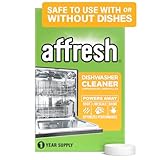
- HELPS POWER AWAY SMELLS created by odor causing bacteria, foggy limescale and mineral deposits hiding deep inside the dishwasher’s pump, filter, tub, valve, drain, washer arms and recirculation hoses to help optimize appliance performance.
- USE WITH OR WITHOUT DISHES. Unlike other brands, affresh dishwasher cleaner is safe to use while running a full load.
- TRUSTED BY APPLIANCE EXPERTS. Backed by over 100 years of appliance innovation, affresh is the dishwasher cleaner brand recommended by Whirlpool, Maytag, KitchenAid, Amana, and JennAir.**
- SAFER FOR PEOPLE. SAFER FOR PLANET. Affresh dishwasher cleaner is EPA Safer Choice Certified and is septic safe.
- NO MESSY POWDERS OR LIQUIDS. Affresh tablets are clean, convenient and powerful.
Damaged filter
A torn, warped, or permanently clogged filter should be replaced with an exact-model part. Record the full model number from the dishwasher’s rating plate before ordering an exact-model dishwasher replacement filter. Compatibility can vary even within the same brand and product family.
Cleaning mistakes to avoid
- Do not mix vinegar and bleach or combine cleaning products.
- Do not treat every white film as soap scum; mineral scale and glass etching require different responses.
- Do not use bleach or abrasive cleaners on stainless-steel surfaces unless the appliance manufacturer expressly permits the product.
- Do not use wire brushes or abrasive pads on filter mesh, spray arms, seals, or the tub.
- Do not run a product with dishes inside unless its label specifically allows it.
- Do not remove spray arms, pump covers, or filters by force.
- Do not claim that a cleaner disinfects the dishwasher unless its label specifically makes that claim.
- Do not use repeated vinegar treatments as a substitute for a model-approved maintenance schedule.
Frequently Asked Questions
What is the difference between a dishwasher cleaner and a descaler?
A dishwasher cleaner targets grease, food residue, odors, starch, protein, and undissolved detergent buildup. A descaler targets mineral deposits such as hard-water scale and limescale. They are different products and should not be treated as interchangeable.
Can I clean every dishwasher with vinegar?
Only if the owner’s manual and the vinegar instructions permit it. Some Whirlpool and Maytag guidance allows an occasional rinse with two cups of white vinegar in a dishwasher-safe container, but vinegar can damage some components if used too often.
Can I mix vinegar, bleach, or baking soda in the dishwasher?
No. Never mix vinegar with bleach or other household cleaners. Vinegar and baking soda should not be mixed as a general dishwasher-cleaning formula; if a manufacturer permits both, use them in separate cycles as directed.
Recommended Free Tools
Why is there still water in the bottom of my dishwasher after cleaning?
Clean the filter and inspect the accessible pump area first. Depending on the installation, check the drain hose and air gap. If water remains, the problem may require service rather than another cleaning product.
Will descaler remove cloudy film from glassware?
Possibly, but not always. White film may be mineral scale or detergent residue, while permanent cloudiness can be glass etching. Use an approved descaler or citric-acid procedure for mineral deposits, but do not expect etching to be reversible.
The Bottom Line
Clean the filter and spray arms first, wipe the gasket and dispenser, then choose the product for the residue: a dishwasher cleaner for grease, odor, detergent buildup, and soap scum; a descaler or approved citric-acid treatment for hard-water film and limescale. Your owner’s manual and the product label always take priority, and persistent drainage, heating, leak, or error-code problems need troubleshooting or service rather than more chemicals.
Quick Recap
Product prices and availability are accurate as of the date/time indicated and are subject to change. Any price and availability information displayed on Amazon at the time of purchase will apply.

