Quick wins for a faster PC:
Repair Windows errors before they cause bigger problemsFix Now →Fix the driver behind crashes, sound loss and screen glitchesFind Drivers →Clear out junk files and repair common Windows errorsFree Scan →Choose the panel that meets the cabinet or furniture part’s fabrication and service requirements, then verify recycled content and formaldehyde emissions as two separate documented attributes. MDF is made from refined wood fibers; particleboard is made from discrete wood particles. Neither construction is automatically the better environmental or performance choice. Before ordering, obtain the exact panel’s grade, thickness, intended-use data, recycled/recovered-fiber percentage, post-consumer percentage, calculation basis, and current emissions certification.
What you are actually choosing: MDF or particleboard
Medium-density fiberboard (MDF) and particleboard are both composite wood panels, but they are not the same material. MDF is manufactured from cellulosic fibers that are combined with resin and pressed into a uniform panel. Particleboard is made from discrete cellulosic particles pressed with resin. The U.S. Environmental Protection Agency (EPA) uses these construction categories in its formaldehyde rule; marketing terms alone do not establish a product’s regulatory classification. See the EPA regulated-stakeholder FAQ for the definitions and compliance framework.
As an Amazon Associate I earn from qualifying purchases.
For a cabinet door, shelf, side, back, drawer component, or furniture part, the useful question is not “Which panel is universally better?” It is “Which documented grade can be machined, fastened, finished, loaded, and kept in the intended environment?” The sources available for this guide do not provide head-to-head mechanical results sufficient to declare MDF or particleboard a universal winner. Require the manufacturer’s technical data for the actual product and application.
- Construction: confirm whether the panel is fiber-based MDF or particle-based board and which grade is being offered.
- Fabrication: check data for machining, edge treatment, fastening, thickness tolerances, and finishing.
- Service: match load, span, impact, moisture, and exposure conditions to the panel’s intended-use information.
- Environmental documentation: request product-specific recycled/recovered content and distinguish it from post-consumer content.
- Emissions: obtain the applicable U.S. TSCA Title VI certification and label information; do not infer low emissions from a recycled-content claim.
Begin with the part’s manufacturing and service requirements
Identify the component and how it will be made
List every panel part before comparing products. A painted door, a concealed cabinet side, a long adjustable shelf, a drawer bottom, and a furniture back may require different grades or thicknesses. Record whether the part will be routed, drilled, edge-banded, laminated, painted, screwed, doweled, or joined with another method. Ask the supplier for data that addresses those operations rather than accepting a generic “MDF panel” or “particleboard sheet” description.
#1 Best Overall
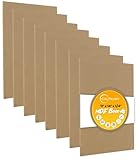
- ●MEGA PACK MDF BOARDS - This pack is for 8 pieces 11 inches wide by 14 inches long by 1/4 inch thick MDF boards. Get the most out of these exact-cut MDF board sheets
- ●HIGH-QUALITY MDF BOARDS - Both sides have machined, smooth unfinished surfaces with precision-cut straight, sanded edges. Each board is sturdy and has some weight to it
- ●VERSATILE SHEET BOARD MATERIAL - MDF is a cost-effective alternative to other sheet boards. It’s perfect as a picture frame backing board, signage, centerpieces, pyrography, interior design pieces, scrapbooking, or other hobby crafts
- ●SUITABLE FOR PAINTING - Accepts different paints exceptionally well. Since MDF is quite porous, a coat or two of paint primer or gesso primer is a must. These boards are also suitable for stenciling, distressing, whitewashing, antiquing paint techniques
- ●HIGHLY CUSTOMIZABLE UNFINISHED BOARD SHEETS - Aside from painting, you can glue or add embellishments to your MDF board. They’re easy to cut by hand saw or power saws ,and are also perfect for routing and engraving
Machining and edge treatment matter because the panel’s fiber or particle structure, density profile, and stated grade affect how the supplier intends it to be cut and finished. The reviewed sources do not quantify comparative machining, edge, or fastening performance. Therefore, require the manufacturer to state suitable tooling, edge-sealing or edge-banding guidance, fastener limitations, and any restrictions on routed or drilled features.
Define loads, thickness, and exposure
For shelves and structural furniture parts, document span, supported load, fixing points, expected impact, and the design thickness. For doors and fronts, document hardware locations, hinge loads, face treatment, and edge details. For every part, state whether it will remain indoors in a controlled environment or encounter intermittent humidity, liquid contact, unconditioned storage, or another exposure. Then compare the proposed panel’s grade and technical sheet with those conditions.
Do not substitute a recycled-content percentage for engineering information. A panel can have a documented recycled or recovered fiber share and still be unsuitable for a particular span, fastening pattern, finish, or exposure. Conversely, a panel selected for the right grade and service conditions may not have a recycled-content claim that can be verified without supplier records.
Understand what “recycled content” means on a panel
Recovered wood, recycled fiber, and post-consumer fiber are different claims
Wood-processing residues and recovered fibers can be legitimate feedstocks without establishing a particular percentage of recycled or post-consumer material in the board you are buying. The Composite Panel Association (CPA) Environmental Product Declaration (EPD) explains that North American MDF commonly uses lumber-milling coproduct residues and/or recovered fibers from harvesting operations. Those descriptions are industry information, not a product-specific declaration for every board, brand, SKU, or batch.
Ask the supplier to separate at least three figures:
- Total recycled or recovered fiber: the percentage claimed under the supplier’s stated accounting method.
- Post-consumer fiber: material recovered after use by consumers or commercial users, reported separately rather than folded silently into a broad recovered-material figure.
- Calculation basis: whether the percentage is by mass, by bone-dry mass, or another defined basis, and which ingredients are included or excluded.
A statement such as “made with recovered wood” is not enough to establish a numerical recycled-content claim. Request a signed product declaration, certification scope, or other current supplier record that identifies the exact product and calculation method.
What the CPA ECC criterion does—and does not—prove
The CPA voluntary Environmentally Certified Composite (ECC) standard includes a recycled/recovered-material criterion. A qualifying route requires at least 75% recycled or recovered fiber. An alternative route requires at least 50% recycled or recovered fiber plus at least 5% post-consumer fiber. The percentages are calculated by weight as measured in a bone-dry ton.
Rank #2

- 1. MEGA PACK MDF BOARDS - This pack is for 8 pieces 8 inches wide by 10 inches long by 2mm thick MDF boards. Get the most out of these exact-cut MDF board sheets.
- 2. HIGH-QUALITY MDF BOARDS - Both sides have machined, smooth unfinished surfaces with precision-cut straight, sanded edges. Each board is sturdy and has some weight to it.
- 3. VERSATILE SHEET BOARD MATERIAL - MDF is a cost-effective alternative to other sheet boards. It’s perfect as a picture frame backing board, signage, centerpieces, pyrography, interior design pieces, scrapbooking, or other hobby crafts.
- 4. SUITABLE FOR PAINTING - Accepts different paints exceptionally well. Since MDF is quite porous, a coat or two of paint primer or gesso primer is a must. These boards are also suitable for stenciling, distressing, whitewashing, antiquing paint techniques.
- 5. HIGHLY CUSTOMIZABLE UNFINISHED BOARD SHEETS - Aside from painting, you can glue or add embellishments to your MDF board. They’re easy to cut by hand saw or power saws ,and are also perfect for routing and engraving.
ECC-certified plants must also comply with applicable California Air Resources Board (CARB) and EPA formaldehyde requirements for their panels and meet at least three additional criteria in the standard. An ECC reference therefore indicates a broader plant and product certification framework, but you still need to confirm that the offered panel is within the current certification scope and that the recycled-content figures apply to that exact product. Certification of a plant or product family is not permission to assign the same percentage to every board without checking the certificate and supplier documentation.
Use the EPD correctly: useful context, not a product certificate
The CPA MDF EPD was published April 24, 2024. It reports 2021/2022 production from 13 MDF facilities in the United States and Canada, with combined capacity of 3.47 million cubic metres, described in the EPD as 69% of total North American industry production. These are figures for the EPD’s stated reporting scope; they are not current annual production totals and do not identify the content of an individual panel.
| EPD figure | Reported value | How to use it |
|---|---|---|
| Participating facilities | 13 MDF facilities in the United States and Canada | Industry-average scope for the declaration, not proof that every manufacturer or SKU is included. |
| Combined capacity | 3.47 million m³ | Capacity reported for the EPD participants; do not treat it as current market output. |
| Share of North American production | 69% | The EPD’s stated coverage for its reporting scope. |
| Reporting years | 2021 and 2022 | Historical production data used in the declaration. |
The same EPD reports that average North American MDF weighs 727.10 kilograms per cubic metre on an oven-dry basis. Its weighted-average wood component is 654.37 kilograms, or 90.01%, and its resin component is 72.63 kilograms. The reported average resin composition includes urea-formaldehyde at 6.30%, melamine urea-formaldehyde at 1.74%, and polymeric methylene diphenyl diisocyanate (pMDI) at 0.63%.
Those composition values describe the EPD’s declared, weighted industry-average product profile. They are not specifications for a particular board, and they do not establish that a panel has a particular recycled or post-consumer percentage. Use the EPD to understand the declared industry scope and assumptions; use the supplier’s product documentation for the board you intend to purchase.
What’s actually slowing this PC down?
Pick the symptom - the matching free tool is one click away.
Verify recycled content before you issue a purchase order
- Name the exact product. Record manufacturer, product line, grade, thickness, finish or raw-panel status, plant if supplied, and any laminated or veneered construction.
- Request the recycled/recovered-fiber percentage. Ask for the percentage for that product, not an industry average or a statement covering an entire product category.
- Request the post-consumer percentage separately. Have the supplier state whether the figure is zero, a defined percentage, or not reported.
- Request the accounting basis. Confirm whether percentages are by weight, by bone-dry weight, or another method; ask which resin and wood streams are included.
- Obtain supporting documentation. Request a current certificate, signed declaration, chain-of-custody or feedstock statement, or other record that identifies the applicable product and validity period.
- Check scope and date. Confirm that the document covers the thickness, grade, plant, and shipment you will receive and has not expired or been superseded.
- Keep the record with the project file. Store the declaration, certificate, product label, technical sheet, and purchase records so the recycled-content claim can be traced to the installed material.
| Supplier statement | What it establishes | What you still need |
|---|---|---|
| “Made with recovered wood” | Only that the supplier describes some feedstock as recovered. | Numerical recycled/recovered percentage, post-consumer share, and calculation basis. |
| Industry-average EPD | Declared impacts and composition for the EPD’s defined participants and period. | Product-specific content and confirmation that the offered panel is represented. |
| ECC certification reference | Certification against the ECC framework, subject to current scope. | Current certificate, covered product, recycled-content route, and shipment applicability. |
| Product recycled-content declaration | A numerical claim for the identified product if the document is complete and current. | Definitions, mass basis, post-consumer share, and verification or certification details. |
Check formaldehyde emissions separately
U.S. TSCA Title VI limits
For regulated composite wood products in the United States, the EPA lists these formaldehyde emission limits under TSCA Title VI and its specified test framework:
| Panel category | EPA-listed limit |
|---|---|
| MDF | 0.11 parts per million (ppm) |
| Thin MDF | 0.13 ppm |
| Particleboard | 0.09 ppm |
These are regulatory limits, not evidence that products at the limit are interchangeable, that one panel has zero emissions, or that a recycled-content claim predicts emissions. Verify the panel category, certification, and label rather than comparing the numbers as if they were a performance ranking. The current limits and implementation details are in the EPA FAQ and the EPA formaldehyde rule page.
Dates, labels, and supply-chain responsibilities
EPA states that regulated composite wood products manufactured or imported into the United States after March 22, 2019, must be certified and labeled TSCA Title VI compliant. EPA established a third-party certification program for laboratory testing and oversight. Panel producers test and certify panels; fabricators and retailers are responsible for purchasing compliant panels and maintaining the required records.
Rank #3

- Perfectly Sized & Easy to Cut – Includes 12 pieces of 12” x 12” x 1/4”MDF wood boards, ideal for various DIY projects. The smooth surface allows for easy sanding, glazing, or dyeing, and you can cut them into different shapes to suit your needs.
- Premium Quality & Durable – Made from quality medium density fiberboard wood, these 1/4-inches (6mm) thick MDF boards feature smooth, unfinished surfaces with precision-cut edges. Sturdy and evenly structured, they offer excellent durability for crafting and woodworking.
- Versatile Sheet Board Material – MDF is an excellent alternative to other sheet boards, making it perfect for picture frame backing, signage, centerpieces, pyrography, interior design, scrapbooking, and other hobby crafts.
- Suitable for Painting – Accepts different types of paint exceptionally well. Since MDF is porous, applying a primer or gesso is recommended before painting. Also great for stenciling, distressing, whitewashing, and antiquing techniques.
- Highly Customizable Unfinished Boards – In addition to painting, you can glue or add embellishments to these MDF boards. They are easy to cut with an engraving tool, hand saw, or power saw, and work well for routing and engraving.
Finished-goods testing is generally not required after initial panel certification, subject to specific requirements, including requirements that can apply to non-exempt laminated products. When a cabinet or furniture component includes laminate, veneer, or another bonded layer, ask the supplier to explain exactly how that component is covered by the certification and whether any exemption or additional documentation applies.
What chamber testing means for cabinets and furniture
“Some products such as kitchen and audio/video cabinets and wood furniture may be made using substantial quantities of wood product components containing formaldehyde. These products are not in flat panel form and are, from time to time, tested in large chambers to determine formaldehyde emission potential.”
EPA relays this standards-method statement in its FAQ with reference to ASTM E1333 and ASTM D6007. It explains why a finished cabinet is not evaluated in exactly the same way as a loose flat panel, but it does not replace the requirement to buy compliant certified panels and retain supplier records.
Pending standards changes are not final requirements
The EPA rule page reports that on February 6, 2026, the agency proposed updates to incorporated voluntary consensus standards and proposed adding ISO 12460-2:2024 as a quality-control test method. That notice describes a proposal. Treat the existing published requirements as controlling unless a later final rule confirms a change, and ask suppliers which version of the applicable certification and test method their documentation uses.
Compare MDF and particleboard by the job, not by a slogan
| Decision axis | MDF questions | Particleboard questions | Evidence to request |
|---|---|---|---|
| Panel identity | Is the offered product an MDF grade covered by the manufacturer’s definition and certificate? | Is it a particleboard grade covered by the manufacturer’s definition and certificate? | Technical sheet, grade designation, and TSCA Title VI documentation. |
| Machining | What routing, drilling, cutting, and edge-finishing operations are approved? | What cutting, drilling, and edge-treatment limits apply to the particle structure? | Manufacturer machining guidance and project-specific engineering input. |
| Fastening and joining | Which screws, dowels, connectors, or adhesives are permitted, and where? | Which fastener spacing, pilot-hole, edge-distance, and connector rules apply? | Fastening data for the exact thickness and grade. |
| Finish and overlays | Is the surface suitable for the specified paint, foil, veneer, or laminate system? | Is the surface suitable for the specified overlay and edge treatment? | Finish-system compatibility and laminated-component documentation. |
| Thickness and loading | What span, load, and thickness tables apply to the part? | What span, load, and thickness tables apply to the part? | Manufacturer load data or engineering calculations; do not infer from panel name. |
| Moisture or exposure | Is the grade approved for the project’s humidity and liquid-contact conditions? | Is the grade approved for the project’s humidity and liquid-contact conditions? | Exposure classification, installation limits, and maintenance requirements. |
| Recycled content | What percentage is recycled/recovered, and what percentage is post-consumer? | What percentage is recycled/recovered, and what percentage is post-consumer? | Product-specific declaration and calculation basis. |
| Emissions | Does the label identify TSCA Title VI compliance for this MDF category? | Does the label identify TSCA Title VI compliance for this particleboard category? | Current label, certificate, and supplier records. |
This comparison deliberately leaves performance outcomes open where the available evidence is not quantitative. The correct choice depends on the grade and design data supplied for the actual panel. A generic claim that “MDF is stronger,” “particleboard is greener,” or one is always better for cabinets is not supported without product-specific testing and intended-use information.
The Tool Desk
Outbyte Driver Updater FREEScan for outdated or missing drivers - takes under a minuteDriver Scan →Outbyte PC Repair FREERepair Windows errors before they cause bigger problemsFix Now →A practical purchasing workflow for a cabinet or furniture project
1. Write a part schedule
For each part, note dimensions, thickness, span, supported load, edge treatment, fasteners, finish, hardware, and exposure. Identify which surfaces will be visible and which will be concealed. This schedule gives the supplier enough information to propose a grade rather than a commodity panel with an ambiguous name.
2. Request matched technical sheets
Ask for MDF and particleboard options that meet the same dimensional and service requirements. Require the sheet to state grade, density or other relevant classification, thickness tolerance, machining guidance, fastening guidance, finish compatibility, and exposure limitations. If a value is not published, mark it “not stated” and ask the manufacturer for a written answer instead of filling the gap with a generic assumption.
Rank #4

- Perfectly Sized & Easy to Work With – Includes 24 pieces of 12” x 12” x 1/8” MDF craft wood panels, ideal for a variety of DIY projects. The smooth, uniform surface allows for effortless sanding, staining, or painting, and they can be cut into different shapes to fit your creative needs.
- Durable & Premium Quality Material – Made from premium-density fiberboard, these 3mm-thick MDF sheets feature precisely cut edges and a smooth, unfinished texture. Strong and structurally sound, they provide excellent reliability for woodworking and artistic projects.
- Versatile for Multiple Applications – A great alternative to plywood, these MDF boards are ideal for picture frame backing, signage, centerpiece bases, wood burning, model making, scrapbooking, and home décor projects.
- Ideal for Painting & Finishing – Highly absorbent and suitable for acrylics, oils, and stains, these MDF sheets require a primer or gesso base for best results. Perfect for stenciling, distressing, antiquing, and whitewashing techniques to achieve a unique artistic finish.
- Easy to Cut & Customize – These unfinished MDF boards can be effortlessly shaped, engraved, or routed using hand tools, power saws, or engraving machines. Easily adaptable for gluing, crafting, and embellishing, making them a must-have for creative projects.
3. Separate environmental submittals
Request the recycled/recovered percentage, post-consumer percentage, calculation method, and validity date in one submittal. Request the EPD, if available, as a separate document and read its geography, declared unit, reporting period, and industry-average scope. Request the emissions certificate and label separately. Keeping these documents distinct prevents an EPD or recycled-content statement from being mistaken for an emissions certificate.
4. Confirm the supply chain
Before purchase, verify that the distributor’s stock matches the documented product: same manufacturer, grade, thickness, finish, and certification scope. If boards are substituted, repeat the review. For imported material, confirm that the importer’s TSCA Title VI responsibilities and labeling records are in place before the material enters fabrication.
5. Approve a sample or first article
Use a sample to confirm the planned cut, edge, fastener, finish, and overlay operations. A sample does not replace engineering data or certification, but it can reveal fabrication issues before a full cabinet or furniture run. Keep the approved sample identification with the project records so later deliveries can be checked against it.
6. Record substitutions and laminated components
Any veneer, foil, laminate, or bonded overlay can change what documentation is needed. Have the supplier state how the finished component is covered under TSCA Title VI, including whether a non-exempt laminated product requirement applies. Do not assume that a compliant raw panel automatically answers every question about a composite finished component.
Independent reader supportYour contribution helps us test, update, and keep practical guides available for everyone.Common mistakes and how to correct them
Mistake: treating a generic listing as recycled-content proof
Correction: require a product-specific percentage and post-consumer figure with the calculation basis. If the supplier cannot identify the exact product or provide the basis, describe the material only as an MDF or particleboard panel, not as a verified recycled-content panel.
Mistake: counting all recovered fiber as post-consumer
Correction: ask whether the feedstock is manufacturing residue, recovered fiber from harvesting operations, post-consumer material, or a combination. Report each category exactly as the supplier defines it.
Do these 3 things before closing this tab:
1Scan for outdated or missing drivers - takes under a minute2Clear out junk files and repair common Windows errors3Fix the driver behind crashes, sound loss and screen glitchesMistake: using an industry-average EPD as a board certificate
Correction: cite the EPD’s 2021/2022 North American scope and use it for declared average information only. Obtain the offered product’s own environmental or recycled-content declaration when making a project claim.
Best Value

- Build up unique painting grounds & textures on this artist-grade hardboard
- Comes with complete priming instructions-should be primed before painting
- Moisture resistant and formaldehyde free - archival - eco-friendly
- Use to mount watercolor papers- photographs- fabrics and prints
- 12 x 16 inches - 1/8 inch depth
Mistake: assuming recycled content determines emissions
Correction: check TSCA Title VI category limits, labels, third-party certification, and supplier records independently. Recycled/recovered content and formaldehyde emissions answer different questions.
Mistake: selecting by panel name without a part specification
Correction: supply the manufacturer with the part schedule and require grade-specific data for machining, fastening, finish, thickness, load, and exposure. If the supplier cannot support the intended use, select another documented grade or obtain engineering input.
Mistake: treating a proposed rule as already effective
Correction: distinguish EPA’s February 6, 2026 proposal concerning consensus standards and ISO 12460-2:2024 from final requirements. Verify the current rule and the certification documents applicable at the time of purchase.
Free tools Windows power users keep installed
One-click scans. No signup required.
Specification language you can send to a supplier
The following request keeps the environmental and technical questions explicit:
Provide the proposed panel manufacturer, product name, grade, thickness, plant (if available), and intended-use data for each scheduled part. State whether the panel is MDF or particleboard and provide machining, edge-treatment, fastening, finish, loading, and exposure guidance for the specified application.

Provide a product-specific statement of:
- recycled/recovered fiber percentage;
- post-consumer fiber percentage;
- calculation basis (including whether percentages are by bone-dry weight);
- feedstock categories included in each percentage; and
- certificate or declaration number, scope, issuer, and validity date.

Provide the current TSCA Title VI label and certification records for the panel category. For any veneer, foil, laminate, or other bonded component, explain how the finished component is covered and identify any applicable non-exempt laminated-product requirement. Identify any substitution before shipment and resubmit the documentation for approval.
When the decision needs engineering review
Obtain project-specific engineering input when a panel is carrying a significant load, spans a long distance, supports concentrated hardware, forms a safety-critical furniture component, or will see moisture or exposure outside ordinary controlled interiors. Engineering review is also appropriate when the supplier’s grade data does not address the proposed fasteners, joints, span, thickness, or finish system.
The reviewed evidence does not establish comparative strength, screw-holding, moisture resistance, price, lifecycle impact for an individual SKU, or cabinet-performance results for a named commercial board. Those questions must be answered by the manufacturer’s technical data, project testing, or an engineer familiar with the design and applicable code requirements.
Make the final selection defensible
A defensible submittal identifies the exact MDF or particleboard product, matches its grade to each part’s fabrication and service requirements, and keeps three records together: technical-use data, recycled/recovered and post-consumer content documentation, and current emissions compliance evidence. If any one of those records is missing, narrow the claim rather than guessing. The result is a panel choice that can be explained to the fabricator, client, and inspector without treating an industry average or a marketing phrase as proof of a property the supplied board may not have.
Crashes, No Sound, or Screen Glitches?
Random freezes, missing sound and display glitches usually trace back to one bad driver. Find and replace yours safely.Free scan · under a minuteWindows Errors? Fix Them Before They Spread
Repair common Windows errors and clear accumulated junk for a smoother, more stable PC - no reinstall needed.Free scan · no reinstallQuick Recap
Product prices and availability are accurate as of the date/time indicated and are subject to change. Any price and availability information displayed on Amazon at the time of purchase will apply.

