What’s actually slowing this PC down?
Pick the symptom - the matching free tool is one click away.
The safest starting point is not a material name but the exact slab and its documentation. For most outdoor kitchens, compare a porcelain or sintered surface specifically approved for exterior use with a carefully selected granite slab. Both can handle demanding exposure when the product, fabrication and installation are appropriate. Ordinary resin-bound engineered quartz needs particular caution in direct sun unless its manufacturer expressly approves that product line for outdoor countertops.
Your decision should match the countertop to four site conditions: ultraviolet exposure, heat from grills and hot cookware, rain and standing water, and freezing or freeze-thaw cycles. Then confirm the required substrate, support, edge details, cleaning routine and warranty in writing before fabrication.
As an Amazon Associate I earn from qualifying purchases.
Start with the exact product, not a broad material category
“Porcelain,” “granite” and “quartz” describe broad families, but outdoor performance depends on the individual slab, finish, thickness, reinforcement and installation. A product that performs well in one application may have different limitations in another. Ask for the manufacturer’s current exterior technical guide and warranty for the exact color and surface you intend to buy.
What the documentation must confirm
- Approval for an outdoor countertop or backsplash, rather than only an indoor application.
- Permitted exposure to direct sunlight and ultraviolet radiation.
- Limits around grills, burners, pizza ovens, hot pans and other concentrated heat.
- Requirements for the supporting cabinet, substrate, overhangs, seams and edge profiles.
- Suitability for rain, wetting, drainage and the freezing conditions expected at your site.
- Cleaning, sealing and maintenance instructions for the selected slab.
- Warranty coverage for your location, installation type and residential or commercial use.
For example, Caesarstone publishes a dedicated Outdoor technical guide and separate fabrication and installation guidance. Its US Outdoor Residential Warranty applies only to named Outdoor surfaces, specified countertop or backsplash uses, single-family residences and stated temperature conditions; it does not automatically cover other products. Treat that as a model for the level of product-specific evidence to request, not as approval for an unrelated slab.
#1 Best Overall

- SEAL & PROTECT YOUR VALUED STONE SURFACES: Keep your countertops and natural stone surfaces looking like new by protecting and sealing them with Weiman Granite & Stone Sealer Spray
- BENEFITS OF SEALING STONE: When natural stone is not properly cleaned and sealed, water and soil can penetrate the stone and cause difficult or impossible to remove staining. Weiman Granite & Stone Sealer provides a protective barrier that protects your stone surfaces and repels water and soil
- GENTLE YET EFFECTIVE FORMULA: Weiman specializes in effective and reliable stone care products. Our sealer formula is gentle, yet effective and is pH neutral and ammonia-free
- HOW OFTEN DO I NEED TO SEAL? A great way to know if your stone needs sealed is to drop some water onto the surface. If the water soaks into the surface or does not maintain a bead or droplet shape, it's time to seal or re-seal!
- HOW TO USE WEIMAN STONE CARE PRODUCTS: To maintain the beauty of your granite, quartz, marble, tile, limestone, or slate surfaces, we recommend using our Daily Cleaner for everyday messes & clean up. On a weekly basis, use our 3-1 Granite & Stone Polish and Protect Spray, and finally our Granite & Stone Sealer as needed based on your stone. Generally, 1-2 applications of sealer, when used as directed, every 6 months will keep your countertops and surfaces stain-free and looking their best!
Compare the exposures at your site
A countertop under a roofed bar has a different duty cycle from one beside an uncovered grill in a snowy climate. Before choosing a surface, write down how the kitchen will actually be used.
Ultraviolet light and color stability
Direct sun can heat a slab and can affect resin-bound materials over time. A surface may be called “quartz” while having no approval for continuous exterior exposure. Read the outdoor-use statement for the exact product and color, and ask whether the warranty covers visible change caused by sunlight.
Porcelain and sintered surfaces are commonly selected for their resistance to ultraviolet exposure. Homes & Gardens reported a trade executive’s view that sintered surfaces such as porcelain and ceramic offer excellent resistance to UV, heat, stains and scratches and are well suited to outdoor kitchens. That is an industry statement, not an independent, product-by-product test, so the manufacturer’s guide remains decisive.
Recommended Free Tools
Heat from grills and cooking equipment
Outdoor countertops experience both broad ambient heat and intense, localized heat. A grill lid, burner, chimney, pizza oven or hot pan can create a much harsher condition than warm weather alone. Ask the fabricator to confirm clearances and heat-shield details for your appliance layout. Do not place a hot pan directly on the surface unless the product instructions explicitly allow it; use a trivet or designated heat-resistant landing area.
Heat resistance does not mean immunity to thermal shock. Sudden temperature changes, unsupported cutouts and narrow sections around sinks or cooktops can increase stress. Follow the specified support and edge treatment, particularly at appliance openings and long overhangs.
Rain, standing water and humidity
Water exposure is usually a design issue as much as a material issue. Provide a level, well-supported installation with positive drainage so water does not remain at seams, wall junctions or around sink rims. Confirm which sealants, adhesives and backing materials are approved for exterior use. A countertop that sheds water effectively will generally be easier to maintain than one with persistent pooling, regardless of its surface category.
Rank #2

- DAILY GRANITE CLEANER WITH DISINFECTING FORMULA: Specially formulated for granite and stone surfaces, Weiman Disinfectant Clean and Shine spray keeps your kitchen surfaces clean and leaves a beautiful streak-free and residue-free shine on hard, non-porous surfaces
- FOR USE ON MULTIPLE SURFACES: These products are formulated for use on non-porous sealed surfaces including granite, quartz, quartzite, marble, slate and glazed tile. They can be used in the kitchen on countertops, backsplashes and in the bathroom on showers, tile and vanity tops
- SEAL AND PROTECT YOUR VALUED STONE SURFACES: Keep your countertops and natural stone surfaces looking like new by protecting and sealing them with Weiman Granite and Stone Sealer Spray
- BENEFITS OF SEALING STONE: When natural stone is not properly cleaned and sealed, water and soil can penetrate the stone and cause difficult or impossible to remove staining. Weiman Granite and Stone Sealer provides a protective barrier that protects your stone surfaces and repels water and soil
- 2 PACK OFFER: Includes one 24 oz Granite and Stone Clean and Shine Spray, and one 24 oz Granite and Stone Sealer Spray
Freeze-thaw cycles
In climates that freeze, water entering a seam, porous edge, unsealed joint or damaged substrate can expand and contract repeatedly. Ask whether the complete assembly—not only the slab—is approved for freeze-thaw exposure. Protect exposed edges during transport and installation, and repair chips or failed joints before winter weather allows water to enter.
Outdated Drivers Are Slowing You Down
One free scan finds every outdated or missing driver and matches the right update for your exact hardware.Free scan · exact hardware matchWindows Errors? Fix Them Before They Spread
Repair common Windows errors and clear accumulated junk for a smoother, more stable PC - no reinstall needed.Free scan · no reinstallPorcelain and sintered surfaces
Porcelain and sintered slabs are frequently considered for exterior kitchens because manufacturers and trade professionals associate them with resistance to UV, heat, stains and scratches. Their low-absorption behavior can simplify routine cleaning, but the installation still requires specialist handling.
Where these surfaces fit well
- Uncovered counters receiving strong sun, when the exact product carries exterior approval.
- Cooking zones where stain and scratch resistance are priorities.
- Projects that need a consistent manufactured appearance across a large run.
- Installations where the owner wants to minimize sealing, subject to the product’s care instructions.
Fabrication and installation considerations
Large-format porcelain and sintered slabs can be unforgiving during transport, cutting and edge fabrication. Use a fabricator experienced with the selected brand and thickness. Confirm the required support pattern, sink cutout radius, seam placement and edge profile before ordering. Do not assume an installer who routinely works with interior stone uses the same handling methods for thin or large-format exterior slabs.
Ask how the fabricator will protect corners and cutouts, how seams will be supported, and what happens if a slab arrives with damage. A written installation plan is particularly important where a grill, sink or appliance creates several openings in one piece.
Maintenance
Follow the manufacturer’s cleaning instructions rather than applying a generic stone sealer. Many porcelain or sintered products are maintained with routine washing and prompt removal of food, grease and organic debris, but the exact finish may have additional restrictions. Avoid abrasive pads or chemicals that the product guide excludes.
Do these 3 things before closing this tab:
1Repair Windows errors before they cause bigger problems2Fix the driver behind crashes, sound loss and screen glitches3Clear out junk files and repair common Windows errorsGranite: durable outdoors, but slab selection still matters
Granite is a natural-stone option with a long history in exterior applications. Its suitability is not uniform across every color, finish or fabrication detail. Inspect the actual slab, ask about its absorption and finish, and obtain care instructions for that stone.
Rank #3

- MAXIMUM STAIN PROTECTION: Granite Gold Sealer creates a protective barrier that resists soil build-up and stains from oil, water, coffee, wine, and other everyday spills; ideal for natural stone countertops, sinks, floors, grout, and other stone surfaces
- WORKS ON ALL NATURAL STONE: Works on all natural stone, including granite, marble, travertine, quartzite, limestone, and slate in the kitchen, bathroom and other areas of the home; Not for use on engineered stone
- SAFE FOR FOOD-PREP SURFACES: Granite Gold Sealer is pH balanced and safe for food-preparation surfaces with no strong or harmful odors and no phosphates or ammonia to worry about
- THIRD-GENERATION KNOWLEDGE: Created and made in the USA by a third-generation family of stone-care experts — formulated to protect and maintain stone surfaces, unlike everyday household cleaners that can damage stone
- COMPLETE STONE CARE SYSTEM: Use with Granite Gold Daily Cleaner and Polish for long-lasting results — a complete routine to clean, shine, and protect your natural stone
Sealing and stain resistance
Iowa State University Extension and Outreach explains that sealing can improve a stone countertop’s resistance to staining but does not eliminate staining. Sealing therefore supports maintenance; it is not a substitute for prompt cleanup, sound drainage and correct installation. Ask which sealer is compatible with the specific slab and how often the fabricator recommends reassessment.
Granite questions to resolve before fabrication
- Does this slab’s finish and absorption suit the intended outdoor exposure?
- What sealer, if any, is recommended, and is it approved for exterior use?
- How should oil, wine, acidic foods and leaves be removed?
- Will the chosen edge profile shed water or hold it at the underside?
- How will seams and sink rims be protected during freeze-thaw cycles?
Granite can be a sensible choice when its appearance, maintenance and documented exterior use fit the site. Do not treat a generic “granite is outdoor-safe” statement as a substitute for slab-specific advice.
Engineered quartz requires a product-by-product check
Standard engineered quartz is resin-bound. The Homes & Gardens comparison cautions that ordinary products may be unsuitable for direct sun, while some manufacturers offer named outdoor lines. The practical rule is simple: never infer exterior approval from the word “quartz” alone.
Quick wins for a faster PC:
Clear out junk files and repair common Windows errorsFree Scan →Scan for outdated or missing drivers - takes under a minuteDriver Scan →Repair Windows errors before they cause bigger problemsFix Now →Questions for a quartz proposal
- What is the exact product line, color and finish?
- Does its technical documentation approve permanent exterior installation?
- Does the warranty cover direct sunlight, temperature variation and the intended climate?
- Are there limits on proximity to grills, burners or other heat sources?
- Does the installation require a particular substrate, adhesive or ventilation detail?
If any answer is unclear, select a product with explicit outdoor documentation or return to a documented porcelain, sintered or suitable granite option. Do not rely on a salesperson’s general statement about the performance of a different quartz collection.
Other stone and tile options
Natural stones and tile can work in outdoor kitchens, but their trade-offs differ. The comparison covered several stones and tile as possible choices without establishing one universal winner. Evaluate each candidate using the same checklist: UV approval, heat limits, water absorption, freeze-thaw suitability, fabrication method, grout or seam maintenance and warranty.
Tile and grout
Tile can offer design flexibility, but grout introduces additional joints that may collect grease, food residue and moisture. Ask how often grout should be cleaned or resealed, whether the grout is rated for exterior exposure, and how movement in the supporting structure will be accommodated. A tile surface is only as weather-resistant as its tile, setting system, grout and substrate working together.
Rank #4
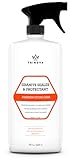
- Professional Quality Stone Care – TriNova’s Granite Sealer and Protectant offers a premium sealant and caring solution for your premium stone surfaces, including marble. Whether you’re looking for a sealing product for the first time or a resealer for long-lasting protection, this product can give your granite surfaces the before and after results you want to see. Great for Quartz, Marble, Granite, Quartzite, and Soapstone.
- Advanced-Action Stain Protection – This spray uses a powerful blend of polymers to penetrate the stone’s naturally porous surface to block out stains from seeping in and becoming permanent. By doing this, TriNova’s Granite Sealer also provides a protective layer on top of the granite to prevent water spotting and to keep other residue from sticking.
- Enhances Existing Gloss and Shine – TriNova’s Granite Sealer and Protectant is essential when the time comes to treat all types of stone and enhance surfaces for a polished and natural look. The sealer and protectant works by enhancing the existing shine, but will not create shine on already dulled surfaces. It works miracles on grout to guard against stains that develop between your shower or bath tiles that can be the most difficult to remove with just a sponge, no matter how hard you scrub.
- Do the Water Test - The best test to see if your granite needs to be sealed is to put drops of water in certain sections of your granite and wait 30 minutes. If the granite absorbs the water, you need to reseal. If not, your granite is protected. However, we still recommend using the Granite Sealer at least once a month to prevent stains from happening in the future.
- Trust TriNova - We have a 100 percent satisfaction guarantee. If you aren't absolutely satisfied with your TriNova purchase, just tell us and we'll refund the purchase price. That's how much we believe in our products.
Unspecified natural stone
Do not approve an unnamed “outdoor stone” from a sample alone. Stone types, finishes and individual slabs vary. Require written exterior guidance for the exact product, including care and freeze-thaw limitations.
A practical comparison
| Criterion | Porcelain or sintered surface | Suitable granite | Ordinary engineered quartz | Tile or other stone |
|---|---|---|---|---|
| Sun and UV | Often selected for UV resistance; verify the exact product’s exterior approval. | Assess the actual slab, finish and documentation. | Use caution in direct sun unless the exact line is outdoor-approved. | Varies by product; require exterior guidance. |
| Heat | Trade guidance describes strong heat resistance; verify appliance clearances and installation limits. | Generally durable in outdoor use, but confirm slab and installation details. | Product-specific; resin-bound construction makes documentation essential. | Varies; evaluate tile, stone, grout and setting system together. |
| Stains and scratches | Trade guidance describes strong resistance; follow the care guide. | Sealing can improve stain resistance but does not prevent every stain. | Follow the exact product’s care and warranty terms. | Depends on absorption, finish and grout or joint design. |
| Fabrication | Requires experienced handling, precise cutouts and specified support. | Experienced natural-stone fabrication is important. | Follow the manufacturer’s approved fabrication method. | Requires coordinated substrate, setting materials, joints and edge details. |
| Maintenance | Routine cleaning per manufacturer; sealing may not be required for every product. | Prompt cleaning and any recommended sealing schedule. | Use only the care instructions for the approved outdoor line. | Include grout, joints and any stone-specific sealing. |
| Warranty | Check product and regional terms. | Check the supplier’s slab and installation terms. | Outdoor coverage may be limited to named product lines and conditions. | Check each component’s warranty and exclusions. |
Use this step-by-step selection process
- Map the exposure. Record whether the counter is fully exposed, partially covered or enclosed; note hours of direct sun, prevailing rain, snow and the location of grills, burners and ovens.
- Describe the climate. Tell the supplier the project location and whether it experiences freezing temperatures, repeated freeze-thaw cycles, coastal moisture or high humidity.
- Shortlist documented products. Keep only slabs whose current technical documentation explicitly addresses exterior countertops or backsplashes.
- Check the appliance layout. Share appliance models or cut-sheet dimensions so the fabricator can plan clearances, supports, seams and heat protection.
- Review fabrication details. Approve thickness, support spacing, overhang limits, cutout reinforcement, edge profile, seam locations and drainage details in writing.
- Confirm care requirements. Obtain the approved cleaners, stain-removal method and any sealing schedule before installation.
- Read the warranty. Verify that the warranty covers your region, property type, use, exposure and installation. Record exclusions for sunlight, heat, movement, improper cleaners or non-approved fabrication.
- Inspect before acceptance. Check corners, edges, seams, sink rims and appliance openings for chips, cracks, unsupported spans or standing-water risks.
Installation details that protect the surface
Support and overhangs
Outdoor cabinets and masonry can move differently as temperatures change. Follow the slab manufacturer’s support spacing and overhang limits, and provide reinforcement where required. Never extend a large unsupported overhang simply because the material feels rigid.
Cutouts and edges
Cutouts for sinks, grills and taps are stress concentrators. Use the specified corner radii and reinforcement, and avoid sharp internal corners. A properly finished edge also reduces water retention and protects against impact during use.
Seams and junctions
Place seams away from constant splash zones when the design allows. Use exterior-approved sealants and adhesives, and make sure the supporting structure does not leave the seam carrying unsupported load. Inspect joints periodically, especially after a severe winter or movement in adjacent masonry.
Care, seasonal checks and repairs
- Remove grease, food acids, leaves and bird debris promptly using the approved cleaner.
- Do not use abrasive tools, strong solvents or improvised sealers that the manufacturer excludes.
- Use trivets under hot cookware unless the product guide specifically permits direct contact.
- Keep drainage paths clear so water does not pool at seams or wall returns.
- Before freezing weather, inspect seams, caulk, sink rims and chipped edges for openings that could admit water.
- After storms or winter, check for movement, new cracks, loose grout, failed sealant or frost-related damage and arrange an appropriate repair.
For granite, follow the slab-specific sealing recommendation. Iowa State University Extension notes that sealing improves stain resistance but does not make the surface stain-proof, so sealing and prompt cleanup remain complementary measures.
What to ask your supplier or fabricator
- Is this exact product approved for an outdoor countertop in my climate and exposure?
- What are its limitations around direct sun, grill heat, water and freezing conditions?
- Which substrate, support, edge treatment and installation details are mandatory?
- Who performs the fabrication, and what experience do they have with this slab?
- What warranty applies to this location and use, and which exclusions are likely to matter?
- What cleaning and sealing schedule applies to this specific slab?
- What remedy is available if the slab arrives damaged or develops a problem after installation?
Common mistakes and how to avoid them
Choosing from a sample without reading the technical guide
A sample shows color and texture, not exterior approval, heat limits or warranty scope. Obtain the product documents before paying a fabrication deposit.
Best Value

- Complete clean & protect system: This stone & quartz cleaner countertop kit includes a cleaner and a stone sealer to help clean, polish, and protect natural surfaces. Our granite cleaner & counter spray are designed to remove everyday messes while preserving the beauty of sealed stone countertops.
- Streak-free cleaning for daily use: Granite polish & counter cleaner gently remove grease, food residue, water spots, and fingerprints without streaking or dulling. Safe for regular use and leaves a clean, polished look without buildup on sealed stone surfaces.
- Seals to help prevent stains: Granite & marble sealer and stone cleaner create a protective barrier that helps repel water, oils, and food before they can penetrate stone surfaces. Weiman granite & stone sealer helps reduce staining and makes future cleaning easier while maintaining the natural appearance.
- Safe for multiple natural stone surfaces: Our kitchen counter cleaner spray kit is formulated for use on sealed granite, marble, quartz, slate, sandstone, limestone, travertine & soapstone. This marble polish is ideal for kitchen countertops, bathroom vanities, backsplashes, tabletops & bar tops.
- Professional results at home: Using a cleaner alone is not enough to protect stone. This quartz countertop cleaner kit helps restore shine, maintain clarity & protect against everyday wear. Our countertop spray delivers professional-level stone care.
Assuming all quartz is the same
Standard resin-bound quartz may not be approved for direct sun, while a named outdoor line may carry different documentation. Identify the exact collection and warranty.
Relying on sealer to solve every granite problem
Sealer can improve stain resistance but cannot eliminate staining or correct poor drainage, unsupported spans or failed joints.
Ignoring the installation system
A weather-resistant slab can still fail when the substrate moves, water collects at seams or cutouts lack reinforcement. Review the complete assembly, not only the top surface.
Leaving heat protection until after fabrication
Grill location, clearance and landing areas affect seam placement and support. Coordinate appliances and countertop fabrication before the slab is cut.
Bottom-line decision framework
Choose an exterior-documented porcelain or sintered surface when UV, stain and scratch resistance are priorities and you have an experienced fabricator. Choose granite when a specific slab’s outdoor suitability, care requirements and sealing plan are acceptable to you. Choose engineered quartz only when the exact product line—not merely the material category—has written approval and warranty coverage for your exposure. Consider tile or other stone only after checking the complete assembly, including grout, substrate and freeze-thaw behavior.
The final selection should be the product whose documentation, installation plan and maintenance requirements match your actual site. Keep those documents with your project records so future cleaning, repairs and warranty questions can be handled correctly.
Quick Recap
Product prices and availability are accurate as of the date/time indicated and are subject to change. Any price and availability information displayed on Amazon at the time of purchase will apply.
The Tool Desk
Outbyte Driver Updater FREEFix the driver behind crashes, sound loss and screen glitchesFind Drivers →Outbyte PC Repair FREEClear out junk files and repair common Windows errorsFree Scan →
