Recommended Free Tools
The right boardwalk decking is the material-and-detailing system that suits the site’s water exposure, users, structural loads, accessibility obligations, maintenance access and environmental constraints. Start by documenting those conditions, then compare timber, composite or recycled plastic, fiber-reinforced plastic (FRP) and precast systems against the same performance brief. No material is universally safest, cheapest, longest lasting or maintenance-free.
Start with the site, not the product catalogue
A boardwalk in a tidal wetland has a different materials brief from an inland trail that is occasionally rained on. Before requesting prices, record the conditions that will determine whether a deck surface remains safe and serviceable.
As an Amazon Associate I earn from qualifying purchases.
Exposure and water conditions
- Coastal or inland location, including salt spray and marine atmosphere.
- Repeated wetting from rain, splash, spray or wash-down.
- Tidal inundation, flood levels, storm surge and the likely duration of standing water.
- Waterlogging, poor drainage and how quickly the deck can dry after wetting.
- Sun, heat, freeze-thaw exposure and temperature changes that may affect boards, joints or fasteners.
- Leaf litter, sand, mud, driftwood and other debris that can collect on or beneath the deck.
- Geotechnical conditions, including bearing capacity, settlement risk and the support conditions for piles, piers or other foundations.
Boardwalk design guidance identifies coastal and hydraulic processes, tidal drying and geotechnical investigation as design matters, not afterthoughts. A deck board cannot compensate for foundations that settle, drainage that traps water or a layout that blocks flood flows.
Free tools Windows power users keep installed
One-click scans. No signup required.
Use and users
- Expected pedestrian volume and whether traffic will include mobility devices, strollers, maintenance carts or emergency vehicles.
- Whether people may walk barefoot, which raises the importance of splinters, sharp edges, exposed fasteners and surface heat.
- Wheel, cane and foot traffic patterns, turning areas, passing spaces and edge conditions.
- Access for inspection, washing, board replacement and fastener repair.
- Vandalism, impact from equipment and the likelihood that loose debris will be dragged across the surface.
Regulatory and project constraints
Identify the governing building, environmental, floodplain, coastal and accessibility requirements before selecting a material. The applicable rules depend on the jurisdiction, facility type and whether the route is a covered accessible route. Confirm design loads, guard and edge requirements, fire or conservation constraints, approvals and product installation instructions with the project’s responsible designer.
#1 Best Overall

- 【Superior Durability & Longevity】Unlike traditional wood that rots, warps, or splinters over time, our WPC decking is engineered to withstand the elements. It is 100% rot-proof, decay-resistant. The composite structure ensures it maintains its structural integrity for years, even under heavy foot traffic or extreme weather conditions, saving you money on long-term replacements.
- 【Zero Maintenance】Say goodbye to the annual chore of sanding, staining, or sealing your deck. Our boards feature a hard outer shell that resists stains and fading. To clean, all you need is soap and water. This "fit-and-forget" nature gives you more time to enjoy your outdoor space rather than working on it.
- 【Eco-Friendly & Safe Design】Made from a blend of recycled wood fibers and high-density polyethylene (HDPE), our decking is an environmentally responsible choice. Furthermore, the surface is engineered with a wood grain texture that provides a high slip-resistance, making it safer for children and pets compared to lumber wood.
- 【Beautiful Aesthetic Without the Flaws】Enjoy the luxurious look of natural hardwood without the imperfections. Using advanced cap stock technology, our decking offers rich, consistent color tones that resist UV rays and moisture. It won't crack or split like traditional lumber, ensuring your patio looks picture-perfect all season long.
- 【Advanced Safety: Flame-Retardant Protection】Safety meets peace of mind. Our decking is manufactured with added flame retardants, achieving an excellent non-combustible rating. This critical feature minimizes fire risks, making it a responsible choice for your home, especially in outdoor entertainment areas where grills or fire pits are present.
Turn the site survey into a performance brief
Use one written brief for every material option. This prevents a familiar product name from winning before its wet-weather, structural and maintenance behavior is understood.
| Requirement | Questions to answer | Evidence to request |
|---|---|---|
| Structural capacity | What spans, support spacing, live loads, concentrated loads and impact loads must the system carry? | Engineered section properties, span tables for the actual product, connection details and design calculations. |
| Wet-surface safety | How does the surface perform when wet and contaminated by mud, algae, sand or leaf litter? | Test method and results for the specified surface, plus cleaning and replacement guidance. |
| Accessibility | Will the completed route be stable, firm and slip resistant, with joints and transitions that do not impede users? | Project-specific accessibility review; do not rely on an unqualified marketing claim. |
| Water and debris movement | Will the deck drain and dry quickly? Can floodwater and leaf litter pass through or around it? | Deck spacing, support and edge details, drainage strategy and flood-loading review. |
| Durability | How will salt, ultraviolet exposure, wetting cycles, heat, abrasion and biological growth affect the system? | Exposure limitations, material data, coating or preservative requirements and inspection intervals. |
| Maintenance | Can crews reach the underside and replace an individual board or panel without dismantling the route? | Cleaning method, recoating or reapplication schedule, spare-part availability and repair procedure. |
| Compatibility | Do boards, substructure, fasteners, clips, coatings and foundations belong to a compatible system? | Manufacturer installation instructions and the project specification for fixings and interfaces. |
| Environmental fit | Are there restrictions on treated timber, runoff, reflected heat, habitat disturbance or construction access? | Approval conditions, environmental assessment and product declarations where required. |
Mark each requirement as mandatory, desirable or unresolved. An unresolved item is a reason to pause procurement, not a reason to assume the product will be acceptable.
Compare the main decking material families
Government boardwalk guidance identifies timber, composite or recycled plastic, FRP and precast systems as legitimate categories for consideration. They are alternatives to evaluate against the site brief, not a universal ranking.
Quick wins for a faster PC:
Scan for outdated or missing drivers - takes under a minuteDriver Scan →Clear out junk files and repair common Windows errorsFree Scan →Timber
Timber can be specified as boards or as part of a broader structural system. Boardwalk guidance recommends a rough-sawn face for sufficient slip resistance. That surface is a design choice for expected wet conditions; it is not a guarantee that a board remains safe when coated with algae, mud, oil or leaf residue.
Preservative treatment and other protection must match the timber species, exposure and specified system. The available guidance does not establish one universally suitable species or treatment. Ask the designer or supplier to state the intended exposure class, treatment process, cut-end protection, fastening method and inspection requirements. Confirm how the surface will weather and whether sanding, replacement or retreatment is permitted.
- Potential fit: projects where a timber appearance, conventional carpentry and accessible replacement are important.
- Questions to resolve: wet slip performance after weathering, splinter control, biological decay, treatment compatibility, fire or runoff restrictions and the service access needed for inspection.
- Common mistake: assuming a stain, sealer or preservative makes a wet board permanently slip resistant or eliminates inspection.
Composite or recycled plastic
Guidance identifies composite materials for consideration at beach accesses and wetlands, and a local-government materials guide includes recycled plastic and grooved finishes among the options. These category names do not prove that a particular board has the required structural capacity or wet-weather performance.
For a specific product, verify span limits, creep or deflection behavior, thermal movement, surface temperature, wet and contaminated slip performance, UV and salt exposure limits, edge detailing, fasteners and cleaning restrictions. Confirm whether the boards are structural, decking-only or dependent on closer support spacing than timber. Follow the system’s installation instructions rather than substituting generic clips or screws.
Do these 3 things before closing this tab:
1Fix the driver behind crashes, sound loss and screen glitches2Repair Windows errors before they cause bigger problems3Scan for outdated or missing drivers - takes under a minute- Potential fit: locations where reduced routine coating work or resistance to certain forms of moisture damage is attractive, subject to product evidence.
- Questions to resolve: expansion gaps, heat-related movement, color or surface change, load capacity at access covers and compatibility with the supporting frame.
- Common mistake: treating “plastic” or “composite” as a performance specification instead of identifying the exact formulation and tested installation.
Fiber-reinforced plastic (FRP)
Boardwalk design guidance identifies FRP as a material to consider at beach accesses and wetlands. FRP systems can be supplied as boards, panels or grating, so the surface, resin, reinforcement and connection details vary significantly.
Require project-specific data for structural capacity, deflection, surface texture, wet and dry traction, ultraviolet and chemical exposure, fire behavior where relevant, cutting or drilling procedures and end-of-life handling. Check that the surface remains suitable for the intended footwear, mobility devices and maintenance equipment. A highly open grating may move water well but still be unsuitable where small wheels, canes or dropped objects are concerns.
- Potential fit: sites where corrosion exposure, drainage or a lightweight system is a major design consideration.
- Questions to resolve: resin and reinforcement compatibility, edge protection, heat, tactile comfort, replacement parts and the consequences of damaged fibers or coatings.
- Common mistake: comparing an FRP grating’s drainage advantages with a solid deck’s accessibility performance without assessing the complete route.
Precast systems
A local-government materials guide lists precast boardwalk systems as an option and describes a pedestrian surface as slip resistant. That description applies to a system category, not automatically to every precast product.
Rank #2

- 【Superior Durability & Longevity】Unlike traditional wood that rots, warps, or splinters over time, our WPC decking is engineered to withstand the elements. It is 100% rot-proof, decay-resistant. The composite structure ensures it maintains its structural integrity for years, even under heavy foot traffic or extreme weather conditions, saving you money on long-term replacements.
- 【Zero Maintenance】Say goodbye to the annual chore of sanding, staining, or sealing your deck. Our boards feature a hard outer shell that resists stains and fading. To clean, all you need is soap and water. This "fit-and-forget" nature gives you more time to enjoy your outdoor space rather than working on it.
- 【Eco-Friendly & Safe Design】Made from a blend of recycled wood fibers and high-density polyethylene (HDPE), our decking is an environmentally responsible choice. Furthermore, the surface is engineered with a wood grain texture that provides a high slip-resistance, making it safer for children and pets compared to lumber wood.
- 【Beautiful Aesthetic Without the Flaws】Enjoy the luxurious look of natural hardwood without the imperfections. Using advanced cap stock technology, our decking offers rich, consistent color tones that resist UV rays and moisture. It won't crack or split like traditional lumber, ensuring your patio looks picture-perfect all season long.
- 【Advanced Safety: Flame-Retardant Protection】Safety meets peace of mind. Our decking is manufactured with added flame retardants, achieving an excellent non-combustible rating. This critical feature minimizes fire risks, making it a responsible choice for your home, especially in outdoor entertainment areas where grills or fire pits are present.
Review panel weight, lifting access, support tolerances, joints, settlement tolerance, drainage, replacement logistics and the finish’s performance when wet and contaminated. Confirm how a cracked, displaced or damaged unit will be isolated and replaced. Coordinate the precast supplier’s tolerances with the substructure and foundations; rigid units can expose movement or settlement that a more flexible board system might accommodate differently.
Outdated Drivers Are Slowing You Down
One free scan finds every outdated or missing driver and matches the right update for your exact hardware.Free scan · exact hardware matchWindows Errors? Fix Them Before They Spread
Repair common Windows errors and clear accumulated junk for a smoother, more stable PC - no reinstall needed.Free scan · no reinstall- Potential fit: projects that can support the lifting, foundation and joint requirements of a panelized system.
- Questions to resolve: delivery route, crane or lifting plan, joint transitions, surface temperature, repair method and future access to individual units.
- Common mistake: selecting a “slip-resistant” finish without asking which test method, contamination condition and maintenance regime support that description.
Make slip resistance a surface-in-use decision
The U.S. Access Board’s Chapter 3 guide states: “Accessible floor and ground surfaces must be stable, firm, and slip resistant.” The ADA Standards do not set a universal minimum coefficient of friction because no widely accepted rating method has emerged that can be applied consistently to every situation.
That does not make traction optional. Evaluate the completed surface under the conditions users will encounter:
- Wetness from rain, spray, tide or cleaning.
- Contaminants such as sand, mud, algae, oil, leaf residue and bird waste.
- Texture and groove direction, including whether a cane, wheel or bare foot can catch.
- Finish wear, polishing, coating loss and biological growth.
- Transitions, fastener heads, board cupping, warped edges and changes in level.
- Cleaning frequency and whether maintenance can restore the intended texture.
A laboratory value is meaningful only with its test protocol, orientation, footwear or contact condition and contamination state. Do not treat a number from one method as directly comparable with a number from another. If a slip-resistant application is specified, include its inspection and reapplication requirements in the maintenance plan.
Timber surface guidance
For timber, the cited boardwalk guidance specifically recommends a rough-sawn face. Confirm that the chosen roughness is compatible with wheels, canes and barefoot use, and specify how splinters, raised grain and worn areas will be addressed.
The Tool Desk
Outbyte Driver Updater FREEScan for outdated or missing drivers - takes under a minuteDriver Scan →Outbyte PC Repair FREEClear out junk files and repair common Windows errorsFree Scan →Accessible-route review
Accessibility is a route-wide outcome. Review the deck boards together with approach paths, ramps, cross slopes, joints, drainage slots, thresholds, edge protection and resting or passing areas. Confirm which accessibility standard applies to the facility and jurisdiction; a general statement about ADA requirements is not a substitute for the project’s compliance review.
Design for drainage, drying and debris movement
Where tidal inundation is possible, boardwalk design guidance says to design the boardwalk so that it dries as soon as possible after getting wet. It also recommends a self-cleaning design without fixed elements that block water flow and leaf litter.
These are system-level decisions. During design coordination, examine:
- Board or panel spacing and whether openings remain clear rather than trapping leaves.
- Substructure orientation and support details that do not create dams beneath the deck.
- Low points, transitions and edge conditions where water can pond.
- Flood and storm-surge forces on boards, rails, skirting, signs and other fixed elements.
- Access for removing accumulated sand, silt and organic matter.
- Clearances that permit inspection, ventilation and drying without damaging habitat or foundations.
Do not widen gaps or remove blocking casually to improve drainage. Spacing must remain compatible with accessibility, structural behavior, wheel and cane safety and the selected product’s installation instructions. The civil, structural and environmental design teams should resolve those trade-offs together.
Coordinate boards, substructure and fasteners
Decking is only one component of a boardwalk system. The selected boards must work with joists, beams, piles, clips, screws, brackets, edge restraints and foundations under the same exposure and loads.
Rank #3
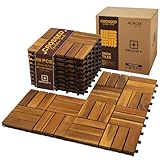
- Premium Acacia Wood 0.9 Thick: Solid acacia hardwood treated with a protective linseed oil finish that penetrates and guards the wood grain against moisture and wear; each tile measures a full 12 x 12 x 0.9 inches for a premium, substantial feel
- Safe Grip on Any Wet Surface with Grooved Slats and PPC Base: Deep-groove pattern keeps feet secure around pools, balconies, patios, and wet areas; supports up to 490 lbs
- Superior Drainage with Elevated Raised Base: Lifts tiles off the ground to channel water away underneath; promotes airflow and keeps surfaces dry — ideal for poolside, bathrooms, RV floors, and balconies
- Snaps Together in Minutes with No Tools Required: Precision interlocking clips lock all four sides by hand; tiles cut easily with a hand saw to fit edges and corners
- Built Tough for All-Weather Outdoor Use: Handles heat, UV exposure, and heavy use in all seasons; sweep or rinse with a hose to keep tiles looking their best
Fasteners and corrosion
Fastener type and corrosion resistance must follow the selected material system, exposure and structural specification. Marine or tidal exposure can require different choices from a sheltered inland route. Verify head geometry, pull-out and shear capacity, galvanic compatibility, embedment, installation torque and the ability to remove a damaged board later. The materials guidance treats fixings as part of the boardwalk specification; it does not establish one universal screw.
Movement and tolerances
Allow for the movement behavior of the actual product. Timber, composites, plastics, FRP and precast units respond differently to moisture and temperature. Set joint, edge and penetration details from the supplier’s instructions and the engineer’s calculations. Do not copy a timber spacing detail onto a composite or panel system.
Support and foundations
Geotechnical investigation determines support conditions. Settlement, scour, erosion, soft soils and flood forces can damage any deck material. Confirm span, deflection and connection calculations for the complete structure, including concentrated loads from wheelchairs, carts, maintenance equipment or temporary construction loads.
Compare whole-life work, not just the purchase price
The available guidance does not provide comparable lifecycle costs, service lives, slip-resistance scores or a universal ranking among timber, composite, FRP and precast. Obtain project-specific prices and maintenance assumptions instead of importing a generic “cheapest” or “longest lasting” claim.
| Cost or effort item | What to include in the comparison |
|---|---|
| Initial supply | Boards or panels, waste, substructure changes, special clips, coatings and delivery. |
| Installation | Cutting, drilling, lifting, access restrictions, temporary works and specialist labor. |
| Inspection | Routine checks for wear, movement, corrosion, decay, cracks, raised edges and blocked drainage. |
| Cleaning | Labor, water controls, approved detergents, debris removal and access equipment. |
| Surface renewal | Reapplication of slip-resistant finishes, timber protection, recoating or replacement of worn units. |
| Component replacement | Spare-board availability, isolation of a damaged section, lifting equipment and traffic management. |
| End-of-life work | Removal, disposal or recycling requirements and disturbance to the site. |
Ask each supplier to state what is included, which assumptions control the warranty and which maintenance tasks are mandatory. A lower initial quotation can become difficult to operate if it requires specialist cleaning, unavailable replacement parts or frequent access closures.
Independent reader supportYour contribution helps us test, update, and keep practical guides available for everyone.A step-by-step selection process
- Map the site. Record water levels, wetting frequency, salt, sun, heat, debris, soils, access limitations and environmental constraints. Include photographs and seasonal observations where conditions change.
- Define users and loads. State pedestrian volume, mobility-device use, barefoot exposure, maintenance traffic, emergency access and any concentrated loads.
- Confirm governing requirements. Identify accessibility, building, flood, coastal, environmental and facility-specific rules. Obtain the design loads and approval conditions before finalizing a board profile.
- Write mandatory performance criteria. Include structural capacity, deflection, wet and contaminated slip performance, drainage, drying, durability, heat, maintenance and replacement access.
- Shortlist material families. Compare timber, composite or recycled plastic, FRP and precast systems only where each has a plausible fit with the site and support design.
- Request product evidence. Ask for tested surface data with the method and conditions, span and connection information, exposure limitations, fastener requirements, cleaning instructions and replacement details.
- Review the complete assembly. Check boards, substructure, fixings, supports, joints, edges, drainage and foundations as one engineered system.
- Resolve accessibility and maintenance details. Review gaps, transitions, textures, slopes, clearances, inspection access and the ability to renew a surface without creating a hazard.
- Price the operating plan. Include installation, inspections, cleaning, reapplication, replacement, access closures and end-of-life work. Label assumptions and one-time costs clearly.
- Approve a written specification. Name the exact product or performance requirements, installation method, approved alternatives, inspection schedule and acceptance checks. Do not procure from a broad category label alone.
Common selection mistakes and corrections
Choosing from appearance or colour
Problem: A visually attractive board is selected before exposure, traction and structural behavior are known.
Correction: Require the product to pass the site performance brief, then choose among compliant finishes.
Assuming “wet area” means every product is suitable
Problem: A material marketed for moisture resistance is treated as suitable for tidal immersion, flood debris, salt and repeated drying.
Correction: Ask for the actual exposure limits, wet-surface evidence and installation details for the intended environment.
Using a generic slip rating
Problem: A single coefficient or label is compared across different test methods or clean, dry conditions.
Rank #4

- Authentic Wood Aesthetic - Expertly crafted texture that flawlessly mimics the richness and elegance of real wood, offering a breathtakingly natural and timeless look that transforms your outdoor space into a luxurious retreat.
- Effortless Installation - Enjoy hassle-free setup with our flexible installation options, complete with a FREE tool kit including stainless steel spiked clips, screws, and edge clips.
- Unmatched Durability - Engineered to withstand the toughest conditions, our boards offer supreme resistance to stains, fading, water, scratches, and wear, ensuring they remain as stunning as the day they were installed, no matter the weather.
- Low-Maintenance Luxury - Revolutionize your outdoor living with composite boards that demand almost no upkeep. Forget the endless sanding, staining, and sealing of traditional wood—our boards stay pristine and beautiful year after year with minimal effort.
- Eco-Friendly & Pest-Resistant - Designed with sustainability in mind, our boards are not only durable but also resistant to rodents and insects, offering a planet-friendly and worry-free solution for your outdoor oasis.
Correction: Record the test protocol and contamination condition, then assess texture, cleaning and route details in use.
Adding a coating as a substitute for design
Problem: A coating is expected to solve ponding, algae, poor drainage or an unsuitable board profile.
Correction: Fix water movement and surface geometry first; treat coatings as maintainable components with defined reapplication requirements.
Ignoring debris and maintenance access
Problem: Leaves and sand accumulate beneath fixed elements, while crews cannot reach the underside or remove individual boards.
Correction: Detail self-cleaning flow paths, inspection openings and replaceable components during design.
Mixing incompatible components
Problem: Generic fasteners, clips or coatings are substituted for the specified system.
Correction: Follow the product installation instructions and verify corrosion, movement and structural compatibility with the engineer.
Scenario-based decision checks
Tidal wetland or beach access
Prioritize rapid drying, flood and debris behavior, salt exposure, accessible traction and inspection access. Compare composite, FRP, timber and precast systems only after confirming how each handles inundation, cleaning and replacement. Keep the substructure and foundations in the same review.
Inland park boardwalk with heavy leaf fall
Focus on drainage, self-cleaning details, biological growth, cleaning access and seasonal inspection. A surface that performs well in a clean laboratory condition still needs a plan for wet leaves and mud.
What’s actually slowing this PC down?
Pick the symptom - the matching free tool is one click away.
Protected route with frequent mobility-device use
Prioritize stable, firm and slip-resistant travel, predictable joints, manageable openings, smooth transitions and an accessible maintenance strategy. Review the complete route rather than judging a deck board in isolation.
Remote boardwalk with difficult replacement access
Give greater weight to component availability, transport, lifting, repair method and inspection frequency. Confirm that a damaged board or panel can be isolated and replaced without an unsafe temporary condition.
Final procurement checklist
- Site exposure, water levels, drying conditions and geotechnical information are documented.
- Users, traffic, barefoot exposure and maintenance access are defined.
- Applicable accessibility, structural, environmental and flood requirements are identified.
- The exact decking product or a measurable performance specification is named.
- Wet and contaminated surface performance is documented with its test method and limitations.
- Board spacing, texture, joints, edges and transitions have been reviewed for accessibility and safety.
- Drainage, debris movement and rapid drying are addressed in the layout and substructure.
- Fasteners, clips, coatings and supports are compatible with the selected material and exposure.
- Inspection, cleaning, reapplication and replacement tasks have owners and intervals.
- Prices include installation, access, maintenance and replacement assumptions rather than supply alone.
- The responsible structural, accessibility and environmental professionals have approved the system for the actual project.
The best decking choice is therefore the one that satisfies the documented site brief as a complete boardwalk system. Timber, composite or recycled plastic, FRP and precast can each be appropriate in the right conditions, but only project-specific design, product evidence and a maintainable drainage and inspection plan can establish that fit.
Quick Recap
Product prices and availability are accurate as of the date/time indicated and are subject to change. Any price and availability information displayed on Amazon at the time of purchase will apply.

