Choose cordless when you regularly move between work areas, work where outlets are unavailable, or need to eliminate a trailing cord. Choose corded when a suitable receptacle is dependable and uninterrupted operation matters more than mobility. The right answer depends on the specific task, tool ratings, battery platform, charging plan, and worksite—not on a universal claim that one power source is stronger.
The short answer: match the power source to the worksite
A cordless tool removes the need to run a power lead to a receptacle while you work. That is valuable on unfinished structures, roofs, exterior sites, remote maintenance jobs, and any project where moving a cord would slow the crew. A corded tool can run continuously while connected to an appropriate supply, so it avoids recharge interruptions when electricity is reliably available.
As an Amazon Associate I earn from qualifying purchases.
Neither category wins every job. A cordless purchase also means planning for compatible batteries, a charger, and enough charged capacity for the workload. A corded purchase means planning the power route, extension-cord suitability, inspections, and protection from damage. Compare the individual tool’s rated capability and instructions before assuming that a platform voltage, battery label, or cord automatically makes one model better.
Recommended Free Tools
| Decision factor | Cordless model | Corded model |
|---|---|---|
| Work location | Useful where outlets are absent or work areas change frequently. | Needs a suitable receptacle; an extension cord may be required for reach. |
| Runtime | Limited by battery capacity, tool load, temperature, and the number of charged compatible batteries available. | Can operate without a recharge break while the supply remains appropriate and available. |
| Upfront and platform cost | Consider the tool, batteries, charger, and whether you already own compatible equipment. | Consider the tool and any suitable extension cord or power-access equipment. No general price advantage is established here. |
| Handling | No trailing power cord; battery size and weight vary by model. | Cord routing can restrict movement and create trip or damage hazards. |
| Capability | Check the exact model’s rating and instructions; do not infer performance from voltage alone. | Check the exact model’s rating and required supply; a cord does not prove superior capability. |
When cordless tools make more sense
You work away from receptacles
On framing, roofing, exterior repairs, utility work, or remote punch-list jobs, reaching a receptacle can require long cable runs or a temporary distribution setup. A cordless tool lets you start work without routing a lead across floors, stairs, scaffolding, or a finished surface. That advantage is greatest when the tool is used in many locations for short periods rather than held in one station.
#1 Best Overall

- Ergonomically Designed: Work in tight areas with a compact design that gets into tough spots
- Both tools are designed to fit into difficult to reach spaces
- Complete a wide range of applications with a high-performance motor that delivers up to 300 UWO, and an impact driver delivering up to 1,400 in-lbs of torque
- Both the DEWALT impact driver and drill driver feature integrated LED work lights with a convenient 20-second delay, ensuring enhanced visibility in dimly lit or challenging work areas
- One-Handed Loading - Keep one hand free with a 1/4 in. hex chuck that accepts 1 in. bit tips
You change position often
Even when electricity exists, a trailing cord can become the limiting part of the workflow. Moving from one side of a room to another may require repositioning the cord, protecting it from vehicles or sharp edges, and keeping it out of a coworker’s path. Cordless operation removes that particular movement problem, although it replaces it with battery planning and the added mass of the battery on the tool.
You already own a compatible battery platform
Platform ownership changes the economics. If your existing batteries and charger are approved for the new tool, the additional purchase may be only the bare tool. A first-time buyer must account for the complete system and should confirm compatibility rather than relying on a similar-looking battery or a shared voltage label.
You can manage charging around the work
Runtime is not a single number. It varies with the tool, battery, material, duty cycle, load, and the number of charged packs available. A crew that keeps several compatible batteries charged can work through a longer shift; a single-battery user may face a stoppage at the point of highest demand. Include charging location, turnaround time, and a backup plan in the decision.
Crashes, No Sound, or Screen Glitches?
Random freezes, missing sound and display glitches usually trace back to one bad driver. Find and replace yours safely.Free scan · under a minuteWindows Errors? Fix Them Before They Spread
Repair common Windows errors and clear accumulated junk for a smoother, more stable PC - no reinstall needed.Free scan · no reinstallManufacturers sometimes publish comparisons for named batteries. For example, DEWALT states that its FLEXVOLT 20V/60V MAX 6Ah battery delivers “4X runtime compared to DCB201 1.5Ah Battery Pack.” That is a DEWALT claim about those specified products, not a neutral statistic comparing cordless tools with corded tools or proving that every FLEXVOLT-equipped tool will run four times as long in your application. DEWALT also markets its platform with the slogan “Power of corded.Freedom of cordless™”; treat that as manufacturer positioning, not independent test evidence.
When corded tools make more sense
You have dependable, suitable power at the point of use
A corded tool is attractive when the work is concentrated near an appropriate receptacle and the supply meets the tool’s requirements. Continuous connection avoids swapping or recharging batteries, which can matter for long cuts, extended grinding, drilling in dense material, or any operation where stopping mid-task creates quality or safety problems.
The tool stays in one work area
Bench work, shop fabrication, fixed-position cutting, and repeated operations in one room reduce the mobility penalty of a cord. If the cord can be routed away from traffic, heat, oil, sharp edges, and moving parts, the setup may be simpler than maintaining multiple charged batteries.
Rank #2

- Drill/Driver features a 3/8" chuck, 0-650 rpm ideal for consumer DIY projects, 11 position clutch to prevent stripping of screws and damaging work material and an LED work light for increased visibility in tight or dark spaces
- The circular saw's compact design makes it easy to use and reduces fatigue. The 5.5" blade is capable of cutting 2x lumber, and its high torque motor makes it ideal for consumer DIY projects. Adjustments are quick and easy with the tool-free depth of cut and bevel settings for angled cutting.
- Work light features up to 11 hours of runtime
- 2 batteries double the runtime for less down time on larger projects
- Part of the BLACK+DECKER 20V MAX* Lithium Ion Battery System
You do not want to buy into a battery system
A corded tool does not require a proprietary battery and charger. That can reduce the number of components to manage for an occasional-use tool, but you still need to budget for an appropriate extension cord when the receptacle is not close enough. Current prices for either setup are not established, so calculate the actual total for the specific models and accessories you are considering.
Compare the complete system, not just the tool body
Cordless system checklist
- Confirm the battery model is explicitly compatible with the tool.
- Price the tool, every required battery, and the charger if you do not already own them.
- Estimate how many charged packs are needed for the job’s load and shift length.
- Check the manufacturer’s runtime information for the named tool and battery, and note the test conditions or comparison basis.
- Account for battery weight and clearance if you will work overhead or in confined spaces.
- Verify the tool’s rated capacity, speed, torque, cutting depth, or other task-specific specifications rather than using battery voltage as a performance proxy.
Corded system checklist
- Confirm the tool’s voltage, amperage, plug, and other supply requirements.
- Identify the receptacle and circuit that will power it; do not assume any convenient outlet is suitable.
- Choose an extension cord whose rating and construction match the tool, distance, environment, and applicable rules.
- Plan the route so the cord is protected from traffic, water, heat, oil, sharp edges, doors, and pinch points.
- Allow enough slack for the task without leaving loops where people can trip.
- Inspect the tool, plug, and cord before use and remove damaged equipment from service.
A step-by-step way to decide
- Describe the job. Write down the material, operation, expected duration, required precision, and whether the tool will be stationary or carried through several work areas.
- Map power access. Identify the nearest suitable receptacle for every work position. If the answer changes during the job, record where a cord would cross traffic, stairs, wet areas, or unfinished edges.
- Set the interruption tolerance. Decide whether a recharge stop is acceptable. If not, determine whether additional charged batteries are practical or whether continuous corded operation is the safer workflow.
- Check the exact models. Compare rated capacity, speed, duty information, dimensions, weight, and manufacturer instructions for the tools that can actually perform the task.
- Calculate total ownership needs. For cordless, include batteries and a charger. For corded, include any extension cord and power-distribution equipment required to reach the work safely.
- Evaluate handling hazards. Consider battery mass and charging logistics on one side; cord routing, trip exposure, and potential cord damage on the other.
- Verify compatibility and rules. Confirm battery fit, power requirements, and any workplace or jurisdictional requirements before purchase or use.
- Choose for the dominant constraint. If access and movement dominate, select a suitable cordless model. If uninterrupted operation at a reliable supply dominates, select a suitable corded model. If both constraints are serious, keeping one option of each type may be more practical than forcing one tool to cover every job.
Safety requirements for corded tools and extension cords
Basic handling practices
OSHA’s construction power-tool guidance advises users not to carry a tool by its cord, yank a cord to unplug it, or use damaged tools. Keep cords away from heat, oil, and sharp edges; disconnect a tool before servicing it or changing an accessory; and route cords so they do not become trip hazards. Electric tools used in damp or wet locations must be approved for that purpose. These controls address the corded setup directly, but the tool’s own instructions still govern the particular model.
Inspection rules in occupational workplaces
OSHA 29 CFR 1910.334 generally requires portable cord-and-plug equipment and flexible cord sets to receive a visual inspection before use on each shift, with exceptions for equipment that remains connected and is not exposed to damage. A defective or damaged item that could expose an employee to injury must be removed from service until it is made safe. This is a federal occupational standard for covered workplaces; it should not be presented as a blanket household inspection law, although inspecting equipment before use is a prudent practice.
Construction extension-cord requirements
For construction work, OSHA 29 CFR 1926.405 states that extension-cord sets used with portable electric tools and appliances must be three-wire and designed for hard or extra-hard usage. Applicability depends on the work context and jurisdiction. A construction employer should confirm the current requirements that apply to its site rather than treating a general-purpose household cord as automatically acceptable.
What these rules mean at the jobsite
- Inspect before the shift and again whenever the cord may have been damaged.
- Remove cords with exposed conductors, damaged insulation, defective plugs, or other dangerous defects from service.
- Use the correct grounding and rating for the tool and environment.
- Keep connection points and cords out of water unless the equipment is specifically approved for that condition.
- Never defeat a grounding feature or use a cord merely because it reaches the work area.
Safety and operating discipline for cordless tools
Cordless operation eliminates the trailing power lead, but it does not remove the need to follow the tool and battery manufacturer’s instructions. Use only batteries and chargers identified as compatible, inspect the tool and battery for damage, and charge and store them as directed. Keep the battery system organized so a depleted pack is not mistaken for a charged one, and plan a safe replacement procedure when the tool is used at height or in an awkward position. The exact precautions, charging limits, and environmental restrictions are model-specific, so the supplied instructions take precedence over a generic platform assumption.
What’s actually slowing this PC down?
Pick the symptom - the matching free tool is one click away.
How the choice changes by application
| Typical situation | Likely advantage | What to verify before deciding |
|---|---|---|
| Exterior framing or roofing with no convenient receptacle | Cordless mobility | Battery quantity, charging access, weather limitations, and the tool’s rated capacity. |
| Long cutting or grinding session beside a suitable outlet | Corded continuity | Supply suitability, cord rating, routing, and inspection requirements. |
| Repeated punch-list work across finished rooms | Usually cordless handling | Battery weight, spare-pack logistics, and protection of finished surfaces from dropped equipment. |
| Fixed shop or bench operation | Often corded simplicity | Permanent power arrangement, guarding, and safe cord placement. |
| Short tasks spread across a large site | Cordless convenience | Whether charged batteries can cover the total duty cycle. |
| Occasional use with no existing battery platform | Depends on access and total cost | Complete cordless-system cost versus the corded tool plus any required extension cord. |
Common mistakes that lead to a poor choice
Assuming higher voltage proves greater performance
Voltage alone does not establish cutting ability, torque, runtime, or durability. Compare the model’s task-specific ratings and instructions. A platform label is not a substitute for a specification sheet or a safe trial on the intended material.
Rank #3
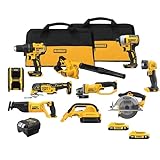
- Compact (7.6 in. front to back), lightweight design fits into tight areas. Variable speed trigger allows for control and precision on delicate work surfaces.
- DCS381 with keyless blade clamp allows for quick blade change without touching blade or reciprocating shaft.
- Hook the DCL040 20V MAX* Lithium Ion LED Work Light in your workspace for more visibility and hands-free use
- Optimized rubber overmolded comfort grip for optimized balance and control.
- Quick-change wheel release allows for tool-free wheel changes without the need for a wrench
Comparing bare-tool prices
A cordless bare tool can look inexpensive until the required battery and charger are added. Conversely, a corded tool may need a compliant heavy-duty extension cord or another method of reaching power. Compare the complete setup you will actually use.
Treating a manufacturer’s runtime claim as a universal result
Runtime claims apply to the named battery, tool, and comparison conditions. They do not predict every load or establish that cordless operation beats corded operation. No neutral, cross-brand statistic comparing overall corded and cordless performance is published for this subject.
Using an unsuitable extension cord
Length, construction, grounding, environment, and tool demand all matter. A cord that physically reaches the work may still be inappropriate. Follow the tool instructions, applicable OSHA requirements, and local rules.
Ignoring the worksite after purchase
A tool that is ideal in a shop may be awkward on a roof, and a cordless tool that works for short fastening tasks may be inefficient for sustained high-load work. Reassess the dominant constraint for each job instead of applying one preference everywhere.
What evidence can—and cannot—tell you
Official manufacturer pages document the existence and compatibility of their battery platforms and may publish product-specific runtime comparisons. OSHA guidance and regulations establish cord-handling and workplace requirements. Those sources do not provide independent, model-by-model testing of output, runtime, price, or durability across corded and cordless categories. As a result, the defensible buying method is to use the sources for compatibility and safety, then compare the exact models against the demands of your job.
There is no reliable universal answer to “Are cordless power tools powerful enough?” A particular cordless model may be fully suitable for its rated application, while another may be a poor match for a continuous high-load task. The same logic applies to corded models: continuous connection removes recharge limits, but it does not make an under-rated tool suitable or an unsafe power arrangement acceptable.
A practical final checklist
- Where will the tool be used, and how often will its position change?
- Is a suitable receptacle available at every work position?
- Can the job tolerate recharge pauses?
- If cordless, do you own compatible batteries and a charger, and how many charged packs are needed?
- If corded, is the supply suitable and is the extension cord rated for the tool and construction environment?
- What do the exact model’s specifications say about the intended material and duty?
- Have you planned inspection, routing, charging, storage, and accessory-change procedures?
- Which constraint is more likely to stop the work: lack of mobility or lack of continuous power?
The best choice is the one that removes the dominant constraint without creating a new safety or logistics problem. Treat cordless and corded tools as different system designs, verify the individual model, and make the decision from the worksite backward.
Quick wins for a faster PC:
Scan for outdated or missing drivers - takes under a minuteDriver Scan →Clear out junk files and repair common Windows errorsFree Scan →Fix the driver behind crashes, sound loss and screen glitchesFind Drivers →Quick Recap
Product prices and availability are accurate as of the date/time indicated and are subject to change. Any price and availability information displayed on Amazon at the time of purchase will apply.

