A construction time card app does more than replace a paper punch. Properly configured, it turns a field event into coded labor data that supervisors can approve, payroll can process, and project managers can compare with budgets, schedules, and production. The practical change is a shorter path from clock-in to management decision.
What a construction time card app actually does
Construction time card software records employee or crew hours and connects them to jobs, phases, tasks, cost codes, payroll, and project records. Products range from basic mobile clocks to workforce platforms that also handle GPS, scheduling, daily reports, photos, safety forms, equipment hours, and accounting integrations.
As an Amazon Associate I earn from qualifying purchases.
| Category | Typical capability | Best fit |
|---|---|---|
| Digital time clock | Clock-in/out, breaks, approvals, export | Small crews needing reliable payroll records |
| GPS construction time clock | Jobsite verification, geofences, location history | Teams working across multiple sites |
| Job-costing workforce platform | Cost codes, budgets, labor reports, scheduling | Contractors managing labor margins by project |
| Field-documentation system | Time plus photos, daily reports, documents, safety records | Companies connecting labor to progress and claims |
| Specialized payroll platform | Union, prevailing-wage, or certified-payroll workflows | Public works and complex labor compliance |
Why paper time cards create project-management problems
Paper and spreadsheets are not automatically wrong, but they introduce delays and re-entry. Hours may reach the office after a shift or pay period, handwriting may be unclear, and a worker may forget a punch or charge an entire day to the wrong project. Approval bottlenecks, buddy punching, missing cost codes, and weak edit histories make payroll disputes and labor forecasting harder.
The Tool Desk
Outbyte Driver Updater FREEFix the driver behind crashes, sound loss and screen glitchesFind Drivers →Outbyte PC Repair FREERepair Windows errors before they cause bigger problemsFix Now →Workyard says its analysis of 280 contractor discovery calls found 65% of construction businesses still primarily using paper time cards. That is a vendor-published analysis, not an industry census (Workyard comparison).
#1 Best Overall

- TIME MANAGEMENT — The 60-minute learning clock helps to stay on task, and assist with organization and concentration during study time. The dry-erase activity card helps to keep track of a task list and daily reminders
- SPECIAL NEEDS — The visual design of the desk timer helps to ease transitions between activities and encourages independence and productivity for all abilities, including those with autism, ADHD, or other special needs
- EASY TO USE — The timer for kids provides no loud ticking for concentration and a dry-erase activity card to write down tasks and placed on top of the slot as a reminder
- OPTIONAL AUDIBLE ALERT — The homework timer provides an optional alarm feature for sound-sensitive environments; ideal for activities such as doing homework, reading, studying, cooking and working out
- PRODUCT DETAILS — The 12. inches x 1.65 inches x 12 inches visual timer requires 2 AA batteries (not included). The size of the countdown timer is ideal for medium and large groups. The magnetic clock timer can be used as a wall mount or stand with foldable feet on a kids' desk
From punch to project-control data
- Clock-in: A worker or foreman records start time, job, and possibly phase or cost code.
- Verification: The app may capture a location, apply a geofence, or require an onsite clock-in.
- Coding: Hours are assigned to direct labor, indirect work, travel, equipment, or a construction cost code.
- Approval: A supervisor reviews missing punches, transfers, breaks, and corrections, then signs electronically.
- Handoff: Approved records move to payroll, accounting, or a construction-management system.
- Control: Managers compare actual labor with budget, production, overtime, and remaining work.
That chain is the real transformation: paper time card → verified field event → coded labor record → payroll and job cost → corrective action.
How apps change day-to-day project management
Earlier labor-variance warnings
Mobile entries and approvals can make labor information available soon after it is recorded. ClockShark describes real-time reporting for payroll, job costing, and labor management, while BusyBusy describes budget-versus-actual reporting (ClockShark; BusyBusy). A superintendent can investigate a concrete phase consuming twice its estimate, excessive overtime, or hours charged to the wrong code while there is still time to change staffing or sequence.
Usable job costing
Total hours are not enough. Managers need to know who worked, on which project, in which phase, under which cost code, and at what pay or burdened rate. BusyBusy describes switching between projects and cost codes and comparing labor budgets with actuals (BusyBusy). Ask whether an integration preserves project IDs, phases, cost codes, employee classifications, pay types, overtime status, equipment, and approval data.
Rank #2

- Eliminates the errors, hassles and time theft common with traditional time sheet systems.
- Rugged, weatherproof design for use outdoors.
- No fingerprint or other biometric info collected means no risk of expensive biometric privacy lawsuits.
- Built in the USA.
- iButton technology discourages "buddy punching." Employees clock in and out using house-key-sized iButtons (10 included; maximum capacity 2,000).
Better crew and schedule visibility
A time app can show who is working, where, and for how long. ClockShark advertises drag-and-drop scheduling, job assignments, directions, and reassignment (ClockShark). This supports attendance, labor allocation, and basic crew scheduling, but it does not automatically provide critical-path logic, baseline schedules, procurement dependencies, resource leveling, or change-order impact analysis.
A shared field record
Some systems combine hours with progress photos, daily reports, safety sign-offs, documents, equipment readings, notes, and digital signatures. BusyBusy lists these capabilities, including GPS- and timestamped photos, safety sign-offs, equipment hour meters, and offline operation (BusyBusy). Linking 120 charged labor hours to photos, installed quantities, delays, and equipment use gives managers context; hours alone do not prove productivity.
Less administrative re-entry
Digital workflows can reduce transcription, illegible cards, spreadsheet consolidation, correction emails, and duplicate payroll entry. ClockShark lists integrations including QuickBooks, Sage 100 Contractor, Xero, ADP, and Paychex (ClockShark). “Integration” may mean a CSV export, one-way total-hours transfer, or a deeper synchronization of cost codes, overtime, breaks, and classifications. Verify the fields and error-handling process.
Rank #3

- TIME MANAGEMENT — The 120-minute visual timer helps to improve time management and productive learning by staying on track of activities. Ideal for time out and workouts
- SPECIAL NEEDS — The visual timer encourages organization and productivity for all ages, including those with autism, ADHD or other learning disabilities. The countdown timer enables a visual schedule to anticipate transition between rotating times
- EASY-TO-USE — The analog timer with portable handle has a protective lens and center set knob to facilitate usage around the desk, kitchen or gym area. It's available in a 5, 20, 60 and 120-minute duration to adjust your time intervals between your routine
- OPTIONAL AUDIBLE ALERT — The countdown clock provides an optional alarm and silent operation features ideal for learning activities, such as reading and studying or cooking and working out
- PRODUCT DETAILS — The 5.5 x 7 inch desktop visual timer requires 1 AA battery (not included). The battery compartment is securely enclosed by a small screw to comply to CPSIA standards and a mini Phillips head screwdriver is needed to open/close it. Transcends language and culture barrier.
Distributed crews and offline work
On a site without reliable service, a capable app stores an event on the device and synchronizes it later. Confirm whether offline mode retains timestamps, location, cost-code changes, breaks, photos, signatures, and approvals—not merely clock-in and clock-out. BusyBusy states that its construction time clock supports offline mode; Workyard’s comparison shows that offline support varies by product (BusyBusy; Workyard comparison).
Quick wins for a faster PC:
Repair Windows errors before they cause bigger problemsFix Now →Fix the driver behind crashes, sound loss and screen glitchesFind Drivers →Clear out junk files and repair common Windows errorsFree Scan →GPS, geofencing, and worker privacy
GPS tracking records a device location at selected or continuous intervals. Geofencing defines a virtual job boundary that can permit, trigger, or flag clock actions. A location reminder prompts a worker near a site, while breadcrumbing collects intermittent points during a work period. BusyBusy describes GPS, required-onsite clock-in, reminders, and breadcrumbing; it says collection is limited to clocked-in periods, a configuration and privacy claim to verify against its current policy (BusyBusy features; BusyBusy GPS information).
- GPS can drift near tall buildings, underground areas, dense urban sites, or rural locations.
- A geofence set too tightly can reject a legitimate punch at a gate, staging area, or nearby work zone.
- Being inside a boundary proves device presence, not productive work, correct project selection, or completed quantity.
- Battery loss, signal loss, shared phones, multi-story work, and forgotten project switches require exception handling.
Before rollout, tell workers what is collected, when collection starts and stops, who can view it, how long records are retained, whether data informs discipline, and what happens on personal devices after employment ends. Location monitoring is not automatically lawful or appropriate in every jurisdiction.
Rank #4
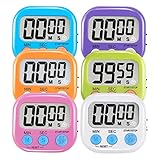
- ⏰UPGRADED VERSION TIMER :The Loud / Silent switch is a whole-new surprise! Alarm buzzer will beep loudly in large spaces, allowing you to hear clearly in another room. Makes it a must-have kitchen timer for cooking safely! Besides, this digital stopwatch timer with silent switch works perfectly for kids and teachers. When countdown to 00:00 on desktop, only the Five-pointed star will flash quietly without startling students in classroom.
- ⏰LARGE LCD SCREEN :This digital timer is simple to read the time and bold numbers effortlessly. LCD digital display made as ABS, difficult to break. Small size and light body make it pocket portable.durable kickstand and hanging hole make this magnetic timer easier to position where it should be.(battery is not included).
- ⏰MULTIPLE INSTALLATION WAYS:The visual timer is designed with a magnetic back, that can adhere to the fridge or other metal surface, and the retractable kickstand can not only put it on the counter, but also use a rope or hook hanging up, multiple installation ways providing you a wide choice.
- ⏰WIDELY APPLED: Countdown timer extensively use in break time, cooking, beauty facial, gym, sport, medicine time, meeting, classroom... Etc. Count up timer: Clear the time to "00:00", press ST/SP button and time will start to count up.
- ⏰GUARANTEE: Include 6 pack digital timer . Come with timer instruction manual.If you didn't absolutely love your timers or if there were any issue. Welcome to contact us ,we could refund or replace you.100% Satisfaction Guaranteed.
Do apps prevent time theft?
They can make some inaccurate reporting harder and create a stronger audit trail. Controls may include onsite restrictions, GPS, photos, facial-recognition alerts, supervisor approval, digital signatures, kiosk controls, and edit histories. BusyBusy advertises facial-recognition notifications for possible buddy punching and digital signatures (BusyBusy). None proves that work was performed or eliminates shared credentials, device misuse, falsified entries, or wrong cost-code selection.
Budget control, productivity, and compliance
Use coded hours to manage cost
Set up the project and cost codes, assign crews, require coded entries, approve them, synchronize approved time, compare actual labor with budget, and investigate variances. Useful measures include labor cost by code, overtime by project, hours per installed unit, rework hours, unassigned hours, indirect time, approval turnaround, and the percentage of punches edited.
Support compliance without outsourcing judgment
Apps can retain records, collect attestations, flag overtime or breaks, and support supervisor approval, certified payroll, prevailing-wage classifications, or union rules when specifically configured. Workyard identifies Lumber as targeting certified payroll, prevailing wage, and union workflows (Workyard comparison). Verify federal, state, local, and agreement-specific requirements. The U.S. Department of Labor provides recordkeeping guidance at dol.gov/agencies/whd/fact-sheets/21-recordkeeping and overtime guidance at dol.gov/agencies/whd/fact-sheets/7-flsa-overtime. Payroll review remains necessary for breaks, overtime, classifications, travel, per diem, leave, and holiday rules.
Best Value
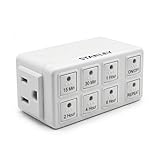
- Six Convenient Presets – Offers single-touch countdown settings of 15 min, 30 min, 1 hr, 2 hr, 4 hr, or 6 hr for effortless timing.
- Auto Repeat Mode – Automatically restarts the same countdown at the same time each day—perfect for daily routines like charging, lights.
- Manual Override – Instant ON/OFF button allows control without altering preset timer schedules
- Compact & Grounded Design – A standard bottom outlet so as not to block the top one. Built-in grounded 3-prong outlet supports up to 15 A (1,875 W)
What time card apps cannot replace
- Estimating and quantity takeoffs
- Critical-path or CPM scheduling
- Full document control and change management
- Production measurement and quality supervision
- Payroll expertise or legal advice
A sophisticated app can still fail when workers cannot find the right code, have low digital literacy, share devices, lack battery or connectivity, or fear surveillance. Keep clock-in to one or two taps, support languages and kiosks where needed, and make corrections transparent.
Buyer checklist organized around workflow
- Project structure: Can users select project, phase, task, and cost code? Can one worker change jobs mid-shift?
- Location: Is verification clock-in-only or continuous? Can radius, retention, and visibility be configured?
- Offline: Test airplane mode, a basement, delayed synchronization, reboot, photos, signatures, and duplicate punches.
- Integrations: Confirm direction and fields for QuickBooks Online or Desktop, Sage, ADP, Paychex, Gusto, Procore, Viewpoint, Foundation, CMiC, HCSS, or other systems.
- Construction workflows: Check equipment hours, daily reports, safety forms, production quantities, certified payroll, prevailing wage, union rules, and photos.
- Auditability: Require edit and approval histories, attestations, permissions, locked pay periods, exports, and retention controls.
- Total cost: Include subscription, base fees, hardware, implementation, training, integration, cellular data, support, and duplicate-system administration.
Which product category fits?
| Use case | Options to investigate | Qualification |
|---|---|---|
| Equipment-heavy field documentation | BusyBusy | Public site describes GPS, equipment, photos, safety, budgets, reports, and offline features; confirm current pricing and integrations (BusyBusy). |
| Time tracking plus scheduling | ClockShark | Public site describes scheduling, reporting, job management, and payroll integrations; verify current plans (ClockShark pricing). |
| Job-level costing and continuous GPS | Workyard | Its comparison describes these capabilities and a dated public pricing signal; verify plan scope directly (Workyard comparison). |
| QuickBooks-centered operation | QuickBooks Time | Native ecosystem connection; confirm current plans and construction-code limitations (QuickBooks Time). |
| Low-cost small crew | Jibble | Free and low-cost signals appear in the comparison; construction job-costing depth may be limited (Jibble). |
| Hardware or kiosk deployment | SmartBarrel; Arcoro Time/ExakTime | Evaluate device availability, branding, installation, and current pricing (SmartBarrel; Arcoro pricing). |
| Certified payroll and prevailing wage | Lumber | Specialized workflow; contact sales and confirm jurisdictional requirements (Lumber). |
A practical implementation plan
- Measure the baseline: Record correction hours, late cards, unassigned labor, approval delay, overtime surprises, disputes, and labor-budget variance.
- Simplify setup: Standardize project names, reduce confusing codes, define direct and indirect labor, map accounting fields, and set approval deadlines.
- Pilot one active project: Use a representative crew, mixed devices, a normal payroll cycle, and some connectivity challenges. Run the new process alongside the old one briefly.
- Test failures: Simulate no signal, dead battery, lost phone, missed clock-out, mid-shift transfer, crew-lead entry, locked-card edits, integration failure, and a location dispute.
- Publish correction rules: State who may edit, how workers are notified, how disputes escalate, when records lock, and how anomalies are reviewed.
- Review at 30, 60, and 90 days: Compare corrections, unassigned hours, overtime visibility, approval speed, participation, foreman time, labor variance, and actual total cost.
Calculate your own return
Estimated monthly benefit equals fewer payroll-correction hours, less unassigned labor, avoidable overtime reduction, recovered billable labor, faster change-order documentation, and fewer disputes. Subtract subscription, setup, training, hardware, integration, and ongoing administration. Treat vendor savings or accuracy claims as claims—not as a substitute for your baseline and pilot measurements.
The Bottom Line
The best time card app is not the one with the longest feature list. It is the one that produces trusted, correctly coded labor data with minimal field friction, handles weak connectivity and real construction exceptions, protects worker privacy, and delivers the fields your payroll and project-control systems actually use.
Recommended Free Tools
Quick Recap
Product prices and availability are accurate as of the date/time indicated and are subject to change. Any price and availability information displayed on Amazon at the time of purchase will apply.

