Outdated Drivers Are Slowing You Down
One free scan finds every outdated or missing driver and matches the right update for your exact hardware.Free scan · exact hardware matchWindows Errors? Fix Them Before They Spread
Repair common Windows errors and clear accumulated junk for a smoother, more stable PC - no reinstall needed.Free scan · no reinstallConstruction robots are not general-purpose builders that arrive on a site and complete an entire house. They are task-specific machines that weld, drill, lay bricks, move heavy materials, produce components in factories, or print concrete walls. People still design the work, operate and supervise equipment, inspect results, coordinate trades, and accept legal responsibility for the building.
The practical question is therefore not “Can a robot build a house?” but “Which part of this project can be automated safely and economically?” The answer depends on the material, repetition, site conditions, building rules, available skills, and a reliable pipeline of similar work.
As an Amazon Associate I earn from qualifying purchases.
What construction robots actually do
Robotics in real-estate construction means applying programmable machinery to a defined operation. A robot may follow a digital path, repeat a placement movement, or provide lifting assistance, while workers prepare materials, set out the work, monitor the process, and complete connected tasks. This is different from an autonomous system managing planning, procurement, foundations, services, finishes, inspections, and handover.
RICS coverage identifies welding, drilling, bricklaying, material handling, automated precast production, and construction-scale concrete printing as current or emerging applications. The same machine can be highly effective in a controlled operation and unsuitable for a changing, weather-exposed jobsite.
#1 Best Overall

- TAKE APART ROBOT TOYS: Kids can enjoy hours of independent building fun as they use the toy tool set to put together custom robots with this robotics lab-themed creative construction playset
- SKILL-BUILDING TOOL KIT: Little builders develop early engineering & fine motor skills while practicing problem-solving & real world application as they use the toy tools to tighten and loosen bolts
- KIDS ROBOT KIT INCLUDES: Kid-friendly drill, Phillips bit, screwdriver, gear socket bit, 32 bolts, 26 interchangeable pieces, seven gears, and sticker sheet; requires two AA batteries (not included)
- GIFTS FOR KIDS: Educational Insights toys and games make great birthday gifts for kids, holiday stocking stuffers, Easter basket toys, and back-to-school presents for teachers and students
- MORE TODDLER BUILDING TOYS: Visit the Educational Insights store link above for more construction kits for kids, STEM construction toys, take apart toys for boys and girls, tools for kids, and more
Bricklaying
Bricklaying systems position mortar and masonry according to a digital layout. They are most useful where wall geometry, brick type, and supply are consistent and where the site can provide a stable working zone. Workers still prepare the area, feed materials, check alignment and joints, deal with openings and interfaces, and correct defects.
RICS’ April 2026 Modus feature reported a 2020 announcement by Construction Automation about its Automated Brick Laying Robot (ABLR). The company said the system had the potential to build a three-bedroom house in two weeks. That is a company-stated potential, not an independently established production rate or a general industry benchmark. Actual duration would also include foundations, services, roofing, windows, finishes, inspections, and site logistics.
Welding and drilling
Robots can perform repetitive welds or drill accurately located holes when the workpiece and coordinates are known. In a factory, fixtures can hold components in repeatable positions and extraction systems can control fumes and debris. On site, variable surfaces, access, weather, and hidden services make reliable positioning harder, so a robot normally needs surveying, guarding, and human verification.
The Tool Desk
Outbyte PC Repair FREERepair Windows errors before they cause bigger problemsFix Now →Outbyte Driver Updater FREEFix the driver behind crashes, sound loss and screen glitchesFind Drivers →Heavy material handling
Material-handling aids reduce the force required to move or position heavy components. Construction Robotics describes its MULE equipment as supporting crews with heavy materials and says it was designed to work alongside people. Those are manufacturer statements, not independent comparative evidence. The benefit is best understood as reducing a lifting task or changing the crew’s physical workload, not eliminating the crew.
Factory production and off-site assembly
Robotics often fits better in a factory than on a conventional site. Automated lines can produce precast concrete, timber or other modules under consistent lighting, temperature, tooling, and inspection arrangements. Modules then travel to the project for rapid assembly. RICS describes this modern method of construction (MMC) as moving more work into controlled facilities while leaving site teams to assemble and connect the finished elements.
Factory automation changes the project sequence rather than removing construction work. Designers must specify joints, lifting points, transport limits, tolerances, fire performance, and service routes before production. A late design change can affect tooling, approvals, and an entire batch of components.
Rank #2
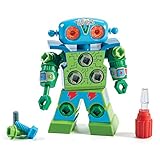
- TAKE APART TOY ROBOT: Kids can enjoy hours of independent building fun as they use the screwdriver to put together their very own snap-and-screw robot with this creative construction toy set
- SKILL-BUILDING TOOL KIT: Little builders develop early engineering & fine motor skills while practicing problem-solving & real world application as they use the screwdriver to tighten and loosen bolts
- KIDS ROBOT KIT INCLUDES: Kid-friendly screwdriver toy, robot with swiveling head, arms, and upper body; 15 bolts in different colors, and one full-color sheet of decorative stickers; ages 3+
- GIFTS FOR KIDS: Educational Insights toys and games make great birthday gifts for kids, holiday stocking stuffers, Easter basket toys, and back-to-school presents for teachers and students
- MORE TODDLER BUILDING TOYS: Visit the Educational Insights store link above for more construction kits for kids, STEM construction toys, take apart toys for boys and girls, tools for kids, and more
Concrete 3D printing
Construction-scale printers extrude successive layers of a cementitious material to form walls or other components. Digital geometry can make curved walls, integrated forms, or customized layouts more practical than conventional formwork in some projects. RICS has described the method as potentially transformative, while stressing that printing a wall is not the same as automating a finished building.
Recommended Free Tools
Printed projects still require foundations, reinforcement or other structural solutions where specified, roofs, windows, doors, insulation, services, finishes, testing, and approvals. The printer needs a consistent material that supports the next layer while bonding to the layer below. Wind, humidity, and temperature can alter wall height and layer behavior, particularly outdoors. Human inspection and quality assurance remain necessary.
Where robots fit in a residential project
A house can contain several robotic operations without being a “robot-built” house. A realistic sequence might look like this:
- Design and planning: The team creates geometry, tolerances, connection details, and a production plan that the selected machine can execute.
- Factory work: Automated equipment cuts, welds, drills, or casts repeatable components while technicians monitor the line and document quality.
- Site preparation: Human crews complete earthworks, foundations, utilities, access, and safety controls. These activities are not automatically solved by a component robot.
- Assembly or printing: A robot lays masonry, places material, or prints a wall under operator supervision. Surveying and checks confirm that the work remains within tolerance.
- Completion: Trades install services, weatherproof the envelope, fit finishes, test systems, and prepare records for building control and handover.
This division can shorten a repetitive operation, reduce manual lifting, or move precision work into a controlled environment. It does not remove planning, logistics, inspections, or the dependencies between trades.
Commercial and infrastructure building uses
Commercial projects can offer the repetition and volume that make automation easier to justify. Repeated floor layouts, standardized precast elements, long runs of drilling, and factory-made façade or structural components provide clearer robot work envelopes than a one-off, irregular extension.
Quick wins for a faster PC:
Repair Windows errors before they cause bigger problemsFix Now →Scan for outdated or missing drivers - takes under a minuteDriver Scan →Clear out junk files and repair common Windows errorsFree Scan →Examples include robotic welding of frames, drilling connection plates, producing repeated precast units, and handling panels or blocks. A contractor must still coordinate cranes, delivery timing, temporary works, fire and structural requirements, and the interfaces between automated components and site-installed systems. A robot that performs one operation quickly can create a bottleneck if the next trade, delivery slot, or inspection cannot keep pace.
Rank #3

- 🎁Ideal Gift for Kids & Teens: Celebrate child’s growing skills and important milestones with this 5-in-1 Programmable robot set. Whether for birthdays, holidays, or achievements, it’s the perfect gift that encourages learning and hands-on fun—a gift that grows with them
- ✨STEM Educational Toys: The robot set for kids ages 8+ combines the fun of STEM learning. It encourages hands-on learning and early programming as they build, which can spark creativity and imagination and provide hours of screen-free play
- 📱Flexible Dual Control Modes: Control the Robotic kit with the intuitive app (Bluetooth) or remote. Enjoy fun features like basic programming, path, and precise movement, exploring endless interactive play
- 🔄 5-in-1 Buildable with Varying Difficulty: The Robot Kit with Progressive Difficulty! From simple robots to complex models, kids can build a robot, dinosaur, car, tank, and more. Adjustable head, arms, and tail allow for fun, playful poses. Perfect for kids 8-12 to develop skills step by step and ignite creativity
- 🛠️Clear & Detailed Build Instructions: This robot kit includes 488 pieces, with clear, colorful step-by-step instructions to make assembly easy. Kids can build their own robots independently or with family, enjoying quality time together and a confidence-boosting building experience
Why repetition matters
Automation gains value when the machine can repeat a known motion many times. Every change in material, geometry, access, or sequence adds programming, setup, supervision, or tooling work. A bespoke commercial interior may therefore offer less opportunity than a standardized housing or warehouse programme, even if the building is larger.
Benefits—and what the evidence does not prove
Less physical strain and exposure to hazards
Machines can take on heavy lifting, awkward reaches, repetitive drilling, or work near hazards. Construction Robotics says its equipment can reduce injuries and increase productivity, but the cited material does not provide an independent comparative study confirming those effects across projects. A benefit should be measured for the specific task, including setup time, operator workload, and any new risks created by the machine.
Potentially more consistent output
When a robot follows a verified path and the input material is consistent, it may repeat dimensions and placement more reliably than an improvised manual process. Factory production can add controlled inspection and traceability. Consistency is not automatic: incorrect coordinates, poor material, calibration drift, or an undetected defect can repeat the same error throughout a batch.
Programme and design possibilities
Off-site production can allow site preparation and component manufacture to proceed in parallel. Concrete printing can reduce the need for conventional formwork and make some geometries easier to produce. These are potential programme or design advantages, not guaranteed savings. Transport, craneage, weather protection, approvals, rework, and connection work can offset them.
Sector productivity context
RICS’ Construction Productivity Report 2026 cites McKinsey’s 2024 research showing global construction productivity growth of about 0.4% a year from 2000 to 2022, compared with around 2% for the total economy. That statistic describes the sector as a whole; it does not measure the effect of construction robots or prove that a particular robotic system will raise productivity.
Limitations that can decide a project
Economics and an uncertain work pipeline
Robotic equipment requires capital, integration, programming, maintenance, training, and suitable space. Eva Magnisali of DataForm Lab told RICS that “Investment in automation is often a project-based decision because there is no clear pipeline of projects to secure return on investment”. A machine used on one unusual building may not recover those costs. A repeat programme can spread setup costs across more units, but demand must be credible rather than assumed.
Rank #4

- 4 INDIVIDUAL KITS INCLUDED: Perfect for group activities, family bonding, or classroom projects, this set includes 4 complete kits for endless fun and learning opportunities.
- HANDS-ON LEARNING FUN: Build your own robot! This STEM kit offers kids aged 8+ an exciting opportunity to learn about electrical circuits, robotics, mechanics, and engineering principles while assembling their robots.
- GREAT FOR STEM COMPETITIONS AND SCIENCE FAIRS: This kit is a fantastic tool for school projects, STEM challenges, and science exhibitions, helping kids stand out and succeed.
- INTERACTIVE & CREATIVE PLAY: Each robot is equipped with fun googly eyes and an electric motor, encouraging kids to engage in creative and interactive play while exploring STEM concepts.
- PERFECT GIFT IDEA: Whether it’s for a birthday, holiday, or a special occasion, this STEM kit makes a thoughtful and educational gift for boys and girls, sparking creativity and curiosity.
Design and workflow integration
Industrial machinery cannot simply be placed on a traditional jobsite and expected to work. Prof. Dr.-Ing. Thomas Bock of Technische Universität München put it plainly: “Taking an industrial robot and placing it onsite in construction just doesn’t work”. The process may need redesigned access, fixtures, digital models, material delivery, guarding, and sequencing. Workers need training to operate, maintain, and safely work around the equipment.
What’s actually slowing this PC down?
Pick the symptom - the matching free tool is one click away.
Variable outdoor conditions
Sites change daily. Uneven ground, wind, humidity, temperature, rain, dust, deliveries, other trades, and restricted access can interrupt a robot’s planned path. Concrete printing is especially sensitive to weather and material consistency: a mix must remain workable for extrusion, support later layers, and bond adequately to the previous layer. Enclosures or schedule changes may reduce exposure, but they add cost and logistics.
Safety, accountability, and assurance
Human–robot work requires defined exclusion zones, emergency stops, training, supervision, and procedures for faults. Project teams must decide who approves the digital model, who verifies each output, who records deviations, and who is responsible if a defect appears after handover. Building control, insurance, warranties, and liability arrangements may require evidence that a new method meets the same performance requirements as a conventional one.
Whole-project bottlenecks
Automation cannot remove planning permission, land assembly, zoning, utility connections, financing, inspections, or building-control queues. RICS interviewees discussing housing delivery argue that these constraints can dominate schedules even when a construction operation is fast. Faster wall production therefore does not automatically mean faster occupation.
Renovation and material trade-offs
Concrete-based systems may be durable and suitable for particular designs, but RICS notes that concrete homes can be harder to renovate than timber-frame houses and records concerns about concrete as a material. Designers should consider future openings, service routes, adaptation, repair, and end-of-life impacts before selecting a printed or heavily prefabricated system.
Free tools Windows power users keep installed
One-click scans. No signup required.
Comparing the main automation options
The following framework helps an owner or contractor compare a bricklaying robot, a material-handling aid, factory automation, and a concrete printer. It is a decision checklist, not a standardized scorecard.
Best Value

- INVENT THE ROBOT OF YOUR DREAMS: Unleash your inner engineer and let your imagination roam free in creating your thousands of new robots in the comfort of your home.
- ENDLESS POSSIBILITIES: Over 100 magnetic parts are included with over 100,000 possible combinations . Plus you'll find letters and numbers so you can name and catalog you unique robotic creations.
- STACKABLE HIGH-QUALITY MAGNETS: These magnetic parts can adhere to any surface that holds magnets, such as fridges, cookie sheets, or filing cabinets, and you can stack our magnets for even more possibilities.
- MIX & MATCH: Our kits are made to work together, so you can combine kits to make even more unique creations.
| Option | Best-fit work | Where it operates | Human involvement | Main exposure |
|---|---|---|---|---|
| Bricklaying robot | Repeated masonry walls with known layouts and supply | On site, in a prepared work zone | Set-out, feeding, supervision, joint and alignment checks, exceptions | Access, changing geometry, weather, and interfaces with openings |
| Material-handling aid | Moving or positioning heavy blocks, panels, or similar loads | Usually on site | Operator control, load guidance, exclusion zones, coordination | Ground conditions, congested sites, and safe interaction with crews |
| Factory automation | Repeated cutting, drilling, welding, casting, or module assembly | Controlled off-site facility | Programming, machine operation, quality records, maintenance, logistics | Up-front design commitment, transport, tolerances, and change control |
| Concrete printer | Selected walls or components with suitable printable geometry | Site or controlled enclosure | Mix control, printer setup, surveying, inspection, finishing, approvals | Wind, humidity, temperature, layer bonding, reinforcement and renovation choices |
For each option, assess the exact material and task; factory versus site use; required supervision; repeatability versus design flexibility; exposure to weather and site variation; skills and data; inspection and building-control requirements; insurance and warranty implications; and the total economics of the project pipeline.
A practical adoption process
- Define the bottleneck: Identify a heavy, repetitive, hazardous, or precision-sensitive operation. Do not begin with a machine catalogue.
- Map the complete workflow: Include design, procurement, delivery, setup, operation, inspection, rework, maintenance, and handover. Record what happens before and after the automated step.
- Check repeatability: Confirm volumes, dimensions, materials, access, and tolerances across the expected project pipeline. A one-off bespoke task may not justify automation.
- Design for the process: Adapt geometry, connection details, fixtures, digital data, and site layout where necessary. Industrial equipment needs a compatible work environment.
- Plan people and safety: Assign trained operators, supervisors, maintainers, inspectors, and an accountable project lead. Define emergency procedures and exclusion zones.
- Validate quality and approvals: Agree inspection points, traceability, building-control evidence, testing, insurance, warranties, and responsibility for defects before production.
- Measure the right result: Compare the complete process—not just machine cycle time—with the existing method. Track labour exposure, setup, downtime, rework, quality, programme effect, and total cost for the project.
Can a robot build a complete house?
Not as a general industry capability demonstrated by the evidence cited here. A robot may print walls, lay bricks, manufacture modules, or assist with heavy components, while people and conventional trades perform the remaining work. The two-week three-bedroom-house statement associated with ABLR was a company announcement reported by RICS in 2020, not proof that an autonomous robot can deliver an occupied home in that time.
A more accurate description is a hybrid project: digital design and automated production for selected elements, combined with human planning, supervision, inspection, services, finishes, approvals, and accountability.
What is likely to matter next
Adoption will depend less on spectacular demonstrations than on repeatable workflows, trained teams, accepted standards, and a dependable project pipeline. Dawud Muneer MRICS of RICS described 3D printing as a modern method of construction that “could have a transformative impact on how we build globally,” while Andrew McCoy of Virginia Tech cautioned, “I believe fundamentally in 3D printing for housing, but I don’t know that it’s concrete we’re going to be using in five years”. Those comments capture both the opportunity and the uncertainty: automation may expand, but the winning materials, business models, and regulatory pathways are not settled.
For now, the strongest case is a narrowly defined task where repetition, risk, or physical load is clear, the process can be redesigned around the machine, and quality and responsibility remain visible to people.
Quick Recap
Product prices and availability are accurate as of the date/time indicated and are subject to change. Any price and availability information displayed on Amazon at the time of purchase will apply.

