Quick wins for a faster PC:
Clear out junk files and repair common Windows errorsFree Scan →Scan for outdated or missing drivers - takes under a minuteDriver Scan →Repair Windows errors before they cause bigger problemsFix Now →There is no single curing time for a concrete road. Depending on the concrete mix, repair depth, temperature, curing protection and the road agency’s specification, a full-depth pavement repair may open in roughly 2–4 hours or remain closed for 24–72 hours. Those figures are examples for particular repair mixes, not a promise for every road.
The reliable answer comes from the project’s opening criteria, usually a measured concrete strength or a calibrated maturity result. A slab that looks hard, or has received curing compound, is not automatically ready for traffic. The agency or contractor should open the lane only after the concrete reaches its specified load-bearing threshold and all other conditions are satisfied.
As an Amazon Associate I earn from qualifying purchases.
Curing and opening to traffic are different decisions
Curing is the early construction process that controls moisture and temperature while cement hydrates and concrete gains strength. Crews normally protect the surface with a liquid membrane-forming compound, coverings or insulation so water is not lost too quickly and the concrete does not cool prematurely.
Opening to traffic is an engineering acceptance decision. It asks whether the repaired area or new slab can carry the expected wheel loads without unacceptable cracking, faulting or loss of support. The curing method helps the concrete reach strength, but it does not prove that the required strength has been reached. The Federal Highway Administration (FHWA) states that, for most concrete pavement applications, measuring concrete strength is preferable to using elapsed time alone (FHWA full-depth repair opening guidance).
#1 Best Overall

- Advanced Moisture Retention Formula - This professional concrete curing compound acts as an effective moisture barrier for fresh concrete. Our curing and sealing liquid locks in water to ensure proper hydration, maximize strength development, and prevent early cracking on new slabs and driveways.
- Dual-Action Cure & Seal Protection - Apply this efficient cure and seal for concrete to new surfaces. It forms a protective concrete curing membrane that retains crucial moisture while providing a temporary sealing layer to shield against stains and weather during the critical initial curing period.
- Integrates Corrosion Inhibiting Benefits - Formulated with a built-in corrosion inhibitor, this concrete treatment helps protect embedded steel rebar and metal from rust. This contributes to longer-lasting durability for your concrete structures, driveways, and patios.
- Easy Spray-On Application & Coverage - This ready-to-use liquid concrete sealer is designed for easy spray or roller application. One gallon covers approximately 50-80 sq ft, making it a user-friendly solution for DIY projects and professional concrete finishing alike.
- Promotes Optimal Strength & Durability - By significantly reducing moisture loss, this concrete curing aid promotes proper cement hydration. This results in a harder, more durable concrete surface with increased abrasion resistance and reduced dusting for a superior final finish.
Posted closure times are therefore a work-control estimate. The final release comes from the responsible road agency, engineer or contractor under the written project specification.
Typical opening times for full-depth pavement repairs
FHWA lists the following typical opening-to-traffic ranges for selected full-depth repair mixes. The values illustrate how dramatically cement type and admixtures can change the schedule; they are not an average for all concrete roads and do not automatically apply to a complete new pavement.
| Repair concrete example | Typical time to traffic | Important qualification |
|---|---|---|
| Selected blended cements or sulfo-aluminate cements | 2–4 hours | Rapid-strength mixes chosen for short closures; the project still must verify its opening criterion. |
| Some Type III or Type I mixes with accelerators | 4–8 hours | Accelerator dosage, temperature and curing protection affect the actual result. |
| Type III cement with a Type A water-reducing admixture | 12–24 hours | A mix-specific example, not a general Type III guarantee. |
| Conventional Type I air-entrained paving mix without fly ash | 24–72 hours | Longer closures are normal when early strength is not specially optimized. |
These ranges come from FHWA’s full-depth repair procedure. A road reconstruction, bridge approach, continuously reinforced slab or large paving operation may use different materials, thicknesses and acceptance tests, so its closure can be shorter or longer.
What’s actually slowing this PC down?
Pick the symptom - the matching free tool is one click away.
FHWA’s material guidance notes that a set accelerator is frequently used when an opening in about 4–6 hours is required. Without an accelerator, listed mixes may require approximately 12–72 hours, while proprietary rapid mixes can be designed for openings in as little as two hours (FHWA material considerations). Those are design possibilities, not permission to drive on an untested slab.
The strength thresholds that control release
For full-depth repairs, FHWA recommends a minimum opening strength of 2,000 psi (13.8 MPa) compressive strength. As alternatives, it lists 300 psi (2.1 MPa) flexural strength under center-point loading or 250 psi (1.7 MPa) under third-point loading (FHWA full-depth repair opening guidance). These are recommendations in FHWA repair guidance; a state, county or municipal specification can set a different value or require additional checks.
Testing may use field-cured cylinders, beams, maturity meters or pulse-velocity devices, depending on the contract. FHWA says maturity and pulse-velocity methods can be preferable to a clock-only requirement when they are properly correlated with the concrete mix. A maturity system estimates in-place strength from the concrete’s recorded temperature history, but it must be calibrated to that specific mixture before it can support an opening decision.
Rank #2

- Mix with water at a 9:1 ratio; Covers 2000-4000 sq ft per gallon after mixing
- Reduces surface moisture loss by approximately 80% in windy conditions and 40% in direct sunlight
- Keeps surface plastic and "finishable" for a longer time
- Will not interfere with the adhesion of subsequent curing and sealing compounds
- Leaves no surface finish
Partial-depth repairs use a different structural situation. FHWA’s partial-depth opening guidance explains that shallow repairs benefit from the surrounding concrete’s lateral confinement, so the opening strength need not be treated as if it were a free-standing full-depth slab. Many agencies use about 1,600–1,800 psi before opening partial-depth repairs, according to the FHWA Concrete Pavement Preservation Guide, Second Edition (2014). That range must not be substituted for a full-depth requirement.
Free tools Windows power users keep installed
One-click scans. No signup required.
The same partial-depth guidance discusses conventional paving concrete commonly specified at 3,000 psi at 28 days. That is a later design-strength reference, not an instruction to wait until 28 days or a universal traffic-opening threshold (FHWA partial-depth opening guidance).
Why two roads poured on the same day can open at different times
Concrete mixture and cement type
Rapid-hardening cements, accelerators and carefully selected admixtures can produce traffic strength in hours. Ordinary paving cement, mixtures containing fly ash or ground-granulated blast-furnace slag, and mixes designed for long-term durability may gain early strength more slowly. The mix design must balance early opening against shrinkage, durability, air entrainment and ultimate performance.
Temperature and the concrete’s heat history
Hydration accelerates when concrete is kept in a suitable temperature range and slows in cold weather. FHWA notes that even small changes in air temperature influence strength development. A cold night after placement can extend the closure; excessive heat or rapid drying can create different durability problems. For mixtures with fly ash or slag, temperature effects on the curing period before opening can be especially important (FHWA materials-related distress guidance).
Thickness, repair geometry and load transfer
A thin, confined partial-depth patch does not behave like a full-depth slab replacement. A thick panel, a joint replacement or a repair over weak subgrade may need more conservative acceptance checks even when the surface appears firm. Dowel bars, tie bars, joint alignment and underlying support also affect whether traffic can be safely restored.
Early curing protection
Wind, low humidity and direct sun can remove surface moisture faster than the concrete can replace it. Poor curing can reduce strength and increase cracking, extending the closure or forcing removal and replacement. Insulation during the first hours can retain hydration heat and promote strength gain when early opening is required, as FHWA notes in its material guidance.
Rank #3
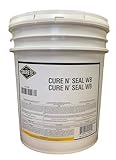
- Cure and seal surfaces
- Interior or exterior applications, new or existing applications
- Concrete, masonry, terrazzo, brick, stone, masonry, and other cementitious materials
- Commercial and residential applications
- Seal many types of resilient floor coverings and porous ceramic tile
Traffic loading and project risk
A lightly traveled residential lane, a bus route and a heavily loaded freight corridor impose different consequences if a young slab deflects. The specification may require more than a minimum compressive result, such as satisfactory joint condition, stable temperature, acceptable surface finish and removal of temporary barriers only after the surrounding pavement is safe.
How a responsible project decides that traffic can return
- Identify the opening requirement. The contract or agency specification should state the required compressive or flexural strength, permitted test method, maturity correlation rules and any restrictions on vehicle type.
- Record placement conditions. Note the concrete batch, placement time, slab or patch dimensions, cement and admixture types, air temperature, concrete temperature and weather exposure. These records explain why strength may differ from a generic schedule.
- Apply curing immediately. Use the specified curing compound, cover or insulation at the required coverage and timing. For partial-depth repair work, FHWA’s construction guidance gives an application rate of about 5.0 m² per litre for a liquid membrane-forming curing compound; the product instructions and project specification govern the actual application (FHWA partial-depth construction guidance).
- Test or calculate in-place strength. Break field-cured specimens at the specified age, or use a calibrated maturity or pulse-velocity system where allowed. Do not use a curing-compound application, a thumbprint test or a hard-looking surface as a substitute.
- Inspect the repair and surroundings. Check joints, edges, dowels, tie bars, drainage, surface defects, barriers and lane transitions. Strength alone does not correct a misaligned joint or an unsafe work-zone layout.
- Obtain the written release. The authorized engineer, inspector or road agency confirms that the strength result and project conditions meet the opening clause, then removes or changes the closure controls.
When a project uses maturity testing, the temperature sensors, concrete batch and strength curve must remain traceable. A maturity number from a different mix or a different weather history cannot be transferred without an approved correlation.
Full-depth, partial-depth and new pavement: do not mix the rules
Full-depth repair
The damaged concrete is removed through the slab and replaced, often with dowels or other load-transfer details. FHWA’s 2,000 psi compressive recommendation and its 2–4-hour through 24–72-hour example range are aimed at this repair context. The required result depends on the specified repair mix and test plan.
Crashes, No Sound, or Screen Glitches?
Random freezes, missing sound and display glitches usually trace back to one bad driver. Find and replace yours safely.Free scan · under a minutePC Slower Than It Used to Be?
A free scan shows the junk files, broken settings and background clutter dragging Windows down - then fixes them in one click.Free scan · Windows 10 & 11Partial-depth repair
Only the upper portion of the slab is removed. The remaining concrete and surrounding slab provide confinement, which is why agencies may use a lower opening strength such as the 1,600–1,800 psi range reported in FHWA preservation guidance. The repair still needs adequate bond, depth, consolidation and curing; a lower threshold does not mean the patch can be opened immediately.
New road pavement
A new roadway placement may have longer continuous sections, more joints, different load-transfer requirements and a separate acceptance plan. The full-depth repair examples should not be presented as a guaranteed schedule for an entire road project. The governing paving specification may require opening by strength, by a minimum age, or by both.
What curing compounds, covers and insulation actually do
A curing compound forms a membrane that limits evaporation while hydration continues. It is particularly important on exposed repair surfaces, where a small area can lose moisture rapidly. The coating must be applied uniformly and at the specified rate; missed areas can dry and weaken even when the rest of the patch is sound.
Rank #4

- Spray or roller applied***
- Eliminating the need for water curing***
- Ready-to-use, milky white color dries to clear satin finish***
Insulation mats or blankets retain heat during the early hydration period. FHWA identifies them as useful when early traffic opening is needed because they can support faster strength development. They do not create strength on demand and must be used without overheating the concrete or violating the project’s temperature limits.
Recommended Free Tools
Water curing, sealed coverings and other methods can be specified instead of a membrane. The choice depends on the mix, weather, surface geometry and agency requirements. In every case, the protection method is part of the strength-development process, not an opening certificate.
Independent reader supportYour contribution helps us test, update, and keep practical guides available for everyone.Traffic strength is not the same as deicer readiness
A lane may have enough load-carrying strength for vehicles and still be unsuitable for deicing chemicals. FHWA materials-related guidance states that newly placed concrete should receive an air-drying period of one month before deicer application, in addition to gaining traffic strength (FHWA materials-related distress guidance, March 2002). That is guidance for the cited context, not a universal rule for every jurisdiction or concrete mixture.
Until the agency permits deicer use, operators may need mechanical snow removal or another approved treatment. Applying salt because the lane has opened can damage immature concrete even when the opening test was passed.
What drivers should do when a road is newly opened
- Follow the posted speed, axle-weight and lane-use restrictions; an opening may be staged or limited to passenger vehicles.
- Stay within the marked lane and avoid crossing fresh joints, barriers or cones.
- Report rocking panels, pumping water, spalling edges or a sudden depression to the road authority rather than driving around controls.
- Expect temporary restrictions to remain while adjacent shoulders, shoulders, markings or tie-ins are completed.
Removing barricades is not a signal that every construction activity is finished. Work-zone personnel may still be protecting adjacent concrete that has a later placement time.
Do these 3 things before closing this tab:
1Repair Windows errors before they cause bigger problems2Scan for outdated or missing drivers - takes under a minute3Clear out junk files and repair common Windows errorsCommon reasons an advertised opening is delayed
The strength result is below the target
Cold temperatures, a slower cementitious blend, excess mixing water or inadequate curing can all postpone the test result. The contractor may extend curing, add insulation where permitted, retest at the next specified age or seek an engineer’s disposition. Traffic should not be allowed simply because the planned hour has arrived.
Best Value

- Great tools at a great price
Tests are invalid or not yet available
Broken specimens, missing temperature records or an uncalibrated maturity curve leave the agency without defensible evidence. The remedy is a valid test under the specification, not an informal visual inspection.
The concrete passes strength but the site is unsafe
Open joints, damaged barricades, ponding water, unfinished transitions or construction vehicles entering the lane can keep a road closed after the concrete itself is strong enough. Opening criteria often include these operational checks.
Weather changes after placement
A sudden freeze, prolonged rain or extreme heat can alter curing conditions and trigger additional protection or testing. The agency may maintain the closure until the concrete’s recorded history and inspection results support release.
A practical checklist for estimating a particular road
To replace a generic internet estimate with a useful answer, obtain these facts from the project notice or road agency:
- Is the work a new slab, full-depth repair or partial-depth repair?
- What cement, supplementary cementitious materials, accelerator and water-reducing admixture were used?
- When was the concrete placed, and what were the concrete and air temperatures afterward?
- What compressive or flexural opening strength does the specification require?
- Is there a calibrated maturity reading or a valid field-cured specimen result?
- Were curing compound, covers or insulation applied as specified?
- Are there additional restrictions for trucks, buses, bicycles, motorcycles or winter deicers?
If those details are unavailable, the posted closure is the only safe public timetable. A generic “24 hours” answer can be dangerously early for one mix and unnecessarily late for another.
The answer in one sentence
Concrete pavement can be ready for traffic in a few hours with a purpose-designed rapid repair mix, or require one to three days with conventional full-depth repair concrete, but traffic should return only after the project’s specified strength and site-opening checks are met—not merely when the surface appears cured.
Quick Recap
Product prices and availability are accurate as of the date/time indicated and are subject to change. Any price and availability information displayed on Amazon at the time of purchase will apply.

