Recommended Free Tools
Keep deliveries moving by treating construction access as a managed operating plan, not a driver-by-driver improvisation. Before work starts, obtain the contractor’s phase schedule and access map, identify a legal loading point for every phase, give suppliers one current set of instructions, and prepare a fallback such as an approved nearby drop-off with a safe hand-transfer route.
Conditions can change when barriers, signs, traffic control or work hours change. Recheck the street in person, follow the latest posted controls, and maintain a named contact with the project team. Delivery hours, curb rules and permits are local matters; examples from New York, London, Calgary and Toronto illustrate options rather than universal rules.
As an Amazon Associate I earn from qualifying purchases.
Start with an access plan before the first barrier goes up
Ask the municipality, contractor or project liaison for information early enough to brief every carrier. Federal Highway Administration (FHWA) work-zone transportation management training emphasizes advance notice of phase changes, keeping owners informed, providing temporary entrances or clear signs, and accounting for employee shifts and peak shopping periods. Its narrator notes state: “Businesses need to continue to operate during road work, so employees, customers, and those bringing deliveries need to be able to reach businesses affected by a work zone.”
Do these 3 things before closing this tab:
1Clear out junk files and repair common Windows errors2Scan for outdated or missing drivers - takes under a minute3Repair Windows errors before they cause bigger problemsRequest a phase-by-phase map
Ask for a written plan, even if the project team initially provides only a meeting or phone update. Confirm:
#1 Best Overall

- 340lb capacity and 47.24" tall handle: Our portable hand truck is built with high-strength steel and aluminum alloy. Featuring a thickened steel pipe tie rod, an aluminum alloy base, swivel adjustable handle,The 7 inch upgraded rubber wheels are more wear-resistant and quiet than other wheels, making it easy to maneuver on most road surfaces.
- Collapsible and foldable comfort design: Foldable design allows for easy storage in your car or garage without taking up too much space. The dolly cart has a height of 47.24'' and comes with a comfortable TPR rubber handle to make it comfortable for most people.This hand truck is ready to use right out of the box and requires no assembly.
- Expert Tips: To prolong the hand truck's service life, avoid pressing the trolley rod directly to a tilted state when transporting heavy goods. Instead, use one hand to hold the cargo and the other hand to press the trolley rod until the trolley body reaches a tilted state.
- Lightweight, sturdy and convenient: Folding hand truck is perfect for home or office use, easy to carry and can be easily stored in the car trunk, under the bed, closet, storage room or garage. Easy solution to move a few boxes of water, pick up express parcels, garden potting soil, luggage handling, warehouse goods delivery, moving, office daily use, etc.
- Multifunctional Hand Truck: Folding hand truck is perfect for home or office use, easy to carry, weighs only 13 pounds, can be easily stored in the trunk of the car, under the bed, in a closet, in a pantry or in the garage. Easily solve the problems of moving a few boxes of water, picking up courier packages, garden potting soil, carrying luggage, warehouse goods delivery, moving, office daily use, etc.
- Construction start date, expected completion date and each phase or weekend closure.
- Which pedestrian entrances, rear doors, loading bays and accessible routes remain open.
- Where delivery vehicles may approach, stop, load and unload during each phase.
- Vehicle restrictions, turning limits, height or weight limits and any permit requirements.
- Temporary loading areas, nearby staging points and the walking route from each point.
- How changes will be announced, including the name, phone number and email of the person responsible for updates.
Dates are often estimates. Record the date of the latest plan and ask when the next confirmation will be issued. A simple phase table prevents staff from relying on an outdated notice.
Make one delivery brief for everyone
Put the current instructions on one page or in a shared digital note. Include a map link or marked-up image, the legal loading location, approach direction, permitted time window, entrance to use, receiving contact and a phone number for problems. State where a driver must not wait; a queue in a travel lane, cycle lane or emergency access route can create a safety and enforcement problem.
Give the same brief to suppliers, freight brokers, parcel carriers, food distributors and independent drivers. Ask each company to acknowledge the instructions and identify the dispatcher or driver who will receive last-minute changes.
Verify the legal loading point in every construction phase
Do not assume that a familiar curb space remains legal because a web map or an earlier project notice shows it. Read the current sign, pavement marking and meter information at the time of delivery. If a sign conflicts with an old map, follow the sign and report the discrepancy to the project liaison.
Use local curb rules, not a generic loading assumption
New York City Department of Transportation describes several curb arrangements, including commercial metered parking, neighborhood loading zones, truck loading, hotel loading and no-parking arrangements. Its map is informational and may not show every current posted regulation, so drivers must obey signs and meter rules on site. Other cities use different names, hours and vehicle eligibility.
Ask the local transportation department whether a temporary loading zone, commercial vehicle bay or curb reservation is available. Obtain written confirmation of any approval and send it to carriers. If the project occupies public right-of-way, check whether your activity triggers a permit. Toronto, for example, requires a street occupation permit for temporary occupation of public right-of-way during construction; the exact requirement depends on the activity and location.
Keep an accessible entrance visible
Where the usual entrance is screened or moved, request a temporary entrance sign that can be seen from the approach route. Keep the path clear of hoses, plates, debris and stored materials. FHWA guidance specifically identifies temporary entrances and clear signage as ways to maintain access. Photograph the route after each phase change so you can show the project team what customers and drivers encounter.
Quick wins for a faster PC:
Fix the driver behind crashes, sound loss and screen glitchesFind Drivers →Clear out junk files and repair common Windows errorsFree Scan →Rank #2

- Enhanced 6 Wheels Design with Integrated Storage**: Crafted from tough TPE material, ensuring resistance to wear and tear. Including 2 fixed front wheels + 4 swivel wheels, which are securely fastened with thick brackets and screws, providing exceptional stability. Plus, a newly added strap storage box keeps your cargo secure while adding convenience for organizing essentials
- Adjustable Platform + 2 Elastic Ropes + Instant Use**: The dolly cart features an adjustable platform that accommodates various item sizes, complemented by two elastic ropes for added security during transport. Enjoy the flexibility and convenience it offers right out of the box – no assembly required
- Portable and Convenient with Effortless Setup**: Weighing merely 6.5LBS, Voipvvii's hand truck is lightweight and foldable, guaranteeing easy storage and portability. It's ready to go upon arrival; simply unpack and start using – perfect for frequent movers, travelers, or space-conscious individuals
- Practical & Versatile Helper**: Be it at home, in the office/warehouse, on trips, or outdoor adventures, this cart effortlessly handles the transportation of items of all shapes and sizes. With its instant usability and versatile design, Voipvvii hand truck stands as a steadfast companion for every task
- Strong Load Capacity and Quiet Operation**: Boasting a robust 500LBS load capacity, our hand truck can handle heavy loads with ease, perfect for moving, transporting, and traveling. Enhanced with 6 wheels for whisper-quiet movement - ideal for noise-sensitive environments like offices, libraries, and hospitals
Coordinate suppliers and carriers instead of protecting the old route
Send carriers the access brief several days before a planned change and again on the first day of the phase. Confirm four operational details:
- Window: the arrival period your staff can actually receive goods.
- Vehicle: maximum length, width, height, weight and maneuvering space.
- Transfer: whether the driver can use a liftgate, pallet jack, hand truck or trolley, and where equipment may be placed.
- Exception: the instruction to call if the route, sign or barrier differs from the brief.
Ask suppliers to consolidate orders when practical, split an oversized shipment, or use a smaller vehicle only when the carrier can guarantee the change. Do not promise a new window until you have checked staff coverage, building access, refrigeration or security requirements.
Set a named receiving procedure
Designate one person per shift to watch arrivals and one backup. Give that person authority to accept, reject or redirect a delivery. Define where temperature-sensitive, high-value or hazardous goods may be placed. If a driver must wait, specify a legal waiting location rather than asking the driver to circle the block.
Prepare a same-day change process
Construction can close a route without notice because of utility work, concrete pours or emergency traffic control. Tell carriers to call before entering an unfamiliar closure. Keep a current message ready for your project contact: time, exact location, sign or barrier observed, vehicle affected, safety impact and the delivery that could not be completed. Document the issue with a photograph when it is safe to do so.
Choose a delivery model for each phase
There is no single best arrangement. Compare the options against local permission, supplier availability, staffing, security, route accessibility, load size, noise and reliability across phases.
| Model | Permission and controls | Staffing and security | Route and load considerations | Noise and reliability |
|---|---|---|---|---|
| Ordinary daytime delivery at an approved curb or bay | Must match current signs, meters, permits and construction traffic controls. | Usually fits existing shifts; staff must meet the vehicle promptly so it does not obstruct the route. | Best when the vehicle can reach the entrance and the load can be unloaded without entering an unsafe work area. | Normal daytime noise; dependable only while that loading point remains open. |
| Off-hour delivery | Requires local authorization, a lawful stopping place and agreement from the receiving business and carrier. | Needs staff, lighting, access control and security outside normal hours. | Can avoid peak work or traffic, but vehicle and pedestrian access must still be checked. | May reduce daytime conflict but can create noise concerns; window is jurisdiction-specific. |
| Nearby drop-off with hand transfer | Drop-off point must be legal and agreed with its owner or authority; pedestrian route must be open. | Requires staff to receive, secure and move goods, often in two stages. | Works for manageable loads and accessible routes; unsuitable for heavy, bulky, fragile or temperature-sensitive goods without appropriate equipment. | Quiet at the storefront, but reliability depends on distance, weather, barriers and transfer capacity. |
Consider off-hour delivery only when the local plan supports it
Changing hours can help when daytime construction or traffic makes access unreliable, but it is not automatically permitted or practical. Check local noise rules, building access, lighting, employee safety, security, supplier schedules and whether customers or neighboring occupants could be disturbed.
New York example
New York City’s Off-Hour Deliveries program encourages commercial deliveries between 7 p.m. and 6 a.m. The program also notes that receiving-business buy-in is needed. This is a local program window, not a general rule for other cities or every street in New York.
Rank #3

- 💎【Durable and Sturdy】 Our portable hand truck is built with high-strength steel and aluminum alloy, ensuring its durability to hold up to 330 lbs of heavy duty cargo. Featuring a thickened steel pipe tie rod, an aluminum alloy base, swivel adjustable handle, and elastic latex rope, it provides added stability and confidence when handling heavy goods. The 6.7 inch upgraded rubber wheels are more wear-resistant and quiet than other wheels, making it easy to maneuver on most road surfaces.
- 💎【Foldable and Collapsible Design】 Foldable design allows for easy storage in your car or garage without taking up too much space. When unfolded, the dolly cart reaches a height of 43.7’’, providing comfortable use for most people
- 💎【Easy to Use and Lightweight 】 No assembly required. Quickly unfold for work or fold back up for storage,just need few seconds; Weighing only 13lbs, it is lightweight and easy to carry
- 💎【Versatile】 Ideal for various occasions such as shopping, business travel, outdoor carry, warehouse delivery, and office use
- 💎【Expert Tips】To prolong the hand truck's service life, avoid pressing the trolley rod directly to a tilted state when transporting heavy goods. Instead, use one hand to hold the cargo and the other hand to press the trolley rod until the trolley body reaches a tilted state.
London example
Transport for London’s guide for a planned Oxford Street arrangement describes servicing access from midnight to 7 a.m. for the affected section. The change is described as planned for later in 2026 and subject to approvals and consents. Businesses are told to coordinate with suppliers. Do not adopt those hours unless the applicable local arrangement, approvals and building access have been confirmed.
What’s actually slowing this PC down?
Pick the symptom - the matching free tool is one click away.
Use a nearby drop-off and hand transfer when the route allows it
If a delivery vehicle cannot reach the door, ask the project team or local authority whether a legal nearby staging point exists. Confirm that the point is not reserved for emergency access, buses, accessible parking or another regulated use. Obtain the site owner’s permission if it is private property.
Walk the entire transfer route before using it. Check curb ramps, surface condition, width, gradients, crossing points, lighting, barriers and the distance from the drop-off point to the receiving door. Count the number of trips for a typical shipment and decide where goods will be secured between trips.
Transport for London’s Oxford Street guide says goods can be moved on foot or with pedestrian trolleys in its described arrangement. A folding hand truck or pedestrian trolley may help with suitable loads, but it is not appropriate for every business. Check rated capacity, package stability, wheel clearance, staff training and the ability to control the load on slopes. Never move a load through an active work area or into a live traffic lane.
Keep customers informed without implying the business is closed
Update your website, booking messages, invoices, voicemail and entrance signage with practical directions:
- Which entrance is open and the nearest accessible route.
- Whether customer collections or returns use a different door.
- Any temporary delivery or collection hours, with the effective dates.
- Where drivers should stop and whom to call on arrival.
- Whether a short delay is possible during a phase change.
Use precise language such as “Our entrance remains open from the north side; delivery vehicles use the signed loading area on Oak Street.” Do not tell customers that construction has closed the business when access remains available. Remove old notices as soon as a phase ends.
Independent reader supportYour contribution helps us test, update, and keep practical guides available for everyone.Run a safe receiving operation around active work
Assign responsibility for stopping a delivery when conditions are unsafe. A driver or employee should never cross a barrier, enter an excavation, move a traffic-control device or ask construction workers to clear a route informally.
Rank #4
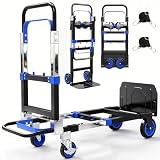
- 【3 in 1 Convertible Hand Truck】This folding 3 in 1 hand trucks is ready to use right out of the box—no assembly required! Switch between two modes in two seconds: a two-wheel upright dolly cart (220 lbs capacity) and a four-wheel platform dolly (500 lbs capacity). Equipped with 2 bungee cord to ensure secure transport, it's the ideal choice for quickly and effortlessly moving all kinds of items
- 【Durable and Sturdy Moving Dolly】Our Convertible cart dolly is crafted Heavy duty steel and chrome plating. The weight is approximately 11.7 kg (including packaging). An optimized body design , making the hand cart more durable and reliable; as well as wear-resistant, Long service life, strong bearing, making it ideal for both indoor and outdoor use
- 【Expandable Base & Adjustable Handle】This collapsible trolley features an expandable loading base surface that can accommodate larger sized items. The base can be expanded from 34" to 44". The telescopic handle is adjustable, it can be adjusted 30" to 36.6" , giving you flexibility according to your needs.In addition, there is an anti slip cover on the armrest, which can prevent hands from freezing in cold weather
- 【Silent Rubber Wheels】This Retractable dolly cart with wheels features premium rubber tires for wear resistance and slip prevention, plus two 360°swivel casters for effortless maneuverability. Suitable for all surfaces: smooth floors, rough factory floors, or uneven streets. Glides silently without leaving marks, ensuring smooth, long-lasting operation even on complex indoor/outdoor terrains. The wheels are made of silent rubber wheels, which are easy and convenient to use. No ear-splitting noise during
- 【Versatile for Any Scene】This hand truck foldable Perfect for offices, homes, food service, shopping malls, outdoor lawns, and more. Keep it in your car for whenever you need it. Its compact size lets you store it in tight spots—under beds, in closets, storage rooms, or garages—without cluttering up your space. Please follow the instruction Manual to use it
- Keep pedestrians, forklifts and delivery vehicles separated from construction traffic.
- Use high-visibility clothing and required site personal protective equipment where the project rules require it.
- Do not leave pallets, carts or packaging in an open walkway, accessible route or fire exit.
- Check weather, lighting and surface conditions for early-morning or night deliveries.
- Secure goods during a staged transfer and maintain required temperature or chain-of-custody controls.
- Record near misses, blocked access and damaged goods, then report them to the named liaison.
Ask about local coordination and support
Municipalities and business organizations sometimes provide construction bulletins, access coordination meetings or financial support, but availability and eligibility vary. Calgary describes a business-friendly construction approach and a 2024 Main Streets Business Support Grant pilot evaluated during 2025. That example shows what to ask for locally; it does not establish a grant entitlement elsewhere.
Contact your city transportation or construction office, business improvement area, chamber or equivalent organization. Ask whether there is a business contact list, weekly bulletin, delivery coordination meeting, temporary signage support or assistance for documented disruption. Verify the current program, location, eligibility and application dates before relying on it.
A phase-by-phase operating checklist
Before work begins
- Obtain the latest phase map, dates, restrictions, entrances and project contact.
- Walk the proposed vehicle and pedestrian routes.
- Confirm legal loading points and any permit requirements with the local authority.
- Send the delivery brief to every supplier and carrier.
- Set receiving shifts, security arrangements and a fallback transfer plan.
- Publish customer directions and temporary hours, if needed.
At each phase change
- Inspect signs, barriers, entrances and loading points in person.
- Replace the delivery brief and remove obsolete copies.
- Call scheduled carriers to confirm the route and window.
- Check that staff, lighting, equipment and storage are ready.
- Update customers and neighboring businesses if access differs.
When the plan fails
- Move the vehicle and people to a safe, legal location.
- Call the receiving contact and carrier dispatcher.
- Photograph or record the obstruction without entering the work zone.
- Contact the named project liaison or local authority with the exact facts.
- Reschedule, redirect or split the delivery only after confirming the alternative is lawful and staffed.
- Update the written brief so the same failure does not recur.
Common failure points and fixes
The driver follows an old map
Make the current date and phase number prominent on every instruction. Require a call if the on-site sign differs from the brief.
The approved bay is occupied
Do not double-park or block a travel lane. Use the pre-identified fallback, ask the project liaison about enforcement or a temporary alternative, and record the time and location.
The vehicle is too large for the temporary route
Confirm dimensions before dispatch. Use a smaller vehicle, split the shipment or arrange a legal transfer point only when the receiving team can handle it.
Night delivery has no safe receiver
Do not switch to off-hours solely because a local program lists a window. Provide staffing, lighting, access control and a secure receiving location first.
The Tool Desk
Outbyte PC Repair FREERepair Windows errors before they cause bigger problemsFix Now →Outbyte Driver Updater FREEScan for outdated or missing drivers - takes under a minuteDriver Scan →Hand transfer becomes unmanageable
Measure the distance and load count using a normal shipment. If the route, weight or weather makes repeated trips unsafe, renegotiate the loading point or delivery method with the project team and supplier.
Quick Recap
Product prices and availability are accurate as of the date/time indicated and are subject to change. Any price and availability information displayed on Amazon at the time of purchase will apply.

