Neither ladder is automatically safer. A stepladder is usually the safer choice when you can place it fully open on a firm, level surface and complete the work within its permitted height. An extension ladder is the appropriate choice when you must reach an elevated support or landing, but it becomes safe only when it is set at the correct angle, secured, inspected and used with a safe handhold. The job, access route, surface, electrical exposure, ladder condition and rated load determine the safer option.
U.S. OSHA rules provide required practices for construction and general industry, but they do not rank extension ladders against stepladders in a controlled comparison. Apply the rules for your work setting, follow the manufacturer’s instructions and confirm any requirements that apply in your jurisdiction.
As an Amazon Associate I earn from qualifying purchases.
The short answer: choose the ladder that matches the task
An extension ladder is non-self-supporting. It must lean against a wall, roof edge or another suitable support, so it is designed primarily for access to a higher level or for work where its reach can be safely maintained. A stepladder is self-supporting. Its front and rear sections open on their own base, making it suitable for work that can be completed from a firm, level surface without leaning the ladder against another structure.
Using the wrong type creates predictable hazards. A stepladder used folded or leaned against a wall is no longer being used as designed. An extension ladder that is too short encourages overreaching, standing on unsafe rungs or stepping sideways onto a landing. OSHA requires ladders to be used only for the purpose for which they were designed.
#1 Best Overall

- Reduced Wobble: After repeated tests, we added two new triangle stabilizers on the telescopic ladder, which can reduce the shaking amplitude from 30° to 10° and effectively improve the stability by 36% compared with the same product.
- Safety of Use: The high quality construction of the telescoping ladder ensures that each part retracts safely. Smart locking pins hold the parts in place and prevent sliding, and the ladder will retract smoothly and slowly.
- Quality Material: The sturdy frame of the telescopic ladder is made of high-quality aluminum alloy, which is resistant to wear and corrosion, rust, high and low temperatures and aging, and can withstand up to 330 pounds of weight.
- Multi-Scene Application: Changing light bulbs and going up to the attic indoors, or repairing roofs or climbing into RVs outdoors, our aluminum retractable ladders can be used in any scenario where you need a ladder.
- Easy Portability and Storage: Retractable ladder, tied with a fixed belt, easily pick up, no matter where to take it is very convenient. The ladder 19 * 33 size can also be placed in the trunk or in various corners of the house at will.
| Question | Stepladder | Extension ladder |
|---|---|---|
| Does it support itself? | Yes, when fully opened and locked. | No; it relies on a stable upper support and a stable base. |
| Best access pattern | Work within the ladder’s height and reach from the floor. | Reach an elevated support, roof edge or landing, or work along a vertical surface. |
| Main setup issue | Opening the sections completely and engaging the spreader or locking device. | Correct angle, adequate top support, stable footing and securing against movement. |
| Typical misuse | Standing on the top or top step, climbing rear bracing not designed for climbing, or using it partially open. | Setting it too steep or too shallow, failing to secure it, or transferring to a landing without adequate rail extension. |
There is no OSHA statistic showing that one category has a lower overall injury rate than the other. Safety comes from matching the equipment and setup to the work.
When a stepladder is the safer choice
Choose a stepladder for self-supported, short-reach work
Use a stepladder when the work can be performed from a position directly above its footprint and you do not need to reach a roof, mezzanine, scaffold or other elevated landing. Examples include installing a light fixture in a room, painting a limited wall area, accessing a low ceiling or completing interior finish work.
The floor or ground must be firm and level. Do not compensate for an uneven base by placing blocks, loose boards or other objects under a leg. If the surface cannot support all feet evenly, relocate the work, correct the surface or use equipment designed for that condition.
Quick wins for a faster PC:
Fix the driver behind crashes, sound loss and screen glitchesFind Drivers →Repair Windows errors before they cause bigger problemsFix Now →Scan for outdated or missing drivers - takes under a minuteDriver Scan →Open every section and engage the safety device
OSHA 29 CFR 1926.1053(a)(8) requires a metal spreader or locking device on each stepladder to hold the front and back sections open while it is being used. Open the ladder completely and verify that the spreaders, hinges and locks have engaged before climbing. A ladder that appears open but has not locked can fold unexpectedly.
Stay off prohibited steps and rails
The construction standard prohibits using the top or top step as a step. OSHA field guidance also advises selecting a stepladder so the worker is not required to use the top two steps. Keep your torso between the side rails rather than leaning out to reach. If the task requires standing on a prohibited step or repeated side-reaching, select a taller ladder or change the work method.
Do not climb the rear cross-bracing unless the ladder is specifically designed and equipped for climbing on both sections. Bracing is not automatically a set of climbing rungs. Check the labels and manufacturer’s instructions for the ladder’s permitted climbing surfaces.
Rank #2
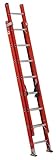
- NON-CONDUCTIVE: Crafted with fiberglass for non-conductive safety assurance, this extension ladder combines strength and durability.
- MAXLOCK RUNG LOCK: Engineered with your safety in mind, custom engineered specifically for our extension ladders from a patented, advanced molecular polymer.
- QUICKLATCH SYSTEM: Seamlessly offers a straightforward and intuitive solution for our extension ladders, securing both the fly and base sections during extension.
- SAFE AND STABLE: Steel Swivel Safety Shoe with metal shield specifically designed for extension ladders, ensures stability and safety even on uneven surfaces.
- STURDY AND STRONG: With its 300-Pound capacity, elegant design and smooth finish, you won’t find a more durable, reliable 16-foot Extension Ladder.
When an extension ladder is the safer choice
Use it when the work requires elevated access
An extension ladder is appropriate when you must reach a roof edge, upper landing or other elevated support that cannot be reached from a self-supporting ladder. It may also be appropriate for exterior work along a wall when the ladder can be placed and secured without exposing the worker to unstable ground, traffic or overhead hazards.
Choose a ladder long enough to provide the required access without standing on prohibited rungs or stretching beyond the side rails. OSHA’s field manual says an extension ladder should be taller than the point of support. A ladder that barely reaches the support leaves little room for a safe handhold and can force an unsafe transfer.
Set the angle using the construction 4:1 rule
For construction work, OSHA 29 CFR 1926.1053(b)(5)(i) requires a non-self-supporting ladder to be used at an angle where the horizontal distance from the top support to the foot is approximately one-quarter of the ladder’s working length. In practical terms, for every four units of vertical working length, place the feet about one unit away from the support. The working length is the distance along the ladder between the foot and the top support, not simply the ladder’s overall label length.
Measure from the upper support to the point where the feet rest. If that distance is too small, the ladder is too steep and can tip backward; if it is too large, the feet can slide outward. The 4:1 relationship is an approximately rule for the construction standard, not permission to ignore the surface, manufacturer limits or site-specific hazards.
Secure the ladder at the top and base
A non-self-supporting ladder must have a stable upper support and a base that cannot slide. OSHA requires portable ladders on slippery surfaces to be secured and stabilized. Tie, block or otherwise secure the ladder using a method appropriate to the structure and the manufacturer’s instructions. A coworker holding the ladder can help during placement, but should not be treated as the sole long-term substitute for securing it when the work requires both hands.
Windows Errors? Fix Them Before They Spread
Repair common Windows errors and clear accumulated junk for a smoother, more stable PC - no reinstall needed.Free scan · no reinstallCrashes, No Sound, or Screen Glitches?
Random freezes, missing sound and display glitches usually trace back to one bad driver. Find and replace yours safely.Free scan · under a minuteDo not rest the rails on a weak, movable or deflecting surface. Check that the support can carry the imposed load and will not shift when the worker climbs or transfers. Keep the feet clear of doors, vehicle paths, loose materials and areas where another worker could move the ladder.
Rank #3

- NON-CONDUCTIVE: Crafted with fiberglass for non-conductive safety assurance, this extension ladder combines strength and durability.
- MAXLOCK RUNG LOCK: Engineered with your safety in mind, custom engineered specifically for our extension ladders from a patented, advanced molecular polymer.
- QUICKLATCH SYSTEM: Seamlessly offers a straightforward and intuitive solution for our extension ladders, securing both the fly and base sections during extension.
- SAFE AND STABLE: Steel Swivel Safety Shoe with metal shield specifically designed for extension ladders, ensures stability and safety even on uneven surfaces.
- STURDY AND STRONG: With its 300-Pound capacity, elegant design and smooth finish, you won’t find a more durable, reliable 16-foot Extension Ladder.
Reaching an upper landing or roof
Provide the required rail extension
When an extension ladder is used to access an upper landing, OSHA’s construction rule generally requires the side rails to extend at least three feet above the landing. The extension gives the worker a handhold while stepping on or off the ladder. It is not a recommendation to step onto a roof from a ladder that ends level with the edge.
Use the alternative when three feet is impossible
If the ladder is too short to provide the three-foot extension, the construction rule specifies an alternative: secure the top to a rigid support that will not deflect and provide a grasping device to help with the transfer. This is a specific exception, not a reason to use an unsecured short ladder. Plan the transfer before climbing, and do not improvise a handhold from loose material.
Make the transfer deliberately
- Confirm that the landing is strong, clear and wide enough for a stable step.
- Verify that the ladder is secured and that both rails extend as required, or that the permitted alternative has been installed.
- Face the ladder and maintain three points of contact while moving through the transfer.
- Do not carry bulky materials in your hands; use a hoist, tool belt or another method that preserves your handhold.
- Return to the ladder facing it rather than jumping or turning sideways at the edge.
How to decide for a particular job
| Decision question | If the answer is yes | What to do |
|---|---|---|
| Must you reach a roof, mezzanine or other elevated landing? | The task involves a landing transfer. | Use an extension ladder only if the 4:1 setup, securing and three-foot extension (or the specified alternative) can be achieved. |
| Can all work be completed from a ladder that stands on its own? | No landing transfer is needed. | A fully opened stepladder may be the better fit, provided the surface and height are suitable. |
| Would you need the top step, top of the ladder or excessive side reach? | The selected ladder does not provide enough safe working height. | Choose a taller or differently configured ladder; do not use prohibited steps or lean outside the rails. |
| Is the base slippery, uneven, soft or exposed to traffic? | The ladder can move or sink. | Stabilize or secure it using an approved method, improve the surface or choose another access method. |
| Could the ladder or worker contact exposed energized equipment? | There is an electrical exposure. | Use nonconductive side rails as required by OSHA’s construction rule and control the electrical hazard before climbing. |
| Are any rails, rungs, feet, locks, hinges or spreaders damaged? | The ladder has a defect. | Do not use it. Tag and remove it from service until repaired or replaced. |
Inspection before climbing
Check the ladder itself
OSHA construction guidance recommends looking for broken or cracked parts before each use. Inspect both ladder types for:
What’s actually slowing this PC down?
Pick the symptom - the matching free tool is one click away.
- Bent, split, cracked or corroded side rails.
- Loose, missing, bent or contaminated rungs and steps.
- Worn or missing nonslip feet.
- Damaged extension locks, guides, ropes or pulleys.
- Stepladder hinges, spreaders and locking devices that do not engage fully.
- Oil, mud, wet paint or other contamination that can reduce grip.
- Missing, unreadable or contradictory capacity and use labels.
Do not attempt an improvised field repair. A defective ladder must be tagged and removed from service until it is repaired or replaced in accordance with the applicable rule and manufacturer’s requirements.
Check the environment
- Look above for electrical lines, exposed energized equipment, falling objects and low overhead obstructions.
- Look below for soft soil, ice, water, debris, holes and slippery coatings.
- Control doors, gates, vehicles and pedestrian traffic that could strike the ladder.
- Ensure lighting is adequate and that the work area will remain clear during the task.
- Confirm that weather, wind and rain do not make the setup unstable.
Confirm the load
Stay within the ladder’s rated capacity. Count your body weight, clothing, tools and materials. Do not assume that a larger-looking ladder has a higher rating. OSHA guidance warns against exceeding the intended load, and the manufacturer’s label controls the ladder’s capacity and use limitations.
Inspection timing and workplace rules
Requirements differ by work setting. OSHA’s general-industry rule, 29 CFR 1910.23, requires inspection before initial use in each work shift and more often as necessary. A ladder with defects must be tagged and removed from service until it is repaired or replaced. OSHA construction requirements and guidance emphasize checking before each use and removing defective equipment. A construction site may impose additional employer or project rules.
Rank #4
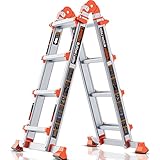
- REINFORCED AND THICKENED UPGRADE, More secure and reliable aluminum ladders, aluminum thickness of 2mm, is double the thickness of other Multi Position Ladders on the market, the weight therefore increased but will not affect its portability, more secure security escort to you
- PRACTICAL AND FLEXIBLE, Multi Position Ladder can be quickly converted into different types of ladders: extended A frame ladder, stair ladders, tall ladders, outdoor long ladders, Storable folding ladders, thus improving efficiency for different work needs
- BALANCE UPGRADE, With 2 Anti-slip balance bars, effectively strengthen the stability of the ladders, with sloping mesh design, more grip, more stable and solid than other Multi Position Ladder, and the soft pad will not wear the floor and walls
- DETAILS UPGRADE, The whole body of the ladder aluminum manufacturing, we use high-strength plastic components wrapped local metal, metal edge polishing and plastic protection, effectively prevent the use of being cut
- SAFETY CERTIFICATION, EN131 standards and ANSI standards. ISO9001 BSCI GS TUV facility certification. our reinforced thickened aluminum Multi Position Ladder easily load 300 pounds, experimental testing load up to 450KG, please pay attention to identify other inferior ladders, responsible for safety
These are U.S. OSHA provisions. They do not automatically establish the law for residential work, another country or a different regulatory authority. Identify which standard governs your job, then follow the stricter site requirement when instructed by your employer or safety plan.
Electrical and material considerations
Control electrical exposure first
OSHA’s construction rule requires nonconductive side rails when the worker or ladder could contact exposed, energized electrical equipment, subject to the rule’s stated exceptions. “Nonconductive” does not make a ladder safe to place against or near energized equipment. De-energize, isolate or maintain the required clearance according to the electrical safety procedure before setting up the ladder.
Choose material for the environment, not appearance
Material affects electrical exposure, weight, durability and handling. The safe choice depends on the site hazard and the ladder’s label, not on whether the ladder feels heavy or rigid. A ladder that is difficult to carry can create handling risks during setup, while a ladder that is too light for the conditions may be easier to move accidentally. Check the manufacturer’s instructions for material-specific restrictions.
Independent reader supportYour contribution helps us test, update, and keep practical guides available for everyone.Common failure modes and corrections
The extension ladder slides at the feet
Stop climbing. Descend while maintaining control if it is safe to do so, then secure and stabilize the base. Recheck the 4:1 angle and remove mud, water or debris. Do not rely on a person’s hands as the only control for a ladder that must remain stable during two-handed work.
The top support flexes or shifts
Do not use that support. Move the ladder to a rigid support that will not deflect, or select another access method. A correct angle cannot compensate for a weak upper contact point.
The stepladder rocks
Close it, move it to a firm level surface and reopen it fully. Confirm that all feet contact the surface and that the spreader or locking device is engaged. Never level a stepladder with loose objects.
Best Value

- 🏗️【High-Strength Aluminum, Holds Up to 330 lb】Built with high-strength 6063 aluminum alloy with an oxidized surface, holds up to 330 lb. Resists wear, corrosion, rust, and aging. Reinforced nylon fiber in plastic parts enhances strength. Features 40 cm (15.7 inch) step spacing. Lightweight at only 35 lb.
- 🔗【Detachable Top Hooks & Non-Slip Feet for Secure Fixing】Equipped with 2 detachable hooks that securely grip roof edges, gutters, or wall tops — greatly increasing stability on attics, lofts, roofs, RVs, and trees. Non-slip bottom caps and angled feet protect your safety during use. For indoor use, simply turn the hooks toward you. Need more storage space? Remove the hooks in seconds.
- 🔒【Two Locks Per Rung, Prevents Pinching & Collapse】Each rung features two independent auto-locking mechanisms. You’ll hear a solid “click” when they lock — your clear signal that the ladder is secure. Helps prevent accidental collapse and pinching, while allowing flexible height adjustment.
- 🧳【Lightweight & Portable, Fits Anywhere】Lightweight at only 35 lb and folds down to just 19″×3.7″×42″. Includes storage straps and a carrying handle for easy transport. Toss it in your car trunk, slide it under your bed, or stand it in a closet corner. No more bulky ladders eating up your space.
- 🏠【One Ladder for Roof, Attic, and Job Site】From roof repairs and second-story window cleaning to warehouse shelving and RV roof access — this ladder reaches up to 20.3FT, going where others can‘t. Need something mid-height? Just extend the bottom few sections where you stand, no need to open it all the way.
The job requires the top step
Stop and reassess the ladder height. Use a taller stepladder or another approved access system. Standing on the top or top step is prohibited under the construction rule.
The ladder is too short for a roof transfer
Do not climb it to the edge and step across. Obtain a ladder that extends at least three feet above the landing, or implement the construction rule’s alternative with a rigid support and grasping device when the extension is impossible.
A defect is found after setup
Descend, mark the ladder as defective and remove it from service. Do not continue because the defect appears minor or because the ladder is already in position.
Recommended Free Tools
A practical setup sequence
For a stepladder
- Choose a ladder whose rated capacity covers the worker, clothing, tools and materials.
- Inspect rails, steps, feet, hinges, spreaders and labels.
- Clear the work area and check for electrical, overhead and traffic hazards.
- Place all four feet on a firm, level surface.
- Open the front and rear sections completely.
- Engage and verify the spreader or locking device.
- Climb only the permitted steps, face the ladder and keep your body between the rails.
- Descend and reposition instead of leaning or walking the ladder while occupied.
For an extension ladder
- Select a length that reaches the support and allows a safe handhold without prohibited standing positions.
- Inspect rails, rungs, feet, locks, rope, guides and labels.
- Survey overhead electrical hazards, traffic, doors, weather and the ground surface.
- Place the feet approximately one-quarter of the working length from the upper support for construction work.
- Set the rails against a rigid support that will not deflect.
- Secure the base and top against slipping or movement.
- For a landing transfer, confirm at least three feet of rail above the landing, or install the specified rigid-support and grasping-device alternative when the ladder is too short.
- Climb facing the ladder, maintain three points of contact and keep tools from occupying both hands.
What “safer” means in the real decision
A stepladder generally reduces setup complexity because it does not depend on an upper support or an angle calculation. That advantage exists only when it is fully open, locked, level and tall enough for the task. An extension ladder can provide the access a stepladder cannot, but its safety depends on correct geometry, secure contact at both ends and a planned landing transfer.
If a task can be completed from a properly positioned stepladder without using the top two steps, that configuration may avoid the additional hazards of leaning, securing and transferring. If the task requires elevated access, forcing a stepladder to substitute for an extension ladder is not safer. Select the extension ladder and complete the full setup instead.
Quick Recap
Final jobsite checklist
- The ladder type matches the task and is being used only as designed.
- The selected height permits a safe handhold and avoids prohibited steps.
- The ladder is rated for the complete load.
- Rails, rungs, feet, locks, hinges and spreaders are intact.
- The base is firm, level and protected from slipping, traffic and doors.
- An extension ladder is set at approximately 4:1 for construction work and secured at the top and base.
- A landing transfer has three feet of rail above the landing, or the specified alternative is installed.
- Electrical exposure is controlled and nonconductive rails are used where required.
- The worker can climb and descend facing the ladder with three points of contact.
- Any defective ladder is tagged and removed from service.
Product prices and availability are accurate as of the date/time indicated and are subject to change. Any price and availability information displayed on Amazon at the time of purchase will apply.

