PC Slower Than It Used to Be?
A free scan shows the junk files, broken settings and background clutter dragging Windows down - then fixes them in one click.Free scan · Windows 10 & 11Crashes, No Sound, or Screen Glitches?
Random freezes, missing sound and display glitches usually trace back to one bad driver. Find and replace yours safely.Free scan · under a minuteThe most economical, energy-efficient roof assembly is the one that meets your jurisdiction’s insulation and air-control requirements, limits moisture and thermal bridging, suits the roof slope and climate, and delivers acceptable life-cycle cost—not simply the roof with the brightest surface. Compare the complete assembly: deck, insulation type and location, air and vapor control, membrane or covering, drainage, solar reflectance, thermal emittance, installation cost, maintenance, and replacement timing.
In warm or hot climates, the U.S. Department of Energy (DOE) says replacing a conventional roof with a cool roof can reduce annual air-conditioning energy use in a single-story building by up to 15%. That is a conditional upper bound, not a promise for every building. Winter heating can rise because a reflective roof rejects solar heat, although DOE says the penalty may be smaller than summer cooling savings even in mixed climates.
As an Amazon Associate I earn from qualifying purchases.
What makes a roof assembly economical and energy-efficient?
Roof energy performance comes from how the parts work together. A high-R-value insulation layer can underperform if it is interrupted by fasteners, parapets, curbs, structural members, or poorly sealed penetrations. A reflective membrane can reduce solar heat gain but cannot correct condensation caused by an incomplete vapor-control strategy. A low first-cost system can become expensive if it needs frequent cleaning, has a short service life, or forces premature replacement.
Evaluate each candidate against six questions:
- Climate and geometry: Is the project warm/hot, mixed, or cold, and is the roof low-slope or steep-slope?
- Thermal performance: What assembly R-value or U-factor is required and what value will the installed system achieve? Where is insulation placed, and are thermal bridges addressed?
- Surface behavior: What are the initial and aged solar-reflectance and thermal-emittance values?
- Water, air, and vapor control: How will the design handle deck moisture, condensation, air-barrier continuity, drainage, and penetrations?
- Economics: What are the installed first cost, expected energy effects, cleaning needs, service-life assumptions, and replacement dates?
- Compliance and constructability: Can the design be documented, inspected, and installed as a compatible roof system under the locally adopted code?
Use project bids and building-specific modeling for the financial decision. No universal installed price or payback period applies to every roof assembly.
#1 Best Overall
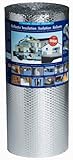
- Reflective insulation for use in a crawl space, attic, wall, metal buildings and post and frame structures
- Fiber free, environmentally safe, easy to install and lightweight
- Made up of seven layers, two outer layers of aluminum foil reflect most of the heat which hits them
- Each layer of foil is bonded to a tough layer of polyethylene for strength
- Two inner layers of bubble pack resist heat flow, while a center layer of polyethylene gives additional strength
How cool roofs affect energy use
A cool roof reflects more incoming sunlight and emits absorbed heat more effectively than a conventional dark surface. DOE’s 2021 Consumer Guide to Cool Roofs evaluates these properties on scales from 0 to 1:
- Solar reflectance: the fraction of sunlight reflected away; higher values mean less solar heat is absorbed.
- Thermal emittance: the ability of the surface to radiate absorbed heat; higher values generally keep the roof cooler.
Look at both values and ask for aged as well as initial performance when available. Dirt, weathering, biological growth, and surface wear can change reflectance over time. DOE says the energy result depends on climate and building characteristics, including the cooling and heating loads, roof area, insulation, and existing system.
In warm or hot climates, the potential cooling benefit is most relevant. DOE’s stated upper bound is up to 15% lower annual air-conditioning energy use for a single-story building when a cool roof replaces a conventional roof. That figure should be treated as conditional guidance rather than a guaranteed project result. In mixed climates, a reflective roof can increase winter heating demand by rejecting sunlight that would otherwise warm the building. Model both seasons before assigning a savings value.
Rank #2

- 1,000 SQUARE FEET PER ROLL: Our insulation foil roll measures 250 feet in length and is 4 feet wide. This gives you 1,000 square feet of reflective insulation roll. Studies have shown that aluminum reflective barrier can result in a noticeable temperature drop in your home during the summer. It can also help reduce cooling costs by 10-45% depending on your climate region.
- HIGHLY REFLECTIVE: 99.7% Reflective Value. Double-sided and tear-resistant, our foil’s material is highly reflective to reflect radiant heat rather than absorb it. The industrialized strength foil is remarkably thin to the touch. It is designed to withstand heavy handling without tearing, puncturing, or overly wrinkling. Cuts easily with utility scissors so you can install it properly with ease with no special tools or protective equipment required.
- EASY TO MAINTAIN: Works for both new and pre-existing house and buildings. The material is unaffected by humidity and climate changes so no further maintenance is required upon installation. This insulation foil is a superior alternative to bulky insulation such as foil-faced bubble wrap.
- ASTM COMPLIANT: Meets the American Society for Testing and Materials (ASTM) fire and smoke safety requirements of most state and local building codes, as well as the breathability standards for building materials. Class A/ Class 1 fire rating. E2599 fire code, radiant sheet barrier classification (C1313), FIRE/SMOKE (ASTM E-84). Meets breathability requirements for building materials (ASTM 96-00).
- SIMPLE HANDLING: Although our reflective roll insulation is strong and mighty enough to properly assist in insulating your desired area, it is also light enough for perfectly easy installation. All help, no hassle.
Roof products by slope and assembly type
Surface choices depend on roof geometry and the rest of the system. DOE identifies the following categories:
| Roof form | Cool-roof categories identified by DOE | Design questions |
|---|---|---|
| Low-slope | Thermoplastic membranes, elastomeric coatings, and metal products | Will the membrane or coating remain compatible with the substrate, seams, flashings, and expected maintenance? How will penetrations and drainage be detailed? |
| Steep-slope | Cool asphalt shingles, clay tile, concrete tile, and metal products | Does the covering provide the required weather protection and ventilation strategy at the roof pitch? Are reflectance and emittance ratings available for the selected color and finish? |
A cool surface is not a substitute for continuous insulation or a sealed air barrier. For any of these categories, specify the entire tested or engineered assembly, not just a product color.
Insulation R-value: how to determine what is required
There is no single roof-insulation R-value that applies to every building. The requirement depends on the adopted energy code, climate zone, occupancy and scope, roof construction, and whether the work is new construction, an addition, or reroofing. The final design may be expressed as a minimum insulation R-value, a maximum U-factor, or an approved performance path.
Rank #3

- Premium Material: The double-sided insulation roll is made of high-quality reflective aluminum film and polyethylene air bubble cushion, with a surface round hole design to increase reflectivity. The RV window insulation is durable and long-lasting, resistant to scratches.
- Temperature Protection: The reflective insulation roll reduces heat transfer for year-round comfort, while the reflective bubble sheet provides energy-saving, window insulation and privacy protection.
- Excellent Performance: The window insulation for summer has excellent waterproof performance, allowing worry-free outdoor use. It is easy to clean with a simple wipe. When not in use, it can be easily folded up for space-saving and convenient carrying.
- Wide Usage: Our insulation sheet is versatile and can be used for various spaces, including windows, RVs, roofs, garage doors, and more as a heat blocker.
- Easy Installation: The usage of the foil insulation roll is easy and convenient. Simply cut it to the desired size with a utility knife or scissors, then use the provided double-sided tape for easy installation.
Start with the adopted code
DOE identifies the International Energy Conservation Code (IECC) and ASHRAE 90.1 as widely used commercial model codes. DOE’s cited page lists ASHRAE 90.1-2022 as the current edition there, but a project must follow the edition and amendments adopted by its authority having jurisdiction. Confirm the applicable edition, climate zone, roof category, and exceptions with the code official or the project’s energy-code consultant.
What’s actually slowing this PC down?
Pick the symptom - the matching free tool is one click away.
Document location and continuity
NRCA’s review of the 2024 IECC commercial provisions says construction documents should identify insulation material and R-value. The review describes documenting whether insulation is above the deck, integral to the deck, or below the deck, along with required thermal-bridge mitigation and air-leakage controls. It also describes two layers of above-deck insulation boards with staggered edge joints and a continuous air-barrier position with sealed transitions. Those details are part of the cited NRCA review; verify whether the 2024 IECC is actually adopted for your project before treating them as binding.
When comparing bids, ask for the assembly R-value or U-factor, board thicknesses, joint layout, fastener pattern, cover board, membrane, and air-barrier interfaces. A nominal insulation number is not enough if gaps, compression, or thermal bridges reduce the installed performance.
Rank #4

- Summer Heat Block & Winter Warmth Retention: Install on the outside to reflect sunlight and block summer heat, keeping interiors cooler. Install on the inside to trap warmth and reduce heat loss during winter, helping maintain a cozy indoor environment
- Triple-Layer Reflective Insulation Technology: Each panel features reflective aluminum foil on both sides with a polyethylene bubble core in the middle, reflecting up to 95% of radiant heat for excellent summer heat blockage
- Pre-Cut 16-Panel Set for Easy Installation: This kit includes 16 pre-cut panels sized 24" x 48" each. The panels are folded for shipping, so slight creases may appear but will not affect performance. Simply cut to your desired size and fit them into your garage door sections
- Versatile Application Beyond Garage Doors: Works great for windows, walls, RVs, attics, roofs, campers, sheds, water heaters, pipes, and crawl spaces
- Easy DIY Installation: Lightweight and easy to cut with scissors. Waterproof, odorless, and reusable. Clean surface first and attach using double-sided tape
Moisture, vapor, and air control on concrete decks
Concrete roof decks can retain construction moisture. That moisture can alter the vapor-control strategy, raise condensation risk, and affect insulation and membrane compatibility. For new or reroofed concrete decks, NRCA advises using a low-perm vapor retarder directly over the deck when adequate dryness cannot reasonably be ensured. The design should also minimize products with organic content where deck moisture could infiltrate.
NRCA technical-services vice president Mark S. Graham’s cited guidance states: “Coated, fiberglass mat-faced polyisocyanurate insulation is preferred over fiberglass-reinforced, cellulosic mat-faced polyisocyanurate in concrete roof deck applications.” This recommendation is limited to the concrete-deck application discussed by NRCA; it is not a universal ranking of all polyiso products or all roof decks.
Free tools Windows power users keep installed
One-click scans. No signup required.
Field checks before closing the assembly
- Confirm the deck is within the moisture condition required by the roof-system manufacturer.
- Verify vapor-retarder location and continuity at parapets, curbs, drains, and penetrations.
- Seal air-barrier laps, fasteners, edge transitions, and service openings according to the approved details.
- Prevent wet insulation from being enclosed; document damaged or replaced boards.
- Coordinate membrane, adhesive, fastener, cover-board, and flashing compatibility as one system.
How to compare first cost and life-cycle cost
Cool-roof economics depend on climate, building characteristics, long-term reflectance and emittance, incremental first cost, and any added cleaning cost. DOE states in its guide: “It is rarely economical to replace a mechanically sound roof just to increase its solar reflectance.” If an existing roof is sound, coordinate a reflective upgrade with normal replacement, recoating, or other planned work instead of assuming a stand-alone replacement will pay back.
Best Value

- Ships in 10 linear foot section for easy handling and flexibility.
- Roll Width & Thickness/Weight: 60" width, 1.65 inches (44mm) thick, 0.95 lbs/cubic foot
- R-Value: 5.45 per inch (RSI 0.96) / FMVSS 302 certified Engineered for Vehicles
- Moisture Resistance: Exceptional moisture resistance, no need for additional waterproof layers, resistant to odors
- Lightweight & Easy to Install: Made from lightweight polyester and polypropylene fibers, easy to die-cut, heat seal, and bond to substrates
For a new roof or scheduled reroof, request comparable proposals that show:
- Installed cost for the complete assembly, including insulation, cover board, membrane or covering, flashings, drains, edge metal, and access provisions.
- Energy assumptions: local utility rates, cooling and heating loads, operating hours, and modeled reflectance and emittance over time.
- Cleaning, recoating, inspection, and repair intervals, including access and safety costs.
- Expected service life and the date or condition that would trigger replacement.
- Any premium for additional insulation, vapor control, thermal-bridge treatment, or higher-performance surface finishes.
DOE’s national comparison of ASHRAE 90.1-2022 with the prior edition estimated 9.8% site-energy savings, 9.4% source-energy savings, and 8.9% energy-cost savings for commercial buildings. Those are whole-code national estimates, not roof-only savings and not a project payback calculation. For an individual building, use local energy prices, actual bids, replacement timing, and building-specific modeling.
Independent reader supportYour contribution helps us test, update, and keep practical guides available for everyone.A practical selection process
- Define the project baseline. Record location and climate zone, roof slope, deck type and condition, conditioned floor area, existing insulation, HVAC system, utility tariffs, and whether the work is new construction or reroofing.
- Identify the governing requirements. Confirm the adopted IECC or ASHRAE edition, local amendments, fire and wind provisions, roof-system standards, documentation requirements, and inspection process.
- Set thermal targets. Establish the required R-value or U-factor, insulation location, thermal-bridge strategy, and air-barrier path before selecting a membrane or finish.
- Screen moisture risks. Determine deck dryness, vapor-retarder position, interior humidity, condensation potential, drainage, and the treatment of penetrations and transitions.
- Shortlist compatible surface systems. Use low-slope or steep-slope categories appropriate to the geometry. Compare initial and aged reflectance and emittance, warranty conditions, cleaning requirements, and color-specific ratings.
- Obtain apples-to-apples bids. Require contractors to price the same insulation thickness, board layers, cover board, membrane or covering, flashings, edge details, accessories, and disposal scope.
- Model energy and cost. Include summer cooling, winter heating, local tariffs, maintenance, and replacement timing. Do not transfer a national code-savings percentage directly to the roof.
- Review constructability. Check sequencing, temporary dry-in, substrate moisture, fastening or adhesive limitations, penetrations, rooftop equipment, and inspection hold points.
- Approve a documented assembly. Keep product data, aged-performance information where available, shop drawings, air-barrier details, insulation layout, and inspection records with the construction documents.
Using the NRCA EnergyWise Roof Calculator
NRCA’s EnergyWise Roof Calculator lets users build roof assemblies graphically, assess thermal performance, and estimate assembly energy costs. It includes minimum insulation requirements for listed IECC and ASHRAE editions, making it useful for comparing insulation locations and conceptual alternatives.
Use it as a screening tool, not as a whole-building simulation. NRCA cautions that the calculator omits solar heat gain and exterior shading, and its annual energy cost represents the roof assembly rather than the building’s total energy bill. For complex buildings, involve an experienced mechanical engineer; detailed financial analysis may also require an accountant. Record the inputs and assumptions so the design team can reconcile calculator results with the energy model and contractor bids.
When a reflective reroof is—and is not—worth considering
Usually worth evaluating during planned replacement
- The building is in a warm or hot climate with substantial cooling demand.
- The roof is already due for replacement or recoating.
- The proposed surface has documented reflectance and emittance that remain suitable after weathering.
- The added cost is modest compared with the planned work and the assembly remains compatible with insulation, drainage, and flashing details.
Usually difficult to justify as a stand-alone project
- The existing roof is mechanically sound and has significant remaining service life.
- The building has low cooling demand or substantial winter heating exposure.
- The expected energy effect is smaller than the cost of removal, replacement, cleaning, and disruption.
- No reliable project-specific model or local bid supports the assumed payback.
In those cases, improve air sealing, insulation continuity, controls, shading, or maintenance at the next planned roof intervention if those measures produce a better risk-adjusted return.
Quick Recap
Common design and procurement mistakes
- Choosing by color alone: Surface color does not establish the full solar-reflectance and thermal-emittance performance of a roof product.
- Quoting an R-value without an assembly: Interruptions, compression, fasteners, and thermal bridges can change installed performance.
- Assuming a model-code number is local law: Adoption, amendments, edition, and project scope control the actual requirement.
- Ignoring moisture during reroofing: Wet concrete decks and enclosed wet insulation can create condensation and durability problems.
- Comparing incomplete bids: Excluding edge metal, flashings, cover boards, drains, or disposal makes apparent first-cost differences misleading.
- Using roof-only savings as a building forecast: A calculator estimate or national code percentage does not represent the total utility bill.
- Overlooking maintenance: Dirt and biological growth can reduce surface performance; include inspection and cleaning in the life-cycle comparison.
Decision checklist for owners and designers
- Have climate, roof slope, deck type, occupancy, HVAC, and utility rates been documented?
- Is the adopted energy-code edition and local amendment set confirmed?
- Are insulation material, R-value or U-factor, location, joints, and thermal-bridge details shown?
- Is the air barrier continuous, with sealed penetrations and transitions?
- Has concrete-deck moisture been measured or otherwise addressed?
- Are vapor-retarder and condensation-control assumptions explicit?
- Are initial and aged solar-reflectance and thermal-emittance values available for the selected finish?
- Do bids include every roof-system component and a comparable warranty and maintenance scope?
- Does the economic model include heating penalties, cleaning, replacement timing, and local energy prices?
- Has an independent engineer reviewed unusual loads, humidity, equipment density, or complex geometry?
Product prices and availability are accurate as of the date/time indicated and are subject to change. Any price and availability information displayed on Amazon at the time of purchase will apply.

