For most critical data centres, the strongest design is layered rather than choosing one replacement for another: a battery UPS provides instantaneous ride-through, while a diesel generator or hydrogen fuel-cell system supplies longer-duration power. Diesel remains the established, comparatively low-cost option for extended outages. Lithium-ion batteries are quiet and have no on-site combustion, but their cost and footprint increase sharply as runtime grows. PEM hydrogen fuel cells can reduce local air emissions and noise, yet depend on hydrogen storage, delivery, permitting and a business case that is still highly sensitive to equipment and fuel prices.
The right choice depends on outage duration, load shape, redundancy tier, local air rules, available space, fuel logistics and the carbon intensity of both electricity and fuel. This comparison explains where each technology fits in a data-centre power architecture and how to specify, build and test it.
As an Amazon Associate I earn from qualifying purchases.
What backup-power system does a data centre actually need?
A data centre normally needs two different capabilities: instantaneous continuity while utility power is lost or transferred, and sustained generation for an outage lasting many hours or days. Treating those as one problem often produces an oversized, inefficient or difficult-to-permit system.
- Ride-through: Power must remain within the IT equipment’s voltage and frequency limits during the first milliseconds and seconds after a utility disturbance.
- Transfer and start: A standby source must start, synchronize and accept load without dropping critical buses.
- Extended operation: The facility needs enough stored energy or fuel, refuelling access and maintenance coverage for the expected outage duration.
- Redundancy: Tier objectives determine whether equipment is configured as capacity (N), N+1, 2N or another arrangement, and whether maintenance can occur without interrupting the critical load.
That is why a battery UPS commonly sits upstream of a generator or fuel cell. The battery handles the immediate event; the longer-duration source takes over once it is stable. The same control pattern can pair batteries with fuel cells.
#1 Best Overall

- Robust and Portable: The generator features a sturdy steel frame with an integrated lifting eye, making it easy to transport and secure on the jobsite. It's a reliable power source for both remote locations and professional use
- Clean and Smooth Operation: With only 6% total harmonic distortion, this generator ensures the smooth operation of tools, appliances, and even sensitive electronics, offering peace of mind for your power needs
- Extended Runtime: The XD5000E from Generac features a 12-gallon diesel fuel tank provides an impressive run-time of 32.4 hours at 50% load, minimizing the need for frequent refueling and ensuring uninterrupted power supply for extended periods
- Industrial-Grade Diesel Engine: Equipped with a Yanmar LW Series 435cc air-cooled direct injection diesel engine, this generator is built to withstand heavy-duty use and provide reliable performance even in demanding environments
- Durable and Strong: The 1-1/4-inch steel cradle adds strength and durability to the generator, ensuring it can handle the rigors of the job site or other challenging situations. A dependable power source engineered to keep running when you need it most
At-a-glance comparison
| Criterion | Diesel generator | Lithium-ion UPS/BESS | PEM hydrogen fuel cell |
|---|---|---|---|
| Typical role | Long-duration standby generation | Instant ride-through, short-duration backup and peak management | Longer-duration generation with low local combustion emissions |
| Response | Requires engine start, synchronization and load acceptance | Immediate electronic response | Fast electrical response once the system is operating; still requires controls and hydrogen supply |
| Runtime | Hours to days, limited mainly by tank capacity and deliveries | Milliseconds to hours; 24-hour operation is generally uneconomic and space-intensive | Hours to days, limited by hydrogen storage and deliveries |
| On-site combustion emissions | Yes; air-quality compliance is required | None during discharge | No combustion at the stack; upstream emissions depend on how hydrogen is produced |
| Noise | High without substantial acoustic treatment | Very low | Lower than a running diesel engine, but balance-of-plant equipment still produces noise |
| Low-load behaviour | Efficiency falls at light load, requiring load management or a larger operating set | Efficient over a broad electrical range, subject to conversion losses and battery limits | Depends on stack and balance-of-plant design; operating strategy matters |
| Fuel or charging logistics | Bulk liquid-fuel tanks, testing and dependable delivery contracts | Utility charging, electrical infrastructure and eventual battery replacement | Hydrogen storage, delivery, detection, pressure management and permitting |
| Maintenance | Routine engine servicing, fuel testing, exercising and overhauls | Monitoring, thermal management, power-electronics service and battery replacement planning | Stack and balance-of-plant maintenance plus hydrogen-system inspections |
| Relative economics | DOE/NREL analysis identifies diesel as consistently among the lower-cost options | Cost rises with required energy capacity and duration | Scenario economics are sensitive to capital cost, diesel price and hydrogen price |
Diesel generators: why they remain the incumbent
Strengths for extended outages
Diesel generator sets are familiar to data-centre operators, electrical contractors and maintenance providers. Stored liquid fuel contains substantial energy in a compact footprint, so a facility can design for long runtimes and replenish tanks during a prolonged utility failure. The technology is widely understood, and the supply chain for engines, alternators, switchgear and service technicians is mature.
A DOE/NREL cost-of-ownership analysis found diesel generators consistently among the lower-cost alternatives when capital, maintenance and operating costs are amortised. The same analysis examined runtime cases of 8, 52, 72 and 176 hours. Those are planning scenarios, not a guarantee that any particular generator or tank will operate for those periods.
Limitations that affect construction and operation
- Air permits and emissions: Engines emit nitrogen oxides, particulate matter, carbon monoxide and greenhouse gases. Permitting thresholds, dispersion requirements, emergency-use limits and testing allowances vary by jurisdiction.
- Fuel infrastructure: Tanks need containment, leak detection, filtration, water management, fire protection and access for delivery vehicles. A fuel contract is only useful if roads, loading areas and regional supplies remain available during a disaster.
- Noise and vibration: Acoustic enclosures, silencers, resilient mounts and separation from occupied or noise-sensitive areas can materially affect the site plan.
- Low-load inefficiency: Diesel engines consume fuel inefficiently at light load. Controls may sequence multiple sets, add load banks or use another source to keep operating engines within an appropriate load range.
- Maintenance and testing: Engines require regular exercising, lubrication and consumables management. Testing must be coordinated with the critical electrical system and environmental permit conditions.
Lithium-ion UPS and battery energy storage
Where batteries excel
Battery UPS systems respond electronically in milliseconds or less, eliminating the waiting period for an engine to crank and stabilize. They operate quietly, have no on-site combustion emissions and can support power-quality functions such as voltage regulation, peak management and short transfers between sources.
The Tool Desk
Outbyte PC Repair FREERepair Windows errors before they cause bigger problemsFix Now →Outbyte Driver Updater FREEScan for outdated or missing drivers - takes under a minuteDriver Scan →For a conventional architecture, the battery carries the critical bus while the generator starts. A battery energy-storage system can also reduce generator oversizing because it supplies fast transients and step changes in load that an engine cannot follow instantly.
Rank #2

- Perfect as a backup power source for larger homes or a dependable source of portable power
- 14,500 peak watts, 11,500 running watts (gasoline); 13,500 peak watts, 10,500 running watts (propane)
- Runs for up to 19 hours on a 9.5 gal. fuel tank with built-in fuel gauge; up to 7 hours on a 20 lb. propane tank
- Engineered with low THD, so it's safe for sensitive electronics. Power phones, computers, TVs and more. Stay connected with people, news and entertainment during power outages, or on jobsites and campsites. Durable copper windings help your generator produce cleaner power, run cooler and last longer
- Powered by a heavy duty 550cc 4-Stroke OHV Westinghouse Engine constructed with a durable cast iron sleeve
Why long runtime becomes difficult
Schneider Electric states plainly: “Lithium-ion batteries are not well-suited for 24-hour backup.” The reason is physical and economic: extending runtime requires proportionally more cells, racks, cooling, fire protection, power-conversion equipment and floor area. The battery also must be recharged after the event, and its usable capacity declines with age, temperature and operating history.
Retail rack UPS products are appropriate as small-scale components or short-duration bridges. They should not be treated as substitutes for an engineered, megawatt-scale BESS serving a critical facility. A data-centre design must account for the complete system: battery modules, racks, DC protection, inverters, controls, thermal management, fire detection and suppression, ventilation and maintenance clearances.
Battery-specific design checks
- Define the required autonomy at the actual critical load, not the nameplate capacity of the IT room.
- Set end-of-life capacity and temperature assumptions; new-battery runtime is not an acceptable design basis for a 10- or 15-year facility plan.
- Coordinate battery-management-system alarms with the electrical supervisory control system.
- Complete fire-risk studies, separation reviews and emergency-response planning under the codes adopted at the site.
- Specify black-start, recharge and restart behaviour after a deep discharge.
PEM hydrogen fuel cells
What changes compared with diesel
Proton-exchange-membrane (PEM) fuel cells generate electricity electrochemically rather than by burning fuel in an engine. They can reduce local combustion emissions and usually produce less noise than a running diesel set. They still need inverters, controls, cooling, ventilation and auxiliary power, so “zero-emission” should not be assumed. The climate impact depends on the hydrogen pathway: hydrogen made with renewable electricity has a different footprint from hydrogen produced from fossil fuel without carbon capture.
Recommended Free Tools
Hydrogen storage is the central infrastructure challenge. The site may need compressed-gas or other storage, pressure regulation, leak detection, hazardous-area controls, delivery access and code-compliant setbacks. Permitting authorities and emergency responders may have less experience with this equipment than with diesel tanks and engines.
Rank #3
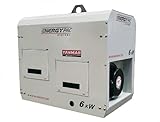
- - Electric Start - Yanmar Heavy Duty L100 9.3HP Industrial 3600 RPM Air Cooled Electric Start Diesel Engine - Recoil Backup - Industrial Generator End - Automatic Voltage Regulator - 3.5 Gallon Fuel Tank (8 Hr Run Time) - Roll bar skid - 12 Volt Starter - Alternator - Control Panel (Key Switch & Low Oil Shutdown) - Receptacle Panel with 120V Duplex - 120V 30A twist lock - 240V 20A Twist lock plug - 12VDC Receptacle (8.3A Battery Charging) - Engine Oil - Fuel & Oil Filters - Battery Included Shop Tested.
What the published economics show
Yang and co-authors’ 2024 modelled benchmark payback periods of 13.4 years for Tier 1–2 data centres and 13.1 years for Tier 3. These are scenario results, not universal market prices or guaranteed project returns. For Tier 4, the study found feasibility improved if fuel-cell capital cost fell by 20.3%, diesel price rose by 19.7% or green-hydrogen price fell by 35.5%.
Those sensitivities show why a fuel-cell decision must use site-specific quotations and energy assumptions. Equipment cost, hydrogen availability, delivery distance, storage duration, electricity prices, incentives, utilization and the value assigned to lower local emissions can change the result.
Hybrid architectures: the practical middle path
A hybrid system assigns each source the job it performs best. Batteries provide immediate ride-through and absorb fast transients. A diesel generator or fuel cell then supplies the sustained load. Controls transfer the load only after the long-duration source is synchronized and stable.
Quick wins for a faster PC:
Repair Windows errors before they cause bigger problemsFix Now →Fix the driver behind crashes, sound loss and screen glitchesFind Drivers →Clear out junk files and repair common Windows errorsFree Scan →Battery plus diesel
This is the most established combination. The battery bridges engine start time, while generators carry the outage for as long as fuel and maintenance plans allow. Multiple generator sets can be sequenced so that lightly loaded engines shut down while the remaining sets operate efficiently. The battery can also reduce nuisance starts for short disturbances.
Rank #4

- With 13,000 watts of power, the XP13000HX Dual Fuel generator will keep your whole home running during a storm or power outage, while protecting your family from harmful fumes with CO Alert
- Enjoy the freedom and flexibility of running your generator on either gasoline or propane. Propane is cost effective, clean-burning, fuel efficient, low maintenance, has a long shelf life, and is a readily-available fuel source.
- Built using a powerful 500cc OHV DuroMax engine and features ALL COPPER WINDINGS designed to make your generator last for years.
- The XP13000HX comes with a push button start, a front facing interface that allows you to change your fuel type in seconds, and a wide variety of outlets (including a transfer switch-ready 50 amp outlet)
- The fully loaded power panel includes four 120V GFCI household outlets, one 120V 30AMP outlet, one 120/240V 30AMP twist-lock outlet, and a heavy-duty 120/240V 50AMP outlet making it transfer switch ready!
Battery plus hydrogen fuel cell
The electrical arrangement is similar, but the long-duration source substitutes hydrogen storage and fuel-cell equipment for combustion engines. This can reduce local exhaust and acoustic impacts, subject to hydrogen logistics and permitting. It also introduces additional controls, conversion equipment and maintenance interfaces.
Trade-offs introduced by hybridisation
- More equipment means more commissioning points, alarms and failure modes.
- Power-conversion stages can add losses and require coordinated protection settings.
- Controls must define source priority, black-start sequence, minimum operating load, recharge strategy and degraded-mode operation.
- Maintenance staff need competence across batteries, switchgear, engines or fuel cells, and the supervisory controls tying them together.
How to select a system for a construction project
- Establish the critical load. Separate life-safety, cooling, controls, security and IT loads from noncritical building services. Model starting currents, step loads and harmonic content.
- Set the outage envelope. Evaluate at least the expected short event and the credible extended event. DOE/NREL’s 8-, 52-, 72- and 176-hour scenarios are useful planning points, but the final duration must reflect the site’s hazard assessment and utility reliability.
- Choose the redundancy objective. Confirm whether the project requires N, N+1, 2N or another topology, and whether each source, fuel train, battery room and control path must be independently maintainable.
- Map the site constraints. Reserve space for generators, radiators, exhaust, tanks, hydrogen storage, battery rooms, fire separation, delivery vehicles and maintenance access before freezing the civil design.
- Check permits and emergency operations. Engage air-quality, fire, building and hazardous-material authorities early. Confirm generator test-hour limits, tank rules, hydrogen setbacks and emergency-response procedures.
- Compare life-cycle cost. Include capital equipment, civil works, fuel or hydrogen infrastructure, electricity for charging, scheduled maintenance, replacements, testing, staffing, permits and end-of-life disposal. Use the correct amortisation period: the DOE/NREL comparison modelled batteries over 5 years and diesel and fuel-cell systems over 15 years.
- Write performance requirements. Specify transfer time, ride-through duration, step-load acceptance, voltage and frequency limits, autonomy at end of life, recharge or refuelling time, black-start capability and degraded-mode operation.
- Commission under realistic conditions. Test utility failure, source start, synchronization, load transfer, rejection, protection trips, controls communications, alarms, fuel or hydrogen changeover and recovery. Use load banks where the facility load cannot safely exercise the plant.
Carbon, reliability and total cost: how to make the decision
There is no universally cheapest, cleanest or most reliable technology. Diesel usually wins on mature supply chains and long-duration cost. Batteries win on response, local noise and combustion-free operation. Fuel cells can improve local emissions and acoustic performance, but their carbon advantage depends on hydrogen production and their financial case depends on prices and incentives.
Compare alternatives using the same load profile and reliability target. A battery sized for eight hours is not equivalent to a generator sized for 176 hours; a fuel-cell system with limited hydrogen storage is not equivalent to a diesel plant with contracted refuelling. Include the consequences of a source being unavailable for maintenance, the probability of fuel delivery disruption and the operational value of reducing short engine runs.
Do these 3 things before closing this tab:
1Fix the driver behind crashes, sound loss and screen glitches2Repair Windows errors before they cause bigger problems3Scan for outdated or missing drivers - takes under a minuteCommon failure modes and corrective actions
“The battery will replace the generators.”
Check the required autonomy, end-of-life capacity, room volume, cooling and fire strategy. If the calculation becomes impractical at the target duration, retain a long-duration source and use the battery as a bridge.
Best Value

- 9500 Running Watts and 12500 Peak Watts (Gasoline); 8500 Running Watts, 11200 Peak Watts (Propane); Remote Start with Included Key Fob, Electric and Recoil Start; Up to 12 Hours of Run Time on a 6. 6 Gallon Fuel Tank with Fuel Gauge
- Features Two GFCI 120V 5–20R 20A Standard Household Receptacle, One Transfer Switch Ready 120V L14-30R 30A, and One RV Ready 120/240V 14–50R 50A; All Outlets Have Rubber Covers for Added Safety
- Powered by a Heavy Duty 457cc Westinghouse 4-Stroke OHV Engine Featuring a Long-Lasting Cast Iron Sleeve with Automatic Low Oil Shutdown and Digital Hour Meter. VFT display gives you real time updates with the voltage output, frequency, and lifetime hours
- Plug-and-Play: Comes with a Remote Start Key Fob, 12V Battery Charger, Oil, an Oil Funnel, a Tool Kit, and a User’s Manual to Get You Started Right Out of the Box (Minimal Assembly Required)
- All Westinghouse Portable Generators are Functionally Tested in the Factory and May Contain Minimum Residual Oil and/or Fuel Odor; EPA Compliant; Backed By 3-Year Limited Service, Labor, and Parts Coverage and Nationwide Customer Service Network
“The generator can run indefinitely.”
Verify tank usable volume, fuel quality, oil and filter service intervals, coolant capacity, load-bank requirements, delivery access and permit limits. Runtime is a logistics plan, not only a tank-size calculation.
“Hydrogen is automatically zero-carbon.”
Document the production pathway, electricity source, transport method and any contractual environmental attributes. Report local stack emissions separately from full life-cycle emissions.
“A hybrid system is automatically more resilient.”
Review common points of failure in switchgear, controls, communications, cooling and auxiliary power. Require independent operating modes and manual recovery procedures where appropriate.
Free tools Windows power users keep installed
One-click scans. No signup required.
“Nameplate power equals usable backup.”
Recalculate at the real critical load, including inrush, harmonics, ambient derating, battery end-of-life limits and the capacity lost to auxiliaries. Validate the result during integrated systems testing.
Quick Recap
Product prices and availability are accurate as of the date/time indicated and are subject to change. Any price and availability information displayed on Amazon at the time of purchase will apply.

