Do these 3 things before closing this tab:
1Scan for outdated or missing drivers - takes under a minute2Repair Windows errors before they cause bigger problems3Fix the driver behind crashes, sound loss and screen glitchesFor most occasional DIY, choose a cordless oscillating multitool if you already own a compatible battery platform or regularly work away from outlets. Choose corded when sessions are long or repetitive, the work stays near a convenient socket, and uninterrupted operation matters more than mobility. Neither format is universally better: performance, handling, accessory fit and the actual kit contents vary by model.
An oscillating multitool can cut, flush-cut, plunge-cut, sand, scrape and, with the right attachment, grind or polish. The useful choice is therefore the one that matches your work pattern, power access and accessory needs—not simply the one with the highest voltage or the longest specification list.
As an Amazon Associate I earn from qualifying purchases.
What an oscillating multitool is used for
The tool accepts interchangeable blades, sanding pads and other accessories that move through a small oscillating arc. Depending on the attachment and the tool, typical DIY jobs include:
Outdated Drivers Are Slowing You Down
One free scan finds every outdated or missing driver and matches the right update for your exact hardware.Free scan · exact hardware matchPC Slower Than It Used to Be?
A free scan shows the junk files, broken settings and background clutter dragging Windows down - then fixes them in one click.Free scan · Windows 10 & 11- Cutting wood, metal, drywall and baseboard.
- Making flush cuts around door jambs, flooring and trim.
- Starting plunge cuts where a circular blade cannot enter from an edge.
- Sanding furniture, edges and small surfaces.
- Scraping adhesive, sealant, paint or grout.
- Routing, rasping, grinding or polishing with compatible accessories.
Because the same body handles several detailed operations, an oscillating multitool is most valuable for repair, renovation and finishing work. It is not a replacement for a dedicated circular saw, reciprocating saw or random-orbit sander when those tools are better suited to large, continuous cuts or broad surfaces.
#1 Best Overall

- The 3-speed selector of DEWALT 20V tools allows users to choose their speed setting based on application.
- Brushless motor of DEWALT oscillating tool delivers up to 57% more run time over brushed
- Dual-Grip variable speed trigger of DEWALT cordless tools gives users ultimate speed and application control
- Universal accessory adapter for use with most oscillating tool accessory brands. Oscillations/min: 0-13,000/ 0-17,000/ 0-20,000 OPM
- Quick-Change accessory system allows blades and attachments to be changed quickly without wrenches
Corded and cordless at a glance
| Decision factor | Corded model tends to suit | Cordless model tends to suit |
|---|---|---|
| Session length | Long or repeated sessions beside an outlet, with no battery swap or recharge interruption while connected to power. | Short, intermittent tasks where swapping or recharging a battery is manageable. Exact runtime depends on the battery, load and work pattern. |
| Access and movement | A fixed workbench, room or job area with convenient outlet access. | Moving around a room, working outdoors or in unfinished spaces, and avoiding a trailing cord. |
| Up-front cost | Can avoid buying a battery and charger, although comparable prices were not established for the examples here. | Often makes more financial sense when you already own the matching battery platform. Bare-tool listings may exclude both battery and charger. |
| Weight and balance | Must be judged from the exact tool; a cord does not guarantee a lighter body. | Compare the bare tool with the weight of the battery installed; published tool-only figures do not include battery mass unless stated. |
| Accessories and controls | Check the accessory interface, speed range, included attachments and change mechanism. | Make the same checks, then confirm the battery platform and exactly what the kit includes. |
When a corded multitool is the better DIY choice
Long, predictable work near power
A corded tool can continue operating while it remains connected to a suitable outlet. Bosch’s category guidance says a corded oscillating tool is ideal when sustained power is needed for long hours. BLACK+DECKER describes the BD200MTB as offering “unlimited runtime”; that is manufacturer product language, not a measured runtime comparison.
This format fits jobs such as removing grout throughout a room, sanding a sequence of furniture parts, trimming many boards or completing repeated cuts during a renovation. You can work continuously without planning battery changes, charging time or a second pack.
A simpler purchase when you have no battery platform
A corded kit normally requires the tool, its accessories and access to mains power. A cordless bare tool can look inexpensive until the compatible battery and charger are added. If you do not already own a battery system, compare the complete usable setup rather than the tool-only price.
Quick wins for a faster PC:
Fix the driver behind crashes, sound loss and screen glitchesFind Drivers →Repair Windows errors before they cause bigger problemsFix Now →Limitations to plan around
- The cord restricts your working radius to the outlet and the extension lead.
- A lead can snag on framing, furniture or the workpiece and can enter the cutting area if it is not routed carefully.
- Outdoor work requires an extension cord rated for outdoor use and a suitable power supply.
- A corded model is inconvenient where there is no safe outlet, such as a remote garden repair or an unfinished shell without temporary power.
When a cordless multitool is the better DIY choice
Mobility and awkward access
Cordless operation removes the trailing lead when you move between rooms, climb a ladder, work in a vehicle or make repairs away from a socket. That freedom is especially useful for short cuts and small batches where setting up an extension cord would take longer than the task.
Value from an existing battery system
If you already own compatible batteries and a charger, a bare tool can be a practical addition to that system. Check the exact listing: BLACK+DECKER’s BDCOS20B, for example, uses the POWERCONNECT battery system but is sold without a battery or charger. The same issue applies to Bosch’s GOP18V-28N, for which the battery and charger are sold separately.
Rank #2
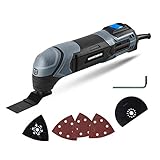
- Powerful Motor - The 2. 2-Amp motor delivers up to 20, 000 OPM for easy cutting, sawing, trimming, grinding and sanding
- Ergonomic Design - Compact size and ergonomic soft grip provides optimal handling and control of the tool
- Variable Speed Dial – Adjust the speed for different applications
- Universal Collet System - Compatible with standard oscillating multi-tool blades and accessories on the market
- Bright LED Light – Light where you need it
Runtime is a planning variable, not a fixed class specification
Runtime changes with battery capacity, material, accessory, pressure, speed and how often the trigger is used. The available manufacturer material does not establish a universal runtime figure for cordless oscillating tools. For a long job, plan a charged spare, a fast charger or a corded alternative rather than assuming that a stated voltage predicts hours of operation.
Does cordless mean less power?
Not automatically. Performance is model-specific, and voltage, oscillations per minute, motor input and weight are not interchangeable performance measurements.
The Tool Desk
Outbyte Driver Updater FREEFix the driver behind crashes, sound loss and screen glitchesFind Drivers →Outbyte PC Repair FREERepair Windows errors before they cause bigger problemsFix Now →Bosch states that its GOP18V-28N has power and speed comparable to the corded GOP40-30. That statement applies to those named models only; it does not establish that every cordless multitool matches every corded model, battery size or task. Bosch lists the GOP18V-28N at up to 20,000 oscillations per minute with a 2.8° arc and a 2.7 lb weight, with the battery and charger sold separately.
Speed range also needs context. A high maximum speed can help with some cutting or sanding work, while a lower setting can give better control on delicate surfaces or with scraping accessories. Treat the control range as a feature to match to your materials, not as a stand-alone power ranking.
Published examples: read the specifications in context
The following figures illustrate how different manufacturers publish specifications. They are not a controlled corded-versus-cordless test because the products, regions and configurations differ.
Rank #3

- More Efficient Work - 4.5 degrees of oscillation angle makes working more efficient. Compared with normal oscillating tool, 4-5 times efficient in cutting wood and 2-3 times efficient in cutting metal tubes
- Quick-Change Accessory System - The locking level allows blades and other attachments to be changed quickly without the need for a wrench, saving time and effort for you
- Variable Speed & Wide Applications - 6-speed switches allow users to choose a more appropriate output speed; With versatile accessories, you can use this tool to do various household projects, such as cutting, scraping, sanding, cleaning, polishing and more
- Ergonomic Design - Auxiliary handle provides convenient and stable operation for users; Universal fit system matches most brands of blades or other accessories
- 12 pcs Accessories - 1pc plunge saw blade, 1pc wood/plastic plunge blade, 1pc semicircle saw blade, 1pc scraper blade, 1pc sanding pad, 5pcs sanding papers, 1 side handle, 1 pair of carbon brushes
| Model and format | Published specifications | What the listing includes or says |
|---|---|---|
| Bosch PMF 220 CE, corded | 220 W; 15,000–20,000 oscillations per minute; 2.8° oscillation angle; 1.1 kg. | Figures from Bosch DIY’s Saudi Arabia regional category listing. |
| Bosch AdvancedMulti 18, cordless | 18 V; 10,000–20,000 oscillations per minute; 2.8° angle; 1.5 kg. | Different product from the PMF 220 CE; the regional listing does not make this a controlled comparison. |
| Bosch GOP18V-28N, cordless | Up to 20,000 oscillations per minute; 2.8° arc; 2.7 lb. | Bosch says performance is comparable to the corded GOP40-30. Battery and charger are sold separately. |
| BLACK+DECKER BD200MTB, corded | 2.5 A; six speeds from 10,000 to 20,000 OPM; 4.4 lb. | Package includes a wood/metal blade, sandpaper, sanding base, adapter kit and bag. |
| BLACK+DECKER BDCOS20B, cordless | 20V MAX; 2.8 lb. | Compatible with POWERCONNECT; battery and charger are not included. Includes wood, wood/metal and scraper blades, sanding platen and sandpaper. The published 2.8 lb figure should not be assumed to include a battery. |
The Bosch regional figures show why weight comparisons need care: the PMF 220 CE and AdvancedMulti 18 are different products, and the 1.1 kg and 1.5 kg values are not a laboratory comparison of corded and cordless formats. Likewise, a bare-tool cordless weight can feel different once a battery is fitted.
Free tools Windows power users keep installed
One-click scans. No signup required.
Accessory compatibility can decide the purchase
Check the interface before buying blades
Oscillating accessories are not automatically universal. Bosch identifies Starlock and StarlockPlus accessory ranges for the cited cordless model. The corded BLACK+DECKER BD200MTB listing describes an adapter intended to broaden accessory compatibility. Those claims are model-specific; verify the interface in the manual or product listing before ordering replacement blades or sanding pads.
Match accessories to the work
- Use a wood or bi-metal blade for the material and cut type specified by its manufacturer.
- Use a scraper for adhesive or sealant removal rather than forcing a cutting blade sideways.
- Use a sanding platen and the correct abrasive grade for furniture or trim.
- Confirm that plunge depth and blade geometry leave clearance behind the material before starting.
Compare the included kit, not just the bare tool
One package may include several blades and a sanding base while another supplies only the body. The BD200MTB includes a wood/metal blade, sandpaper, sanding base, adapter kit and bag. The BDCOS20B includes three blade types, a sanding platen and sandpaper but excludes the battery and charger. These contents change the first-day usefulness and the real cost.
How to choose the right format step by step
- List the actual jobs. Separate occasional trim cuts and small repairs from long sanding, extensive grout removal or repeated cutting.
- Map power access. Mark where the work will happen. If every session is beside a safe outlet, corded remains practical; if outlets are distant or absent, cordless mobility has a clear advantage.
- Check your battery inventory. Record the brand, voltage family and usable battery capacity you already own. A battery from another platform is not automatically compatible.
- Price a complete working kit. Add the battery, charger, required blades and sanding accessories to any bare-tool price. Compare that total with a corded kit and any extension-cord needs.
- Check the accessory interface. Confirm Starlock, StarlockPlus, an adapter system or another specified fitting before buying consumables.
- Compare controls and handling. Look for the speed range, trigger or switch arrangement, tool-free accessory change and the weight in the configuration you will actually hold.
- Plan the longest session. For cordless work, decide whether one battery, a spare or a charging break is acceptable. For corded work, plan cable routing and outlet protection.
- Choose the format only after those checks. The result should reflect your jobs and setup, not a blanket assumption that one power source is stronger.
Practical setup for corded use
- Inspect the cord, plug, extension lead and tool housing before connecting power.
- Use an extension cord suitable for the environment; outdoor work requires an outdoor-suitable cord.
- Route the lead behind you and away from the blade, moving parts, heat, oil and sharp edges.
- Fit the accessory with the tool disconnected from power and verify that it is locked as the manual specifies.
- Set a conservative speed for the first pass, keep both hands positioned as the manual directs and let the accessory do the cutting rather than forcing it.
- Disconnect power before changing accessories, clearing a jam or inspecting the workpiece.
Practical setup for cordless use
- Confirm that the battery belongs to the tool’s specified platform and is charged.
- Check whether the listing supplied a battery and charger; do not assume a bare tool includes either.
- Install the accessory with the battery removed, then inspect the locking mechanism and clearance.
- Use the speed setting appropriate to the material and accessory, starting slowly on a visible edge or scrap.
- Keep a charged spare or a charging plan for work that could exceed one battery’s practical runtime.
- Remove the battery before changing accessories, clearing debris or storing the tool.
Safety rules that apply to both formats
The DEWALT DCS354/DCS356 instruction manual states general power-tool warnings for both mains-operated and battery-operated tools. Follow the manual for your exact model, because accessory limits, guards and operating procedures differ.
- Keep cords away from heat, oil, sharp edges and moving parts.
- Use an outdoor-suitable extension cord for outdoor operation.
- If damp operation cannot be avoided, use a GFCI-protected supply.
- Disconnect mains power or remove the battery before accessory changes and maintenance.
- Wear the protective equipment specified by the manual and accessory maker, and control dust and debris appropriate to the material.
- Secure the workpiece so it cannot shift into the blade or sanding pad.
- Inspect blades, sanding sheets and adapters for damage before use; replace worn accessories rather than increasing pressure.
Common buying mistakes and how to avoid them
Assuming voltage equals cutting performance
Voltage identifies a battery system, not a universal cutting result. Compare the exact model’s stated speed range, arc, accessory system and manufacturer claims for the work you intend to do.
Rank #4

- [Friendly Reminder] ---- 1. This oscillating tool does NOT INCLUDE any batteries, it is just a bare tool. 2. The oscillating power tool machine belongs to the Synxiter brand, just compatible with Dewalt batteries.
- Your Freedom,Your Power:This cordless oscillating tool is designed to work seamlessly with DeWalt 20V batteries (sold separately),giving you the ultimate freedom to work anywhere,anytime! No more tangled cords—just pure, untethered power at your fingertips!
- Precision Meets Power:With 6 variable speed settings (6000-21000 OPM), this oscillating multitool is ready to handle any task with ease. Plus,it’s packed with a newly upgraded brushless motor for long-lasting performance, energy efficiency,and rock-solid stability.
- Bright, Sharp,and Versatile:The built-in LED light on this oscillating saw ensures you’ll always have perfect visibility,even in the darkest corners.And with a 3°oscillating angle,cutting in tight spaces has never been easier or more precise!
- The Complete Package:Our oscillating tool kit comes loaded with everything you need to get started:1 oscillating tool,3 straight saw blades, 1 segment saw blade,a flexible scraper,a sanding pad holder,15 sanding papers,and an auxiliary handle.Tool-free blade installation makes switching blades a breeze—seriously,it’s that easy!
Comparing weights that are not measured the same way
A corded listing may include a fixed cable while a cordless listing may show tool-only weight. Add the installed battery when judging overhead work, and note the region and configuration of every published figure.
Buying a bare tool without budgeting the power system
Check the box contents before checkout. A cordless tool without a compatible battery and charger cannot be used immediately, and buying into a new platform may cost more than expected.
Ordering accessories by appearance
Blade shapes can look similar while their interfaces differ. Confirm the named fitting and any required adapter, then buy accessories rated for the material and operation.
Treating manufacturer feature language as independent testing
Statements such as “unlimited runtime” describe operation while connected to power; they do not provide a measured battery-to-battery comparison. No verified head-to-head figures were established here for runtime, cut speed, vibration, noise, durability or total cost.
Recommended Free Tools
A practical decision for common DIY situations
| Your situation | More sensible starting point | Reasoning |
|---|---|---|
| One-off trim repair in a room with a nearby outlet | Corded or cordless | Either can work; choose based on whether you already own the battery platform and how much cable management matters. |
| Several hours of repeated cutting at a fixed bench | Corded | Continuous connection avoids battery swaps and charging interruptions. |
| Small repairs across rooms, stairs or a vehicle | Cordless | Mobility and no trailing cable reduce setup friction. |
| Remote outdoor repair without dependable mains power | Cordless | Operation does not depend on a nearby outlet; bring sufficient charged batteries. |
| First multitool purchase with no battery system | Compare complete kits | Include battery, charger, accessories and any extension-cord requirement before deciding. |
| You already own several compatible batteries | Cordless bare tool | The platform investment has already been made, provided the tool and battery family match. |
For an occasional DIY owner, the default choice is usually cordless when a compatible battery and charger are already available or when the work moves beyond outlet reach. A corded model is the more dependable fit for long, repeated sessions in one powered workspace. Use the exact model’s specifications and kit contents to settle close calls.
Quick Recap
Product prices and availability are accurate as of the date/time indicated and are subject to change. Any price and availability information displayed on Amazon at the time of purchase will apply.

