Short answer: A benchtop oscillating spindle sander is the right machine for accurately shaping and smoothing curved edges, inside radii, arcs, contours, and irregular profiles. The spindle rotates and moves vertically so the abrasive wears more evenly. Choose by the drum diameters and replacement sleeves you need first, then compare table size, tilt, stability, dust collection, and machine weight.
What a benchtop oscillating spindle sander does
A benchtop oscillating spindle sander is a specialized woodworking machine for smoothing and accurately shaping curved edges. It uses a cylindrical abrasive sleeve mounted on a sanding drum. The drum rotates while the spindle moves up and down, spreading the sanding action over more of the sleeve instead of concentrating wear at one narrow band.
That combination makes the machine particularly useful for sanding inside curves, outside curves, arcs, contours, and irregular profiles. It is often the next tool used after a bandsaw or router has cut a curved shape: the sander can bring the edge cleanly to a layout line and smooth inside radii that are difficult to reach with a random-orbit sander. Grizzly describes the oscillation as helping reduce burning, remove material, and extend sleeve life compared with a non-oscillating spindle; Harbor Freight similarly positions its machine for curved and contoured work. See the Grizzly G0739 specifications for an example of the conventional benchtop design.
As an Amazon Associate I earn from qualifying purchases.
It is not a general-purpose replacement for a random-orbit sander or a wide belt sander. A spindle sander is primarily a shaping and edge-finishing tool. It can remove material efficiently from a curved edge, but it is not the best choice for flattening large panels or producing a uniformly finished flat surface.
Representative benchtop oscillating spindle sanders
The models below illustrate the range of specifications available. They are not controlled test results, and the figures should not be read as a universal performance ranking. Prices, stock, warranty terms, and model availability can change; verify them with the manufacturer or retailer before buying.
#1 Best Overall
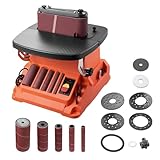
- Efficient Sanding: This oscillating belt and spindle sander runs at 2400RPM high speed, delivering smooth, efficient sanding on flat, curved, and contoured surfaces. Ideal for furniture finishing, crafts sanding, and DIY woodworking projects
- Complete Sanding Kit: Equipped with 24 x 3.86 inch sanding belt, 5 sanding sleeves (1/2", 3/4", 1", 1-1/2", 2") and 5 table inserts, suitable for different workpiece sizes and curves. Quick replacement makes sanding more flexible and efficient
- Tilting Worktable: This benchtop spindle sander features a 5/8-inch (16mm) stroke length to adapt to thin and thick workpieces. And the 0–45° tilting worktable allows you adjust to the ideal angle and position for precise sanding
- Dust-Free Operation: Equipped with a 1.38 inch (35mm) ID and a 1.52 inch (38.6mm) OD dust port, our belt spindle sander connects easily to vacuum hoses for efficient dust collection, reducing cleanup and keeping your workspace cleaner
- Organized Storage: This spindle sander for woodworking features integrated slots to keep sanding sleeves and table inserts neatly organized, reducing clutter and keeping them within easy reach for efficient operation
| Model | Motor and spindle | Oscillation | Table and tilt | Included or stated spindle range | Notable details |
|---|---|---|---|---|---|
| Grizzly G0739 | 1/2 HP; 120 V; 2,000 RPM | 58 SPM; 5/8-inch stroke | 11-1/2 by 15 inches; cast iron | 1/2 to 3 inches; six sleeve sizes | Onboard storage; 1-1/2-inch dust port; paddle switch with removable key; one-year warranty listed by Grizzly |
| Central Machinery 58546 | 1/5 HP; 1,725 RPM | 30 OPM; 5/8-inch stroke | 14-inch cast-iron table | 1/2 to 3 inches | Dust-collection port; included drums and sleeves; verify current listing details |
| Triton TSPS450 | 450 W; 2,000 RPM no-load speed | 58 OPM; 16 mm stroke | 370 by 295 mm cast iron; standard table non-tilting | 13 to 76 mm, approximately 1/2 to 3 inches; six diameters | Onboard storage; extraction adaptor; replacement sleeves identified in 80G, 150G, and 240G |
| JET JBOS-5 | 1/2 HP | 1-inch oscillating action | 14-1/2-inch tilting table | 1/4, 1/2, 5/8, 1-1/2, and 2 inches | Sealed oscillation gearing; 2-inch dust port; built-in storage |
| Rikon 50-300 | 1/2 HP; 370 W; 1,700 RPM no-load speed | 29 OPM; 24 mm stroke | 14-3/4-inch square table; tilts 0 to 45 degrees forward | 1/2 to 2 inches; five included diameters | 50 mm dust outlet; separately available 3-inch assembly noted by accessory listings |
| Delta 31-483 | 1/2 HP; 110 V; 1,720 RPM | 29 SPM; 24 mm stroke | 14-1/2-inch square table; tilts 45 degrees in either direction | 1/4 to 3 inches | 81-pound stated weight; heavy-duty bench configuration |
Terminology varies between manufacturers: “SPM” and “OPM” describe strokes or oscillations per minute, while “oscillating action” may be stated without the same complete specification. Compare the rate together with the stroke, motor, spindle support, table rigidity, and machine weight rather than treating one number as a quality score.
How to choose one
1. Match the spindle diameter to the curves you make
The sanding drum diameter determines the approximate scale of curve the machine can address. A smaller spindle reaches tighter inside curves; larger drums support broad arcs and remove material over a wider contact area. The usable radius also depends on the workpiece shape, table opening, sleeve length, and the clearance around the drum, so the drum diameter is a selection guide rather than a guaranteed minimum radius.
A broad included range from roughly 1/2 to 3 inches is versatile for furniture parts, templates, signs, cabinet components, and general shop work. Other machines concentrate on smaller sizes. JET, for example, lists 1/4-, 1/2-, 5/8-, 1-1/2-, and 2-inch spindle assemblies, while Rikon lists five included sizes from 1/2 to 2 inches and identifies a separately available 3-inch assembly through accessory documentation.
Do not compare only the size of the supplied drums. Before buying, confirm that replacement sleeves are available in the diameters, lengths, backing type, and grits you actually use. Triton identifies compatible 80G, 150G, and 240G sleeve sets, while Rikon replacement sleeves and an optional 3-inch spindle assembly are listed through Lee Valley’s accessory path. Compatibility should be confirmed for the exact machine and production version.
2. Consider table size, rigidity, and tilt
A larger, rigid table gives a larger workpiece more support and leaves more room to keep the material flat and under control. Representative tables range from Triton’s 370 by 295 mm cast-iron surface to the approximately 14-1/2- to 14-3/4-inch square tables specified for JET, Delta, and Rikon. Grizzly uses an 11-1/2 by 15-inch cast-iron table.
Tilting is important when you need a beveled or angled edge. Delta specifies 45 degrees in both directions; JET specifies a table that tilts to 45 degrees; and Rikon specifies 0 to 45 degrees forward. The standard Triton TSPS450 table is non-tilting. Triton’s related TSPST450 combination machine adds a belt-sander configuration and a 0- to 45-degree tilting front section, so it should not be treated as an identical single-function spindle sander.
The Tool Desk
Outbyte PC Repair FREERepair Windows errors before they cause bigger problemsFix Now →Outbyte Driver Updater FREEFix the driver behind crashes, sound loss and screen glitchesFind Drivers →If most of your work consists of vertical curved edges, a fixed table may be entirely adequate. If you regularly make angled components, a tilting table can be more valuable than a higher oscillation rate.
3. Treat oscillation rate and stroke as a pair
Oscillation moves the abrasive vertically through the sleeve. A longer stroke uses more of the sleeve length, while the rate affects how quickly that travel is repeated. The specifications in this group range from Central Machinery’s 30 OPM and 5/8-inch stroke to Grizzly and Triton at 58 SPM/OPM with a 5/8-inch or 16 mm stroke. Delta and Rikon list 29 strokes or oscillations per minute with a 24 mm stroke, and JET describes a 1-inch oscillating action.
These figures do not establish which machine sands fastest or lasts longest. Motor power, sleeve diameter, pressure applied by the operator, spindle support, table rigidity, dust removal, and the material being sanded all affect the result. Use the numbers to understand the machine’s design, not as a substitute for independent testing.
Rank #2

- Efficient Sanding: This oscillating spindle sander runs at 2000RPM high speed, delivering smooth, efficient sanding on flat, curved, and contoured surfaces. Ideal for furniture finishing, crafts sanding, and DIY woodworking projects
- 6 Sanding Sleeve Sizes: Equipped with 6 sanding sleeves (1/2", 3/4", 1", 1-1/2", 2", 3") and 6 table inserts, suitable for different workpiece sizes and curves. Quick replacement makes sanding more flexible and efficient
- Spacious Worktable: This benchtop spindle sander features a 0.59-inch (15mm) stroke length to adapt to thin and thick workpieces, paired with a 12.5 x 11.5-inch cast aluminum table that offers spacious workspace and stable support
- Dust-Free Operation: Equipped with a 1.38 inch (35mm) ID and a 1.54 inch (39mm) OD dust port, our spindle sander connects easily to vacuum hoses for efficient dust collection, reducing cleanup and keeping your workspace cleaner
- Organized Storage: This spindle sander for woodworking features integrated slots to keep sanding sleeves and table inserts neatly organized, reducing clutter and keeping them within easy reach for efficient operation
4. Balance power against portability and stability
Compact machines are easier to move or store but may have less mass to resist movement. Grizzly specifies a 1/2-HP motor and approximately 33-pound shipping weight; Central Machinery specifies 1/5 HP and approximately 33 pounds; Triton weighs approximately 12.9 kg, or 28.4 pounds. By contrast, Delta specifies 81 pounds and Rikon 76 pounds net, with both using a stated 1/2-HP motor.
The heavier Delta and Rikon designs are materially different from lightweight portable benchtop units. They may suit a shop that values stability and resistance to movement, while a lighter model may make sense when the machine must be lifted onto a bench or put away after use. In either case, use the manufacturer’s recommended mounting method and do not assume that a generic mobile base or bench fixture is compatible.
5. Plan dust collection before the machine arrives
Wood and composite sheet goods produce fine dust. A dust port is useful only if it connects effectively to a suitable shop vacuum or dust extractor. The stated connections differ: Grizzly lists a 1-1/2-inch port, Rikon a 50 mm outlet, and JET a 2-inch port. Central Machinery lists a built-in dust-collection port, while Triton supplies a dust port and extraction adaptor.
Check the port diameter, the hose or adapter required, your extractor’s capacity, and the available space behind the machine. Use appropriate respiratory and eye protection, keep the work area clean, and follow the machine and abrasive manufacturer’s safety instructions. Dust collection does not eliminate the need for personal protection.
Table inserts, drums, and replacement parts
Use the table insert matched to the selected spindle whenever the manufacturer provides one. The insert reduces the exposed opening around the drum and helps support the work close to the abrasive. Triton supplies inserts matched to its sleeve sizes, and JET supplies multiple round and oblong inserts for its spindle set. Do not operate with a larger opening than necessary, and never improvise an insert that can contact the moving spindle.
Free tools Windows power users keep installed
One-click scans. No signup required.
Common replacement and purchase-adjacent items include:
- Mixed-size sanding sleeve assortments and grit-specific packs
- Replacement rubber drums and spindle washers
- Spare table inserts
- Dust-hose adapters and a suitably sized shop vacuum or dust extractor
- Bench-mounting hardware or a mobile base, where the machine’s design permits it
For example, Grizzly G0739 documentation and parts pages provide model-specific replacement information, including spindle washers. This is preferable to buying a visually similar generic component. Match the exact model, spindle diameter, sleeve length, dust-port size, voltage, and table-insert pattern.
Independent reader supportYour contribution helps us test, update, and keep practical guides available for everyone.Using the sander effectively
- Cut close to the line. Leave a small, controlled amount of material after bandsawing or routing rather than expecting the spindle sander to correct a badly oversized profile.
- Install the correct drum, sleeve, washer, and insert. Disconnect power while changing accessories. Make sure the sleeve is seated properly and that the drum hardware is tightened according to the manual.
- Connect dust extraction. Confirm that the hose and adapter do not interfere with the work or moving parts.
- Support the work flat on the table. Keep fingers away from the sleeve and maintain control without forcing the material into the abrasive.
- Use light, moving pressure. Let the abrasive remove material. Excessive pressure can increase heat, load the sleeve, and make the cut less accurate.
- Check progress frequently. Stop before the edge crosses the layout line. Switch to a finer sleeve for final smoothing rather than using heavy pressure with a coarse sleeve.
- Inspect the sleeve. Replace a worn, clogged, torn, or damaged sleeve. A fresh sleeve is safer and more predictable than compensating for a degraded abrasive.
Always use the guard, insert, switch, and other safety equipment supplied or specified for the model. Read the manual for the exact spindle-changing procedure, permitted materials, electrical requirements, and dust-collection instructions.
Rank #3

- Versatile Dual Sanding Modes: The 2/3HP Oscillating Belt and Spindle Sander features both oscillating spindle and belt sanding, allowing precise finishing for complex curves and large flat surfaces. Ideal for woodworking professionals and DIY enthusiasts
- Variable Speed Control: Adjustable speed ranging from 1000-1800 RPM and 29-58 OPM, meeting diverse project needs. Perfect for detailed furniture refinishing or intricate edge work
- Comprehensive Sanding Options: Includes a 4x24-inch sanding belt and 5 drum sleeves of varying sizes (1/2" to 2"), providing flexibility for shaping, smoothing, and polishing tasks
- Efficient Dust Collection System: Unique dust collection belt cover and dust port ensures a clean workspace, minimizing airborne particles during operation, essential for health and project precision
- Effortless Mobility and Storage: The oscillating sander features convenient storage for all spindles and plates, while innovative buckles ensure that everything stays securely in place during transport
Single-function sander or combination machine?
A conventional benchtop oscillating spindle sander is the focused choice when curved-edge work is the main requirement. A combination machine can be attractive when bench space is limited and you also need a belt sander. However, the extra configuration does not automatically make it better at spindle sanding. Triton’s TSPST450, for example, combines spindle and belt-sander functions and adds a tilting front table; it should be compared as a combination tool, not as a direct equivalent to the single-function TSPS450.
Do these 3 things before closing this tab:
1Repair Windows errors before they cause bigger problems2Fix the driver behind crashes, sound loss and screen glitches3Clear out junk files and repair common Windows errorsChoose the combination format when the belt-sanding function has real value and you accept the associated setup and configuration trade-offs. Choose a dedicated spindle sander when access to curved edges, a clear work surface, and straightforward sleeve changes are the priority.
Buyer checklist
- What is the tightest inside radius you regularly need to sand?
- Does the machine include the spindle diameters you use, and can you buy replacements in those exact sizes?
- Are the sleeve lengths, grits, drums, washers, and table inserts available for the exact model?
- Is the table large and rigid enough for your workpieces?
- Do you need a table that tilts, and in which direction?
- Are the oscillation rate and stroke suitable for your workload when considered with motor power and machine mass?
- Will the machine remain stable on your bench, or must it be mounted or moved after use?
- Does the dust port match your extractor or require a specific adapter?
- Is the stated electrical specification correct for your location? Confirm voltage, frequency, and plug requirements.
- Are the current price, stock status, warranty, and replacement-parts policy acceptable? Recheck these volatile details immediately before purchase.
Bottom line
Buy a benchtop oscillating spindle sander when your work involves curved profiles, inside radii, contours, or irregular edges—not when you primarily need to finish flat panels. For broad versatility, look for several spindle diameters and readily available replacement sleeves. For angled work, prioritize a tilting table. For stability, favor a heavier machine and a secure mounting arrangement. For a compact shop, compare the machine’s actual footprint, storage, dust connection, and accessory availability rather than relying on motor horsepower alone.
The Grizzly G0739, Central Machinery 58546, Triton TSPS450, JET JBOS-5, Rikon 50-300, and Delta 31-483 represent different balances of sleeve range, table design, tilt, oscillation, weight, and dust collection. None is universally best; the correct choice is the one whose spindle sizes, table geometry, stability, extraction connection, and replacement-parts supply match the work your construction or woodworking shop actually performs.
Frequently Asked Questions
What is a benchtop oscillating spindle sander used for?
A benchtop oscillating spindle sander is best for curved edges, inside radii, arcs, contours, and irregular profiles. It is especially useful after bandsawing or routing a shape and is not intended to replace a random-orbit sander for large flat panels.
What’s actually slowing this PC down?
Pick the symptom - the matching free tool is one click away.
What spindle size should I choose?
Smaller drums generally reach tighter inside curves, while larger drums work better on broad arcs. Check the manufacturer’s actual spindle range and the availability of matching replacement sleeves before buying.
Is a higher oscillation rate better?
Not necessarily. Motor power, spindle support, table rigidity, machine weight, stroke, dust extraction, and sleeve size all affect performance. Oscillation figures should be compared as part of the complete machine specification.
Do all benchtop spindle sanders have tilting tables?
The standard Triton TSPS450 has a non-tilting table. Triton’s related TSPST450 combination spindle-and-belt sander adds a tilting front section, but it is a different combination configuration rather than the same single-function machine.
The Bottom Line
Bottom line: A benchtop oscillating spindle sander is a curve- and contour-shaping specialist. Prioritize the drum diameters and replacement sleeves you need, then compare table size, tilt, stability, dust collection, and model-specific accessories. Do not choose on horsepower or oscillation rate alone.
Quick wins for a faster PC:
Scan for outdated or missing drivers - takes under a minuteDriver Scan →Clear out junk files and repair common Windows errorsFree Scan →Fix the driver behind crashes, sound loss and screen glitchesFind Drivers →Quick Recap
Product prices and availability are accurate as of the date/time indicated and are subject to change. Any price and availability information displayed on Amazon at the time of purchase will apply.

