The Tool Desk
Outbyte Driver Updater FREEScan for outdated or missing drivers - takes under a minuteDriver Scan →Outbyte PC Repair FREERepair Windows errors before they cause bigger problemsFix Now →A rabbet is an L-shaped recess cut along the edge or end of a board. The best way to cut one depends on the work: use a dado-equipped table saw for repeated through-rabbets, a standard blade for occasional two-pass work, a handheld router for curved, interior, or assembled parts, a router table for repeatable straight or stopped rabbets, and a jointer for a wide, smooth rabbet on a straight outside edge.
Before choosing a tool, decide whether the rabbet is through or stopped, whether its edge will be visible, whether the workpiece is straight or curved, and how many identical parts you need. Then establish the cut from the actual mating component—not only its nominal thickness—and verify the setup on scrap.
As an Amazon Associate I earn from qualifying purchases.
What makes a rabbet precise?
A rabbet has two dimensions:
- Depth: how far the recess goes into the face or edge.
- Width: how far the recess extends inward from the edge.
For example, a cabinet-back rabbet might be sized to accept the actual thickness of a plywood panel, with a shoulder positioned so the back sits flush or at a planned recess. The labeled thickness of plywood and manufactured panels is not always their measured thickness, so measure the panel that will actually fit the joint.
Mark the reference face and reference edge on every workpiece. Those surfaces must register consistently against the table-saw table and fence, router-table fence, router guide, or jointer table. A small change in orientation can move the shoulder or alter the apparent depth of the joint.
#1 Best Overall
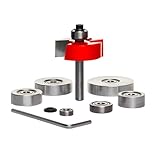
- Versatile Use - Ideal for making rabbeted joints, recesses for back panels, or creating unique molding details. Perfect for furniture makers, cabinetmakers, and carpenters, this set delivers high precision on both softwood and hardwood materials.
- Multiple Depths - Includes interchangeable bearings to cut depths from 1/8" to 1/2". Easily adjust the size of your rabbet profile, allowing for precise and consistent results with just one bit. Compatible with hand-held and table-mounted routers.
- High-Quality Build - Crafted from durable materials for long-lasting performance. This is designed to cut through plywood, composite materials, and soft or hardwoods with ease, ensuring professional-grade results every time.
- Convenient Set - This set comes with a 1/4" shank and includes all the necessary interchangeable bearings. A wrench is also included for easy adjustments, making it a complete tool for efficient and versatile woodworking.
- Wide Compatibility - Use the rabbeting set with various routers, including hand-held, table-mounted, and palm routers. Designed for woodworkers, it cuts efficiently through a range of materials, including veneered plywood and composites.
The most reliable general workflow is:
- Measure the mating part and define the required rabbet width and depth.
- Choose the method that suits the shape, visibility, and quantity of the work.
- Set the cutter using scrap of the same material and, ideally, the same thickness as the project stock.
- Make a test cut and check both dimensions with a rule or calipers.
- Test the actual mating component. It should fit without force but should not be needlessly loose.
- Make the final cuts only after the shoulder, depth, and fit are correct.
Whenever possible, make the first cut slightly undersized and widen it in controlled increments. An oversized rabbet is much harder to repair invisibly than one that needs one more light pass.
1. Table saw with a stacked dado set
A stacked dado set is usually the fastest method for making many identical, straight, through-rabbets along an edge. The set removes most or all of the waste in one pass, so it is efficient for cabinet parts, casework, and production-style work.
Basic setup
- Confirm that the table saw accepts the particular dado set. Saw arbor length, throat-plate clearance, maximum dado width, and the manufacturer’s operating instructions control the setup; not every saw accepts every dado set.
- Install the dado blades and shims according to the set manufacturer’s instructions. The nominal stack width is only a starting point because actual cut width varies with the blades, shims, blade condition, and material.
- Fit an auxiliary or sacrificial fence to the rip fence. This lets the dado blade be partially buried in the fence while the fence is positioned for the required rabbet width.
- Set the blade height for the required rabbet depth.
- Use scrap stock to check the shoulder location, depth, and mating fit before cutting project parts.
For repeated parts, use a consistent reference face and a stop or repeatable layout system that does not create a trap between the blade and fence. Support long stock at the infeed and outfeed sides.
A stacked dado blade set can be a useful choice when the saw is explicitly compatible with it. Check both the saw manual and the dado set instructions before purchase or installation; compatibility is not universal.
When this method is best
- Several identical through-rabbets are required.
- The rabbet is on a straight outside edge.
- Speed and repeatability matter more than avoiding a blade change.
Limitations and control points
A dado stack is efficient, but it is not automatically safer or more accurate than every other method. The stack must be installed correctly, the work must remain firmly supported, and the waste side must be controlled. For a non-through operation such as rabbeting, a featherboard can help maintain contact with the fence or table when positioned according to the saw manufacturer’s instructions. Use an appropriate push device to keep hands away from the cutter.
Do not reach near a spinning blade to retrieve offcuts or waste. Do not allow waste to become trapped between the blade and fence. Follow the saw manual for guarding, push devices, featherboard placement, and prohibited operations.
2. Table saw with a standard blade
If you need only one or two rabbets—or your saw cannot use a dado set—you can make the cut with a normal combination or general-purpose blade. This method uses two operations: one cut establishes the depth and the other establishes the width.
Do these 3 things before closing this tab:
1Fix the driver behind crashes, sound loss and screen glitches2Clear out junk files and repair common Windows errors3Scan for outdated or missing drivers - takes under a minuteTwo-pass procedure
- Make the depth cut. With the workpiece positioned so the blade cuts into the appropriate face, set the blade height to the rabbet depth. On many setups this means placing the workpiece facedown on the table, but the correct orientation depends on the desired reference surfaces. Verify the layout before cutting.
- Make the width cut. Reorient the workpiece on edge and set the fence so the blade establishes the rabbet’s inside shoulder. The blade height and fence position must allow the two cuts to meet cleanly.
- Test on scrap. Check that no ridge remains between the cuts and that the blade has not cut past the intended shoulder.
- Adjust gradually. Confirm the depth first, then move the fence in small increments to refine the width and fit.
For a precise setup, use a rule or calipers to verify the depth cut before making the width cut. Then make the complete two-cut rabbet in scrap. This approach is particularly practical on a lower-powered saw because it avoids removing a large amount of material in one pass.
Rank #2

- 【Rabbet Router Bit Set】Newdeli 4pcs rabbet router bits 1/4" shank. 4 different cutting height: 1/8", 1/4", 3/8", 1/2", with 6 Interchangeable bearing used for cut different depths 1/2", 5/8", 3/4", 7/8", 1", 1-1/8".
- 【Quality Blade】The blade is made of high-quality YG8 carbide steel, which is sharp, reliable and impact resistance. It can cut the wood smoothly and not easily broken. An ideal biscuit jointer router cutter for slotting, grooving and rebating applications in a wide range of wood based materials.
- 【Teflon Coating】Baking heat-resistant coating to prevent accumulation of wood chips, resin and asphalt, good wear resistance and long service life. Note: Avoid cutting metal and non-wood materials.
- 【Applicable Material】This professional rabbeting bit set suitable for wood, MDF, particle board, plywood, acrylic and different wood composites. Biscuit router bit provide a fast and easy way to join cabinet parts and furniture components.
- 【Compatible Machines】Use on CNC and other automatic routers as well as hand-held and table-mounted portable routers. Please Note: The short clamping of this router bit might cause bend. When using, it should be noted that at least clamp to 2/3 of the shank, and the RPM≦16000. Pushing slowly can help you get a smoother and cleaner cut.
When this method is best
- Only a few rabbets are needed.
- You want to avoid changing the installed blade.
- The saw is not rated for a dado set.
Limitations and control points
The second operation requires the workpiece to be held upright. Narrow or tall parts can be unstable, so use an auxiliary fence, a suitable fixture, or another support method that keeps the stock firmly controlled. Long pieces also need side or outfeed support.
Because the rabbet is made in two cuts, small errors can produce a visible ridge, a shoulder that is too wide, or a joint that is too loose. Do not rely only on the fence scale. Test cuts are part of the setup, not an optional final check.
3. Handheld router with a bearing-guided rabbeting bit
A handheld router is the most flexible option when the rabbet is on a curved edge, inside an opening, or on a large or already-assembled part that would be awkward or unsafe to run across a table saw or router table. It is also a strong choice when the rabbet edge or end grain will remain visible and you want to avoid the small scoring marks that some saw setups can leave.
Free tools Windows power users keep installed
One-click scans. No signup required.
How the dimensions are controlled
With a bearing-guided rabbeting bit, the bearing follows the reference edge and determines the cut’s lateral position. Changing the bearing changes the rabbet width. Router depth controls the rabbet depth. The bearing must be firmly against a sound, continuous reference edge throughout the cut.
A bearing-guided rabbeting bit or a rabbeting bit set can provide several width options. The mention is a tool category, not a recommendation of a particular brand; match the bit’s shank, bearing arrangement, diameter, and rated operating limits to the router.
Practical routing sequence
- Inspect the reference edge. If it is irregular, the bearing will reproduce that irregularity in the rabbet.
- For a critical straight cut, clamp a straightedge or router guide and use it as the reference when the raw edge is not reliable.
- Secure the workpiece so it cannot shift as the router enters, travels, or exits.
- Set the depth conservatively and make a test cut in scrap.
- Use multiple shallow passes for a deep rabbet rather than forcing the full depth in one pass. Stay within the bit and router manufacturers’ limits.
- Feed the router in the normal safe direction for the cutter and setup, keeping both hands in control of the tool.
For a stopped rabbet, mark the start and stop points clearly. A stop block, layout line, or preliminary saw kerf can help define the end. A handheld router can round the end of a stopped cut or gouge the shoulder if it is lifted, pivoted, or stopped without adequate control. Plan how the router will enter and leave before switching it on.
Limitations
The bearing is only as accurate as the edge it follows. A bowed, chipped, or uneven edge will produce a corresponding variation. Handheld routing also demands attention to tear-out, especially at end grain and at the end of a stopped cut. Keep the router flat, avoid forcing it, and use a sharp bit.
Quick wins for a faster PC:
Clear out junk files and repair common Windows errorsFree Scan →Scan for outdated or missing drivers - takes under a minuteDriver Scan →Repair Windows errors before they cause bigger problemsFix Now →4. Router table with a straight bit
A router table combines a fixed cutter with a fence, making it especially effective for short, manageable workpieces, repeated parts, and stopped rabbets. The bit height controls rabbet depth; the fence position controls rabbet width.
Rank #3
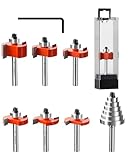
- 【Complete 6-Piece Set with Versatile Sizing】 Get everything you need in one box! This comprehensive set includes 6 rabbeting bits (1/4", 5/16", 3/8", 1/2", 3/16", 5/8" height) and 6 interchangeable bearings (3/8", 1/2", 5/8", 3/4", 7/8", 1-1/8"). Achieve a wide range of precise groove depths and profiles for all your woodworking projects without needing multiple, costly individual bits.
- 【Superior Carbide Construction for Long-Lasting Performance】 Engineered for excellence, our router bits feature high-quality carbide blades known for their exceptional hardness and wear resistance. This premium material stays sharper longer than standard steel bits, providing clean, smooth, and precise cuts through hardwoods, softwoods, and composite materials again and again. Built to resist heat and impact for outstanding durability.
- 【Effortless Depth Adjustment with Interchangeable Bearings】 Switch cutting depths in seconds, not minutes! Simply change the bearing on the bit—no need to adjust the router's base height. This innovative design allows for incredible versatility and precision, making tasks like biscuit joining, rabbeting, and grooving incredibly efficient and user-friendly.
- 【Wide Compatibility for Professionals & DIYers】 Designed for both hand-held and table-mounted routers, as well as CNC machines. The 1/4-inch shank is universally compatible. Perfect for working with hardwoods, softwoods, plywood, MDF, and other wood composites. Ideal for creating strong joints in furniture, cabinets, picture frames, and more.
- 【Secure Storage & Added Value】 Each router bit is securely housed in a individual transparent plastic case for easy identification, organization, and protection. We include a free hex wrench for quick and easy bearing changes. Crosstar delivers professional-grade quality and convenience right to your workshop.
Setup
- Choose a straight bit with a suitable diameter and shank for the router table and workpiece.
- Set the bit height for the desired depth, using scrap to verify the measurement.
- Position the fence so the stock contacts the intended portion of the bit. Make sure the fence and bit arrangement gives the work a stable bearing surface rather than leaving it balanced precariously over the cutter.
- Use featherboards, guards, and push devices as appropriate for the table and operation.
- Test the cut and adjust the fence in small increments until the mating component fits correctly.
A large straight bit can make a wider rabbet than a typical piloted rabbeting bit, but the practical limit depends on bit diameter, router horsepower, stock dimensions, feed rate, and the manufacturer’s limits. A larger cutter is not automatically the right cutter for a deep or aggressive cut.
For repeatable setup, a router-table rabbeting setup gauge can reduce trial and error when transferring a target rabbet width and height to the fence and bit. One commercially available gauge is specified for rabbeting or straight bits with 1/4-inch and 1/2-inch shanks and cutter diameters from 1/2 inch to 1-1/2 inches; those are that product’s specifications, not a universal limit for all router-table setups.
Stopped rabbets
A router table is often preferable to a table saw for a stopped rabbet because the cut can begin and end at defined locations. Use suitable stops and guarding, and follow the table and router instructions for the operation. The sequence must be planned:
- Mark the starting and stopping points on the workpiece.
- Set stops so the stock cannot travel beyond the intended ends.
- Start the router and establish control of the work before bringing it to the cutter, using the manufacturer’s approved procedure.
- Lower or introduce the stock to the cutter at the defined starting point, keeping it firmly against the table and fence.
- Feed only to the stopping point, then withdraw or lift the work using the planned safe sequence.
Do not treat a stopped cut like an ordinary through-cut. The entry and exit can create a catch or an imperfect end, and the work must never be maneuvered casually around an exposed cutter.
When this method is best
- Short, straight parts need identical rabbets.
- A fence-based reference is more reliable than the raw edge.
- The rabbet must stop before the end of the workpiece.
Large panels can be awkward on a router table. For those parts, a handheld router with a straightedge or a different method may give better support and control.
5. Jointer
A jointer is a specialist option for cutting a smooth, relatively wide rabbet along a straight outside edge. It can be useful when the rabbet needs a broad, clean surface or when its width exceeds what is convenient with a typical router-bit setup.
What the jointer can and cannot do
The practical rabbet width is related to the cutterhead length, while the jointer’s depth-of-cut capacity limits the rabbet depth. In the setup described by WOOD, depth is typically limited to about 1/2 inch and no more than 1/8 inch is removed per pass. Actual limits depend on the machine and its rabbeting configuration, so use the jointer manufacturer’s instructions rather than treating those figures as universal specifications.
Crashes, No Sound, or Screen Glitches?
Random freezes, missing sound and display glitches usually trace back to one bad driver. Find and replace yours safely.Free scan · under a minuteWindows Errors? Fix Them Before They Spread
Repair common Windows errors and clear accumulated junk for a smoother, more stable PC - no reinstall needed.Free scan · no reinstallThis method is limited to straight outside edges. It cannot conveniently cut an interior opening or a curved edge, and it is not the usual first choice for a cabinet-back rabbet. The described operation also uses a preliminary table-saw cut to protect the ends of the jointer knives. Follow the exact machine procedure and do not improvise a knife-protection method.
Rank #4

- SIZE - Shank Diameter - 1/4",cutting depth (change by replacing bearing): 1/16", 3/16", 1/4", 5/16", 3/8", 7/16", 4 different cutting height: 1/8", 1/4", 3/8", 1/2".
- MATERIAL - Made of high-quality carbide and Teflon coating, not easy to break. high hardness, wear resistance, excellent thermal stability, good strength and toughness. Its advantages make it cost-effective and high efficiencyc
- DURABLE STEEL BODY - These router bits made from high-quality alloy blade, makes clean and accurate cuts on all types of wood with excellent resistance to heat.
- FEEDING SPEED: 8-12M/Min; [Spindle Speed]:18000-24000RPM, please select the correct casing size and use low speed.
- NOTE - Please check the shank size for your router takes to avoid ordering in mistake. Ensure the screws are tightened before use and operate in a safe environment to prevent accidents!
General approach
- Lay out the rabbet and identify the reference face and edge.
- Make any required preliminary saw cut according to the jointer’s instructions.
- Set the rabbeting ledge or jointer configuration for the desired width and depth.
- Remove material in controlled passes rather than attempting the full depth at once.
- Check the rabbet frequently so the final shoulder and depth are not exceeded.
The jointer’s advantage is a smooth, broad cut on a straight edge. Its disadvantage is that it is a dedicated, less flexible solution: it does not replace a router or table saw for curved, interior, or stopped rabbets.
Independent reader supportYour contribution helps us test, update, and keep practical guides available for everyone.Precision principles shared by all five methods
1. Reference the correct surfaces
Choose the face and edge that determine the finished joint, mark them, and keep them oriented consistently. The same reference surface should be used for the scrap test and the project parts.
2. Measure the mating component
Do not size a rabbet solely from a label such as “1/2-inch plywood.” Measure the actual panel, back, glass, or frame member that will enter the recess. Decide whether the fit should be flush, recessed, or slightly relieved for finish and seasonal movement.
What’s actually slowing this PC down?
Pick the symptom - the matching free tool is one click away.
3. Test with matching scrap
Scrap reveals errors in blade height, bit height, fence position, bearing choice, and material behavior before they reach the finished part. Test both dimensions and the real mating fit. If the project uses plywood or a manufactured panel, use offcut from that material when possible.
4. Sneak up on the width
Set the first cut fractionally narrow, then widen it with controlled adjustments. Change one variable at a time and record the successful settings when making a batch of parts.
5. Support and control the work
Long stock needs infeed, outfeed, or side support. Tall or narrow stock may need an auxiliary fence or fixture. Featherboards can maintain contact during appropriate non-through operations, and push blocks or other approved push devices keep hands away from blades and cutters. These accessories improve control but do not make every setup safe automatically.
6. Plan for tear-out and visible surfaces
Use the method that gives the cleanest result on the visible face. A router may be preferable where saw scoring marks would show, while a carefully supported table-saw setup may be faster for hidden cabinet joinery. Sharp cutters, a stable workpiece, appropriate feed direction, and shallow passes all help.
Climb-cutting can sometimes reduce tear-out, but it is an advanced operation with a higher risk of the tool pulling itself forward. It should not be presented as a general solution; use it only with a method and workholding arrangement you fully understand.
Best Value

- TOOL SPECS: Multi rabbet, 1/2" shank set with 1-3/8" large diameter and 1/2" cutting length. Eight different bearings and hex wrench included for different cuts.
- RABBETING: Rabbeting bits are designed to cut a recessed shoulder along the edge of your material, perfect for creating precise, clean joints in woodworking projects.
- CUTTING DEPTHS: Includes multiple bearings to offers eight different cutting depths, from flush trim to 1/2", with 1/16" increments for specific adjustments in your woodworking projects.
- SPECIFICS: Achieve the following rabbet depths with this set- flush trim, 1/8", 3/16", 1/4", 5/16", 3/8", 7/16", 1/2".
- STORAGE: Supplied in a durable hardened plastic case, perfect for organizing and keeping your tools safe and secure.
7. Treat stopped cuts differently
A through-rabbet is open at the end and can usually be fed continuously. A stopped rabbet requires controlled entry and exit, defined stops, and a method that does not expose the operator to an unstable maneuver. Router methods are generally more suitable than a table saw for stopped rabbets.
Which rabbet-cutting method should you choose?
| Situation | Preferred method | Why it fits | Main limitation |
|---|---|---|---|
| Many identical through-rabbets | Table saw with dado set | Fast waste removal and repeatable setup | Requires a compatible dado-capable saw and careful installation |
| One or two rabbets with no dado set | Standard table-saw blade | No blade change; useful on lower-powered saws | Usually requires two passes and stable upright workholding |
| Curved edge, interior opening, or assembled frame | Handheld router with rabbeting bit | Flexible access and bearing-guided cutting | The bearing follows irregular edges and handheld control affects the finish |
| Short straight parts or a stopped rabbet | Router table with straight bit | Fence-based repeatability and controlled stops | Large workpieces are awkward and setup must be carefully guarded |
| Wide, smooth rabbet on a straight outside edge | Jointer | Broad, smooth rabbeting capability | Specialist operation; unsuitable for curves and interior openings |
Safety essentials
Use the machine manufacturer’s manual for guarding, compatible blades and bits, push devices, featherboard placement, stock support, and prohibited operations. Before cutting:
- Secure the workpiece and provide support for long or awkward stock.
- Keep hands away from spinning blades and cutters; never reach for waste while the cutter is turning.
- Confirm that the waste side cannot become trapped between a table-saw blade and the fence.
- Use an auxiliary fence or fixture when the workpiece is too narrow, tall, or unstable for a normal fence setup.
- Make stopped cuts only with a planned entry, travel, and exit sequence.
- Disconnect power before changing blades, bits, shims, or setup components.
- Wear appropriate eye and hearing protection and keep the work area clear.
Frequently Asked Questions
What is the easiest way to cut a rabbet?
For several straight through-rabbets, a compatible table saw with a stacked dado set is usually the most efficient. For a single rabbet, a standard blade in two passes may be more convenient. A handheld router is generally easier for curved edges, interior openings, or assembled work.
Recommended Free Tools
How deep and wide should a rabbet be?
The dimensions depend on the mating component and the joint design. Measure the actual panel or part that will fit into the recess, decide whether it should be flush or recessed, and verify both dimensions with a scrap test before cutting the project stock.
Can a regular table-saw blade cut a rabbet?
Yes. Make one pass to establish the depth and a second pass to establish the width. The workpiece must be stable during the upright cut, and the two settings should be verified on scrap so the cuts meet without leaving a ridge or cutting past the shoulder.
Is a router or table saw better for a stopped rabbet?
A router—handheld or in a router table—is generally better suited to a stopped rabbet because the start and end can be controlled with layout marks, stops, or a planned entry and exit sequence. A through-rabbet is usually faster on a table saw.
The Bottom Line
Precision comes less from choosing the most powerful machine than from choosing the method that matches the rabbet. Use a dado set for repeated straight through-cuts, a standard blade for occasional two-pass work, a bearing-guided router for access and curves, a router table for repeatable or stopped cuts, and a jointer for a wide, smooth straight-edge rabbet. In every case, reference the same surfaces, measure the actual mating part, test on scrap, and adjust gradually.
Quick Recap
Product prices and availability are accurate as of the date/time indicated and are subject to change. Any price and availability information displayed on Amazon at the time of purchase will apply.

