Outdated Drivers Are Slowing You Down
One free scan finds every outdated or missing driver and matches the right update for your exact hardware.Free scan · exact hardware matchWindows Errors? Fix Them Before They Spread
Repair common Windows errors and clear accumulated junk for a smoother, more stable PC - no reinstall needed.Free scan · no reinstallTo fix a farm fence, identify its construction and the source of the failure, repair the part carrying the load, then inspect the whole run again. A loose staple or broken wire may need a local repair; a weak corner, end post, or brace must be stabilized before you tighten the wire. Electric fences also need checks for vegetation shorts, sound connections, insulation, grounding, and energizer setup.
Use the 24 fix-ups below as a practical inspection-to-repair sequence. The right materials and method depend on fence design, livestock, soil, terrain, and the instructions for your fence and energizer.
As an Amazon Associate I earn from qualifying purchases.
How do I fix a broken farm fence?
Start by identifying the fence type—woven wire, barbed wire, high-tensile smooth wire, or electric—and tracing the failure beyond the visible damage. Check whether the wire, attachment, post, brace, or anchor is the weak point. Corner and end assemblies bear significant wire pull, so repair a weak assembly before adding tension to the run.
- Make the area safe. Keep people and livestock away from sharp or unstable wire. For an electric fence, follow the energizer manufacturer’s instructions for isolating or switching off the system before working on it.
- Inspect the whole affected section. Look for loose attachments, damaged wire, leaning or bent posts, a weak brace, vegetation touching an electric wire, and signs of washout around posts.
- Repair the part that failed. Use wire, connectors, staples, clips, insulators, and strainers compatible with the fence construction. Stabilize a weak anchor or brace before retensioning.
- Check the repaired run. Confirm wire attachments are secure but allow movement where needed, the fence is properly tensioned, and no unsafe ends remain. For electric fencing, test the system with a suitable fence tester and check that it is operating as intended.
24 DIY fence fix-ups for your farm
Wire and attachment repairs
- Refasten loose wire on a wooden post. Use a suitable galvanized fencing staple, but do not drive it tight enough to trap the wire. Wire needs room to move as it expands and contracts. For softwood posts, University of Georgia Cooperative Extension recommends hot-dipped galvanized staples with cut points and barbs, 1.75 or 2 inches long and 8 or 9 gauge. UGA Cooperative Extension’s fence guide explains the recommendation.
- Splice a broken wire. Choose a connection method and material suited to the wire and fence system. For electric fencing, use a suitable clamp or crimp rather than relying on a hand-wrapped connection, especially for lead-out and jumper wires.
- Retension slack high-tensile wire. Inspect the anchor and brace assemblies first; do not increase pull against a weak structure. UGA says high-tensile fence wire may need tension maintenance once or twice per year. Actual adjustment depends on the fence system and its instructions.
- Replace a loose clip on a steel post. Match the clip to both the post profile and the wire system so the attachment holds without damaging the wire.
- Replace a worn or damaged wire strainer. Select a strainer designed for the wire and tension system, and check the anchor assembly before using it to draw the wire tight.
- Repair loose brace wire. Inspect the entire brace assembly, not only the slack diagonal. A brace that no longer supports the end or corner load may need more than a wire adjustment.
- Address rusted or damaged wire. Use compatible fencing materials for a repair. If the wire is structurally weak along a larger section, a short splice may not restore the run.
- Secure protruding wire ends. Use a suitable connector or end treatment so people and livestock cannot snag themselves on exposed wire.
Posts, braces, and gates
- Stabilize a weak anchor assembly. Repair or replace an anchor post assembly showing weakness before retensioning its fence run. UGA’s guidance stresses that these assemblies carry substantial wire pull.
- Reset or replace a leaning line post. Before pushing it upright, look for the cause: unstable soil, post spacing, erosion, or excessive wire load can make the post lean again.
- Inspect and reinforce a failing H-brace. Check the posts, brace, and brace wire as one assembly. Correct structural weakness before tightening the fence wire.
- Repair a weak gate post or gate brace. Check whether the support and bracing can carry the gate’s load; inadequate bracing can leave a gate dragging.
- Correct a dragging gate. Inspect the gate post, brace, and support as well as the latch and hinges. Adjusting hardware alone will not solve a support problem.
- Replace a broken wooden-post staple. Use an appropriate galvanized fencing staple and avoid trapping the wire. On woven wire, take care not to staple through the vertical or stay wires.
- Replace a damaged steel-post clip. Confirm the replacement is compatible with the post profile and fence construction before fitting it.
- Stabilize a line where steel posts bend. Periodic wooden line posts may help limit bending and improve stability, but the layout depends on the fence and site.
- Repair an exposed or washed-out post base. Treat this as a stability and site problem: identify why soil has washed away or the base is exposed before choosing a repair. There is no single drainage or concrete fix suited to every location.
Electric-fence troubleshooting
- Clear weeds and brush from the fence line. Vegetation touching an electric wire can reduce performance. Keep the line clear, particularly around low wires.
- Find a grass short on a low wire. Grass close to the ground can contact a wire and reduce voltage. After clearing vegetation, inspect the line for other contact points.
- Repair an electric-fence connection with a suitable clamp or crimp. Virginia Cooperative Extension favors quality clamps or crimps over hand wrapping where possible, particularly on energizer lead-out and jumper wires. Follow the connector and energizer instructions.
- Replace unsuitable lead-out wire. Use insulated fencing wire designed to pass through buildings or under gates. Virginia Cooperative Extension warns that ordinary residential electrical wire is not adequate for this high-voltage use.
- Check the separate grounding system. Grounding recommendations differ in both distance and reference point. Virginia Cooperative Extension specifies at least 33 feet from utility poles and residential or farm grounding systems. UGA specifies at least 30 feet from other driven grounds; its guide describes a grounding system that usually has three 8-foot driven rods spaced 6 feet apart, or at least 24 feet from first to last rod. These are recommendations in the respective guides, not one universal measurement. Follow your energizer instructions and applicable local electrical guidance. See the Virginia Cooperative Extension troubleshooting guide and UGA fence guide.
- Use a cutout switch to isolate a section. A cutout switch can help isolate fence sections during troubleshooting or reduce the load when heavy grass growth is affecting the system. Install and use it according to the fence design and equipment instructions.
- Test and recheck after repair. Use a suitable electric-fence tester to check whether the repair restored operation, then inspect the line for vegetation contact and connection problems. The cited extension guidance does not endorse a particular tester or model.
How do I tighten a sagging fence wire?
- Identify the wire and tension system. A high-tensile smooth wire, woven wire, and electric fence do not necessarily use the same adjustment method or hardware. Follow the system’s instructions rather than applying a generic tension target.
- Check the structure first. Inspect end and corner posts, anchors, braces, and attachments. Repair weakness in those load-bearing parts before drawing the wire tighter.
- Use a compatible strainer or tensioning method. Make a controlled adjustment appropriate to the wire and fence design. Do not over-tighten or use a damaged strainer.
- Inspect the full run afterward. Check attachments, posts, and braces for movement or strain, and make sure the repair has not created a new weak point.
For high-tensile fences, UGA says tension maintenance may be needed once or twice per year; that is a maintenance suggestion, not a guarantee or a universal schedule for every fence.
#1 Best Overall

- Complete 8 Pack Fence Repair Kit: Includes 8 heavy duty fence repair stakes, mounting screws, socket adapter, and work gloves. Everything needed to reinforce damaged fence posts and restore fence stability
- Strong Support for Damaged Fence Posts: Designed to strengthen leaning, cracked, damaged, or weakened wooden fence posts. Helps extend fence life without the cost and labor of replacing entire fence sections
- Heavy Duty Steel Construction: Made from thick steel with reinforced construction for reliable support. Built to withstand outdoor conditions and provide long-lasting fence post reinforcement
- Heavy Duty Powder Coated Finish: Finished with a durable black powder coating that provides exceptional strength and withstands all weather conditions. Suitable for year-round outdoor use
- Easy Ground Installation: Simply position the fence repair stake beside the damaged post and secure with the included hardware. Ideal for wood fences, privacy fences, garden fences, livestock fences, and property boundary fences
What should I check during routine fence maintenance?
Regular inspection helps catch a small attachment problem before it becomes a structural failure. UGA recommends repairing weak anchor assemblies, refastening loose wires, splicing broken wires, keeping wires properly stretched, clearing vegetation, and inspecting routinely. For electric fences, include vegetation contact, connections, insulation, grounding, and energizer configuration in the inspection.
- Look for loose or broken wires, pulled staples, damaged clips, and unsafe ends.
- Check anchor and brace assemblies for weakness before adjusting wire tension.
- Look for leaning, bent, exposed, or washed-out posts and consider what caused the movement.
- Clear vegetation that touches electric wires, especially low wires.
- Confirm electric-fence lead-out wire, connections, insulators, grounding, and energizer setup match the equipment instructions.
- After any repair, inspect the section and adjacent run again.
These are general repair principles, not a substitute for the design and safety instructions for a particular fence, energizer, livestock operation, or location. The extension publications cited here are U.S. guidance; local soil, climate, terrain, livestock, and electrical requirements can change what is appropriate. Virginia Cooperative Extension’s electric-fence guidance also says, “Do not use copper in electric fencing systems.”
Quick Recap
Best Value

- 【Package Content 】: 2 sets of unassembled 32 inch repair stakes, 12 galvanized assembly screws, 16 galvanized fixing screws, and 1 small wrenches.Size: 1.96” x31.5 ”( W” x H”). Deep ground size:15.75 in
- 【Super Stability & Support】Innovative H-frame fence post repair kit with reinforced ribs boosts lateral stability by 30%. 5 reinforcing screws, providing all-round fixation, soil movement and storms, preventing post tilting/collapse. Reinforce damaged parts instead of replacing entire posts, cutting labor, time & costs while prolonging fence lifespan
- 【Installation Steps 】 Connect the two parts together, use a hammer to drive the repair pile into the soil, and fix the repair bracket to the wooden fence by tightening the screws. If the screws are loose, please tighten them again
- 【Versatile Application】The fence post repair stakes are ideal for gardens, estates, courtyards and farms. This fence post repair kit reinforces 4x4/6x6 wooden or metal fence posts, and secures mailboxes, flagpoles, pergolas, road signs, boundary fences and small sheds , blending practicality and aesthetics for diverse outdoor reinforcement needs
- 【Sturdy Long Lasting 】The fence post repair kit stakes anchor is an excellent choice for quickly repairing deteriorating fence pillars. It can help you solve fence problems without the need to replace new fence posts. There by reducing your time and costs. Prevent them from tilting or collapsing without replacing the fence posts
Rank #4

- 2mm Thick Steel with Double-Sided Welded Joints:These fence repair stakes feature 2mm heavy-gauge steel construction with double-sided welding at the joints for enhanced structural strength; rust and corrosion resistant for long-lasting outdoor use.
- Fixes Leaning & Broken Wood Posts:This leaning fence post repair kit effectively stabilizes tilted, rotting or cracked wooden fence posts 4x4/6x6; restores full structural integrity without full post replacement — saves you expensive professional repair costs.
- No-Dig Fast Installation:Simply drive these fence post anchors into the ground with a hammer;kit includes drill bit and mounting hardware for easy setup;works with fence posts,mailbox posts,sign posts and more.Not suitable for concrete surfaces.No digging, no concrete.
- Wide Range of Applications:Ideal for yard fences,garden borders,farm enclosures,deck supports,mailbox stands,and outdoor sign posts; universal design fits most standard wood post sizes.
- Reliable After-Sales Support:Backed by quality assurance and responsive customer service;reach out anytime for installation guidance or product concerns—your satisfaction is our priority.
Rank #3
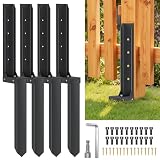
- H-Shaped Design for Maximum Stability: The H-shaped double-layer steel bracket wraps around your wood post on both sides, locking it in place with 5 assembly screws. Widened side flanges resist twisting from high winds and soil movement, keeping leaning or sagging fence posts straight without digging them up
- Heavy-Duty Steel Build That Lasts: Constructed from thickened double-layer steel with a black powder-coated finish that resists rust, corrosion, and daily wear. The reinforced frame handles repeated force from wind and gate use without bending, so your fence stays straight season after season
- Quick Fix Without Digging Up Old Posts: No need to remove and replace the entire post. Simply connect the two bracket halves, drive the pointed stake into the ground with a hammer, then secure it to your wood post using the pre-drilled holes and included screws. Most repairs take under 15 minutes
- Complete Kit with Everything You Need: Each pack includes 4 sets of unassembled 32-inch repair stakes, 16 galvanized assembly screws, 20 galvanized fixing screws, and 1 small wrench. Bracket size: 1.8" x 29.67" (W x H); buried depth: 15.1 inches
- Works for Garden, Farm, and Yard Fences: Ideal for reinforcing leaning, sagging, or rotting wood fence posts around your yard, garden, farm, greenhouse, or property line. Also works for metal posts, road signs, and gate supports. Confirm your post size before installation
Rank #2

- 2mm Thick Steel with Double-Sided Welded Joints:These fence repair stakes feature 2mm heavy-gauge steel construction with double-sided welding at the joints for enhanced structural strength; rust and corrosion resistant for long-lasting outdoor use.
- Fixes Leaning & Broken Wood Posts:This leaning fence post repair kit effectively stabilizes tilted, rotting or cracked wooden fence posts 4x4/6x6; restores full structural integrity without full post replacement — saves you expensive professional repair costs.
- No-Dig Fast Installation:Simply drive these fence post anchors into the ground with a hammer;kit includes drill bit and mounting hardware for easy setup;works with fence posts,mailbox posts,sign posts and more.Not suitable for concrete surfaces.No digging, no concrete.
- Wide Range of Applications:Ideal for yard fences,garden borders,farm enclosures,deck supports,mailbox stands,and outdoor sign posts; universal design fits most standard wood post sizes.
- Reliable After-Sales Support:Backed by quality assurance and responsive customer service;reach out anytime for installation guidance or product concerns—your satisfaction is our priority.
Sources
- University of Georgia Cooperative Extension, Fences for the Farm (Circular 774; reviewed March 12, 2024).
- Virginia Cooperative Extension, Electric Fencing: Troubleshooting (published May 13, 2025).
- Virginia Cooperative Extension, Designing a Permanent Grazing Infrastructure.
Product prices and availability are accurate as of the date/time indicated and are subject to change. Any price and availability information displayed on Amazon at the time of purchase will apply.

