Crashes, No Sound, or Screen Glitches?
Random freezes, missing sound and display glitches usually trace back to one bad driver. Find and replace yours safely.Free scan · under a minutePC Slower Than It Used to Be?
A free scan shows the junk files, broken settings and background clutter dragging Windows down - then fixes them in one click.Free scan · Windows 10 & 11The best climbing rose depends on the space, climate, support, flower color, fragrance, and amount of maintenance you can provide. For a broadly useful repeat-flowering rose, start with New Dawn, Aloha, or Strawberry Hill. For a smaller structure, consider Dublin Bay. For a cold northern garden, William Baffin has the strongest documented case in this list. For a large pergola, tree, or substantial frame, look at Climbing Cécile Brünner or Paul’s Himalayan Musk.
This is a curated shortlist rather than a universal ranking. Rose performance changes with climate, soil, disease pressure, winter exposure, rootstock or own-root production, pruning, and the strength of the support. The dimensions below are approximate, and local availability and hardiness should be checked before purchase.
As an Amazon Associate I earn from qualifying purchases.
What counts as a climbing rose?
True climbing roses usually have relatively stiff canes and often flower repeatedly through the growing season. Ramblers tend to have more flexible, vigorous growth and commonly produce one major flush in early summer. Some shrubs can also be trained upward, while catalog descriptions do not always use climber, rambler, and trainable shrub consistently.
None of these roses climbs by adhesive discs or aerial roots like ivy. Every one needs a trellis, wire system, arch, pillar, obelisk, pergola, or another structure. That distinction matters when planning a garden wall or construction project: the rose needs to be tied to a support, and the support needs to be securely attached to a suitable substrate or built as an independent frame.
#1 Best Overall
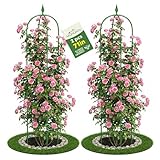
- 【6 Ft Adjustable Height】This 4-tier garden trellis for climbing plants provides ample space to plant thrive. With removable 4-way connectors, you can easily adjust the height as your plants grow—reaching up to 6 feet tall. It offers the flexibility needed for healthy vertical development
- 【Rustproof & Durable】This garden tower trellis is made of PVC-coated iron, so it is rust resistance. It stands up to sun exposure not easy to fading and is gentle on plant stems. The sturdy yet lightweight design holds up well indoors or outdoors, giving you reliable durability and stability
- 【Easy to Assemble】No tools required—one person can set up this tower obelisk garden trellis in minutes. The detachable design also allows quick disassembly for compact off-season storage. Tip: For best stability, insert the four longest tubes at the bottom for deeper soil anchoring
- 【Supports Various Climbing Plants】The durable steel frame of the obelisk trellis offers strong support for climbing plants: roses, clematis, vines, tomatoes, cucumbers. Whether indoors or outdoors, this trellis keeps climbing plants organized, healthy, and beautifully displayed
- 【Space-Saving】This outdoor climbing plant trellis features a three-dimensional structure that guides plants upward, making the most of your garden space. Perfect for small yards, balconies, or patios—ideal for apartment renters and gardeners to create a greener garden without clutter
Quick comparison: 17 climbing roses at a glance
| Rose | Best use | Useful scale or classification | Flower color |
|---|---|---|---|
| Eden Climber | Romantic wall, fence, or arch | Strong, repeat-flowering modern climber | Large pink-blushed blooms |
| New Dawn | Wall, fence, pillar, or moderate arch | About 3 m / 10 ft; repeat flowering; RHS AGM | Soft blush pink |
| Zéphirine Drouhin | Path, doorway, or seating area | Thornless Bourbon climber | Pink; fragrant |
| Don Juan | Prominent wall, arbor, or cut-flower garden | Large-flowered climber | Dark velvety red |
| Aloha | Sunny wall, pillar, or arch | About 3 m / 10 ft; repeat flowering; RHS AGM | Rose pink |
| Dublin Bay | Smaller wall or fence | About 2.1 m / 7 ft; compact climbing floribunda; RHS AGM | Red |
| Climbing Iceberg | Familiar white-flowered display | Order the climbing form specifically | White |
| Joseph’s Coat | Large fence, cutting garden, or substantial frame | About 10–11-plus ft by 6 ft; Zones 5–10 as seller-described | Cherry red, gold, and orange |
| Lady of Shalott | Trainable shrub for an upright display | About 2.25–2.75 m; RHS AGM shrub | Orange to orange-red |
| Strawberry Hill | Fragrant wall or arch | Repeat-flowering English climber; RHS AGM | Soft pink |
| Crown Princess Margareta | Substantial wall, pillar, or obelisk | English rose suitable for vertical training | Apricot orange |
| The Pilgrim | Wall, fence, or living-wall planting | English climbing rose | Lemon yellow |
| Wollerton Old Hall | Doorway or close-viewing wall | Fragrant English climber | Pale, soft-toned blooms |
| James Galway | Medium-to-large support | Repeat-flowering English climber | Pink |
| Climbing Cécile Brünner | Large tree, pergola, or tall structure | About 8 m / 26 ft; vigorous climbing polyantha; RHS AGM | Shell pink |
| Paul’s Himalayan Musk | Large tree, pergola, or major cascade | About 6 m / 20 ft; once-flowering rambler; RHS AGM | Pinkish lavender |
| William Baffin | Cold-climate garden | About 9 ft by 6 ft; Zones 3–7; repeat flowering | Semi-double pink |
The 17 best climbing roses for different garden situations
1. Eden Climber
Best for: A romantic wall, fence, arch, or entrance feature.
Eden Climber is a classic modern climber for gardeners who want large, full flowers with pink-blushed coloring. Its formal, romantic appearance makes it particularly effective against a simple wall or dark-painted fence, where the blooms can become the main feature.
It is generally treated as a repeat-flowering climber, but do not assume that catalog performance will be identical in every garden. Verify local stock, hardiness, and regional growing experience before ordering, particularly if the rose will be exposed to severe winters, intense summer heat, or persistent humidity.
Free tools Windows power users keep installed
One-click scans. No signup required.
2. New Dawn
Best for: A reliable-looking, soft-pink display on a wall, fence, pillar, or moderate-sized arch.
New Dawn is one of the safest broadly useful choices in this group. The RHS lists it as an Award of Garden Merit climbing rose reaching approximately 3 m / 10 ft, with suitability for a sunny wall and pillar training. Its soft blush-pink flowers and repeat-flowering habit suit gardens where you want a long-season display without the scale of a huge rambler.
Give it enough room to spread its main canes outward rather than forcing every stem straight up. That training approach usually produces a fuller flowering surface instead of concentrating most of the blooms at the top.
3. Zéphirine Drouhin
Best for: A fragrant rose near a path, doorway, bench, or seating area.
Quick wins for a faster PC:
Repair Windows errors before they cause bigger problemsFix Now →Scan for outdated or missing drivers - takes under a minuteDriver Scan →Clear out junk files and repair common Windows errorsFree Scan →Zéphirine Drouhin is a thornless Bourbon climber and one of the most appealing options where people will regularly pass close to the plant. Thornlessness can make tying, pruning, and maintenance more comfortable, and the fragrance is a natural reason to place it near a door or sitting area rather than at the far end of the garden.
Thornless does not mean disease-proof or maintenance-free. Good air circulation, appropriate watering, sensible pruning, and regular monitoring still matter, especially in humid climates or crowded planting beds.
4. Don Juan
Best for: A dramatic red climber on a prominent wall, arbor, or fence.
Don Juan is the high-impact red choice in this selection. Seller descriptions emphasize large, dark velvety-red, full, cupped blooms, along with a tea-and-fruity fragrance, glossy foliage, and usefulness as a cut flower. The contrast is especially strong against a white or pale fence.
Those characteristics are catalog descriptions rather than guarantees of identical results in every climate. Flower size, fragrance, repeat performance, and foliage quality can change with weather, light, soil, disease pressure, and care.
5. Aloha
Best for: A sunny wall, pillar, or arch where fragrant rose-pink flowers and moderate scale are wanted.
The RHS lists Aloha as an Award of Garden Merit climbing hybrid tea rose, approximately 3 m / 10 ft, with repeat flowering and suitability for sunny structures. It offers a useful middle ground: more presence than a small patio rose, but generally easier to place than a very vigorous rambler.
Its rose-pink flowers and fragrance work well near an outdoor seating area, provided the support is strong enough for mature growth and the site receives the light required by the variety.
The Tool Desk
Outbyte PC Repair FREEClear out junk files and repair common Windows errorsFree Scan →Outbyte Driver Updater FREEScan for outdated or missing drivers - takes under a minuteDriver Scan →6. Dublin Bay
Best for: A compact red climber for a smaller wall, fence, or garden structure.
Rank #2

- ELEGANT GARDEN ARCH TRELLIS – Transform your backyard into a beautiful garden retreat with this classic black metal garden arch. Create an inviting entrance along pathways, over garden beds, or among your favorite flowers and climbing plants.
- IDEAL FOR CLIMBING PLANTS – Give climbing roses, clematis, flowering vines, and other climbing plants a decorative framework to grow around. The open arch design allows greenery to weave naturally through the structure, creating a beautiful garden focal point.
- VERSATILE OUTDOOR DECORATION – Perfect for backyard gardens, walkways, garden entrances, and seasonal displays. Decorate the arch with flowers, greenery, or string lights to create an attractive backdrop for weddings, birthdays, and outdoor celebrations.
- CLASSIC BLACK METAL DESIGN – The timeless arched silhouette and black finish complement a wide variety of garden styles. Its open metal framework adds height and visual interest to your outdoor space without obstructing the surrounding landscape.
- EASY-TO-ASSEMBLE GARDEN ARBOR – The sectional metal frame is designed for convenient assembly and placement. Create a garden feature or a decorative entrance for your favorite outdoor space. Secure the arch properly before adding plants or decorations.
Dublin Bay is a practical choice when a full-size rambler would overwhelm the available space. The RHS lists it as an Award of Garden Merit climbing floribunda reaching approximately 2.1 m / 7 ft. That makes it particularly useful for a modest fence, a narrow side passage, or a trellis where you need to keep the planting visually proportionate.
Its classic red flowers provide strong contrast against pale masonry, rendered walls, or light-colored timber. Even a relatively compact climber should be tied and pruned so that it does not block paths, windows, gates, or access for maintenance.
7. Climbing Iceberg
Best for: A familiar white-flowered rose in climbing form.
Climbing Iceberg is the straightforward white option for gardeners who like the well-known Iceberg appearance but need vertical growth. It can brighten a darker wall or soften a fence without introducing a strong color clash.
Buyers should order the explicitly climbing plant. A climbing form and a bush form of the same named rose can differ substantially in vigor, mature shape, and pruning requirements; choosing the standard bush by mistake may leave a wall or arch under-covered.
8. Joseph’s Coat
Best for: A high-impact multicolor display on a large fence or substantial support.
Joseph’s Coat brings a different effect from single-color climbers. Heirloom describes semi-double flowers combining cherry red, deep gold, and orange, with continual flowering and glossy foliage. The seller gives a mature size of roughly 10–11-plus ft high by 6 ft wide and describes suitability for Zones 5–10.
Do these 3 things before closing this tab:
1Fix the driver behind crashes, sound loss and screen glitches2Clear out junk files and repair common Windows errors3Scan for outdated or missing drivers - takes under a minuteThis is a large, thorny rose, so placement matters. Allow space for access and maintenance, and do not install it on a light decorative trellis that cannot accommodate the mature canes, foliage, and wind exposure. It is a better match for a robust fence, wide arch, or independently supported frame.
9. Lady of Shalott
Best for: A warm orange display when you are willing to train a shrub upward.
Lady of Shalott is often sold as a shrub rather than as a conventional climbing rose. The RHS lists it as an Award of Garden Merit shrub reaching approximately 2.25–2.75 m, while David Austin and Heirloom include it among their current English rose offerings. Treat it as a trainable shrub, not as an automatic replacement for a purpose-bred climber.
Its warm orange-red buds and loosely arranged orange blooms make it useful against neutral walls or in a mixed border. Training can create an upright display, but the final shape and coverage will depend on the plant, site, support, and pruning.
10. Strawberry Hill
Best for: Fragrance, soft pink color, and a refined wall or arch display.
The RHS identifies Strawberry Hill as an Award of Garden Merit climber suited to a sunny, sheltered wall. David Austin also lists it among repeat-flowering roses that can be trained into decorative shapes. This makes it a strong candidate for a garden feature that will be viewed from close range rather than simply used to cover a large boundary.
Its soft pink flowers and fragrance are especially effective around an entrance, courtyard, or seating area. Fragrance intensity is influenced by weather and growing conditions, so treat catalog fragrance descriptions as useful guidance rather than a fixed guarantee.
11. Crown Princess Margareta
Best for: Apricot-orange flowers on a substantial wall, pillar, obelisk, or other vertical frame.
David Austin includes Crown Princess Margareta in its climbing and rambling collection and lists it among the varieties that can be trained vertically. Its apricot-orange color palette works well where a warmer alternative to pink or red is wanted.
Rank #3

- 【Tool-Free Quick Assembly】 No extra tools or complex instructions needed! Just insert the 11.8-inch reinforced ground spike into soil, and your plant trellis is ready to use in 5 minutes. Perfect for busy gardeners—no professional skills required. Unit Dimension: 2 Pack, 86.7" H x 19.7" W. Note: Vines and plants are not included.
- 【Heavy-Duty Rustproof Construction】YOBAZAN garden trellis for climbing plants Crafted with thickened steel tubes (2mm thicker than ordinary trellises). High-temperature black powder coating, this climbing plant trellis is weatherproof. It withstands rain, snow, and intense sunlight without fading or bending, maintaining stability for years in outdoor gardens, patios, or balconies.
- 【Elegant Bird Pattern & Versatile Style】 Unique laser-cut bird motifs add a charming, nature-inspired touch to your outdoor space—blending seamlessly with modern, cottage, or rustic garden styles. The open wire lattice design not only supports climbing growth but also creates a decorative screen to hide unsightly areas (like utility boxes or fence gaps) while keeping your yard visually appealing.
- 【Multi-Scene Support for All Climbers】 Ideal for supporting small to medium potted plants and various climbing flowers (roses, ivy, clematis, jasmine, morning glories) as well as vine vegetables (tomatoes, peas, cucumbers, beans). Use it as a standalone plant stand, wall-mounted trellis, or fence extender—adds vertical interest to your garden and maximizes growing space.
- 【Reliable After-Sales & Quality Guarantee】 If your 2-pack trellis arrives damaged, missing parts, or fails to meet expectations, contact us anytime for a free replacement . Our 24/7 customer service team is ready to assist—shop with confidence for your garden upgrade.
Plan the support before planting. If a vigorous rose is repeatedly cut back simply because the structure is too small, flowering can suffer and the plant may become difficult to manage. The appropriate structure is more important than the word climbing on the label.
12. The Pilgrim
Best for: Lemon-yellow flowers on a wall, fence, arch, or living-wall-style planting.
The Pilgrim is an English climbing rose that David Austin names as a suitable vertical planting choice in its living-wall guidance. It is a good selection when lemon-yellow flowers and a softer English-rose form matter more than finding the most compact or universally adaptable climber.
What’s actually slowing this PC down?
Pick the symptom - the matching free tool is one click away.
Use it as a site-dependent recommendation. Confirm the mature habit, local performance, and support requirements from the current seller or breeder information before committing it to a narrow wall or small arch.
13. Wollerton Old Hall
Best for: A fragrant, pale-toned rose beside a doorway, wall, or other close-viewing location.
Wollerton Old Hall is categorized as an English climbing rose and appears in Heirloom’s current climbing collection. Its pale, refined flowers and fragrance make it particularly attractive where visitors can see and smell the blooms at close range.
Availability can change between seasons and retailers. Check live stock before purchase, and confirm that the plant being offered is the climbing form rather than a similarly named shrub or a temporarily unavailable listing.
Recommended Free Tools
14. James Galway
Best for: A pink, repeat-flowering English-rose look on a medium-to-large support.
James Galway appears in David Austin’s climbing collection and Heirloom’s current catalog. It suits a gardener who wants a romantic pink display with repeat-flowering potential and has enough room for a substantial support.
A fixed mature height would be misleading without identifying the seller, root system, climate, and growing conditions. Allow the support and planting space to accommodate variation rather than designing the installation around a single catalog number.
15. Climbing Cécile Brünner
Best for: A large tree, pergola, or tall structure that can handle vigorous growth.
Quick wins for a faster PC:
Clear out junk files and repair common Windows errorsFree Scan →Fix the driver behind crashes, sound loss and screen glitchesFind Drivers →Climbing Cécile Brünner is not a small-trellis rose. The RHS lists it as an Award of Garden Merit climbing polyantha with a potential height of about 8 m / 26 ft. Its vigorous, rambling habit and clusters of shell-pink flowers make it a spectacular choice where a large-scale cascade is wanted.
Before planting, assess the long-term space, access, wind exposure, and maintenance route. A robust pergola or purpose-built frame is more appropriate than a narrow decorative panel. If using a tree, allow the rose to be supported without damaging the trunk or obstructing essential maintenance.
16. Paul’s Himalayan Musk
Best for: A spectacular once-yearly cascade over a large tree, pergola, or tall structure.
The RHS lists Paul’s Himalayan Musk as an Award of Garden Merit rambler reaching approximately 6 m / 20 ft. It produces a major display of pinkish-lavender flowers, making it a display-first choice for gardeners who value scale and early-summer impact.
Free tools Windows power users keep installed
One-click scans. No signup required.
It is not the best choice for a small wall that needs flowers from summer into autumn. Its flexible, vigorous habit and principal annual flush are fundamentally different from a compact repeat-flowering climber, so plan the structure and pruning around the rambler’s natural behavior.
Rank #4

- Sturdy Metal Design: Our garden flower trellis is constructed from high-quality Q195 metal, expertly engineered to handle heavy plants, providing unwavering support for your vibrant ivy and flourishing rose bushes.
- Chic Aesthetic: Elevate your outdoor space with this beautifully crafted metal garden trellis, designed to be a stunning focal point in your garden or courtyard, enhancing its overall charm and appeal.
- All-Weather Durability: Featuring a robust powder-coated finish, this garden trellis for climbing plants is built to resist rust and corrosion, ensuring it withstands the elements while looking great for years to come.
- Hassle-Free Setup: Enjoy the ease of assembly with our garden trellis—no special tools or skills required! It's perfect for gardening enthusiasts of all levels, especially those just starting out.
- Versatile Support: This rose trellis plant support is ideal for more than just flowers! It provides reliable support for a variety of plants, including vegetables and fruits, catering to all your gardening aspirations.
17. William Baffin
Best for: A cold-climate garden where winter hardiness is a primary concern.
University of Minnesota Extension lists William Baffin as a deciduous climbing rose with semi-double pink flowers in June and recurring through summer. It gives an approximate mature size of 9 ft high by 6 ft wide and lists hardiness in Zones 3–7. Heirloom describes it as a vigorous, extra-hardy shrub or climber.
William Baffin has the strongest cited northern case in this selection, but it is not automatically the best rose for every cold garden. Winter exposure, snow and ice, summer humidity, soil drainage, and local disease pressure still affect results. Confirm the hardiness zone and site conditions before buying.
Do these 3 things before closing this tab:
1Scan for outdated or missing drivers - takes under a minute2Repair Windows errors before they cause bigger problems3Fix the driver behind crashes, sound loss and screen glitchesHow to choose the right rose from the list
For a small wall, fence, or doorway
Start with Dublin Bay, New Dawn, Aloha, or a moderate English climber such as Strawberry Hill. These are more proportionate choices than Climbing Cécile Brünner or Paul’s Himalayan Musk, whose vigor can overwhelm a small structure.
For fragrance
Shortlist Zéphirine Drouhin, Don Juan, Strawberry Hill, and Wollerton Old Hall. Place fragrant roses where people pass or sit. Remember that fragrance varies with weather, temperature, time of day, and growing conditions.
For red flowers
Choose between Don Juan and Dublin Bay. Don Juan offers large, full, dark red blooms and a more dramatic presence. Dublin Bay is the more compact choice when the support or planting area is limited.
For yellow or apricot flowers
The Pilgrim is the clearest lemon-yellow choice. Crown Princess Margareta offers apricot-orange flowers on a rose suitable for vertical training. Aloha and Lady of Shalott provide additional warm tones, but Aloha is presented as a formal climbing hybrid tea while Lady of Shalott is a shrub that can be trained upward.
Outdated Drivers Are Slowing You Down
One free scan finds every outdated or missing driver and matches the right update for your exact hardware.Free scan · exact hardware matchWindows Errors? Fix Them Before They Spread
Repair common Windows errors and clear accumulated junk for a smoother, more stable PC - no reinstall needed.Free scan · no reinstallFor a multicolor effect
Joseph’s Coat is the standout option, with seller-described flowers combining cherry red, gold, and orange. Its size and thorniness make it a better fit for a large support than a narrow passage or lightweight trellis.
For a cold climate
William Baffin is the strongest northern recommendation supported by the research, with a cited hardiness range of Zones 3–7. Treat the zone as guidance rather than a promise: a protected garden in the same zone may perform very differently from an exposed site with drying winter winds.
For a tree or very large pergola
Choose Climbing Cécile Brünner or Paul’s Himalayan Musk when the structure and available space can accommodate vigorous growth. Cécile Brünner is a large climbing polyantha; Paul’s Himalayan Musk is a large, generally once-flowering rambler. Neither belongs on a small decorative trellis.
Support and construction planning
Support is not an accessory for a climbing rose; it is part of the planting design. Before selecting the plant, decide whether the rose will grow against a wall, along a fence, over an arch, around a pillar, across an obelisk, or over a pergola. Then select a structure that matches the mature size and vigor of the rose.
Recommended Free Tools
For a permanent installation, make sure the trellis or wire system transfers its load into sound masonry, timber framing, or an independent support. A decorative panel attached only to weak cladding or a lightweight fence section may not remain suitable as the rose becomes larger and more exposed to wind. Match fasteners and anchors to the actual substrate, and leave enough clearance for tying, pruning, repainting, and inspecting the wall or frame.
If you are installing a garden trellis for climbing roses, choose its height and width around the selected cultivar rather than buying the plant first and trying to contain it later. Small climbers such as Dublin Bay need a very different support strategy from Cécile Brünner or Paul’s Himalayan Musk.
Wire spacing and stem placement
The RHS recommends horizontal wires beginning about 45 cm / 18 in above ground, with later wires approximately 30 cm / 1 ft apart. A trellis can provide the same general framework, provided it is strong enough and has usable points for tying the canes.
Train young main canes outward and as close to horizontal as the structure permits. A cane trained straight upward often produces most of its flowering side shoots near the top. Spreading the main canes outward encourages flowering shoots along more of the available height and width, creating better coverage over a wall or frame.
Use flexible, soft ties rather than tight wire or rigid fasteners. Leave room for the cane to expand, and inspect the ties as the rose grows. Tight ties can bruise or weaken canes, while loose but supportive ties allow the plant to move slightly without rubbing against the support.
Soft plant ties are useful when training young canes because they hold stems in place without cutting into them. Use several loose attachment points rather than forcing one long cane into a sharp bend.
Independent reader supportYour contribution helps us test, update, and keep practical guides available for everyone.Planting conditions that affect performance
Plant climbing roses in fertile, moisture-retentive but well-drained soil. Full sun is suitable for many varieties, although the exact light preference should be checked for the cultivar. A site with good air movement is valuable, particularly for thornless or densely foliaged roses that may otherwise be treated as disease-free simply because they are easy to handle.
Best Value

- Versatile garden arch, perfect for event, wedding, and garden decoration. A must-have for your special occasions.
- Approximately 55 inches Width x 94 inches Height, this real size arbor creates a stunning entrance to your garden, patio or walkway.
- Easy assembly and disassembly, praised by customers. Suitable for both indoor and outdoor use.
- Decorate with vibrant flowers, tulle, balloons, foliage, lights or anything else to create a beautiful arch backdrop stand.
- Not just a garden trellis for climbing plants, but also a balloon arch stand for birthdays and a decorative arch for weddings.
Take special care beside walls. The area immediately next to a wall can sit in a rain shadow, leaving the soil drier than the rest of the bed. A rose may appear correctly planted but still struggle if its roots do not receive adequate moisture. Prepare the soil and plan irrigation around the actual conditions at the base of the wall, not the rainfall recorded elsewhere in the garden.
Also account for the rose’s eventual width. A plant that reaches several metres high may need comparable lateral room for its main canes, and a large rambler can become a long-term access problem if it is planted over a gate, gutter, window, or frequently used path without a maintenance plan.
Pruning and routine maintenance
For established climbers, remove dead, diseased, damaged, and weak growth. Tie in useful new shoots, and shorten flowered side shoots as appropriate for the plant’s habit. The RHS places routine climbing-rose pruning from late autumn through winter, while David Austin’s current guidance emphasizes pruning during dormancy, generally January or February in its own advice. Adapt the calendar to local climate, frost risk, and whether the rose is a repeat-flowering climber or a once-flowering rambler.
Do not prune every rose as though it were a compact shrub. Preserve useful main canes that can be trained across the support, removing only those that are unproductive, damaged, badly placed, or too crowded. Over-pruning a vigorous rose such as Crown Princess Margareta can reduce the flowering surface and create more work without solving the underlying support problem.
Use clean, sharp rose pruning shears for removing small canes and shortening side shoots. For larger woody growth, use a tool appropriate to the cane diameter, and disinfect tools when moving between plants where disease is a concern.
Once-flowering ramblers require a different approach from repeat-flowering climbers. Paul’s Himalayan Musk, for example, is selected for its large seasonal cascade rather than continuous flowering. Avoid cutting away the wood that will carry the main display simply because the plant does not behave like a modern repeat-flowering climber.
Buying and availability caveats
Rose inventory changes quickly. Heirloom’s climbing-rose collection and David Austin’s collection both showed a mixture of in-stock and sold-out listings during the research period. That means an article should not promise that a particular rose is currently available, discounted, or shipping to a particular region without a live check at publication time.
When ordering, verify four things:
- The exact form: confirm that the listing says climbing, not merely the same cultivar name in shrub or bush form.
- The local hardiness and climate fit: check winter exposure, summer heat, humidity, and disease pressure rather than relying on a catalog zone alone.
- The mature scale: compare the seller’s current dimensions with the height, width, and load capacity of the intended support.
- The production method: note whether the plant is own-root or grafted, but treat retailer claims about the advantages of own-root roses as retailer-specific claims, not proof of universal superiority.
Availability of named cultivars such as Eden Climber, Wollerton Old Hall, and the English roses can vary by country, season, seller, and propagation schedule. Confirm live stock and shipping restrictions before designing an installation around one particular rose.
Which rose should you plant?
For the easiest decision, begin with the support and not the flower photograph. Measure the usable height and width, determine whether the structure is a wall, fence, arch, pillar, or pergola, and decide whether you want repeat flowering or one spectacular seasonal flush. Then narrow the list by color, fragrance, and hardiness.
- Small structure: Dublin Bay, New Dawn, Aloha, or Strawberry Hill.
- Fragrance near a path: Zéphirine Drouhin, Don Juan, Strawberry Hill, or Wollerton Old Hall.
- Warm colors: The Pilgrim, Crown Princess Margareta, Aloha, or Lady of Shalott.
- Large-scale coverage: Climbing Cécile Brünner, Joseph’s Coat, or Paul’s Himalayan Musk, depending on flowering habit.
- Cold northern site: William Baffin, subject to local exposure and hardiness checks.
- Classic white: Climbing Iceberg, ordered in the climbing form.
Source note: Cultivar classifications, approximate dimensions, hardiness references, and training guidance in this article are based on listings and advice from the Royal Horticultural Society, David Austin, Heirloom Roses, and University of Minnesota Extension. Dimensions and performance are not guarantees and can change with site, climate, care, and the particular plant supplied.
Frequently Asked Questions
Do climbing roses climb by themselves?
No. Climbing roses do not attach to walls like ivy. Install a sturdy trellis, horizontal wires, arch, pillar, obelisk, or pergola, then secure the canes with loose, flexible ties.
What is the difference between a climbing rose and a rambler?
Climbing roses generally have stiffer canes and often repeat flower. Ramblers usually have more flexible, vigorous growth and commonly produce one major early-summer flush. Paul’s Himalayan Musk is the rambler in this list, while Climbing Cécile Brünner has a particularly vigorous, rambling habit.
Is Lady of Shalott a climbing rose?
It is usually sold as an Award of Garden Merit shrub that can be trained upward, rather than as a conventional climbing rose. It can create a vertical display, but its growth and support requirements may differ from a purpose-bred climber.
The Tool Desk
Outbyte Driver Updater FREEFix the driver behind crashes, sound loss and screen glitchesFind Drivers →Outbyte PC Repair FREERepair Windows errors before they cause bigger problemsFix Now →What is the best climbing rose for a cold climate?
William Baffin has the strongest cited northern case here, with University of Minnesota Extension listing it for Zones 3–7 and describing flowering in June with recurrence through summer. Confirm local winter exposure and disease conditions before buying.
How far apart should support wires be for a climbing rose?
The RHS recommends beginning horizontal wires about 45 cm / 18 in above ground, with subsequent wires approximately 30 cm / 1 ft apart. The structure must still be sized and anchored for the selected rose’s mature growth.
The Bottom Line
Bottom line: Choose the rose that matches the structure, not simply the bloom color. New Dawn and Aloha are versatile moderate-scale choices, Dublin Bay suits smaller supports, Zéphirine Drouhin and Strawberry Hill are natural fragrance picks, William Baffin is the strongest cited cold-climate option, and Climbing Cécile Brünner or Paul’s Himalayan Musk belong on genuinely large structures. Build or install the support first, train the canes outward, and confirm current stock and local suitability before ordering.
Quick Recap
Product prices and availability are accurate as of the date/time indicated and are subject to change. Any price and availability information displayed on Amazon at the time of purchase will apply.

