Recommended Free Tools
Some links on this page are affiliate links: if you buy through them we may earn a commission, at no extra cost to you.
Yes—you can add remote monitoring and limited control to some existing pellet stoves, but it is a retrofit, not a replacement for the stove’s safety system. Alessandro Polselli’s November 2, 2021 Hackster project uses an ESP32, ESPHome, Home Assistant, temperature sensors and a relay to monitor a hydronic pellet stove and imitate a press of its existing power button. Its parts and logic offer a useful example for experienced makers; its sensor thresholds and wiring are specific to that installation, not a universal build recipe. Read the original project.
What “smart” means in this project
A pellet stove can be made smart in several different senses. Monitoring means reading conditions such as exhaust temperature, water temperature or feed-motor activity. Remote control means sending a start or stop command from a phone or automation dashboard. Automation means having a system act on a schedule or occupancy state. These capabilities are not the same as a stove that can independently confirm safe combustion or diagnose every fault.
The Hackster build is an external retrofit for an existing stove. It adds telemetry and a relay that simulates a long press of the appliance’s physical power button. The stove’s own controls remain responsible for the ignition, combustion and shutdown sequence. It is not a new combustion controller, and it does not establish that remote or unattended operation is safe for every appliance.
How the retrofit works
A typical pellet stove stores fuel in a hopper, feeds pellets to a burn pot with an auger or feed motor, ignites them, and uses fans and a heat exchanger to deliver heat. In the documented installation, the stove heats water for radiators. The retrofit observes several clues along that sequence: motor current suggests that pellets are being fed, smoke temperature indicates developing combustion, and water temperature indicates heat reaching the hydronic system.
#1 Best Overall

- ★★ ATTENTION: This device is NOT a power supply/Ignitor unit. (No voltage output itself, but passing voltage from your fireplace thermopile for safety reason). If using it as a switch, please connect it with power source or circuit in series.▼ Durablow battery powered R.F. + LCD screen transmitter and receiver kits give wireless remote control to a gas heating appliance, such as gas fireplace. ▼ Childproof safety lock available. ▼ The controllable temperature range is from 45℉ (7℃) to 99℉ (37℃).
- ★ HOW TRANSMITTER WORKS: Thermostat feature in transmitter turns ON/OFF when the room temperature changes. It also operates the fireplace with room temperature swings 1 °F, 2 °F, or 3 °F. ▼ The timer feature operates with options ranging from a 15-minute minimum to a 9-hour maximum. ▼ FCC approved. Operates within a 20-foot range & in a non-directional RF signal evironment.
- ★ HOW RECEIVER WORKS: Receiver with LEARN function, snap-on wall plate, and 18-inch wires with connectors to gas MILLIVOLT valve or electric spark ignition module. ▼ Receiver BOX DIMENSION: 2.6"x2.4"x1.54". (Please measure your wall outlet box first)
- ★ REPLACES CROSS REFERENCE MODELS OF FIREPLACE: SKY, 9800322, 9800323, 9800324, 9800326, 9800328, 9800329, 9800550, 9800580, 1001-A, 1001, 1001TH, 1001T, 1410T, 1410-A, 1410TH, 3002, 3301, CON, RCK-K, RCK-KS, 5001, 5010, 5301, 5310, 55644, HRC200, RG04-1M, UN3. If the model you're seeking isn't listed, please reach out for further details.▼ LEGAL DISCLAIMER: The brand name and model number are listed for cross-reference only. All trademarks and model numbers remain the property of their respective owners.
- ★ CHECK REMOTE COMPATIBILITY WITH YOUR GAS FIREPLACE: To find a compatible remote for your gas fireplace, first determine the type of gas valve it uses. This information is usually in the installation manual under "Wiring Diagram" or on the rating plate inside or behind the fireplace. If you don't have the manual, search online using your model number. Our remotes are compatible with Millivolt valves that have TH and TH/TP terminals.
Stove power-button circuit
          │
   relay contact (momentary press)
          │
   ESP32 / M5Stack ATOM Matrix
   ├── MAX6675 + K-type thermocouple (smoke temperature)
   ├── DS18B20 (water temperature)
   ├── CT clamp (feed-motor activity)
   └── Wi-Fi
          │
       ESPHome
          │
    Home Assistant
    ├── dashboard and sensors
    ├── remote switch
    └── automations and alerts
The relay’s role matters: the project uses it to imitate the stove’s button, not to cut and restore the appliance’s mains supply. A pellet stove commonly needs a controlled shutdown and cooling period. Removing power with a generic smart plug can interrupt that sequence and is not an equivalent form of control.
Parts in the published build
| Part | Purpose |
|---|---|
| M5Stack ATOM Matrix ESP32 | Wi-Fi controller and GPIO interface |
| M5Stack Mini 3A Relay Unit | Momentarily simulates a press of the stove’s power button |
| MAX6675 and K-type thermocouple | Read smoke or exhaust temperature |
| DS18B20 temperature sensor | Read water temperature in the hydronic installation |
| Current-transformer (CT) clamp | Detect current associated with the pellet-feed motor |
| ESPHome | Firmware, GPIO definitions and sensor reporting |
| Home Assistant | Dashboard, remote commands and automations |
A practical installation may also require a suitable enclosure, strain relief, terminal blocks, wiring, a power supply, probe-mounting hardware rated for the temperature and environment, and appropriate electrical isolation and protection. The project’s parts list is not a complete installation specification. Enclosure, mounting and wiring choices depend on the appliance, location and applicable electrical rules. Have mains work done by a qualified electrician; use a qualified hearth professional for stove or exhaust modifications.
Wiring and ESPHome details: project-specific, not universal
The published configuration assigns the ATOM Matrix’s GPIO23 to MAX6675 MISO, GPIO22 to its clock, and GPIO19 to chip select. The DS18B20 data line uses GPIO21; the CT-clamp signal goes to ADC input GPIO33; and the relay output is GPIO26. The configuration identifies the board as m5stack-atom. These assignments apply to the stated board and wiring. Check the exact board pinout and sensor interface before adapting them; do not assume another ESP32 board has the same pins or electrical characteristics.
The project reports smoke temperature every five seconds and motor current every two seconds. Water temperature is also updated every five seconds. Its feed-state template treats current above 0.27 A as feeding and applies a 15-second delayed-off filter. Its relay turns itself off after an eight-second pulse. The author describes smoke above roughly 200°C and water above roughly 50°C as indicators in that particular installation. None of these numbers is a general setting for pellet stoves: current depends on the motor and CT calibration, temperatures depend on the stove and sensor placement, and the power-button behavior varies by model.
Rank #2
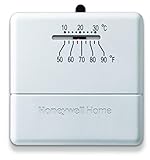
- Heat only manual thermostat
- Simple worry free operation
- Bimetal temperature sensor
- Decorative back plate included,Item does not come with an off switch
- Mercury free
The relay logic published in the project illustrates the momentary action:
switch:
  - platform: gpio
    pin:
      number: GPIO26
    name: Smart Pellet Stove Relay
    id: relay1
    on_turn_on:
      - delay: 8s
      - switch.turn_off: relay1
The feed detector is similarly specific:
binary_sensor:
  - platform: template
    name: Smart Pellet Stove Feeding
    id: feeding1
    lambda: |-
      return id(current1).state > 0.27;
    filters:
      - delayed_off: 15s
These excerpts describe the published project, not independently validated protection logic. An apparently plausible temperature or current reading does not prove that ignition succeeded, exhaust is safe, or the appliance is free of a fault. The project also includes Wi-Fi fallback access-point/captive-portal behavior, over-the-air updates and logging; those conveniences do not make the device fail-safe.
Connecting it to Home Assistant
ESPHome devices can connect to Home Assistant through its ESPHome integration. Once configured, the controller can expose its sensor readings and relay switch for a dashboard, notifications and automations. Home Assistant’s presence-detection guidance describes one route to occupancy-based automations. In the project, presence is used to turn the stove on or off depending on whether people are home.
The Tool Desk
Outbyte Driver Updater FREEScan for outdated or missing drivers - takes under a minuteDriver Scan →Outbyte PC Repair FREERepair Windows errors before they cause bigger problemsFix Now →Safer, useful automations emphasize visibility and deliberate control before automatic starting. For example:
Rank #3

- ★ Transmitter Features: Equipped with a thermostat that turns the pellet stove ON/OFF based on room temperature. Adjustable sensitivity (1°F, 2°F, or 3°F) ensures optimal comfort. Includes a timer function with options from 15 minutes to 9 hours, FCC-approved operation within a 20-foot range, and a non-directional RF signal. Childproof safety lock and temperature control range of 45℉ (7℃) to 99℉ (37℃).
- ★ Receiver Details: Features a "LEARN" function and 3 operation modes (ON / REMOTE / OFF). Includes a 46-inch pigtail lead wire with a 2-pin connector for easy installation to the "LEVEL" port on ComfortBilt control boards. Compact dimensions: 2.6" x 2.4" x 1.54".
- ★ Cross-Reference Model Replacement: Compatible with and replaces ComfortBilt CB3002 remote models. (Legal Disclaimer: Brand and model names are for cross-reference purposes only, and all trademarks remain the property of their respective owners.)
- ★ Compatible Pellet Stove Models: Works with ComfortBilt series Alpine, HP21, HP22, HP22i, HP22N, HP50, HP61, HP75C, and more. Check the "Wiring Diagram" in your installation manual for compatibility or search online with your brand and model number.
- ★ Complete Package Includes: Remote transmitter, receiver box with pigtail wire, wall mount cover plate, screws, slide switch, and user manual. Operates with 2 AAA batteries (transmitter) and 4 AA batteries (receiver) — batteries not included. Recommended: Energizer Lithium Batteries. Note: Battery leakage causing corrosion is considered improper use.
- Notify if a start is requested but expected heating indicators do not appear within a stove-appropriate interval.
- Alert if feed-motor activity continues without a corresponding temperature trend, while treating the signal as an anomaly to investigate rather than a definitive diagnosis.
- Block repeated start commands while an ignition or shutdown cycle is underway.
- Notify when the controller or Home Assistant has been offline, and keep conventional heating available as a fallback.
- Use vacancy as a prompt for a controlled shutdown only if the stove’s own supported button behavior and shutdown cycle are understood. Do not abruptly disconnect power.
Remote “on” commands deserve more caution than monitoring. If the network or Home Assistant disappears, the stove should remain governed by its own controls rather than being driven into an assumed safe state by a failed automation.
Commissioning: prove the basics before automating
Do not begin with an unattended schedule. First confirm, with the appliance manual and appropriate professional advice, that the interface can be safely used. Keep the stove’s original manual controls available, and never bypass factory sensors or interlocks.
- Validate each sensor. Compare readings with plausible conditions and inspect the thermocouple, water probe and CT placement. The clamp must be installed around the intended conductor and configured for the sensor circuit.
- Test the relay separately. In a safe test state, verify that it is normally inactive, produces only the intended momentary action and releases. Confirm suitability of its ratings, isolation and enclosure for the actual circuit.
- Compare with manual operation. Confirm that the relay pulse behaves like the appliance’s button, including what happens if the stove is already on, starting, shutting down or displaying an alarm.
- Observe a normal start and shutdown. Watch the stove and its native indicators throughout both cycles. Confirm that the retrofit’s readings are informative but do not substitute for the appliance’s status or alarms.
- Exercise failure cases. Consider Wi-Fi loss, Home Assistant downtime, a disconnected or implausible sensor, failed ignition, an empty hopper or interrupted feeding. Verify that a fault does not trigger repeated starts or bypass the stove’s controls.
- Retain manual operation. Make sure occupants can use and stop the stove normally if the retrofit, network or server is unavailable.
- Only then consider automation. Begin with notifications or monitoring. Add control only when the appliance behavior, local requirements and failure responses are understood.
Risks and limits to account for
- Indirect state detection: Motor current, smoke temperature and water temperature are clues, not a certified proof of safe combustion. A stove alarm that is not exposed to the retrofit may go unseen.
- Sensor faults: A thermocouple can disconnect or report implausibly low values; a DS18B20 can detach; a CT threshold can be wrong because of calibration, load or installation. A failed sensor should inhibit automatic restart and prompt investigation, not simply be ignored.
- Relay faults: Contacts can stick or weld. Design and install the interface so a controller fault cannot defeat the appliance’s own safety controls.
- Fuel and combustion variation: Pellet bridging, an empty hopper, ash buildup or a different operating mode can alter the pattern seen by the sensors.
- Different stove types: The documented system is hydronic. An air-heating stove has different useful measurements; water temperature and the project’s thresholds do not transfer automatically.
- Network and security: Use strong Wi-Fi credentials, restrict Home Assistant access, keep ESPHome and Home Assistant maintained, and avoid exposing the controller directly to the public internet. Prefer local operation where practical; cloud or network availability should not be part of combustion safety.
- Warranty and compliance: Check the stove maker’s instructions, warranty and local electrical/building requirements before modifying the appliance. A smart retrofit does not change emissions certification.
Provide independent smoke and carbon-monoxide protection as required for the home and jurisdiction. A home-automation dashboard is not a life-safety alarm.
DIY retrofit or factory-smart stove?
A retrofit is most plausible when you already own a working stove with a documented, suitable low-voltage button interface; want detailed local telemetry; and are comfortable maintaining ESPHome and Home Assistant. Consider the full project cost, not just the controller and sensors: include enclosure, wiring, probe mounting, installation and any electrician or hearth-professional fees. The original Hackster page does not establish a complete installed cost, current availability of every part, or long-term reliability.
Rank #4

- Quadra-Fire and Heatilator Mechanical Thermostat and Wire
- Part #812-3760
- Original HHT Parts
Prefer manufacturer-supported controls when buying new, when warranty and installer support matter, or when the appliance has complex interlocks and you do not want to maintain custom firmware. MCZ advertises Maestro+ smartphone control for its Club pellet stove, using Wi-Fi or Bluetooth. That is a European product page; check the exact model, app, installer network, regional availability and certification in your market. Connectivity alone does not guarantee Home Assistant integration.
For another route, consider monitoring-only sensors or a professionally installed thermostat/boiler-control approach that leaves stove operation to its designed controls. This can provide useful heating coordination without adding an external start relay. If comparing appliances in the United States, check the exact model in the EPA wood-heater database. EPA certification concerns emissions and performance, not Wi-Fi or smart-home capability. Product specifications, advertised coverage and certifications are model- and market-specific; coverage claims are not guarantees for a particular home.
Verdict
The project is a strong example of how an ESP32, ESPHome and Home Assistant can add local telemetry and button-level remote control to an existing pellet stove. Its most useful lesson is also its main limitation: external sensors infer what the stove may be doing, while the original appliance must remain in charge of combustion and safety. Treat the published pins, 0.27-A feed threshold, temperature observations and eight-second pulse as an account of one installation—not a copy-and-paste recipe. For many households, monitoring-only automation or a manufacturer-supported smart stove is the more appropriate choice.
PC Slower Than It Used to Be?
A free scan shows the junk files, broken settings and background clutter dragging Windows down - then fixes them in one click.Free scan · Windows 10 & 11Crashes, No Sound, or Screen Glitches?
Random freezes, missing sound and display glitches usually trace back to one bad driver. Find and replace yours safely.Free scan · under a minuteQuick Recap
Product prices and availability are accurate as of the date/time indicated and are subject to change. Any price and availability information displayed on Amazon at the time of purchase will apply.


Leave a Reply