Some links on this page are affiliate links: if you buy through them we may earn a commission, at no extra cost to you.
A pond stays full when dependable inflow balances evaporation, seepage and any managed withdrawals. First identify the pond’s type and water sources, then measure the rate of loss before adding water or repairing anything. Rainfall runoff, groundwater, springs and other surface water can all supply a pond, but their reliability, quality, cost and legal requirements differ.
Start by identifying the pond and its purpose
An embankment or farm pond usually depends on runoff from a surrounding watershed, while a spring-fed pond may have a more consistent inflow. A lined landscape pond has different failure points from an earthen agricultural pond. The intended use—wildlife, fish, irrigation, recreation or landscape—also determines acceptable water quality, oxygen conditions and operating level. There is no single ideal level or refill method for every pond.
Choose a lawful, dependable water source
| Source | Reliability in dry weather | Quality and ecological considerations | Key cost or approval issues |
|---|---|---|---|
| Rainfall runoff | Seasonal; depends on rainfall and watershed size | Vegetated, stable drainage areas are preferable. Bare, eroding or contaminated ground can carry sediment and pollutants. | Often the lowest operating cost, but pond capacity and watershed design control results. |
| Groundwater or spring | Potentially more consistent, subject to aquifer and drought conditions | Mississippi State University Extension cautions that well water can contain substantial dissolved substances such as iron, while groundwater may be low in oxygen. | Well development, pumping energy and groundwater-withdrawal rules may apply. |
| Creek or other surface water | Can vary sharply with season and storms | Mississippi State University Extension advises avoiding standing creek or slough water when possible because it can introduce unwanted fish, parasites and fish diseases. | Diversion or pumping may require authorization; assess downstream and ecological effects. |
| Household well used for make-up water | Limited by well yield and household demand | Test chemistry before introducing large volumes, especially where iron or low oxygen could affect the pond. | Penn State Extension warns that extra pumping can dry a domestic well, particularly during drought. Establish capacity before installing a transfer pump. |
Before diverting surface water, pumping groundwater at scale or altering a permitted dam, check the rules of the responsible local authority. Penn State’s permit guidance is specific to Pennsylvania; requirements differ elsewhere.
Windows Errors? Fix Them Before They Spread
Repair common Windows errors and clear accumulated junk for a smoother, more stable PC - no reinstall needed.Free scan · no reinstallOutdated Drivers Are Slowing You Down
One free scan finds every outdated or missing driver and matches the right update for your exact hardware.Free scan · exact hardware matchRunoff-fed ponds
Protect the watershed with vegetation and erosion control. Mississippi State University Extension gives a regional planning rule of 5 to 10 acres of drainage area for each acre of impounded water; treat that as Mississippi guidance, not a universal design ratio. Runoff-fed levels will normally fluctuate with seasonal rainfall.
#1 Best Overall

- 【Product function】: when the pool water level drops. Our pool water leveler auto fill can automatically fill the pool with water. Maintain the pool water level constant at the set height. Avoid you to fill the pool with water regularly.
- 【Product problem solving】: as a pool enthusiast. We know that maintaining the pool water level regularly is a hassle. Especially in the summer, when the water level evaporates quickly in hot areas, we often need to spend time manually filling the pool ourselves. Our automatic pool filler can automatically maintain the water level at the set level for you!
- 【Scope of application】: The automatic pool filler is suitable for almost all pools inground pools, above ground pools, inflatable pools, assembled pools, cisterns, hydrotherapy pools and more. Simply connect a hose and fix the automatic pool filler. Stabilization of the pool water level can be achieved
- 【2026 NEW VERSION】: We added a water inlet filter to prevent water impurities from clogging the pipes. automatic pool filler also uses a rotary adjustable filler water level control height, easy for you to set. At the same time, we use more resistant to blisters and sunlight, greatly extending the service life.
- IMPORTANT NOTE: Please check the sealing and water level control function of the product after you receive the goods. Avoid continuous injection of pool water overflow. Not only provide high quality products, but also provide good service. Even after the Amazon return date, you have any dissatisfaction or problem. Contact us. We all support to exchange or return for you
Springs and wells
Measure the source during dry weather rather than assuming a spring or well will maintain its design flow year-round. Have groundwater tested when iron, other dissolved substances or low oxygen could affect fish, irrigation equipment or aesthetics.
Surface-water transfers
Do not simply place a pump in a creek or slough. Confirm that the water is suitable for the pond, prevent unwanted organisms from entering, and obtain any required withdrawal or diversion approval.
Rank #2
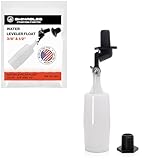
- Versatile Application: Ideal for swimming pool water levelers, auto-fill float systems, and pond water level maintenance, ensuring consistent water availability.
- 2 in 1 Combo: This swimming pool water leveler auto fill float comes with a 1/2" adapter, taking the guess work out of choosing the correct valve auto fill replacement.
- Durable and Reliable Construction: The Pool water leveler Auto Fill Float Valve replacement is crafted from high-quality materials to ensure longevity and great performance in maintaining water levels
- Easy Installation & Adjustment: User-friendly design allows for easy setup and precise water level adjustments to suit specific needs. Utilizes an adjustable arm to get your filler float valve perfect
- Automatic Water Level Control: This pond auto fill and pool filler float valve maintains optimal water levels in swimming pools, ponds, and water tanks, preventing overflows and dry runs.
Measure water loss before trying to refill
A falling level is not automatically a leak. Penn State Extension notes that evaporation and ordinary seepage occur even in a well-constructed pond, with losses increasing during hot, dry and windy weather.
- Choose a rain-free period with no intentional inflow or outflow.
- Mark the water level on a fixed staff, post or other stable reference, and record the date and weather.
- Measure again after several days and again after about two weeks if conditions remain comparable.
- Compare the observed decline with evaporation estimates for your location and weather. Penn State gives a conditional Pennsylvania example of more than one-quarter inch in a day—and nearly four inches in two weeks—during breezy, warm, low-humidity weather without rain.
- Inspect the dam, banks, outlet and drain structures while the level is falling. A wet area, unusually lush water-loving vegetation or a level that drops to a particular point and then stabilizes can indicate a leak path.
For context, Penn State describes about one inch of seepage per month as possible for a well-constructed pond. Missouri Extension describes seepage of two inches or less per month as acceptable in its guidance. Neither figure is a universal guarantee or design standard. Penn State also indicates that a monthly reduction of more than 12 inches is unlikely to be explained by evaporation and trees alone; use that as a diagnostic warning, not a rule for every climate.
Rank #3

- #1 Rated Automatic Pool Fill Valve in the WORLD! The PATENTED design can not be beat.
- In ground or above ground, salt or fresh water, vinyl lined or concrete- the Fill-O-Matic is the best choice!
- 100% rubber base will not slip or slide like cheaper plastic models, preventing it from slipping into the pool
- Includes Stainless Steel Hose, U.V. stabilized acrylic brackets and stainless steel hardware will provide years of service
- Automatically keeps your swimming pool water at your determined height, adjustable from 2" to 9"- extension bracket available on Amazon.
Inspect the places leaks most often start
Outlet and drain pipes
Check around pipe inlets, joints and outlets for wet soil, erosion, rust, animal damage or water emerging where it should not. A damaged or poorly sealed pipe can lose water continuously.
Dam and bank surfaces
Look on the downstream face and outside toe of the dam for wet spots, muddy seepage, springs or bands of water-loving plants. Walk the area after rainfall and during a low-water period so new wetness is easier to distinguish from normal drainage.
Rank #4
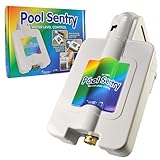
- AUTOMATIC WATER LEVELING – The M-3000 Pool Sentry is the industry leading automatic pool filler - our patented design including our adjustable float valve mechanism maintains ideal water levels in pools, spas, and ponds so you don’t have to!
- PROTECTS YOUR PUMP FROM DAMAGE – The Pool Sentry is the premier auto pool filler that keeps water levels stable to prevent dry running, one of the top causes of pump and filter failure.
- AUTOMATIC PEACE OF MIND – Whether you're at work all day, traveling, renting out your home, or just want low-maintenance pool care, the Pool Sentry keeps water levels where they should be—automatically. Ideal for homeowners who value set-it-and-forget-it reliability.
- FAST, TOOL-FREE SETUP – Just snap the frame together, screw in the float valve, and attach a high-pressure garden hose (we recommend B0F9526J8J). No complicated installation—get reliable performance in just a few minutes.
- DURABLE & STABLE DESIGN – Made from UV-resistant plastic with adjustable legs and a weighted base (just add gravel or rocks), the M-3000 stays firmly in place on pool decks. Portable, reliable, and built to last all season.
Soil, rock and roots
Penn State and Missouri Extension identify inadequately sealed sand or gravel, bedrock fractures, tree roots and burrowing animals such as muskrats as common causes. Tree removal or excavation on a dam can create additional pathways, so structural work should be planned rather than improvised.
The Tool Desk
Outbyte PC Repair FREERepair Windows errors before they cause bigger problemsFix Now →Outbyte Driver Updater FREEFix the driver behind crashes, sound loss and screen glitchesFind Drivers →Liners and plumbing in garden ponds
In a lined pond, inspect the liner for punctures, seams, edges and penetrations, then check skimmer, filter, waterfall and underground plumbing. Agricultural extension guidance focuses mainly on earthen ponds and does not establish a complete garden-liner diagnostic procedure.
Best Value

- PATENTED LEVELER AUTOMATICALLY ADJUSTS POOL WATER LEVEL- Automatically keeps your pool water level at a stable level with a float valve that fills the pool when the water gets low. No more manually filling the pool water level back up with a hose every week. Simply connect your garden hose to the 90° brass connector and set the float valve at your desired height. (Adjusts 2” to 9” in range). If your water pressure is above 60 psi, a separate pressure reducing valve is required.
- INCLUDED STAINLESS STEEL HOSE EXTENSION AND 90° BRASS CONNECTOR - Unlike other pool levelers where you have to separately purchase additional accessories, each Airlie pool water leveler features a stainless steel hose extension and brass connector. This allows for your standard garden hose to seamlessly function and lay flat while in use.
- COMES WITH ADJUSTABLE FEET ON THE BASE FOR SLOPED POOL EDGES- The Airlie Pool Leveler features a set of adjustable legs that are easy to raise and lower to accommodate sloped pool edges.
- USER FRIENDLY, FILLABLE BASE INCREASES STABILITY- The base of the leveler can be filled with water or sand adding stability and keeping it balanced while in use.
- AIRLIE LIFETIME WARRANTY- Each pool leveler comes with a 100% guaranteed lifetime warranty.
Match the repair to the confirmed cause
Do not keep adding water indefinitely to hide a significant leak. Penn State describes make-up water as generally appropriate only for small losses and warns that household-well pumping can threaten domestic supply.
| Confirmed condition | Potential response | Important limitation |
|---|---|---|
| Permeable soil or a poorly sealed sandy or gravelly area | Compaction, a compacted clay blanket, bentonite, a soil dispersant or a flexible membrane may be considered. | Missouri Extension lists these as alternatives, not a single universal cure. Site soil and water chemistry determine suitability. |
| Localized animal burrow or root pathway | Remove the cause where appropriate, repair the channel and recompact the affected area. | Work on a dam can be structural; uncontrolled digging may worsen seepage. |
| Bedrock fracture | Requires site-specific investigation and may need professional grouting or a membrane solution. | Surface treatments may not reach the fracture. |
| Failed outlet or drain pipe | Repair or replace the pipe and restore properly compacted surrounding fill. | Lowering a pond and changing a permitted dam may require engineering and regulatory review. |
| Liner or associated plumbing failure | Repair or replace the liner, fitting or pipe after isolating the leaking component. | Do not assume an earthen-pond sealing product will fix a synthetic liner. |
Iowa DNR notes that a clay or bentonite blanket may seal some leaks but also warns that pond or dam repairs can be difficult and expensive. Engage a qualified pond or dam professional when seepage is structural, the dam is saturated, a pipe is involved, or the repair requires significant excavation.
Use make-up water without exhausting the source
If measurements show a small, predictable loss and the source is lawful and adequate, a controlled make-up supply can maintain the target level. Size the pump and intake for the verified well or spring yield, protect the intake from sediment and aquatic life, and use an automatic shutoff or float control to prevent overflow.
Penn State says some owners pump at night to avoid competing with normal daytime household use. Night pumping does not increase the well’s sustainable yield or remove drought risk; it can still dry the well and affect household supply. Confirm recovery rate and local withdrawal limits before relying on a schedule.
Maintain the pond after the level is restored
- Keep the watershed covered with vegetation and address erosion before sediment fills storage volume.
- Inspect the dam, banks, outlet and drain structures at least seasonally and after major storms.
- Record water level, rainfall, pumping and visible seepage so gradual changes are distinguishable from weather-driven fluctuations.
- Control burrowing animals and manage trees or woody growth in accordance with local dam-maintenance guidance.
- Test source water and pond water when fish health, irrigation, recreation or nuisance algae is a concern.
- Maintain a safe overflow route; a continuous inflow changes nutrient and oxygen conditions as well as water level.
When to call a professional
Get site-specific help if the level continues to fall after ordinary evaporation is accounted for, water appears on the downstream side of a dam, the pond drops rapidly, an outlet pipe is damaged, or the proposed repair involves lowering and excavating the dam. A professional can distinguish seepage from a structural defect, select a compatible sealing method and identify engineering or permit requirements.
Quick Recap
Product prices and availability are accurate as of the date/time indicated and are subject to change. Any price and availability information displayed on Amazon at the time of purchase will apply.


Leave a Reply