Recommended Free Tools
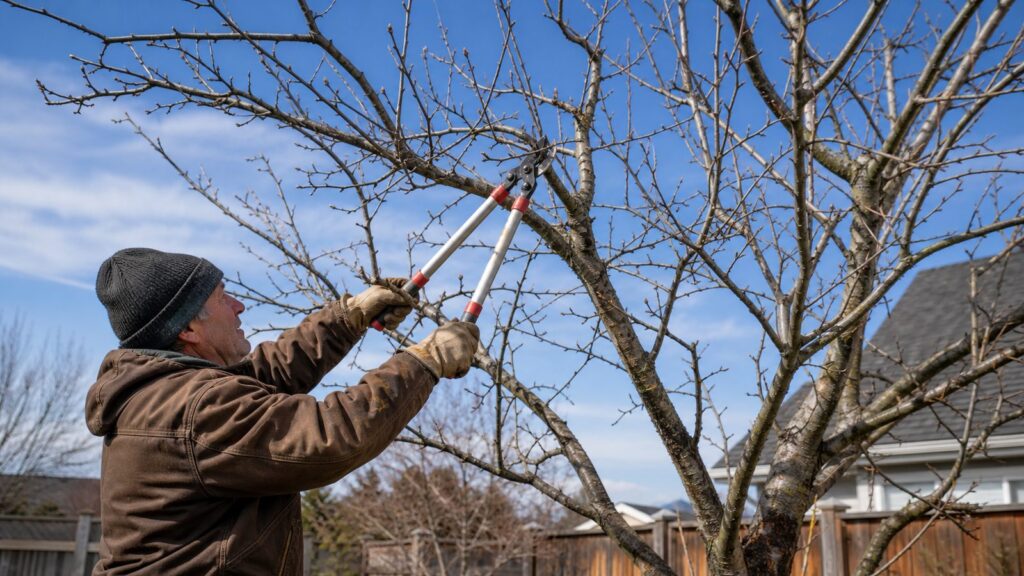
A Bartlett pear tree should usually be pruned in late winter to early spring while it is still dormant, before buds break and new growth starts. The job is part structure, part sanitation, and part property protection: remove dead, damaged, diseased, crossing, and poorly attached limbs; preserve fruiting spurs and older wood; keep the canopy open enough for light and air; and maintain clearance from roofs, gutters, siding, fences, sidewalks, driveways, and utility areas.
The biggest mistake homeowners make is treating pear pruning like hedge trimming. Bartlett pears are productive, vigorous trees, and they respond hard to bad cuts. Topping, over-thinning, or heading every branch tip can trigger a mess of upright water sprouts, reduce fruiting, and make fire blight harder to manage. A better approach is annual light pruning, clean cuts at the branch collar, and a clear plan based on the age and condition of the tree.
On our job sites, we look at trees the same way we look at structures: load paths, clearance, access, failure points, and maintenance over time. A pear limb rubbing a roof edge, hanging over a driveway, or blocking equipment access may not seem urgent in January, but it becomes expensive when it breaks in a storm, scrapes siding, drops fruit on a walkway, or interferes with a patio or drainage project. Good pruning solves those problems before they become repairs.
Best Time to Prune a Bartlett Pear Tree
The best time to prune a Bartlett pear is late winter to early spring, while the tree is dormant and before new growth begins. In much of the United States, that means somewhere between late January and early March, but local climate matters. In colder regions, wait until the worst hard freezes have passed. In warmer regions, prune before the buds swell and the tree starts actively pushing growth.
Windows Errors? Fix Them Before They Spread
Repair common Windows errors and clear accumulated junk for a smoother, more stable PC - no reinstall needed.Free scan · no reinstallOutdated Drivers Are Slowing You Down
One free scan finds every outdated or missing driver and matches the right update for your exact hardware.Free scan · exact hardware match#1 Best Overall

- Limb spreaders is good for new/young trees ,are not for branches larger than 1 cm in diameter.Just really check out the size - make sure these are long enough
- 25 Pieces blue branch and limb spreaders is made of high quality hard plastic, durable and reusable, rugged, and has excellent weight capacity.Ideal for as a Christmas stocking filler
- Fruit tree branch spreader help young tree grow from central stems to form a wide branch angle, making the tree more open, not easy to break
- Tree branch modelling tool is easy to install,simply select a good angle to secure the branch. widely used in small branches
- Bonsai open angle tree branch trunk tool to prevent young branches from sagging from sagging and developing them horizontally
Dormant pruning gives you several advantages. The branch structure is easy to see without leaves. The tree is not spending energy on fruit or canopy growth. Cuts made before spring growth can begin closing over during the growing season. Disease pressure is also easier to manage when you prune during dry dormant weather instead of during warm, wet conditions.
Summer pruning has a narrower role. Use it for urgent fire blight removal, broken limbs, or light vigor control when the weather is dry. Avoid heavy summer pruning on a stressed tree. Removing too much leaf area during the growing season reduces the tree’s ability to feed itself, ripen fruit, and recover from heat or drought.
Do not prune during wet weather if fire blight is a concern. Bartlett pears are susceptible to fire blight, and wet conditions make disease management more difficult. If you see blackened shoots, wilted tips shaped like a shepherd’s crook, cankers, or oozing tissue, treat the job as disease sanitation, not routine shaping.
Tools and Supplies You Actually Need
For a reachable backyard Bartlett pear, you do not need a truck full of equipment. You do need sharp tools sized to the cut. Crushed, ragged cuts slow wound closure and make sanitation harder.
What’s actually slowing this PC down?
Pick the symptom - the matching free tool is one click away.
| Tool or Supply | Best Use | Typical 2026 Cost |
|---|---|---|
| Bypass hand pruners | Small live shoots and twigs up to about 1/2 inch | $10-$80 |
| Bypass loppers | Branches roughly 1/2 inch to 1-1/2 inches, depending on tool rating | Combo pruner/lopper kits often $34-$46 |
| Folding pruning saw | Branches too large for loppers | $30-$50 |
| Manual pole saw | Light overhead pruning from the ground | Often $75-$150+ |
| 70% alcohol or 10% bleach solution | Tool sanitation for fire blight cuts | Usually under $15 |
| Eye protection and gloves | Basic personal protection | $15-$50+ |
Use bypass pruners, not dull anvil pruners, for live pear wood. Bypass blades make a cleaner slicing cut. Anvil pruners can crush stems, especially when the blade is worn or the branch is too large for the tool.
Keep ladders and overhead chainsaw work out of the DIY category. A homeowner standing on uneven ground with a saw above shoulder height is not doing a gardening task anymore. That is elevated tree work with real fall, struck-by, and property damage risk.
Understand How Bartlett Pears Grow Before You Cut
Bartlett pear trees bear fruit on spurs and older wood. That one fact should slow down a lot of unnecessary pruning. If you head back every branch tip because the tree looks uneven, you can remove productive wood and encourage upright vegetative growth instead of fruiting.
A good Bartlett pear structure usually has a central leader, which is the main upright trunk-like stem, and a set of well-spaced scaffold limbs. Those scaffold limbs should be distributed around the trunk, separated vertically, and attached with strong branch angles. Narrow V-shaped crotches are weaker and more prone to splitting under fruit load, wind, or ice.
The goal is not a perfectly symmetrical tree. The goal is a strong, productive, serviceable tree. You want sunlight reaching into the canopy, air moving through the branches, and enough clearance around the tree that people, vehicles, buildings, and maintenance equipment are not fighting it every season.
How to Prune a Newly Planted Bartlett Pear
Start training at planting. If the tree is an unbranched whip, extension guidance commonly recommends heading it at about 36 to 40 inches above the ground to encourage lateral scaffold branches. That height gives the future tree a workable trunk while keeping fruit within reach as it matures.
If the young tree already has branches, do not strip it bare. Select a central leader and remove competing upright leaders. Then look for future scaffold branches with decent spacing and wide attachment angles. In the first year, the tree’s root system is still getting established, so pruning should be intentional and limited.
Rank #2

- 【Not Easy to Damage the Bark】The black part of the branch spreader consists of galvanized iron wire wrapped with the inside of a hose to ensure that the bark does not fray easily. The branch spreader can be reused after removal.
- 【Solve the Problem】Don't let the young branches hang down or rise too much, which will affect the plant's fruiting. Let them grow horizontally. You can choose, which will give you unexpected results.
- 【Tree Branch Modelling Tool】Fruit tree branch puller can pull lower the drooping angle of the tree branch. for orchards with apple trees spaced 1-2 meters and tree age 1-3 years, with a pruning angle of 110-130 degrees.
- 【Wide Range of Use】Suitable for shaping new branches of fruit trees, seedlings and flowers, such as peach, pear, citrus and plum trees. Find the right angle, soften the branches and support them with this product.
- 【Easy to Use】With our tool, you can easily stretch and shape fruit tree branches to improve fruit growth and light exposure. It is easy to carry and store. Suitable for professional gardeners or fruit tree enthusiasts.
First-Year Priorities
Choose one central leader. Remove broken or damaged branches. Keep a few promising lateral branches if they are well spaced and not too low for mowing, walking, or future site use. Avoid leaving several upright leaders that will compete with each other and create weak structure.
On a typical residential lot, we also think about future clearance early. A low branch that seems harmless on a 5-foot tree can become a nuisance over a walkway, fence, or driveway when it is carrying fruit. It is easier to train structure early than to make large corrective cuts later.
How to Train a Young Bartlett Pear Tree
The young training years usually run from planting through about year 4 or 5. This is when pruning has the highest long-term payoff. You are building the tree’s framework, not just cleaning it up.
Each dormant season, keep the central leader dominant and select 4 to 5 well-spaced scaffold limbs over time. They should not all emerge from the same point on the trunk. A better structure has vertical separation between scaffold limbs and spacing around the tree so the canopy does not become one dense wall of branches.
Remove branches that grow straight up into the leader, cross through the center, rub another limb, or form a tight crotch. Keep moderate lateral growth that can develop fruiting wood. Resist the urge to shorten every branch. Too many heading cuts create dense regrowth and delay fruiting.
Free tools Windows power users keep installed
One-click scans. No signup required.
Simple Young-Tree Checklist
- Keep one central leader.
- Select scaffold limbs with strong angles and good spacing.
- Remove broken, dead, diseased, crossing, and rubbing branches.
- Thin crowded areas lightly instead of shearing the outer canopy.
- Keep cuts small whenever possible.
Annual light pruning is cheaper, safer, and better for fruit quality than skipping five years and then trying to fix everything in one afternoon. A young Bartlett pear corrected with 10 to 20 small cuts is much easier to manage than a neglected tree that needs saw work, hauling, and staged restoration.
How to Prune a Mature Bartlett Pear Tree
With a mature Bartlett pear, the focus changes from training to maintenance. Your priorities are structure, light penetration, airflow, safe clearance, and fruiting wood. You are not trying to make the tree look new. You are keeping it productive and structurally sound.
Start by standing back and photographing the tree from several sides. Then mark a modest number of target branches before cutting. This prevents impulse pruning, which is how homeowners accidentally remove too much canopy. Work in this order: dead wood, diseased wood, broken limbs, crossing or rubbing limbs, unsafe clearance problems, then small thinning cuts for light and airflow.
Make removal cuts at the branch collar. The branch collar is the slightly swollen area where a branch meets the trunk or parent limb. Do not make a flush cut tight against the trunk, and do not leave a long stub. Flush cuts damage the tree’s natural defense zone. Long stubs die back and become entry points for decay.
The Tool Desk
Outbyte PC Repair FREERepair Windows errors before they cause bigger problemsFix Now →Outbyte Driver Updater FREEFix the driver behind crashes, sound loss and screen glitchesFind Drivers →Use the Three-Cut Method for Larger Limbs
For any limb too heavy to hold safely by hand, use the three-cut method. First, make an undercut several inches out from the final cut location. Second, make a relief cut farther out on the limb so the branch drops without tearing bark down the trunk. Third, make the final cut just outside the branch collar.
This method matters around houses. A heavy pear limb can peel bark, swing into siding, crack a fence rail, or bounce off a roof edge if it is cut carelessly. On construction sites, we do not rely on luck when gravity is involved. The same rule applies in a backyard.
Rank #3

- Durable & Long-Lasting: Crafted from high-quality materials, these fruit tree branch pullers to withstand the rigors of outdoor use season after season. Resistant to rust, weathering, and wear, they provide consistent performance, becoming your go-to tools for maintaining your orchard year after year.
- Promote Optimal Branch Structure:These limb spreaders for fruit trees encourage balanced growth by preventing overcrowding. Use the tree branch bender to shape limbs into an open canopy, reducing disease risk and ensuring even fruit ripening. Perfect for apple, pear, peach, and citrus trees.
- Easy-to-Use: Engineered for simplicity, our tree branch puller spreaders are a breeze to install, allowing you to quickly adjust branches to the desired angle. The sturdy build ensures a secure hold, acting as reliable tree branch support to prevent branches from breaking under the weight of fruit or adverse weather conditions.
- Versatile Sizing: This set includes tree branch puller spreaders, offering the perfect solution for various tree sizes. Each Limb Spreaders ensures precise and efficient branch spreading, which improves tree structure and fruit production.
- After-Sales Service:If you have any questions or need help during use, please feel free to contact us, we will answer and support you in 24 hours.
Fire Blight: The Disease Issue Bartlett Owners Cannot Ignore
Fire blight is one of the main reasons Bartlett pear pruning needs more care than generic shade-tree pruning. Symptoms can include blackened leaves that remain attached, wilted shoot tips that bend like a shepherd’s crook, sunken cankers, and amber or brownish ooze from infected tissue.
If you are cutting out fire blight, prune only in dry conditions. Sanitize tools between disease cuts with 70% alcohol or a 10% bleach solution. If you use bleach, oil the tools afterward because bleach is corrosive. Do not move from an infected cut directly to healthy wood with the same dirty blade.
For infected shoots, common extension guidance is to cut well below visible symptoms. Clemson guidance uses at least 8 to 12 inches below visible infection. Washington State University lists 12 to 18 inches into two-year-old wood as a best-management practice and 2.5 feet for more aggressive cuts. The right distance depends on severity, season, and tree value. When the infection is extensive, bring in a qualified arborist or local extension office before making major cuts.
Routine pruning sealants are generally not used on normal pruning cuts. Trees close wounds by forming new tissue around the cut; paint-on sealers can interfere with that process in many situations. Use a treatment only when a product label, extension recommendation, or qualified arborist specifically calls for it.
How Much Can You Prune at Once?
Keep live canopy removal conservative, especially on mature or stressed Bartlett pears. Removing too much at once can trigger upright water sprouts, reduce fruit production, expose bark to sunscald, and create tender growth that is more vulnerable to disease and cold injury.
For a healthy, established tree, a practical homeowner rule is to remove only what is clearly needed in one dormant season. Start with dead, diseased, broken, and hazardous wood. Then make selected thinning cuts. If you are still looking at a dense, overgrown tree after that, stop and plan the next phase for the following year.
Overgrown Bartlett pears should be restored over multiple seasons. A neglected tree may need 2 to 4 years of staged corrective pruning. That can feel slow, but it protects the tree and usually produces better fruiting response than a severe one-day renovation.
Never Top a Bartlett Pear Tree
Topping is the practice of cutting large limbs or the main leader back to stubs to reduce height. It is one of the most damaging things you can do to a Bartlett pear. It creates weakly attached shoots, increases long-term maintenance, opens the tree to sunscald and decay, and works against accepted pruning principles such as those reflected in ANSI A300-style standards.
If the tree is too tall, use reduction cuts only where appropriate. A reduction cut shortens a limb back to a lateral branch large enough to take over growth. This is skilled work because the wrong lateral choice creates more problems than it solves. If height control requires large cuts high in the canopy, hire an ISA Certified Arborist.
Property Protection: Clearance Around Houses, Hardscape, and Work Areas
A pear tree can be healthy and still be a problem if it is too close to the wrong thing. Branches rubbing siding or roofing remove paint, hold moisture, and give insects and debris a place to collect. Limbs over gutters drop leaves and fruit into drainage paths. Low branches over walkways and driveways create visibility and impact issues. Branches against fences can push panels out of alignment over time.
Do these 3 things before closing this tab:
1Scan for outdated or missing drivers - takes under a minute2Clear out junk files and repair common Windows errors3Fix the driver behind crashes, sound loss and screen glitchesBefore pruning, check these clearance zones:
- Roof and gutters: keep limbs from rubbing shingles, fascia, and gutter runs.
- Siding and windows: maintain enough clearance for air movement, washing, painting, and repairs.
- Driveways: preserve vehicle clearance, sight lines, and room for opening doors or loading materials.
- Walkways and entries: remove low, fruit-laden, or thorny obstruction points.
- Fences and gates: prevent repeated limb pressure and fruit drop on hinges or latches.
- Construction access: maintain room for ladders, scaffolding, compact equipment, and material staging.
Construction activity near a Bartlett pear can stress the tree. Root-zone compaction, trenching, grade changes, irrigation changes, and driveway or patio work can all affect roots. A stressed pear is more vulnerable to poor wound response, pests, disease, and limb failure. If you are planning hardscape work near the tree, protect the root zone before the equipment arrives, not after the soil is compacted.
Rank #4

- Comprehensive 50-piece Set: this fruit tree branch puller kit includes 25 pieces of 3.94'' and 25 pieces of 10'' Tree Limb Spreaders, ideal for shaping both young shoots and mature branches; Nice for orchard training, this tree puller tool set meets all your garden shaping needs with ease and precision
- Durable Protective Design: crafted from high-strength galvanized iron, these fruit tree branch puller are built to last; The tightly wrapped plastic hose on each Tree branch spreader protects bark from scratches and harm, ensuring plant health during shaping and training
- Optimize Tree Growth: enhance ventilation and light exposure with these Tree Limb Spreaders by adjusting branch angles to an ideal 110°-135°; This fruit tree branch spreaders set promotes even canopy formation, and boosts fruit yield in your orchard or garden
- Easy Tool-free Operation: adjust branch angles effortlessly with these tree branch spreader puller; No tools needed—simply attach the Tree Branch Spreader to the trunk and branch for low-stress training, allowing precise control over tree shape and growth direction
- Versatile Garden Solution: suitable for a wide range of plants, these Tree Limb Spreaders work wonders on peach, pear, citrus, and plum trees; Use this fruit tree branch puller set to shape seedlings and flowers, improving flowering rates and overall yield
When to DIY vs When to Hire a Pro
DIY pruning is reasonable when branches are small, reachable from the ground, away from utilities, and the tree does not show major disease, storm damage, or structural defects. If the work requires a ladder, overhead saw, rope, climbing, large limb removal, or cuts near wires, it belongs with a professional.
| Situation | DIY or Pro? | Reason |
|---|---|---|
| Small young tree, cuts under 1 inch, all reachable from the ground | DIY | Low risk with sharp hand tools and a clear plan |
| Mature tree needing light thinning from ground level | DIY or pro | Depends on height, branch size, disease signs, and comfort level |
| Fire blight present in several areas | Pro strongly recommended | Disease cuts require sanitation, correct cut distance, and judgment |
| Branches over roof, service line, fence, or driveway | Pro | Higher property damage and injury risk |
| Tree near overhead electrical lines | Utility or qualified line-clearance professional | Homeowners should not prune near energized lines |
| Large neglected tree needing restoration | Pro | Best handled in phases with structural assessment |
Do not work near overhead electrical lines. OSHA treats line-clearance tree trimming as specialized work for a reason. If limbs are close to service drops, distribution lines, or other energized equipment, contact the utility or a qualified line-clearance tree professional.
Permit and Local Rule Checks
Many homeowners can prune a fruit tree on private property without a permit, but local rules vary. Street trees, right-of-way trees, heritage trees, protected trees, and trees affecting public visibility may be regulated. Cities can require permits for pruning, removal, or work in the public right-of-way even when the tree is in front of your property.
Before cutting, check whether the pear is on private property, in a planting strip, near a sidewalk, or within a public right-of-way. Also check whether your city has visibility clearance rules for intersections, driveways, stop signs, and sidewalks. If a contractor is working on the property, confirm who is responsible for tree protection and whether pruning is included in the project scope.
Independent reader supportYour contribution helps us test, update, and keep practical guides available for everyone.What Professional Bartlett Pear Pruning Costs in 2026
For 2026, national cost guides commonly place professional tree trimming or pruning around $400 to $900 per tree, with many homeowners paying about $430 to $700, and a medium tree often around $475. A Bartlett pear can fall below or above that range depending on height, access, disease issues, cleanup, and proximity to structures.
| Tree or Job Type | Typical 2026 Cost | What Drives the Price |
|---|---|---|
| Small reachable ornamental or fruit tree | $80-$350 | Simple access, light cuts, little debris |
| Medium residential Bartlett pear | $300-$700 | Height, canopy density, haul-away, ladder or climbing needs |
| Typical single-tree pruning average | $400-$900 | National average range across tree types and regions |
| Large, neglected, or difficult-access tree | $900-$1,700+ | Heavy limbs, difficult cleanup, disease sanitation, structures nearby |
| Exceptional access, crane work, utility proximity, emergency scheduling | $2,500+ | Special equipment, labor, insurance, and risk |
Minimum service fees often run $100 to $300 or more, so bundling several trees or shrubs into one visit can lower the per-tree cost. High-cost metro areas, coastal states, storm seasons, and labor-constrained markets trend higher. Rural areas may have lower hourly rates but higher travel minimums.
Ask whether the price includes debris hauling, disease sanitation, arborist diagnosis, stump or limb disposal fees, and cleanup around hardscape. If the tree is diseased, storm-damaged, or near a roof or power line, the lowest bid is not always the best value. Insurance and qualified supervision matter.
Quick wins for a faster PC:
Fix the driver behind crashes, sound loss and screen glitchesFind Drivers →Clear out junk files and repair common Windows errorsFree Scan →Scan for outdated or missing drivers - takes under a minuteDriver Scan →Step-by-Step Pruning Plan
Use this sequence for a dormant-season Bartlett pear pruning session.
1. Inspect Before Cutting
Walk around the tree from all sides. Look for dead limbs, broken branches, rubbing limbs, narrow crotches, water sprouts, suckers from the base, fire blight symptoms, and clearance conflicts. Photograph the tree before cutting so you can compare your work as you go.
2. Sanitize and Sharpen Tools
Start with clean, sharp blades. If disease is present, keep alcohol or bleach solution nearby and sanitize between infected cuts. Oil tools after bleach exposure.
3. Remove Dead, Broken, and Diseased Wood
Dead and damaged material comes out first. For fire blight, cut well below symptoms and handle the removed wood carefully. Do not drag infected branches through healthy canopy if you can avoid it.
Recommended Free Tools
Best Value

- 1.Multiple application scenarios: This set of branch limb spreader is specially designed for fruit trees, equipped with limb spreader, which can be flexibly applied to different types of fruit trees, and is a good auxiliary tool for your plantation.
- 2.High durability: branch support for fruit tree is made of durable iron material to ensure the durability and stability of the product, providing reliable support and protection for fruit trees.Branch puller are available in a variety of sizes for branches of different thicknesses and heights, ensuring a perfect fit with a variety of fruit trees, providing personalized support and extension.
- 3.Simple installation: Branch supports for fruit trees easy to install and use, so you can quickly provide the support and space needed for fruit trees, improve the efficiency of fruit tree growth.
- 4.Enhance fruit yield: By ensuring that the branches of the tree are evenly distributed in the air, branch spreaders for fruit trees helps to improve the ventilation and light conditions of the fruit, there by promoting healthy growth and increasing fruit yield.
- 5.Protect the health of the tree: The use of limb spreader can prevent the branches from breaking due to excessive weight, protect the tree from damage, and also help the tree to better absorb sunlight and rain, and promote natural growth.
4. Correct Rubbing and Crossing Branches
Where two branches rub, keep the better-attached, better-positioned limb and remove the other. Prioritize branches that improve airflow and light without stripping the canopy.
5. Thin for Light, Not for Looks
Make selective thinning cuts back to a parent limb or lateral branch. Do not shear the outside of the canopy. Pear trees need light inside the canopy for fruit quality, but they also need enough leaf area to stay vigorous.
6. Maintain Safe Clearance
Address branches touching or nearly touching the house, fence, gate, driveway, walkway, or work area. Use reduction cuts where appropriate. If the limb is heavy, high, or over property, stop and bring in a professional.
7. Clean Up and Reassess
Remove pruned debris from the site, especially diseased material. Step back and reassess before making more cuts. If you have already removed the obvious problem wood, the tree may not need as much extra shaping as you first thought.
Common Bartlett Pear Pruning Mistakes
The most common mistake is topping the tree to control height. It looks decisive for about one season, then it creates weak regrowth and long-term maintenance headaches. The second mistake is over-pruning. Removing too much live canopy in one season often creates more water sprouts and less fruit.
Other common errors include pruning during wet weather, ignoring fire blight symptoms, leaving long stubs, making flush cuts, using dull tools, and heading every branch tip. Another frequent problem is waiting until a branch is already rubbing a roof, leaning on a fence, or hanging over a driveway before dealing with it. By then, the cut is larger, the risk is higher, and the cleanup costs more.
Bottom Line
Proper Bartlett pear pruning is a steady maintenance practice, not a one-time rescue job. Prune in late winter to early spring while dormant. Train young trees to a central leader with 4 to 5 well-spaced scaffold limbs. Maintain mature trees with conservative thinning, clean branch-collar cuts, and careful fire blight sanitation. Never top the tree, and do not remove more canopy than the tree can reasonably recover from.
DIY the small, reachable, ground-level work. Hire an ISA Certified Arborist or qualified tree professional when the tree is tall, diseased, storm-damaged, neglected, near structures, or near utilities. That approach protects the tree, the fruit, and the property around it.
Frequently Asked Questions
When is the best time to prune a Bartlett pear tree?
Late winter to early spring, while the tree is dormant and before new growth begins, is usually best. Summer pruning should be limited to urgent disease removal or light vigor control during dry weather.
How much does professional Bartlett pear pruning cost in 2026?
A medium residential pear tree commonly costs about $300-$700 to prune. Small reachable trees may be $80-$350, while large, neglected, difficult-access, or utility-adjacent trees can run $900-$1,700+.
How far below fire blight should I cut on a pear tree?
Common extension guidance recommends cutting well below visible symptoms. Clemson cites at least 8-12 inches, while Washington State University lists 12-18 inches into two-year-old wood and up to 2.5 feet for aggressive cuts.
Can I prune a Bartlett pear tree myself?
Yes, if the branches are small, reachable from the ground, and away from utilities or structures. Hire a qualified arborist for tall trees, heavy limbs, disease problems, storm damage, ladder work, or branches near wires.
The Tool Desk
Outbyte Driver Updater FREEScan for outdated or missing drivers - takes under a minuteDriver Scan →Outbyte PC Repair FREERepair Windows errors before they cause bigger problemsFix Now →Should I top my Bartlett pear tree if it is too tall?
No. Topping creates weakly attached shoots, increases disease and decay risk, and makes long-term maintenance harder. Height should be managed with selective reduction cuts or professional structural pruning.
Do I need a permit to prune a pear tree?
Often not for a private backyard fruit tree, but local rules vary. Check city requirements if the tree is in a right-of-way, planting strip, protected tree category, heritage tree category, or affects sidewalk or street visibility.
Quick Recap
Product prices and availability are accurate as of the date/time indicated and are subject to change. Any price and availability information displayed on Amazon at the time of purchase will apply.




