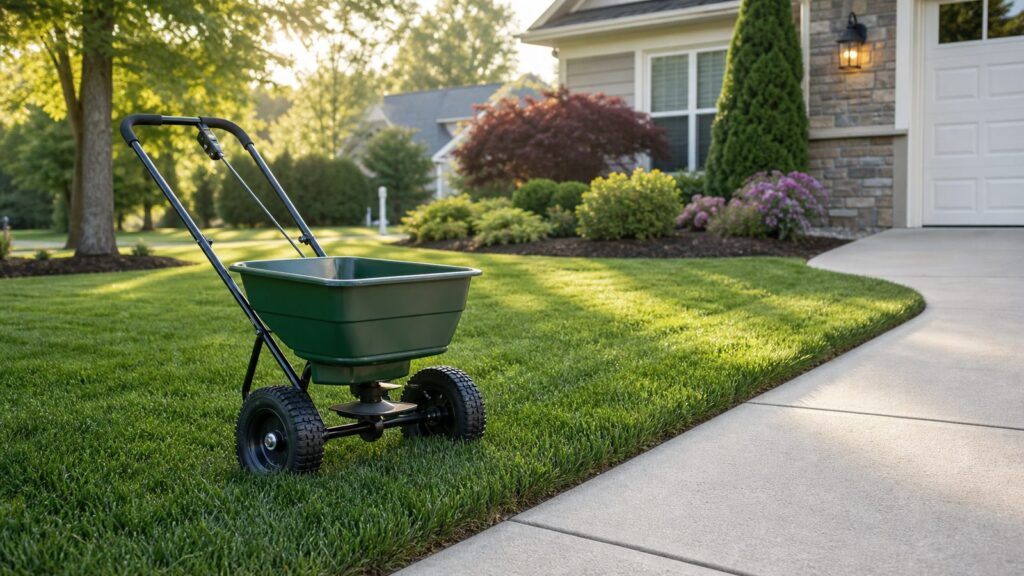
A good broadcast spreader should do three things well: carry the right amount of product for your lawn, throw it evenly, and shut off cleanly before fertilizer lands on sidewalks, driveways, beds, or storm drains. For most homeowners with more than about 2,500 square feet of turf, a push broadcast spreader is the most practical choice because it covers ground much faster than a drop spreader. The tradeoff is precision. Broadcast spreaders throw fertilizer in a fan pattern, so you need overlap, edge control, and calibration.
For 2026, expect to spend about $20 to $35 for a handheld broadcast spreader, $60 to $90 for a small residential push model, $120 to $180 for a stronger mid-range push spreader, $200 to $320 for a large homeowner or prosumer spreader, $250 to $450 for a tow-behind model, and $300 to $700 or more for commercial-grade equipment. The right pick depends less on the logo and more on lawn size, terrain, tire type, frame stability, gear protection, and whether the spreader can apply the actual product you buy at the correct rate.
On our job sites, we treat spreaders the same way we treat saws, ladders, and compactors: the tool has to fit the work. A small spreader that tips on bumpy turf will waste time and leave stripes. A 130-pound tow-behind unit on a small lawn can over-apply around tight turns. The best spreader is the one you can fill, push, control, clean, store, and calibrate without fighting it.
Best Broadcast Spreader Picks by Lawn Size
If you want the short answer, buy by turf area first. Measure the actual grass, not the lot size. Subtract the house footprint, driveway, walkways, patios, pool deck, sheds, planting beds, tree islands, and any hardscape. A 10,000-square-foot lot may only have 4,500 to 6,500 square feet of grass.
#1 Best Overall

- NO ASSEMBLY REQUIRED: Scotts spreader comes pre-calibrated and ready-to-use; use it year-round including as an ice melt spreader or salt spreader for snow
- CAPACITY: Broadcast spreader holds up to 15,000 sq. ft. of Scotts lawn products, and can be used as a lawn food, salt, ice melt or grass seed spreader
- OPERATION: These fertilizer spreaders for lawns feature a hopper and agitator designed for smooth product funneling and consistent coverage
- SIDE SHIELD: Scotts exclusive EdgeGuard Technology on these broadcast spreaders for lawns keeps lawn product off landscaping, driveways, and sidewalks
- BROADCAST SPREADER: Use the Scotts Turf Builder EdgeGuard DLX Broadcast Lawn Spreader to apply Scotts lawn care products, like grass fertilizer for lawns
| Lawn size | Best spreader type | Typical 2026 cost | Good fit | Watch-outs |
|---|---|---|---|---|
| Under 2,500 sq. ft. | Handheld broadcast spreader | $20-$35 | Townhomes, small front yards, patch seeding, ice melt | Less consistent walking speed and hand-crank output |
| 2,500-5,000 sq. ft. | Compact push broadcast spreader | $60-$90 | Small suburban lawns with simple shapes | Narrow wheels, light frames, smaller hoppers |
| 5,000-10,000 sq. ft. | 50-80 lb push broadcast spreader | $120-$180 | Most suburban lawns | Needs edge control and proper overlap |
| 10,000-25,000 sq. ft. | 60-130 lb push spreader | $150-$320 | Large lawns, bumpy turf, repeated seasonal use | Heavier to store and maneuver when full |
| 0.5 acre and larger | 130 lb tow-behind or large push spreader | $250-$450+ | Large open turf areas, lawn tractor owners | Less precise around beds, slopes, and obstacles |
| Frequent or commercial use | Pro-grade broadcast spreader | $300-$700+ | Large properties, crews, repeated fertilizer and seed applications | Higher upfront cost only pays off with use |
Small lawns: handheld or compact push spreader
For a lawn under roughly 2,500 square feet, a handheld broadcast spreader can be enough. It is cheap, light, easy to hang on a garage wall, and useful for spot seeding or winter ice melt. The downside is consistency. Your walking speed, crank speed, and wrist angle all affect the pattern. For fertilizer, that can mean dark green bands, pale gaps, or burned spots if you overlap too aggressively.
For 2,500 to 5,000 square feet, a compact push spreader such as a 5,000-square-foot class model is usually the better homeowner choice. Models in the $60 to $90 range can work well on smooth, simple lawns. Look closely at wheel width and stability. Small hollow plastic wheels can drag fertilizer through the wheel path, and light frames can bounce or tip on uneven turf.
Average suburban lawns: 50-80 lb push spreader
For most 5,000 to 10,000 square foot lawns, a mid-range push broadcast spreader is the sweet spot. In 2026, this category usually runs about $120 to $180. A strong example is the ECHO RB-60, listed around $151.84 with a 60-pound capacity and product coverage claims around 25,000 square feet depending on material. Scotts Elite-style spreaders sit in the same homeowner lane, with large hoppers and claimed coverage up to about 20,000 square feet of Scotts product.
Do not confuse coverage claims with the size of lawn you can fertilize in one pass. Coverage depends on the fertilizer bag, particle size, nutrient rate, and spreader setting. A spreader might physically hold 60 pounds, but a dense lime product, a lightweight grass seed, and a coated slow-release fertilizer will all flow differently.
The Tool Desk
Outbyte PC Repair FREEClear out junk files and repair common Windows errorsFree Scan →Outbyte Driver Updater FREEFix the driver behind crashes, sound loss and screen glitchesFind Drivers →Large lawns: 110-130 lb push or tow-behind spreader
For 10,000 to 25,000 square feet of grass, a larger 110- to 130-pound push spreader saves time because you refill less often and usually get better tires, a more stable frame, and broader spread width. Agri-Fab 130-pound push broadcast spreaders have been listed around $249.99, with stainless versions around $319.99. These make sense for larger lots, especially where the lawn is open and refills would otherwise interrupt the job.
Tow-behind spreaders, commonly about $250 to $450 for homeowner models, are best when you already own a lawn tractor and have broad, open turf. They are not automatically more accurate. Tight turns, sloped edges, tree rings, and narrow side yards can make a tow-behind unit throw too much product in one area and too little in another. If the lawn has many beds and obstacles, a large push spreader may be slower but cleaner.
What Makes a Broadcast Spreader Worth Buying
Hopper capacity gets attention, but it is not the whole machine. A broadcast spreader is a rolling metering device. The best ones roll smoothly, keep the gate opening consistent, protect the gears from fertilizer dust, and shut off cleanly when you release the handle.
Pneumatic tires beat small plastic wheels on real lawns
For smooth, small lawns, plastic wheels can be acceptable. For bumpy turf, slopes, ruts, or larger yards, pneumatic tires are worth paying for. A 10- to 13-inch pneumatic tire rolls over uneven ground instead of bouncing through it. Less bounce means a steadier feed rate and fewer heavy bands. Wider tires also reduce rutting when the hopper is full.
Windows Errors? Fix Them Before They Spread
Repair common Windows errors and clear accumulated junk for a smoother, more stable PC - no reinstall needed.Free scan · no reinstallCrashes, No Sound, or Screen Glitches?
Random freezes, missing sound and display glitches usually trace back to one bad driver. Find and replace yours safely.Free scan · under a minuteFrame geometry matters when the hopper is full
A 60-pound spreader carrying 40 to 60 pounds of fertilizer behaves differently than it does empty in the garage. The handle height, axle width, and hopper position all affect whether it feels balanced or wants to tip. On job sites and large residential properties, we prefer spreaders that sit wide, roll straight, and do not flex when turning at the end of a pass.
Enclosed gears and serviceable controls save frustration
Fertilizer is hard on equipment. Dust gets into gears, moisture turns product into paste, and corrosion attacks bare steel. Enclosed gears, stainless hardware, and a shutoff plate you can clean are practical features, not luxuries. Commercial-grade models in the $300 to $700-plus range cost more because they often include stainless frames, enclosed gears, larger pneumatic tires, hopper grates, covers, and parts that can be serviced instead of thrown away.
Recommended Broadcast Spreaders by Use Case
The models below are useful reference points because they represent the main buying categories most homeowners compare in 2026. Availability and promotions change by retailer, but the capacities and price ranges give you a realistic budget.
Best for small lawns: Scotts Turf Builder EdgeGuard Mini class
For a small lawn with simple geometry, a compact EdgeGuard-style push spreader is usually enough. A 2026 retail example is the Scotts EdgeGuard Mini around $69.99. The main advantage is size. It is light, easy to store, and inexpensive enough for a homeowner who fertilizes once or twice per year.
The compromise is durability and control on rougher ground. Smaller wheels and lighter frames are more likely to leave inconsistent patterns if the lawn is bumpy. Use this class for lawns under about 5,000 square feet, not for a half-acre property.
Best for average lawns: Scotts Elite class
A larger residential spreader such as the Scotts Elite class fits many mid-size lawns. Its listed capacity is commonly described by product coverage, up to about 20,000 square feet of Scotts product, rather than a simple pound rating. That is useful for homeowners who use matching branded fertilizers, but you should still calibrate when using different seed, lime, or fertilizer.
This category is best for homeowners who want more capacity than a mini spreader without stepping into a heavy steel-frame prosumer unit. It is a practical middle ground for 5,000 to 10,000 square feet of turf.
Best durable homeowner pick: ECHO RB-60
The ECHO RB-60 is a strong mid-range choice for homeowners who want a tougher spreader without paying full commercial prices. In 2026, it has been listed around $151.84, with a 60-pound hopper and coverage claims around 25,000 square feet depending on product. That capacity is more than enough for most suburban yards.
Recommended Free Tools
This is the type of spreader we would point to for a homeowner who fertilizes, overseeds, and applies lime or soil amendments several times per year. The value is not just hopper size; it is a more stable, durable machine that should handle uneven turf better than entry-level plastic-wheel models.
Rank #2

- OPERATION: Adjustable arm support on this seed, salt and fertilizer spreader helps provide maximum comfort
- HAND-HELD SPREADER: Perfect hand-held fertilizer, salt and seed spreader for small yards
- CAPACITY: A seed, fertilizer and salt spreader that holds up to 1,500 sq. ft. of Scotts lawn products for year-round lawn care
- USAGE: These hand spreaders for lawns are great for year-round use to seed, fertilize, salt and ice melt
- COVERAGE: These salt, fertilizer and seed spreaders for lawns are engineered for smooth, even coverage
Best for large lots: Agri-Fab 130 lb push spreader
For bigger properties, a 130-pound push spreader cuts refill time and usually gives you better rolling stability. Agri-Fab 130-pound push broadcast spreaders have been listed around $249.99, with stainless models around $319.99. That price range makes sense if you are maintaining 10,000 to 25,000 square feet of turf or more.
The larger hopper is useful, but it also means more weight. A full 130-pound hopper can be awkward on slopes, wet ground, or tight side yards. If your lawn has gates, steps, retaining walls, or narrow storage, measure before you buy.
Best for acreage: Agri-Fab 130 lb tow-behind spreader
If you own a lawn tractor and have open turf, a 130-pound tow-behind spreader can save a lot of walking. For large, simple lawns, it is the faster tool. The caution is accuracy. Broadcast patterns widen at speed, and turns can cause overlap. Near beds, pavement, and water, you may still need to shut off early and finish edges by hand or with a smaller spreader.
Best for heavy repeated use: Lesco, Spyker, or stainless ECHO pro models
If you are maintaining multiple properties, a large estate lawn, or you simply want equipment that can be repaired instead of replaced, look at pro-grade spreaders. Lesco Pro 50-style spreaders, Spyker commercial models, and stainless ECHO units such as the RB-85S class sit in this heavier category. The ECHO RB-85S stainless pro model has been listed around $649, which is a serious purchase for a homeowner but reasonable for repeated use.
Commercial-grade spreaders earn their keep through better frames, tighter controls, enclosed gears, larger tires, hopper covers, grates, and serviceable parts. For a homeowner fertilizing 4,000 square feet twice a year, that is probably overkill. For a property owner handling large turf areas every season, it can be the last spreader you need for a long time.
How to Calibrate a Broadcast Spreader
Calibration matters more than the printed setting on the bag. Universal spreader settings are unreliable because granule size, density, humidity, gate wear, walking speed, and spreader design all change output. University turf guidance commonly treats a spreader as properly calibrated when the application rate is very close to target; one example procedure uses plus or minus 5 percent as the acceptable range.
Here is a practical homeowner method. Measure a test area of 1,000 square feet, such as 20 feet by 50 feet. Weigh the amount of product needed for that area based on the bag rate. If the bag says to apply 4 pounds per 1,000 square feet, weigh 4 pounds into the hopper. Set the spreader low, walk at your normal pace, and cover the test area using consistent passes. If product remains, open the setting slightly. If you run out too soon, close it down. Repeat until the spreader applies the target amount over the measured area.
What’s actually slowing this PC down?
Pick the symptom - the matching free tool is one click away.
For better coverage, apply half the target rate in one direction and the other half at right angles. For example, if the target is 4 pounds per 1,000 square feet, calibrate and apply 2 pounds per 1,000 square feet north-south, then 2 pounds east-west. This crosshatch approach reduces streaking and helps compensate for the natural feathered edge of a broadcast pattern.
Basic fertilizer math homeowners should know
Fertilizer recommendations are often based on pounds of nitrogen per 1,000 square feet. A common cool-season lawn application is around 1 pound of nitrogen per 1,000 square feet in many cases. Sandy soils may need lower soluble nitrogen rates, such as 0.25 to 0.5 pound per 1,000 square feet, to reduce leaching risk.
To calculate product amount, divide the target nitrogen rate by the nitrogen percentage on the bag. A 24-0-10 fertilizer contains 24 percent nitrogen. To apply 1 pound of nitrogen per 1,000 square feet, divide 1 by 0.24. That equals 4.17 pounds of product per 1,000 square feet. For a 6,000-square-foot lawn, that is about 25 pounds of product.
How to Use a Broadcast Spreader Without Burning or Striping the Lawn
Most spreader problems come from three mistakes: opening the gate while standing still, turning with the gate open, and failing to overlap correctly. Start with the gate closed. Begin walking. Open the gate after you are moving. Close the gate before you stop, turn, or cross pavement.
Do these 3 things before closing this tab:
1Repair Windows errors before they cause bigger problems2Scan for outdated or missing drivers - takes under a minute3Clear out junk files and repair common Windows errorsKeep a steady walking speed. Broadcast spreaders are usually calibrated around a normal walking pace, roughly 3 miles per hour. If you slow down on turns or speed up on straight runs, the rate changes. On slopes, it is better to make controlled passes across the slope where safe, rather than rushing downhill with a full hopper.
Overlap the feathered edge of the pattern, not the wheel tracks unless the manufacturer specifically says to do so. Most broadcast patterns are heaviest near the center and lighter at the edges. If you leave too much gap, you get pale stripes. If you overlap too tightly, you get dark stripes or fertilizer burn.
Use edge guards near sidewalks, driveways, patios, planting beds, storm drains, and water. If your spreader does not have an edge guard, reduce the setting near edges or make a controlled perimeter pass with the discharge aimed inward. Sweep any granules off hard surfaces and back onto the grass. Fertilizer left on pavement can wash into stormwater systems and can stain concrete or pavers.
Independent reader supportYour contribution helps us test, update, and keep practical guides available for everyone.Local Fertilizer Rules, Safety, and Cleanup
Homeowners usually do not need a permit or license to fertilize their own lawn, but local fertilizer rules can still affect what you may apply and when. Some states and municipalities restrict phosphorus fertilizer unless a soil test shows it is needed or unless you are establishing new turf. Minnesota and New York are examples of states with lawn fertilizer rules aimed at protecting water quality. Local ordinances may also restrict application near lakes, streams, wetlands, drainage ditches, or storm drains.
Quick wins for a faster PC:
Scan for outdated or missing drivers - takes under a minuteDriver Scan →Repair Windows errors before they cause bigger problemsFix Now →Fix the driver behind crashes, sound loss and screen glitchesFind Drivers →Before buying fertilizer, read the label and check your state extension service or agriculture department guidance. The three-number fertilizer analysis matters. A bag labeled 24-0-10 has nitrogen, no phosphorus, and potassium. Do not apply phosphorus just because it is on sale. Use it when the soil or establishment conditions call for it.
Rank #3
- Lawn fertilizer spreader for evenly distributing grass seed, fertilizer, salt, and ice melt in outdoor areas
- Broadcast spreader can cover up to 5000 square feet in one load
- Multi-purpose garden spreader design with multi-gear operation and precision control
- Durable steel frame and plastic lawn spreader bin stands up to all-season weather use
- Easy assembly with release cable pre-installed
Wear gloves, eye protection when pouring dusty products, long pants, and closed-toe shoes. Keep children and pets off the lawn until the label says it is safe to return, and water in the product if the label calls for it. Do not fertilize before heavy rain. A quarter inch of irrigation can help move many products off the leaf blade and into the soil, but a thunderstorm can move fertilizer off the property entirely.
Cleanup is part of the job. Empty leftover product back into its labeled bag or a sealed container. Do not hose out the spreader and leave wet fertilizer paste in the hopper. Brush or wipe it dry, clear the shutoff plate, and store it out of weather. Moisture is the main cause of clumping, corrosion, and jammed controls.
DIY Cost vs Hiring a Lawn Fertilization Pro
The spreader is only one part of the cost. You also need fertilizer, possibly seed or lime, storage space, and the discipline to apply at the right time. Professional fertilization pricing in 2026 varies widely by region and scope. National cost ranges commonly land around $65 to $405 per visit, with larger one-acre treatments sometimes running about $220 to $440 per application. A small lawn with simple fertilizer service may be near the low end; bundled weed control, aeration, travel minimums, or premium products push the price higher.
Free tools Windows power users keep installed
One-click scans. No signup required.
| Scenario | Typical first-year DIY cost | Professional cost per visit | Best choice |
|---|---|---|---|
| 4,000 sq. ft. lawn, 2 feedings | $70 spreader + fertilizer | Often $65-$150 per visit | DIY if you can measure and calibrate |
| 8,000 sq. ft. lawn, 3-4 feedings | $150 spreader + fertilizer | Often $77-$395 per visit | DIY can pay back quickly |
| 20,000 sq. ft. lawn | $250-$320 spreader + more product | Higher visit cost due to size | DIY if terrain is simple; pro if timing or weeds are complex |
| 1 acre of turf | $250-$450 tow-behind + fertilizer | Often $220-$440 per treatment | Depends on equipment, storage, and accuracy needs |
A homeowner with a 5,000 to 10,000 square foot lawn may recover the cost of a $70 to $150 spreader after one to three avoided professional applications. That math changes if you burn the lawn, apply the wrong product, or send fertilizer into the street. The savings are real, but only if the work is measured.
When DIY makes sense
DIY fertilizing makes sense when your lawn is a manageable size, you can store a spreader, you are willing to measure the turf area, and you can follow product labels carefully. It is also a good fit when you want control over timing. If rain is coming in 24 hours, you can wait. If the lawn is stressed by heat, drought, or disease, you can hold off instead of forcing a scheduled visit.
When to hire a pro
Hire a professional when the lawn has severe weeds, disease, drainage problems, steep slopes, waterfront setbacks, or repeated fertilizer burn. A pro is also worth considering if you need soil testing, pH correction, aeration, overseeding, weed control, or a full seasonal program. On larger properties, the labor saved can be worth more than the equipment cost.
Final Buying Advice
For most homeowners, the best broadcast spreader is a mid-range push model with a 50- to 80-pound hopper, pneumatic or well-built wheels, a stable frame, an edge-control feature, and controls that shut off cleanly. Budget about $120 to $180 for that class. The ECHO RB-60 is a strong reference point in 2026 at about $151.84. For small lawns, a $60 to $90 compact push spreader is usually enough. For large lots, step up to a 130-pound push spreader around $250 to $320, or a tow-behind model around $250 to $450 if the lawn is open and tractor-friendly.
Do not buy the largest hopper just because it looks more capable. Buy the spreader that matches your turf area, terrain, storage, and patience for calibration. Then use it correctly: measure the lawn, weigh the product, calibrate on a test area, apply half-rate in perpendicular passes, close the gate before stopping, and sweep fertilizer off hard surfaces. That is how you get the green lawn without stripes, burn marks, wasted product, or runoff problems.
Frequently Asked Questions
What size broadcast spreader do I need for my lawn?
Use a handheld spreader for lawns under about 2,500 square feet, a compact push spreader for 2,500 to 5,000 square feet, a 50- to 80-pound push spreader for most 5,000 to 10,000 square foot lawns, and a 110- to 130-pound push or tow-behind spreader for larger lots.
Is a broadcast spreader better than a drop spreader?
A broadcast spreader is faster and better for most lawns over about 2,500 square feet. A drop spreader is more precise near beds, sidewalks, and tight areas, but it is slower and requires very careful pass alignment.
How much should I spend on a lawn fertilizer spreader in 2026?
Most homeowners should expect to spend $60 to $90 for a small push spreader, $120 to $180 for a better mid-range model, or $200 to $320 for a large homeowner spreader. Commercial-grade models commonly run $300 to $700 or more.
Quick wins for a faster PC:
Fix the driver behind crashes, sound loss and screen glitchesFind Drivers →Repair Windows errors before they cause bigger problemsFix Now →Scan for outdated or missing drivers - takes under a minuteDriver Scan →What is the best broadcast spreader for a 10,000 square foot lawn?
For a 10,000 square foot lawn, choose a 50- to 80-pound push broadcast spreader with stable wheels, edge control, and clean shutoff. The ECHO RB-60 and Scotts Elite class are practical examples for this size range.
Can I use the same broadcast spreader for fertilizer, grass seed, lime, and ice melt?
Yes, many broadcast spreaders can handle multiple granular materials, but each product must be calibrated separately. Fertilizer, seed, lime, and ice melt have different density, granule size, and flow behavior.
Why does my broadcast spreader leave stripes in the lawn?
Striping usually comes from poor overlap, walking speed changes, incorrect calibration, clogged fertilizer, or opening the gate while stopped. Applying half-rate in two perpendicular passes usually gives more even coverage.
Quick Recap
Product prices and availability are accurate as of the date/time indicated and are subject to change. Any price and availability information displayed on Amazon at the time of purchase will apply.




