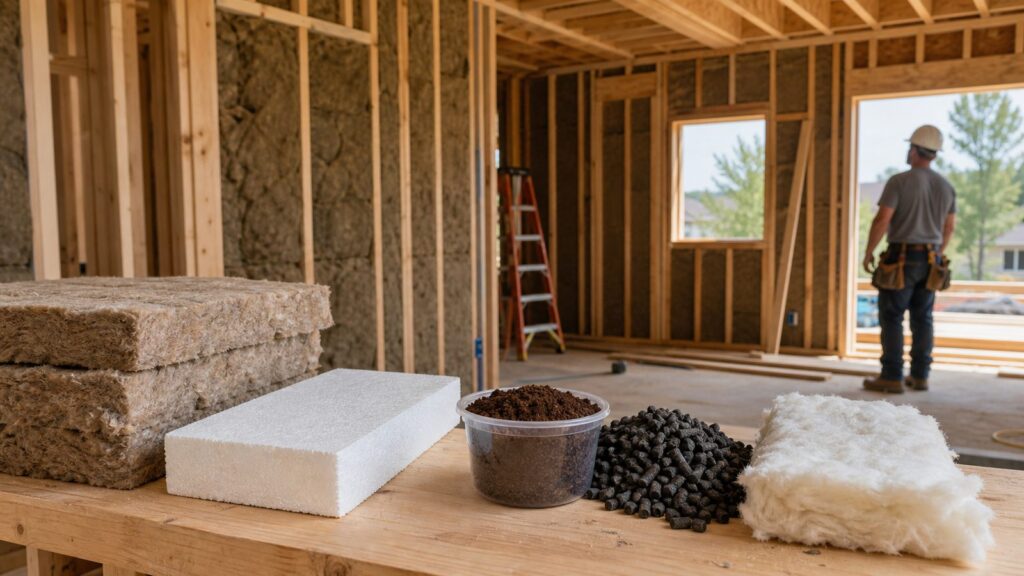
Coffee-ground insulation is one of the more interesting sustainable building material stories of 2026, but it needs a clear-eyed explanation. The short version: researchers have shown that spent coffee grounds can be processed into a porous biochar composite with thermal conductivity around 0.04 W/m-K, which puts it in the same general performance range as expanded polystyrene foam. That is promising. It is also not the same thing as a contractor being able to order it, install it in a permitted wall assembly, and pass inspection tomorrow.
For homeowners, architects, and builders, the useful question is not, “Can coffee grounds insulate?” The useful question is, “Can a specific coffee-ground insulation product meet the same jobsite, code, fire, moisture, durability, and cost requirements as fiberglass, cellulose, mineral wool, rigid foam, or spray foam?” As of August 2026, the honest answer in the US market is: not yet as a common commodity product.
That does not make the material a gimmick. It makes it an early signal of where construction materials are heading: circular feedstocks, lower embodied carbon, biodegradable binders, and more pressure to prove performance with real testing instead of sustainability claims alone. On our job sites, insulation is never selected on R-value alone. We look at the whole assembly: air sealing, moisture control, fire protection, ventilation, access, installer skill, code documentation, and lifecycle cost.
What Coffee-Ground Insulation Actually Is
The strongest current coffee-ground insulation research is not about stuffing loose coffee grounds into a wall cavity. That would be a moisture, odor, pest, and code problem. The 2026 breakthrough uses spent coffee grounds as a feedstock for biochar. The grounds are washed, oven-dried, carbonized at high temperatures, and then blended into a composite material.
Outdated Drivers Are Slowing You Down
One free scan finds every outdated or missing driver and matches the right update for your exact hardware.Free scan · exact hardware matchWindows Errors? Fix Them Before They Spread
Repair common Windows errors and clear accumulated junk for a smoother, more stable PC - no reinstall needed.Free scan · no reinstall#1 Best Overall
In the reported study, spent coffee grounds were carbonized at 500 C, 700 C, and 900 C. The 700 C version produced the best balance of porosity and internal structure for insulation performance. The optimized composite, referred to as EC/SB700/PG-25, used spent coffee-ground biochar, biodegradable ethyl cellulose as a binder, and propylene glycol to help preserve the pore structure instead of letting the binder fill it.
That pore structure matters. Insulation works largely because it traps air and slows heat transfer. Raw spent coffee grounds were reported at roughly 40% porosity, which limits their insulating value. After processing into the optimized biochar material, porosity increased to about 70% to 71%. That is the practical building-science reason the material starts to look interesting.
The thermal conductivity result, about 0.04 W/m-K, is the headline number. Lower thermal conductivity means better resistance to heat flow. Many conventional insulation materials fall near that range, depending on density, formulation, and temperature. But thermal conductivity is not the same as an installed R-value. R-value depends on thickness, continuity, fasteners, framing, compression, moisture, air movement, and the rest of the assembly.
Why Builders Are Paying Attention
Construction has a material problem and a waste problem. Coffee has one too. The research paper cites roughly 8 million tons of spent coffee grounds generated worldwide each year, much of it landfilled or incinerated. Turning part of that waste stream into a useful building material would be a genuine circular-economy win if the product can also satisfy building performance standards.
There are several reasons the concept deserves attention. First, the feedstock is abundant. Second, biochar can store carbon in a more stable form than raw organic waste. Third, biodegradable binders could reduce dependence on petroleum-based foam chemistry. Fourth, the reported thermal conductivity is not just symbolic; it is close enough to familiar insulation categories to justify serious product development.
Still, we would treat coffee-ground insulation as an emerging material, not a standard specification. When we are building or renovating a home, our obligation is not to use the newest material. It is to deliver an assembly that manages heat, air, water, vapor, fire, sound, durability, and budget. A new insulation product has to earn its way into that stack.
How Its Performance Compares With Common Insulation
For homeowners, the easiest mistake is to compare one lab number to a package label at the home center. That is not how insulation decisions should be made. A material with thermal conductivity of 0.04 W/m-K is promising, but the installed wall or attic still has to hit the required R-value for the climate zone and assembly type.
ENERGY STAR guidance says many attics should reach about R-38, which is often around 10 to 14 inches of insulation depending on material. Retrofit attic recommendations range from about R-30 to R-60 by climate zone and existing conditions. Floors and crawlspaces commonly fall in the R-13 to R-38 range depending on climate and assembly. The 2024 residential energy code tables also set prescriptive R-value requirements by climate zone, so the target is local, not universal.
The Tool Desk
Outbyte Driver Updater FREEScan for outdated or missing drivers - takes under a minuteDriver Scan →Outbyte PC Repair FREEClear out junk files and repair common Windows errorsFree Scan →| Material | Typical role today | Practical strengths | Watch-outs |
|---|---|---|---|
| Coffee-ground biochar composite | Emerging research or specialty material | Uses waste feedstock, promising conductivity around 0.04 W/m-K, potential lower embodied carbon | No broad US installed price, limited code documentation, unknown jobsite availability, fire and moisture data needed |
| Fiberglass batts or rolls | Common wall, floor, and attic insulation | Widely available, low cost, familiar to inspectors | Performance drops with gaps, compression, air leaks, and poor installation |
| Blown cellulose | Attics and dense-pack wall retrofits | Recycled content, good cavity fill, often cost-effective | Needs proper density, air sealing, moisture control, and dust management |
| Mineral wool | Walls, floors, fire-rated and sound-sensitive assemblies | Fire resistance, sound control, water resistance, dense batts | Higher cost than basic fiberglass in many markets |
| Rigid foam board | Exterior continuous insulation, foundations, roofs, rim joists | Reduces thermal bridging, high R-value per inch depending on type | Requires careful flashing, fire protection, fastening, and code compliance |
| Spray foam | Air sealing plus insulation in selected assemblies | Can seal irregular areas and provide high R-value per inch with closed-cell foam | Higher cost, chemical handling, ignition or thermal barrier rules, installer quality matters |
The right comparison is not just R-value per inch. We also look at flame spread, smoke development, vapor permeability, water absorption, drying potential, pest resistance, mold resistance, compression, settling, fastening, compatibility with wiring and recessed lights, and whether the local authority having jurisdiction will accept the product in the proposed assembly.
What It Might Cost in 2026
There is no reliable national installed price for coffee-ground insulation in the US in 2026 because it is not yet a common retail or contractor-installed insulation category. Any pilot project should be budgeted as custom material procurement plus engineering, documentation, submittal review, and possibly special inspection. That is a different cost structure than calling for R-49 blown cellulose in an attic.
For context, standard insulation pricing in 2026 often falls into these broad installed ranges:
Rank #2
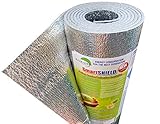
- EXTREMELY EFFECTIVE - reflect 95% of radiant energy, perfect RADIANT BARRIER.
- VAPOR BARRIER -Unaffected by humidity and moisture, can be used indoor/outdoor.
- SUPREME QUALITY - 3mm closed cell polyethylene FOAM ( not a cheap bubbles) sandwiched between highly reflective Engineered Foil on both sides. Easy to install, easy to cut and easy to clean, Strong but lightweight.
- SOUND BARRIER - excellent soundproofing material.
- NON TOXIC - will not irritate skin, eye or throat. Non allergic.
| Insulation type | Common 2026 installed cost range | Notes |
|---|---|---|
| Fiberglass batts or rolls | About $0.30 to $1.50 per sq ft in lower-cost guides; broader homeowner estimates often show about $0.82 to $3.00 per sq ft | Open framing is cheaper than retrofit work; fit quality matters |
| Blown cellulose or fiberglass | Roughly $1 to $3 per sq ft; many blown-in projects total about $750 to $3,800 | Depth, air sealing, access, removal, and target R-value drive cost |
| Mineral wool | Commonly about $1 to $2 per sq ft | Often chosen for fire resistance, sound control, and dense cavity performance |
| Rigid foam board | Commonly about $2 to $4 per sq ft installed | Exterior detailing, flashing, fasteners, cladding removal, and thickness change price quickly |
| Open-cell spray foam | Often about $1 to $4 per sq ft, or roughly $0.44 to $0.65 per board foot in some estimates | Thickness conversion matters; one board foot is 1 sq ft at 1 inch thick |
| Closed-cell spray foam | Often about $2 to $7 per sq ft, or roughly $1.15 to $2.00 per board foot before thickness conversion | Higher R-value per inch, vapor control implications, and stricter installation discipline |
Whole-home spray foam in new construction can run roughly $14,100 to $30,500 for a 2,000 to 2,500 sq ft home in contractor-published estimates. That wide spread is normal because the scope can include roofline foam, wall cavities, rim joists, crawlspaces, air sealing, and different foam thicknesses.
Recommended Free Tools
For coffee-ground insulation to compete commercially, it would need to come in with more than a good lab result. It would need predictable manufacturing, packaging, installer training, code reports, fire documentation, moisture data, warranty language, and distributor availability. Those items add cost before the first bag, board, or batt reaches a project.
Code, Fire, and Permit Reality
This is the section that matters most before anyone tries to use an alternative insulation in a home. A promising material is not automatically legal to install. For permitted work, the inspector is looking for a compliant product in a compliant assembly. That usually means labels, testing, manufacturer instructions, and documentation that connects the material to the building code.
For a new insulation product, we would want to see documentation such as ASTM E84 flame-spread and smoke-developed results, thermal resistance testing, density, water absorption, vapor permeance, mold resistance, corrosion impact on fasteners or wiring, and an evaluation report or other accepted code compliance path. Depending on use, the assembly may also need thermal barriers, ignition barriers, fire blocking, ventilation clearances, and compatibility with recessed fixtures.
Spray foam is a useful example. It is widely used, but it is not installed casually. Attics and crawlspaces can require ignition barriers or thermal barriers depending on access, use, foam type, and code interpretation. Alternative bio-based insulation should expect the same level of scrutiny, not a lighter one because it sounds sustainable.
Do these 3 things before closing this tab:
1Fix the driver behind crashes, sound loss and screen glitches2Repair Windows errors before they cause bigger problems3Scan for outdated or missing drivers - takes under a minuteBefore allowing any coffee-ground insulation or similar experimental material into a permitted project, a homeowner should ask for the exact product name, technical data sheet, safety data sheet, test reports, installation instructions, code evaluation report if available, and written confirmation that the local authority having jurisdiction accepts the proposed use. If the installer cannot provide that paperwork, the material is not ready for your project.
Moisture, Mold, and Pest Questions
Raw organic material in a wall cavity is not something we take lightly. Coffee-ground insulation research is based on processed biochar composite, not loose grounds, but the same practical questions still apply. What happens if it gets wet? Does it dry quickly? Does it hold water against wood framing? Does it support mold growth under real humidity cycling? Does it attract insects or rodents? Does it settle over time?
Good insulation is part of a moisture-managed assembly. It cannot compensate for missing flashing, roof leaks, foundation seepage, poor crawlspace drainage, bathroom fans dumping into attics, or unsealed air leaks carrying humid indoor air into cold cavities. Before we add insulation on our job sites, we check the building enclosure first. That includes roof penetrations, soffit and ridge ventilation, bath fan terminations, attic bypasses, rim joists, crawlspace ground vapor barriers, and signs of staining or microbial growth.
Moisture behavior is one reason cellulose, mineral wool, fiberglass, foam board, and spray foam are not interchangeable. Dense-pack cellulose can manage small amounts of moisture in the right assembly but needs proper density and drying potential. Mineral wool is hydrophobic and fire-resistant but still needs air control. Closed-cell foam can act as a vapor retarder at sufficient thickness, which can help or hurt depending on climate and assembly. Coffee-ground insulation would need similarly specific guidance, not a generic green label.
Where Coffee-Ground Insulation Could Fit First
The first practical uses may not be standard wall cavities in single-family homes. New materials often enter construction through controlled applications: acoustic panels, interior non-structural panels, insulated packaging, specialty demonstration projects, temporary structures, or commercial pilots where the design team can document the assembly and monitor performance.
A board or panel product may be easier to evaluate than loose-fill material because thickness, density, facing, fastening, and edge conditions can be controlled. A factory-made panel can also be tested as a repeatable product. Loose-fill or cavity insulation has more jobsite variables: installer density, voids, settling, dust, moisture exposure, and interaction with wiring, vents, and penetrations.
Rank #3

- Reflective Window Insulation: Our rv window insulation is well-made, which is weight of 200 g / 10.76 sqft. It is of good material and long-lasting
- Aluminum foil roll: Foil insulation roll is the ideal solution for you to beat the heat, reflective insulation roll can stay cool in summer heat and keep your house warm in winter, making you feel comfortable, available in multiple sizes to meet your all need
- Good Material: Reflective insulation roll is made of reflective double aluminum foil and bubble type material, its reflective surface helps to block out the sunshine effectively keep the heat out from the windows, insulation summer,not easily scratched, which can be used for a long time
- Good Performance: Window insulation kit for summer heat not only blocks the sun but it avoid heat loss window insulation summer,and keeps the room cool. This reflective insulation also acts as a barrier insulation summer heat and protects your privacy with its opaque foil surface
- Wide Application: Our insulation roll can be used for a variety of spaces, you can use aluminum insulation roll in windows insulation, garage insulation, rv window insulation,house insulation,roof insulation, window heat blocker, garage door and etc
For residential construction, the most realistic path would be a manufacturer producing a defined batt, board, or panel with published R-value per inch, fire performance, moisture behavior, and installation instructions. Then the product would need acceptance by code officials and insurers. Until then, coffee-ground insulation belongs in the “watch closely” category, not the “specify by default” category.
Better Eco-Friendly Insulation Options Available Now
If the goal is lower-carbon insulation in a real project today, there are proven options that are easier to permit and source. Dense-pack cellulose is often one of the most practical choices for retrofits and framed cavities because it uses recycled paper content and can fill irregular spaces well when installed at the right density. In attics, blown cellulose can be a strong value when paired with thorough air sealing.
Quick wins for a faster PC:
Repair Windows errors before they cause bigger problemsFix Now →Scan for outdated or missing drivers - takes under a minuteDriver Scan →Clear out junk files and repair common Windows errorsFree Scan →Mineral wool is another reliable option. It is not biodegradable, but it performs well in fire, sound, and moisture-sensitive assemblies. We like it where dense batts, better sound control, and fire resistance matter. It cuts cleanly around framing, holds shape better than low-density fiberglass, and tolerates incidental moisture without absorbing water like a sponge.
Wood fiber board, cork, hemp/lime, and hemp batt products are also worth discussing with the right design team and local code path. Availability varies sharply by region, and costs can be higher than commodity insulation. High-recycled-content fiberglass can also be a practical improvement when the budget is tight and the installer can deliver Grade I quality with minimal gaps and compression.
The highest return is often not the trendiest material. It is a well-sealed attic brought from weak existing insulation up to the correct R-value. DOE guidance says air sealing and insulation improvements in attics, floors, crawlspaces, accessible basement rim joists, and leakage areas can save up to 20% on heating and cooling costs, or up to 10% on total home energy costs. That is why we start with the enclosure, not the brochure.
When to DIY vs When to Hire a Pro
Reasonable DIY work
Some insulation-related work is realistic for careful homeowners. Basic attic inspection, measuring existing insulation depth, sealing small accessible gaps with appropriate caulk or foam, installing weatherstripping, and adding unfaced batts in simple open areas can be manageable. A homeowner can also look for obvious problems: uncovered attic hatches, disconnected ducts, bath fans venting into the attic, insulation blocking soffit vents, and thin or uneven attic coverage.
For DIY attic work, safety controls matter. Wear respiratory protection, gloves, eye protection, long sleeves, and knee support. Use temporary lighting. Step only on framing or stable walk boards. Keep insulation away from non-rated recessed lights, flues, chimneys, and heat-producing equipment. Do not bury knob-and-tube wiring. Do not cover soffit vents. Do not assume old insulation is harmless; older homes can involve asbestos-containing materials, vermiculite, rodent contamination, or lead dust.
Work that should be professional
Hire a pro for dense-pack wall insulation, spray foam, exterior rigid foam retrofits, crawlspaces with moisture issues, attic air sealing around complex mechanicals, roofline insulation, cathedral ceilings, and any assembly where vapor control is not obvious. Also bring in a professional if you see mold, roof leaks, wet insulation, electrical hazards, knob-and-tube wiring, recessed light conflicts, pest contamination, or combustion appliances that could be affected by air sealing.
Alternative insulation materials are not a DIY experiment. If coffee-ground insulation or another emerging product is proposed, the project should involve a builder, designer, or energy consultant who can verify documentation and coordinate with the local inspector before work starts. The time to learn that a material is not accepted is before it is installed behind drywall.
Independent reader supportYour contribution helps us test, update, and keep practical guides available for everyone.What to Ask Before Using Any New Sustainable Insulation
Sustainability claims should be the start of the conversation, not the end. Before approving a new insulation material, ask direct questions and expect written answers. What is the tested R-value per inch? What standard was used? What is the flame-spread index and smoke-developed index? Does the product require a thermal barrier or ignition barrier? What is the vapor permeance at the installed thickness? What happens after wetting and drying cycles? Is there mold testing? Is there pest-resistance data? Is there an ICC-ES report, UL listing, or other accepted evaluation?
Free tools Windows power users keep installed
One-click scans. No signup required.
Ask how it is installed. Is it loose-fill, batt, board, sprayed, or panelized? What density is required? How are seams handled? Can it contact masonry, metal, wiring, ducts, or recessed fixtures? What clearances are required? Can it be used in attics, walls, floors, crawlspaces, basements, or exterior assemblies? What climates is it designed for? What does the warranty exclude?
Rank #4

- Superior Thermal Reflection & Insulation High-performance double bubble white reflective foil insulation reflects up to 97% of radiant heat, keeping your space cooler in summer and warmer in winter.
- Excellent Energy Savings Helps reduce heating and cooling costs by creating an effective thermal barrier, making it ideal for garages, attics, warehouses, and metal buildings.
- Heavy-Duty Double Bubble White Design Premium double-layer bubble construction provides superior cushioning, thermal resistance, and durability compared to single-layer alternatives.
- Easy & Versatile Installation Lightweight, flexible, and easy to cut and install. Perfect for walls, ceilings, roofs, crawl spaces, and garage doors with or without additional tools.
- Multiple Sizes Available Wide range of rolls and dimensions (from 12" to 48" wide and various lengths) to fit any project — from small DIY jobs to large commercial applications.
Then ask the cost question in the right way. Do not ask only for price per square foot. Ask for installed cost at the target R-value, including air sealing, old insulation removal, ventilation baffles, vapor retarder work, fire or ignition barriers, permit fees, engineering, disposal, access repair, and finish restoration. That is the number that affects the project budget.
The Bettesworth Takeaway
Coffee-ground insulation is real, technically interesting, and worth tracking. The reported 0.04 W/m-K thermal conductivity is not trivial, and the idea of converting millions of tons of spent coffee grounds into useful building material is exactly the kind of innovation construction needs. But a house is not a lab sample. A permitted wall, attic, roof, or crawlspace assembly has to perform for decades through seasonal humidity, storms, air pressure changes, pests, remodels, and inspection requirements.
Our practical recommendation is simple: do not specify coffee-ground insulation for a normal US residential project in 2026 unless a specific product comes with code-recognized testing, installation instructions, fire and moisture documentation, and local approval. For projects that need lower-carbon insulation today, look first at proven options such as cellulose, mineral wool, wood fiber, cork, hemp-based products, and high-recycled-content fiberglass where they fit the assembly and budget.
The bigger lesson is useful right now. Eco-friendly insulation is not just about what the material is made from. It is about whether the building enclosure is designed and built correctly: continuous air control, continuous thermal control, proper vapor strategy, bulk-water protection, ventilation where required, and verified installation quality. Get those right, and the home will be more comfortable, durable, and efficient regardless of which approved insulation material makes the final cut.
Frequently Asked Questions
Is coffee-ground insulation available for US homes in 2026?
Not as a common, code-listed insulation product. As of August 2026, coffee-ground insulation should be treated as an emerging or prototype material unless a specific manufacturer provides accepted code documentation, fire testing, moisture data, and installation instructions.
What R-value can coffee-ground insulation provide?
The leading 2026 research reported thermal conductivity around 0.04 W/m-K, similar to EPS-level performance, but R-value depends on installed thickness and assembly design. A lab conductivity number is not the same as a code-approved R-value per inch.
Is insulation made from coffee grounds fire safe?
That depends on the finished product, not the feedstock. Before use in a building, it should have documented flame-spread, smoke-developed, thermal barrier, and ignition barrier requirements accepted by the local code official.
What’s actually slowing this PC down?
Pick the symptom - the matching free tool is one click away.
Will coffee-ground insulation attract pests or grow mold?
Loose coffee grounds should not be used in wall cavities. Processed biochar composites may behave differently, but builders still need pest, mold, water absorption, drying, and long-term durability data before trusting the material in a real assembly.
How much does eco-friendly insulation cost in 2026?
Common installed ranges include roughly $1-$3 per sq ft for blown cellulose, about $1-$2 per sq ft for mineral wool, and about $2-$4 per sq ft for rigid foam board. Coffee-ground insulation has no reliable national installed price yet because it is not a mainstream US product.
Should homeowners wait for coffee-ground insulation?
No. If your home needs insulation now, use a proven material and focus on air sealing, moisture control, and the correct R-value for your climate zone. Coffee-ground insulation is worth watching, but current energy savings are available with established products.
Quick Recap
Product prices and availability are accurate as of the date/time indicated and are subject to change. Any price and availability information displayed on Amazon at the time of purchase will apply.
Recommended Free Tools




