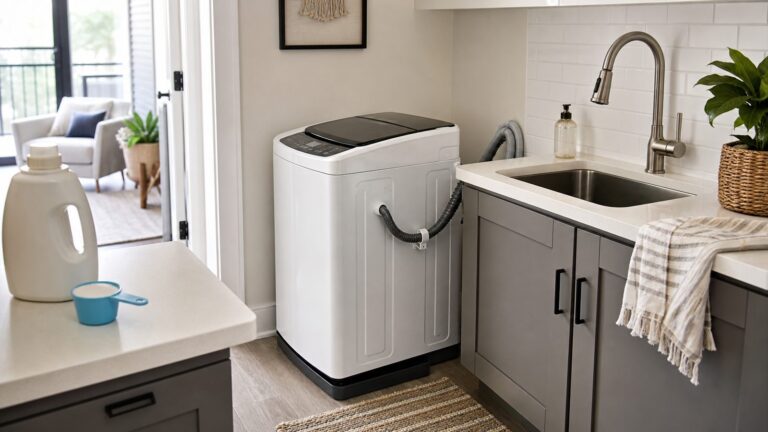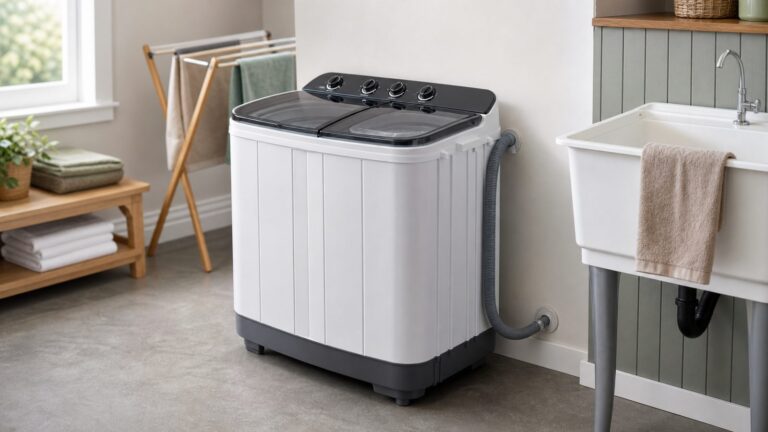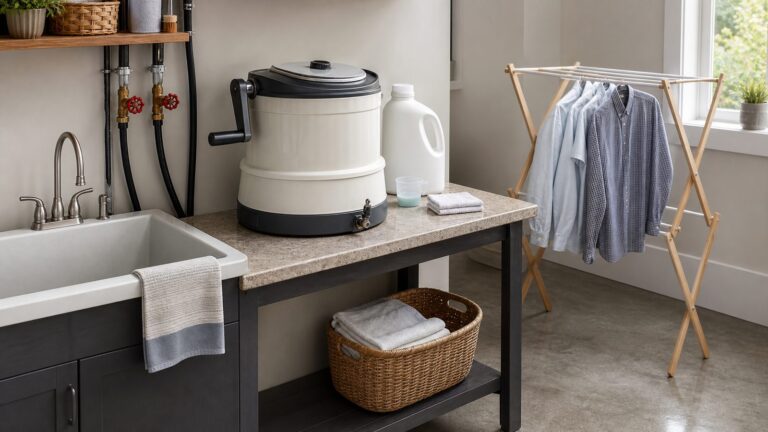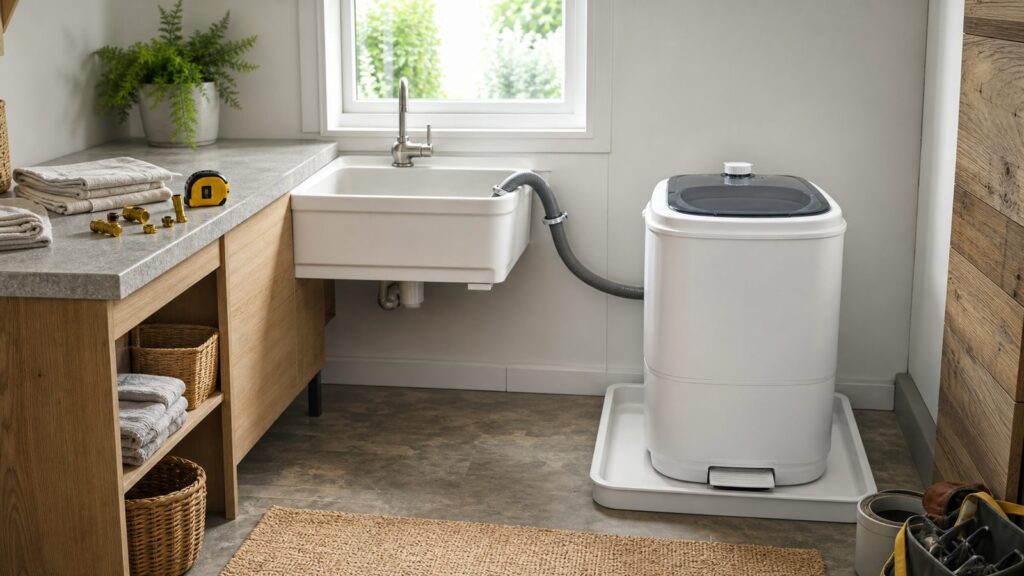
A foot pedal washing machine is best for small, lightweight laundry loads where convenience, portability, and low utility use matter more than speed or capacity. Think socks, underwear, workout clothes, baby items, delicates, camping clothes, and a few shirts at a time. It is not the right tool for towels, bedding, heavy denim, or a family’s weekly laundry pile.
In 2026, most manual or foot-powered washers in the U.S. cost about $50 to $180. That is much less than the common electric portable washers sold by national retailers, which usually run about $160 to $520 and commonly range from about 0.6 to 3.0 cubic feet. The lower price is appealing, but the machine itself is only half the decision. The bigger question is where the water comes from, where it drains, how the floor handles a spill, and whether your home, lease, or HOA allows the setup.
On our construction and remodeling jobs, laundry problems usually start before the first load is washed. The hose does not fit the faucet. The drain hose jumps out of the sink. The floor is finished wood with no pan. The unit is upstairs over a finished ceiling. Or the homeowner buys a portable washer when a compact, code-compliant laundry rough-in would have solved the problem for years. This guide is written from that practical angle.
What a Foot Pedal Washing Machine Actually Does
A foot pedal washing machine uses human power to agitate a small wash chamber. Some models use a pedal, some use a crank, and some are really non-electric wash bags or compact tubs. Many product listings group all of these together under manual, portable, or non-electric washing machines, so read the mechanism carefully before you buy.
Recommended Free Tools
#1 Best Overall

- 【Blue Light Deep Clean】This mini portable washing machine harnesses powerful physical spinning and blue light technology to deliver an exceptional clean, providing a deep hygienic refresh that effortlessly lifts away residues from baby clothes, intimate wear, socks, and towels—all within a compact, user-friendly design.
- 【3 Modes & Upgraded Motor】Meet your laundry needs with precision using this portable washer featuring 3 wash modes and an upgraded powerful motor. Whether it’s a quick rinse, gentle care for delicates, or a deep clean for heavily soiled loads, this machine adapts to every fabric type—from silk to baby clothes. The upgraded motor ensures efficient stain removal while safeguarding delicate textures, making it the perfect companion for both everyday laundry and special-care items.
- 【Foldable & Space-Saving】Save precious space with this compact and foldable portable washer—measuring just 12x12x6in when folded to half its expanded size. Designed for small apartments, dorms, RVs, and hotel rooms, it tucks effortlessly under beds, into closets, or inside cabinet gaps. This space-saving design brings the convenience of a washing machine to even the most limited living spaces
- 【Whisper-Quiet】Enjoy whisper-quiet operation at just 45 dB with this portable washing machine—ideal for shared spaces like apartments, dorms, and hotels. Whether you're doing laundry during the day or late at night, it won't disturb roommates, neighbors, or family. Built for quiet convenience, this compact washer fits seamlessly into daily life in any shared living environment.
- 【No Installation】Experience effortless laundry with this 20L portable washer that requires no installation—simply add water, detergent, and clothes, and you're ready to start washing. Designed for those who appreciate user-friendly convenience, it's easy enough for all ages to operate. Whether you need a camping portable washer or a compact travel washing machine, this hassle-free design makes laundry simple anywhere.
The basic process is simple: add water, add a small amount of detergent, load the clothes, pedal or crank for several minutes, drain the dirty water, rinse, then wring or spin the clothes as much as the unit allows. A good manual unit can refresh small loads well. It will not match the rinse quality, spin speed, or capacity of a standard residential washer.
Capacity is where expectations need to be realistic. A foot pedal washer may handle 3 to 6 pounds of light clothing depending on the design, but that does not mean it should be packed full. For actual cleaning, leave enough room for water and movement. In practice, a good load is often 4 to 6 T-shirts, a few pairs of underwear and socks, or a small batch of baby clothes. One bath towel can consume most of the useful wash volume and may come out too wet to dry quickly.
Best Uses for Foot Pedal Washers
The best foot pedal washing machine is not the one with the biggest advertised capacity. It is the one that fits the job you actually need done. Manual washers make sense when the laundry is small, frequent, and light.
Good fits
Foot pedal washers are a practical fit for renters without washer hookups, RV owners, campers, tiny-home owners, off-grid cabins, emergency-preparedness kits, dorm rooms where rules allow them, and households that want a small secondary washer for delicates or cloth items. They are also useful when you do not want to run a full-size machine for a few garments.
Poor fits
They are a poor fit for large families, regular bedding loads, towel-heavy laundry, users with balance or mobility issues, homes without a safe drain location, and apartments where portable washers are prohibited. If you need to wash 20 to 40 pounds of laundry every week, a foot pedal washer will feel like a chore almost immediately.
Foot Pedal vs Electric Portable Washer vs Permanent Hookups
Most homeowners are really choosing between three approaches: a manual washer, an electric portable washer, or a permanent laundry setup. The right answer depends on load size, budget, plumbing access, and risk tolerance.
| Option | Typical 2026 Cost | Best For | Main Limitation |
|---|---|---|---|
| Manual or foot pedal washer | $50-$180 | Small loads, camping, RVs, off-grid use, delicates | Low capacity and more physical effort |
| Electric portable washer | $160-$520 | Apartments, small homes, repeated weekly laundry | Needs power, water connection, and safe drainage |
| Basic adapter and hose parts | $10-$60 | Temporary sink connection | Faucet compatibility varies |
| Drain pan or waterproof mat | $20-$80+ | Finished floors, rentals, upstairs spaces | A pan only helps if water has somewhere safe to go |
| Permanent laundry hookup work | Few hundred dollars to low thousands | Long-term use, resale value, safer operation | May require plumbing, electrical, drywall, and permits |
If you are washing a few items twice a week, the manual unit is hard to beat on cost. If you are doing repeated household loads, an electric portable washer is usually more practical. If you are using either one every day, price a permanent compact laundry area before assuming the portable setup is saving money.
What to Look For Before Buying
1. Realistic load capacity
Ignore vague claims like “large capacity” unless the listing gives usable dimensions or volume. Electric portable units often list capacity in cubic feet, with common compact models around 0.6 to 3.0 cubic feet. Manual washers may list pounds, liters, or no meaningful number at all. For a foot pedal washer, assume it is for small batches unless the manufacturer gives clear wash and spin limits.
2. Spin-dry function
Spin-dry capability matters more than many buyers expect. Clothes that come out dripping wet take longer to dry, raise indoor humidity, and can make a small apartment or RV feel damp. A separate spin chamber or strong manual spinner is worth paying more for if you plan to use the washer often. Without it, budget time and space for hang drying.
3. Drain style
Some manual washers gravity-drain through a short hose. Others must be tipped, carried, or emptied by hand. For indoor use, a drain hose is much easier to control. Look for a hose that can reach a tub, shower, utility sink, or floor drain without stretching across a walkway.
4. Build quality
Low-cost manual washers often use lightweight plastic pedals, hinges, and gears. That is acceptable for occasional camping use, but daily use is harder on those parts. If the unit will live in a tiny home or apartment, look for a stable frame, a secure lid, replaceable hoses, and a base that does not creep across the floor during use.
5. Storage footprint
Dry-fit the workflow before buying. Where does the dirty laundry sit? Where do wet clothes go after washing? Where does the washer drain? Where does it dry before storage? A compact washer that technically fits in a closet may still be frustrating if you have to carry wet clothes across finished flooring.
Free tools Windows power users keep installed
One-click scans. No signup required.
Water Use, Energy Use, and Detergent
Manual washers use less water per small batch in absolute terms, but they can require multiple batches to equal one normal laundry load. That is the tradeoff. A full-size ENERGY STAR clothes washer is commonly cited around 14 gallons per load, compared with about 20 gallons for a standard machine. EPA materials also cite full-size front-loading ENERGY STAR washers around 13 gallons versus more than 23 gallons for new standard machines.
A manual washer might use only a few gallons for a small batch, but if you run four or five batches to replace one full load, the savings shrink. The real advantage is control. You can wash only what you need, use cold or warm water, and avoid running a large machine for a small pile.
Use far less detergent than you would in a standard washer. For a tiny manual load, a teaspoon or two may be enough depending on detergent concentration and soil level. Too much detergent causes residue, extra rinsing, stiff fabrics, and graywater disposal issues. It also makes small machines harder to clean.
Rank #2

- ★Excellent Materials - This product is made of high-quality stainless steel, ABS, PP, and nylon, environmentally friendly, durable, and wear-resistant, so you can use it for a long time.
- ★Large Capacity: With an impressive 3.17-gallon capacity, the dehydrator can easily hold four to eight light spring and summer loads and one to three heavy autumn and winter loads for your convenience.
- ★Lightweight and Portable - It is lightweight and compact (16.5*12.99*18.5in) and together with the portable handle, allowing for easy carrying and making it suitable for camping, business trips, apartments, and dorms.
- ★Easy Operation - This amazing dehydrator does not require any power source for powerful clothes drying. Simply place the clothes to be treated inside the dehydrator, gently close the lid, then press the pedal with your foot and manually pull the rope to start the operation.
- ★Ideal Gift - The modern style and great practicality make it an amazing gift for someone who travels a lot, lives in the dormitory, or lives with babies, pets, or patients.
Safe Drainage: The Part Buyers Overlook
Water damage is the biggest construction concern with portable laundry. A manual washer may be small, but several gallons on the wrong floor can stain hardwood, swell laminate, damage trim, or leak through a ceiling below.
The safest temporary drain locations are a bathtub, shower, utility sink, laundry sink, or floor drain. A kitchen or bathroom sink can work only if the drain hose is secured and the sink can handle the discharge without backing up. Never assume the hose will stay put. Discharge water can make a loose hose jump, especially from electric portable washers with pump discharge.
For finished spaces, place the washer in a tub, shower, utility sink area, or laundry pan during use whenever practical. A $20 to $80 drain pan or waterproof mat is cheap compared with ceiling repair. If the pan is not piped to a drain, it is only a spill catcher, not a flood solution.
Permanent washer standpipes and laundry fixtures have code requirements for trap, vent, standpipe height, and fixture connections. Laundry trays and standpipes are not just open pipes in a wall. If you are adding a real washer drain, that is plumbing work, and local code may require permits and inspection. For tiny homes, accessory dwelling units, garage conversions, and basement laundry areas, plan the drain and vent routing before walls are closed.
Faucet Connections and Apartment Rules
Many portable washers fill from a sink faucet, but not every faucet is compatible. Standard threaded aerators are easiest. Pull-down kitchen faucets, designer faucets, sensor faucets, and unusual aerator sizes may not accept a basic adapter. Even when an adapter fits, the faucet may not be designed to carry hose tension or repeated connection loads.
Do these 3 things before closing this tab:
1Repair Windows errors before they cause bigger problems2Fix the driver behind crashes, sound loss and screen glitches3Clear out junk files and repair common Windows errorsA basic non-permanent setup may require $10 to $60 in parts: faucet adapter, thread adapter, hose clamp, replacement inlet hose, plumber’s tape, or a drain-hose holder. Test at low flow first. Then inspect every joint under pressure before walking away. If you see seepage at the adapter, stop and correct it before the first load.
Renters should read the lease before buying. Some apartments prohibit portable washers because of overflow risk, shared plumbing limits, or insurance rules. An apartment may allow a small manual wash bag but prohibit electric portable washers connected to sinks. HOA rules can also restrict appliances on balconies, patios, or shared utility spaces.
Upstairs Rooms, Finished Floors, and Leak Risk
We treat upstairs portable laundry differently from garage or basement laundry. A small leak on a slab floor is annoying. A small leak over drywall ceilings, recessed lights, hardwood flooring, or finished cabinetry can turn into a multi-trade repair.
If you use a portable washer upstairs, use it only where water is already expected: a bathroom, tub, shower, or properly protected laundry area. Avoid bedrooms, closets, and hallways unless there is a real drain pan strategy. Do not leave the machine unattended while filling or draining. Check hoses every time.
Outdated Drivers Are Slowing You Down
One free scan finds every outdated or missing driver and matches the right update for your exact hardware.Free scan · exact hardware matchWindows Errors? Fix Them Before They Spread
Repair common Windows errors and clear accumulated junk for a smoother, more stable PC - no reinstall needed.Free scan · no reinstallFlooring matters. Tile over a properly waterproofed assembly is more forgiving than laminate, engineered wood, carpet, or older sheet flooring with open seams. If a washer will be used regularly in a finished space, consider a more permanent solution: a compact laundry closet with shutoff valves, a proper drain, GFCI-protected receptacle where required, and a pan or floor protection plan.
When to DIY vs When to Hire a Pro
A foot pedal washer itself is usually a DIY purchase and setup. Filling it by hand, draining into a tub, and storing it dry does not normally require a contractor. The moment you start modifying plumbing, adding drains, changing electrical outlets, or building a laundry closet, the risk level changes.
DIY is reasonable when
DIY is reasonable when you are using a manual washer in a bathtub or shower, filling it with a bucket or simple hose, draining under supervision, and storing it dry. It is also reasonable when you are installing a manufacturer-approved faucet adapter without altering the plumbing, as long as you test carefully and remove it when not in use.
Hire a pro when
Hire a plumber or qualified contractor when you need a washer box, standpipe, trap, vent, new supply valves, drain correction, laundry sink installation, or a relocated laundry area. Hire an electrician when outlets need to be added, grounded, GFCI protected, or moved away from water exposure. If walls must be opened, expect drywall repair and possibly flooring or trim work as part of the project.
The Tool Desk
Outbyte Driver Updater FREEFix the driver behind crashes, sound loss and screen glitchesFind Drivers →Outbyte PC Repair FREEClear out junk files and repair common Windows errorsFree Scan →Small hookup corrections can land in the few-hundred-dollar range. Full laundry rough-ins or relocated laundry areas can rise into the low thousands depending on access, distance to existing plumbing, drain and vent routing, electrical work, drywall repair, and local labor. That may sound high compared with a $100 manual washer, but it can be the better value if the household needs laundry at home every week.
Independent reader supportYour contribution helps us test, update, and keep practical guides available for everyone.Buy vs Build Hookups: A Practical Decision Tree
Use this quick decision path before spending money.
Rank #3

- 【Hygienic Separate Washing for Delicates】2026 Upgraded Washer: Unleashes powerful spin and next-gen blue light for exceptional clean. Enjoy a private laundry space with this portable washer. It keeps underwear, socks, baby clothes, workout clothing or delicate fabrics separate from daily laundry, ensuring hygienic and gentle cleaning without cross-contamination. Made of TPE and food-grade silicone, it’s safe for your family’s health.
- 20L Capacity with Foldable Compact Design: 20L capacity handles multiple small garments at once. Foldable design (12x12x13 inches unfolded / 12x12x6 inches folded) and 3.5 lbs lightweight build make it easy to store under beds or closets. Suitable for dorms, apartments, RVs, travel, camping or hotel stays
- 【Energy-Saving & Versatile for All Scenarios】This efficient mini washer reduces water and power consumption while maintaining strong performance, saving resources and money per cycle. 3 cleaning modes (3/5/10 minutes) adapt to different needs, working reliably at home, on road trips, camping or in dorms — your go-to laundry companion anywhere.
- 【Compact Washer with Spin Basket】 Perfect for washing small everyday items such as underwear, socks, baby clothes, sports bras, and lightweight garments. After washing, divide the load into multiple spin cycles. The compact spin basket is designed for up to 3 pieces of underwear or 1 sports bra/tank top per cycle to ensure safe and stable operation. It removes excess water but does not completely dry clothes.
- 【Worry-Free After-Sale & User-Friendly Details】Equipped with a spin basket for convenient drying. Easy to carry and operate, with intuitive timer buttons. We offer satisfactory customer service for any questions — ensuring a smooth shopping experience.
Buy a manual foot pedal washer if you wash small loads, can drain into a tub or shower, need portability, and want to stay under about $180. This is the camping, RV, emergency, delicates, and light apartment-laundry answer.
Buy an electric portable washer if you need repeated weekly loads, have a compatible faucet, have a safe drain location, and can use a grounded outlet without an extension cord. Budget about $160 to $520 for the machine plus $10 to $60 for connection parts and $20 to $80 or more for floor protection.
Quick wins for a faster PC:
Clear out junk files and repair common Windows errorsFree Scan →Scan for outdated or missing drivers - takes under a minuteDriver Scan →Repair Windows errors before they cause bigger problemsFix Now →Build permanent hookups if you own the home, plan to use portable laundry daily, are finishing a basement or ADU, are remodeling a bathroom or mudroom, or want better resale value. Price the work before buying multiple temporary machines and accessories. If walls are already open, laundry plumbing is often much easier to add than it will be later.
Common Mistakes to Avoid
The first mistake is buying from a ranking list without checking what the machine actually is. Foot pedal, hand crank, wash bag, twin tub, and electric portable washers are not the same product. The second mistake is overloading. A packed mini drum does not clean well, strains the mechanism, and leaves clothes too wet.
Another common problem is detergent. More soap does not mean cleaner clothes in a small washer. It usually means more rinsing. Use a small dose and increase only if the clothes are still not cleaning properly.
Drainage mistakes are more expensive. Secure the hose. Watch the first drain cycle. Do not run a portable electric washer on an extension cord near a sink. Do not assume a sink drain can take the discharge rate. Do not use an upstairs portable washer without floor protection and supervision.
What’s actually slowing this PC down?
Pick the symptom - the matching free tool is one click away.
Our Bottom Line
A foot pedal washing machine is worth buying when your laundry problem is small and specific. It can simplify delicates, camping clothes, RV laundry, emergency washing, and light apartment use. It is cheap, compact, and independent of electricity at the machine.
It becomes the wrong answer when you expect it to replace a full washer for heavy weekly laundry. At that point, the time, drying hassle, water handling, and leak risk start to outweigh the savings. For homeowners, especially those already planning a remodel, a compact laundry rough-in may be the better long-term construction decision. Before buying any portable washer, answer four questions: where does the water come from, where does it drain, what protects the floor, and what do the rules of the property allow?
Frequently Asked Questions
Are foot pedal washing machines worth it for everyday laundry?
They are worth it for small daily items like socks, underwear, activewear, baby clothes, and delicates. They are not practical as the main washer for towels, bedding, heavy clothing, or a family’s weekly laundry.
How much does a foot pedal washing machine cost in 2026?
Most manual, foot-pedal, crank-style, or non-electric compact washers cost about $50 to $180 in the U.S. Sturdier models with better frames or spin-dry features usually cost closer to $100 to $180.
Do foot pedal washing machines need electricity or plumbing hookups?
Most do not need electricity. Many can be filled by hand and drained by hose or by emptying the tub. You still need a safe water source, a safe drain location, and a place where spills will not damage flooring.
Can I use a portable washer in an apartment?
Only if your lease, building rules, and plumbing setup allow it. Some apartments prohibit portable washers because of overflow risk, shared drain limits, or insurance concerns. Always check before connecting one to a sink.
Where should a portable washing machine drain?
The safest temporary drain locations are a bathtub, shower, utility sink, laundry sink, or floor drain. If draining into a sink, secure the hose and watch the first discharge to make sure the drain keeps up.
When is it better to install real washer hookups?
Install real hookups when you own the home, wash laundry frequently, are remodeling nearby walls, or need a safer long-term setup. Small corrections may cost a few hundred dollars, while full rough-ins can reach the low thousands depending on access and scope.
Windows Errors? Fix Them Before They Spread
Repair common Windows errors and clear accumulated junk for a smoother, more stable PC - no reinstall needed.Free scan · no reinstallOutdated Drivers Are Slowing You Down
One free scan finds every outdated or missing driver and matches the right update for your exact hardware.Free scan · exact hardware matchQuick Recap
Product prices and availability are accurate as of the date/time indicated and are subject to change. Any price and availability information displayed on Amazon at the time of purchase will apply.