Short answer: in most U.S. states, you can trim a neighbor’s tree branches, vines, hedges, or roots where they cross onto your property. But that right is limited. You generally cannot go onto the neighbor’s land without permission, you should not cut beyond the property line, and you can be liable if your pruning seriously damages, destabilizes, or kills the tree.
That is the legal headline, but it is not the whole job. On our construction and exterior work sites, the disputes usually start after someone acts on the phrase “I can cut anything over my yard” without checking the survey, tree health, power lines, local tree rules, or how the limbs will be lowered. A mature tree over a roof, fence, driveway, pool, or service drop is not just a yard chore. It is a liability problem with sawdust.
This guide gives you the practical version: what you can usually cut, what you should not touch, who pays, what permits can change the answer, what professional trimming costs in 2026, and how to write a clean scope before anyone starts cutting.
The Basic Rule: You Can Usually Trim Only What Crosses the Property Line
If the trunk is entirely on your neighbor’s land, the tree is usually your neighbor’s tree. If branches extend over your yard, most states allow you to prune the encroaching growth from your side, up to the property line. The same general idea often applies to roots, hedges, vines, and other vegetation crossing into your property.
Recommended Free Tools
#1 Best Overall

- 2-in-1 Versatile TONYINGO Manual Pruner: This 5-24FT manual pruning tool offers dual functionality, seamlessly switching between a telescopic pole saw for high-reaching tree limbs and a handheld saw for lower branches, brush, and logs. Designed to replace single-function pruners, it is the ultimate all-in-one solution for professional tree trimming and comprehensive yard pruning tasks, meeting all your outdoor maintenance needs in one tool
- Powerful Tree Trimmer Blade with Premium Build: Equipped with a 17-inch 3X sharpened carbon steel blade, this pole saw delivers powerful, clean, and precise cuts for all types of branches. Crafted with a lightweight, durable, and rust-resistant body featuring a non-stick coating, it ensures silky-smooth cutting performance, saving you significant time and effort during palm, tree, and shrub trimming
- Flip-Lock & Screw Dual Locking System - Anti-Retraction Design: Our upgraded dual locking system combines a flip-tab lock with an extra reinforcement screw, effectively preventing the telescopic pole from retracting during use. This innovative design maximizes safety and stability for high-reach trimming, eliminating the risk of sudden pole collapse and ensuring secure, worry-free operation when cutting tall tree limbs
- Extendable Long Pole & Multi-Tool Compatibility: The 5-stage telescopic pole easily adjusts from 5FT to 24FT via the reliable flip-tab lock, providing an extended reach for trimming tall trees and hard-to-reach foliage. Additionally, it is compatible with standard thread attachments, doubling its versatility as a paint roller, squeegee, or duster for various outdoor cleaning and maintenance tasks beyond pruning
- Reliable Support & Customer-Centric Service: At TONYINGO, we prioritize 100% customer satisfaction with our upgraded telescopic pole saw. The anti-slip handle delivers a secure grip for comfortable, all-day use, and our dedicated support team is always ready to assist with any questions about the manual trimmer, tree limb cutting, or product usage. We guarantee a seamless and enjoyable shopping experience for every customer
There are three practical limits:
- Do not trespass. You generally cannot enter the neighbor’s yard, climb their tree from their side, set equipment on their property, or access limbs through their property without permission.
- Do not cut past the boundary. Your right is usually limited to the portion that crosses onto your land.
- Do not harm the tree. If your trimming is negligent and kills, destabilizes, or materially injures the tree, you may be responsible for damages.
That last point is where homeowners get into trouble. A legal right to prune is not a legal right to butcher the canopy. Cutting every branch flat at the property plane can leave large stubs, remove too much live canopy, expose the tree to decay, and create weak regrowth. Proper pruning usually means cutting back to a suitable lateral branch or branch collar, even if that requires judgment instead of simply following an invisible vertical line.
First, Confirm the Property Line
Do not assume the fence is the legal boundary. Fences are often installed inside a property line, shared informally, shifted around old landscaping, or built before a survey was updated. We have seen six-inch mistakes turn into expensive arguments when a contractor trims the wrong side of a hedge or drops limbs onto the wrong yard.
Before you schedule work close to the line, collect one of the following:
- A recorded survey or plat.
- Marked property corners or pins.
- A recent site plan from a closing packet or permit file.
- A boundary confirmation from a licensed surveyor if the line is unclear.
For light hand pruning several feet inside your yard, a full survey may be unnecessary. For a large limb, boundary tree, expensive specimen tree, or hostile neighbor situation, spending a few hundred dollars on boundary clarity can be cheaper than defending a tree-damage claim later.
Do these 3 things before closing this tab:
1Repair Windows errors before they cause bigger problems2Fix the driver behind crashes, sound loss and screen glitches3Clear out junk files and repair common Windows errorsTree Ownership: Trunk Location Matters
Tree ownership usually follows the trunk. If the trunk is wholly on your neighbor’s side, the tree is normally theirs even if half the canopy hangs over your yard. If the trunk straddles the property line, it may be treated as a boundary tree. In that situation, neither owner should remove the tree or materially damage it without agreement from the other.
If the trunk is on your neighbor’s property
You can usually prune only the encroaching branches or roots on your side, subject to tree health, local rules, and utility restrictions. You normally pay for that work unless your neighbor agrees to share the cost or a local nuisance rule shifts responsibility.
If the trunk straddles the line
Slow down. A boundary tree can create shared rights and shared responsibilities. Do not approve major canopy reduction, root cutting, or removal without written agreement. If the tree is valuable, old, leaning, diseased, or close to structures, get an ISA Certified Arborist’s assessment before work starts.
If the tree is in the right-of-way
Street trees may be controlled by the city, county, utility, or HOA even when they look like part of a private yard. Work on a tree between the sidewalk and curb, near a public road, or inside an easement may require permission.
Quick wins for a faster PC:
Scan for outdated or missing drivers - takes under a minuteDriver Scan →Repair Windows errors before they cause bigger problemsFix Now →Check Local Tree Rules Before You Cut
State law gives the broad rule, but local rules can change the practical answer. Cities and counties often regulate protected trees, heritage trees, street trees, historic districts, coastal zones, wildfire clearance areas, and trees above certain trunk diameters.
Permit triggers vary widely. One city may require review for removing or heavily pruning a protected native tree. Another may regulate trees over a specific diameter at breast height, often measured 4.5 feet above grade. Some municipalities treat removal of 25% to 30% of live canopy as major pruning, not routine maintenance. HOAs may also require approval before visible trimming along a lot line.
Before hiring anyone, check:
- City or county tree preservation rules.
- HOA covenants and architectural guidelines.
- Historic district requirements.
- Right-of-way or street tree ownership.
- Protected species rules, especially for mature native trees.
- Permit requirements for heavy pruning, removal, or root disturbance.
If a permit or approval is required, keep a copy with the contractor’s estimate. If a neighbor later complains, documentation matters.
Power Lines Are a Separate Category
Do not trim branches touching or close to overhead electric lines. This is not ordinary yard maintenance. OSHA describes line-clearance tree trimming as specialized work performed by trained workers who can operate near energized lines. Utilities commonly tell homeowners not to trim trees near electric lines, and for good reason.
PC Slower Than It Used to Be?
A free scan shows the junk files, broken settings and background clutter dragging Windows down - then fixes them in one click.Free scan · Windows 10 & 11Crashes, No Sound, or Screen Glitches?
Random freezes, missing sound and display glitches usually trace back to one bad driver. Find and replace yours safely.Free scan · under a minuteRank #2

- Package Includes: Our pole saw and pruner set contains 7 long poles, 1 head with saw, 1 pruner head, 1 spare saw with sheath, and a carry bag. Its extandabe range is about 7.3 to 27 ft (2.24 m to 8.24 m).
- Lightweight Material: All rods are made of high quality, thickened,epoxy resin and connected by aluminum alloy joints. The blades of the saw are made of alloy steel with 65 Mn, which performs much better than the carbon steel. Just in case you need to reach about 27 ft, its total weight of 7 poles and a head is 9.5 lb.
- Intelligent Design: The tree pruner is included to cut all the crossing branches. The pulley system helps to change the pulling direction and makes the job much easier. The saw features a hook knife on its points and ends to remove twigs. Extra saw is provided just in case the blade got stuck on the branches while trimming. After work, all parts could be collected in one carry bag and ready for storage.
- Conflicted Color: The reason that we choose the ugly yellow is meant to help others distinguish the poles from the trees. Others will easily recognize that you're trimming so that they won't accidentally rush into your working area.
- Honest Suggestion: Even though the maximum weight of the 27 fts setting is within 10 lb, it does feel heavy and might not be easy to control if you're not strong. A perfect length to work with is 20 ft which is a using of 6 poles. Wearing back support is recommended while doing a long time trimming. Safe working.
As a practical rule, if a branch is within about 10 feet of an energized line, call the utility or a qualified line-clearance tree contractor. That includes branches near service drops, distribution lines, alley lines, and pole-mounted equipment. A pole saw, ladder, damp branch, or falling limb can create a fatal path to ground.
Utility work also changes cleanup and aesthetics. Utility crews often focus on clearance, reliability, and code requirements, not ornamental shaping. If you want follow-up aesthetic pruning after utility clearance, have an arborist evaluate the tree after the hazard is handled.
Talk to the Neighbor Before You Schedule Work
You may not always be legally required to ask before trimming branches on your side, but it is usually the smartest first move. A calm written note prevents surprises and creates a record that you acted reasonably.
Keep it simple. Identify the tree, the issue, and the proposed work. Include photos if helpful. Do not threaten legal action in the first message unless the situation is already dangerous and documented.
A practical note can say:
“Several limbs from the maple along our shared fence are hanging over our roof and driveway. We plan to have a licensed, insured tree contractor prune only the branches extending over our property, using proper pruning cuts and without entering your yard unless you approve access. Please let us know by Friday if you want to discuss access, cleanup, or coordinating the work.”
Written permission is especially useful if the contractor needs to enter the neighbor’s yard, set ladders or rigging there, lower limbs onto that side, or make cuts that are slightly beyond the property line for tree health.
Who Pays for Trimming a Neighbor’s Tree?
In the usual situation, you pay to trim the branches that hang over your property. Your neighbor owns the tree, but you are choosing to manage the overhang on your side.
There are exceptions. A neighbor may agree to split the cost, especially if the tree also benefits from the work. Local nuisance rules may apply if the tree is dead, dangerous, or causing documented damage. Insurance may become involved after a storm loss. But for routine clearance over a roof, fence, patio, driveway, garden, or walkway, budget as though the cost is yours.
The Tool Desk
Outbyte Driver Updater FREEScan for outdated or missing drivers - takes under a minuteDriver Scan →Outbyte PC Repair FREERepair Windows errors before they cause bigger problemsFix Now →Professional tree trimming costs in 2026 commonly fall between $400 and $900 per tree, with many standard residential jobs landing near $430 to $700. Small ornamental trimming can be as low as $75 to $100, though many contractors have minimum service charges of $100 to $300. Large, difficult, or hazardous work can run $800 to $1,800+, and exceptional cases can exceed $2,500.
| Tree trimming situation | Typical 2026 cost | What drives the price |
|---|---|---|
| Small ornamental tree or low branches | $75-$300 | Hand tools, simple access, limited debris |
| Small to medium residential tree | $250-$800 | Height, canopy density, cleanup, contractor minimums |
| Typical professional trimming job | $400-$900 per tree | Climbing, pruning skill, haul-off, insurance, crew time |
| Large tree over 50-60 feet | $800-$1,800+ | Rigging, roof or fence protection, difficult access |
| Hazardous, emergency, crane, or utility-adjacent work | $1,500-$2,500+ | Special equipment, traffic control, emergency response, high liability |
| DIY hand-tool pruning | $75-$300+ in tools and PPE | Pruners, loppers, pruning saw, pole saw, hard hat, disposal bags |
Ask whether the quote includes debris hauling, chipping, permit paperwork, arborist reports, traffic control, stump or root work, and after-hours response. Those items can materially change the final number.
When to DIY and When to Hire a Pro
DIY trimming is reasonable only when the work is small, reachable, and clearly on your side of the property line. If you can stand on the ground, use hand tools, and remove a few small branches without risking the tree, the fence, the roof, or yourself, DIY may be fine.
DIY is usually reasonable when
- Branches are under about 0.75 inch and can be cut with hand pruners.
- Branches are roughly 1 to 2 inches and reachable with properly rated bypass loppers.
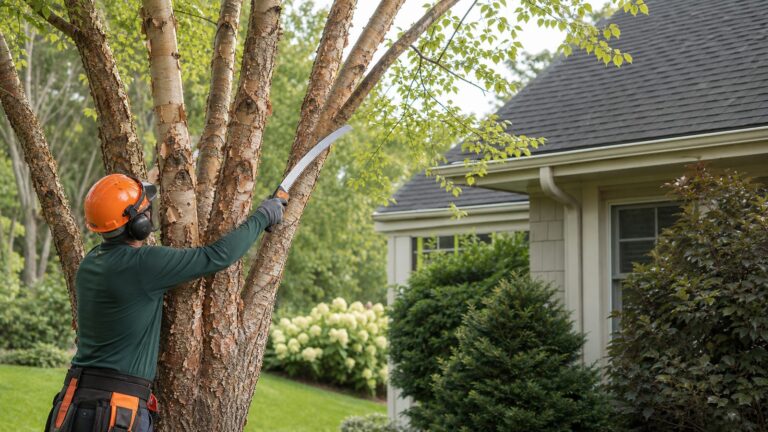
- A small limb can be cut safely with a curved pruning saw from stable ground.
- You are not using a ladder, chainsaw, or powered pole saw near overhead hazards.
- The total live canopy removed is minimal.
- The tree is not protected, diseased, leaning, old, or structurally questionable.
Hire a professional when
- The limb is over a roof, garage, fence, pool, vehicle, service line, greenhouse, or garden structure.
- The tree is over 20 to 25 feet tall and the cuts require climbing or pole tools above shoulder height.
- You need rigging to lower branches in sections.
- Branches are near electric lines.
- The tree is valuable, mature, stressed, diseased, cracked, hollow, or leaning.
- More than light pruning is needed to achieve clearance.
- The neighbor relationship is tense and documentation matters.
For professional work, look for an ISA Certified Arborist or a tree care company that can provide a written pruning scope, proof of insurance, and references for similar residential work. For climbing, chainsaw, or rigging work, do not hire an uninsured handyman or general lawn crew just because the price is lower. Tree claims can be much larger than the original trimming invoice.
How to Prune Without Damaging the Tree
Good pruning starts with an objective. Do not tell a contractor to “cut everything at the line.” Tell them what problem you need solved: 8 feet of walkway clearance, 10 feet above the driveway, 3 feet off the roof, branches off the siding, more light over a garden bed, or clearance from a fence.
Rank #3

- Sharp Mn Steel Blade for Fast & Clean Cuts: This pole saw uses a sharp three-sided edge with a double-sided barb design to grip branches securely and cut smoothly from multiple angles. The Mn steel blade is durable, rust-resistant, and lightweight, delivering fast, clean cuts. This is a manual pole saw with detachable pole sections for adjustable reach, not pruner, not a telescoping pole; it is neither electric nor battery-powered.
- Sturdy Steel Pole Reinforced for Secure Use: This tree branch cutter combines stainless steel poles and Mn steel blade, built for long-term use. The powder-coated finish prevents rust, and the anti-slip grip ensures stable control. An extra screw secures the saw head firmly to the pole, preventing loosening. Strong enough to prune higher branches without climbing ladders, it helps reduce risks and makes outdoor trimming safer and more reliable.
- Adjustable Length & Quick Assembly: This tree trimmer has three options: 8.5ft (6 sections), 11ft (8 sections), and 14.5ft (11 sections). Each stainless steel pole is rust-resistant with a matte finish for durability. The modular design lets you connect or remove sections quickly to adjust the length. Simple to assemble in a few steps, it adapts easily to close hand pruning or trimming tall trees, saving time and effort in your yard work.
- Safe High Reach Pruning Without Ladders: This lightweight manual cutting saw extends up to 14.5ft, letting you prune tall branches from the ground without ladders. It reduces fall risks and increases safety, while the anti-slip grip lowers fatigue. Easy for women and seniors to handle, it makes tall tree pruning, patio care, and yard maintenance more efficient. A reliable tool that combines safety and comfort for long-term outdoor use.
- Versatile Pruning Saw for Garden & Forestry: This extendable pruning saw works both handheld and extended for shrubs, hedges, and tall branches. Use it short for close trimming or fully extended for oaks, palms, pines, and firs. Perfect for yards, gardens, patios, and forestry tasks, it suits both home gardening and professional landscaping. With one tool for high and low pruning, it saves space while providing durable, versatile performance.
That lets the arborist choose cuts that protect the tree. The best cut may be a reduction cut back to a suitable lateral branch rather than a flat-sided slice at the property plane. Cuts should preserve the branch collar, avoid long stubs, and prevent bark tearing.
For larger limbs, trained crews use a three-cut method: an undercut to prevent tearing, a relief cut farther out to remove the limb weight, and a final cut just outside the branch collar. This matters because a heavy limb can peel bark down the trunk or parent limb if it is cut in one pass.
Avoid topping, lion-tailing, flush cuts, and heavy live-canopy removal. Many arborists and municipalities treat 25% to 30% canopy removal as a major threshold, not a target. On stressed, drought-affected, diseased, or mature trees, even less can be appropriate.
What’s actually slowing this PC down?
Pick the symptom - the matching free tool is one click away.
Can You Cut Roots From a Neighbor’s Tree?
Roots are legally similar to branches in many places: if they cross onto your land, you may have some right to address them. Practically, roots are riskier. Cutting structural roots can destabilize the tree, reduce water uptake, invite decay, or cause decline months or years later.
If roots are lifting a driveway, cracking a walk, entering a drain line, or threatening a foundation, document the damage first. Take photos, note dates, and get a contractor or arborist opinion before cutting. For a mature tree, cutting roots within a few feet of the trunk can be a serious injury. If the tree later falls or dies, the root work may become the center of the dispute.
Where possible, consider alternatives: rerouting a walkway, bridging over roots, using flexible hardscape details, root barriers installed under professional guidance, or selective root pruning outside the critical root zone. If the tree is protected, root disturbance may require approval even if you are working on your own property.
Permits, Protected Trees, and HOA Approval
Permit rules are local, and they are easy to miss because homeowners think “I’m not removing the tree, only trimming it.” Some ordinances still regulate heavy pruning, protected species, street trees, heritage trees, or work that affects the root zone.
Free tools Windows power users keep installed
One-click scans. No signup required.
Before approving work, call or search the city arborist, planning department, urban forestry office, or public works department. Ask these exact questions:
- Is this tree species or size protected?
- Is pruning regulated if I remove less than 25% of the live canopy?
- Does work near the street, sidewalk, alley, or utility easement require approval?
- Are there seasonal restrictions for disease, nesting, or storm recovery?
- Does root cutting or trenching near the tree require a permit?
- Does my HOA require architectural or landscape approval?
If the answer is unclear, ask the contractor to include permit responsibility in the written estimate. Do not leave it as a handshake assumption.
What to Put in the Contractor’s Written Scope
A good tree trimming estimate should be more specific than “trim neighbor tree.” The scope should protect you, the neighbor, the tree, and the contractor.
Include:
- The tree location and species if known.
- The pruning objective, such as roof clearance, driveway clearance, or fence clearance.
- A statement that cuts stay on your side unless written neighbor permission allows otherwise.
- Reference to ANSI A300-style pruning practices or accepted arboricultural standards.
- Whether the contractor will use climbing, bucket truck, rigging, or ground-only tools.
- How limbs will be lowered to avoid damage.
- Who owns and removes debris.
- Whether chipping, hauling, and disposal fees are included.
- Permit responsibility.
- Proof of general liability and workers’ compensation insurance.
- Start date, expected duration, and weather delay terms.
Ask for the certificate of insurance directly from the insurer or certificate holder when possible. A line on an estimate is not enough for high-risk work.
Debris: Do Not Throw Branches Back Over the Fence
Cut branches become your cleanup problem unless you and the neighbor agree otherwise. Throwing limbs back into the neighbor’s yard is a fast way to escalate the dispute and may be treated as dumping.
Rank #4

- Safe And Efficient - The Karveden telescoping extension pole saws can reach up to 20FT. You can easily trim tall, difficult to reach branches. You can quickly adjust the length of the pole as needed without climbing a ladder. Pruning trees and shrubs will be easier and safer than ever before. It is designed for pruning high branches, but can also be used as a handheld saw to prune low branches, shrubs and logs.
- Steel Pole Saw Blade - Karveden 19" 3X sharpened tooth are made of high quality carbon steel for high cutting power, lightweight, durable and rust-resistant. The non-stick blade coating extends its life and ensures smooth and efficient cutting and trimming, saving you energy and time. You can use this hand saw for a variety of cutting jobs, such as trees, bamboo, PVC pipes and more.
- Double Security Design - There will be two blue foam cotton designs on the telescopic pole, making the grip more comfortable and very anti-skid. In order to make the connection between the pruning saw and the pole closer and less prone to falling, we have included a screw that can better connect the saw and pole, making it very safe and reliable.
- Multipurpose Extension Pole - The Karveden telescopic extension pole can adjust the smart 4-stage extension pole to any custom length from 5 to 20 foot with the flip-tab lock. The telescopic rod uses standard 3/4 "universal threads, which can complete all difficult to reach tasks. It can be adapted to various accessories, such as paint rollers, feather duster, light bulb changer!
- Great Service From Customer Support: Karveden is committed to providing quality products and good service to customers. We provide up to 1 year warranty service. Besides, we are constantly optimizing and improving the details of our products. Your suggestions may help us improve our products.
Before work starts, decide where debris will land, how it will be moved, and who pays for haul-off. If limbs must be lowered into the neighbor’s yard for safety, get written permission. If the only access route is through a side gate, over a driveway, or across landscaping, protect those surfaces and document existing conditions with photos.
For small DIY work, expect yard-waste bags, tarps, and a few hours of cutting and bundling. For larger jobs, chipping and haul-off may be included in the bid or charged separately. Disposal fees rise after storms when demand is high and local green-waste facilities are backed up.
A Practical Decision Tree Before You Cut
Use this sequence before trimming a neighbor’s overhanging tree:
- Is the branch actually over your property? Confirm the line with a survey, plat, or marked corners if the work is close to the boundary.
- Is the trunk entirely on the neighbor’s land? If yes, prune only encroaching growth. If the trunk straddles the line, treat it as a boundary-tree issue and get agreement.
- Is the tree protected or regulated? Check city, county, HOA, historic district, right-of-way, and species rules.
- Are power lines involved? If branches are near energized lines, stop and call the utility or a qualified line-clearance professional.
- Is the work light and reachable from the ground? If yes, DIY may be reasonable with proper hand tools and PPE.
- Could pruning damage the tree or structures? If yes, hire an arborist or insured tree contractor.
- Have you documented the issue? Take photos, save dates, and send a written neighbor note.
- Is cleanup clear? Put debris handling, access, and haul-off in writing.
Common Mistakes That Create Legal and Repair Problems
The most expensive tree trimming mistakes are predictable. Homeowners cut beyond the property line, assume the fence is the boundary, hire an uninsured crew, or remove too much canopy in one visit. Others work near power lines, drop limbs onto fences or roofs, or leave large stubs that invite decay.
Another common mistake is pruning at the wrong time. Heavy cuts during heat, drought stress, or high disease-transmission periods can weaken the tree. Species matters. Oaks, elms, fruit trees, palms, and conifers do not all respond the same way. A competent arborist will consider season, species, tree condition, and the amount of live canopy being removed.
Keep your goal narrow. If the problem is a limb touching shingles, solve that problem. If the problem is low clearance over a walkway, solve that. Do not turn a small clearance job into a major canopy reshaping project unless the tree has been assessed and the neighbor is involved.
Bottom Line
You can usually trim a neighbor’s tree where it hangs over your yard, but only within limits. Stay on your property, cut only what crosses the line, avoid serious harm to the tree, and check local rules before heavy pruning. If the tree is large, valuable, protected, near power lines, or close to structures, hire a qualified professional and put the scope in writing.
The safest approach is simple: document the overhang, confirm the boundary, notify the neighbor, check permits, use proper pruning cuts, and plan cleanup before the first branch comes down. That is how you protect your yard without creating a bigger problem next door.
Frequently Asked Questions
Can I legally trim my neighbor’s tree if the branches hang over my yard?
In most U.S. states, yes. You can usually trim branches where they cross onto your property, but you generally cannot enter the neighbor’s property, cut past the property line, or prune in a way that seriously damages or kills the tree.
How far back can I cut overhanging branches?
The usual limit is the property line. In practice, cuts should still follow proper pruning standards, which may mean cutting back to a suitable lateral branch or branch collar instead of leaving stubs exactly on the boundary plane.
Who pays to trim a neighbor’s tree over my property?
For routine overhang on your side, you usually pay unless the neighbor agrees to share the cost or a local nuisance or hazard rule applies. Typical professional trimming in 2026 runs about $400 to $900 per tree, with complex work costing more.
Quick wins for a faster PC:
Scan for outdated or missing drivers - takes under a minuteDriver Scan →Clear out junk files and repair common Windows errorsFree Scan →Fix the driver behind crashes, sound loss and screen glitchesFind Drivers →Can I be sued if my pruning kills my neighbor’s tree?
Yes. If your trimming is negligent and damages, destabilizes, or kills the tree, you may be liable. Mature or valuable trees can lead to large claims, and some jurisdictions allow increased damages for wrongful tree injury.
Do I need a permit to trim branches hanging over my yard?
Sometimes. Local ordinances may regulate protected trees, heritage trees, street trees, historic districts, major canopy removal, or root disturbance. Check city, county, and HOA rules before heavy pruning.
What should I do if branches are touching power lines?
Do not trim them yourself. Call the utility or a qualified line-clearance tree contractor. Work near energized lines requires specialized training and equipment.
Quick Recap
Product prices and availability are accurate as of the date/time indicated and are subject to change. Any price and availability information displayed on Amazon at the time of purchase will apply.