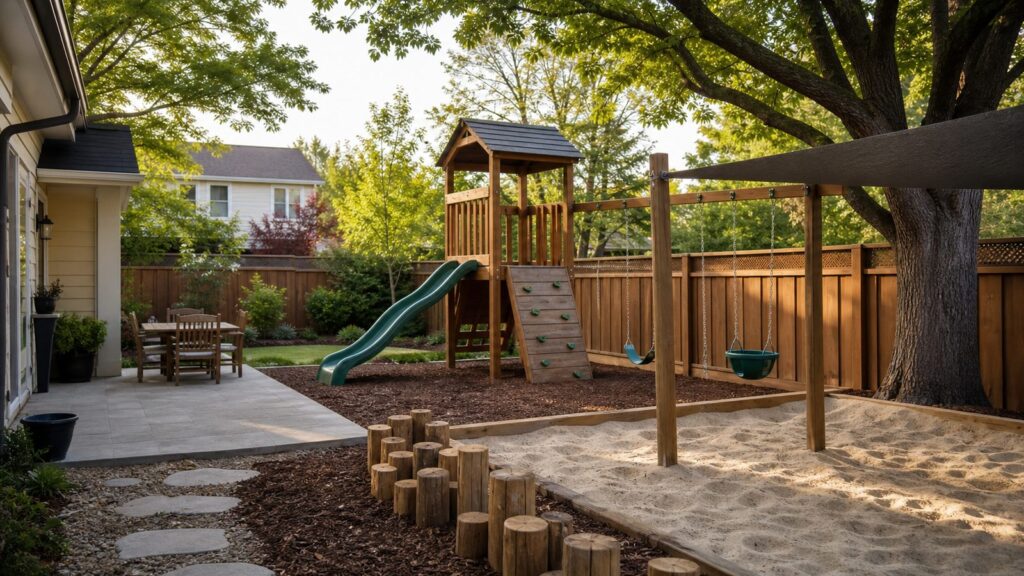
A kid-safe backyard play zone starts with layout, not equipment. Before you buy a swing set, climbing dome, playhouse, turf, or fence panels, map the yard like a small residential construction project: where children run, where they fall, where adults can see them, where water drains, where the sun hits at 3 p.m., and where gates or utilities could create problems.
On our job sites, the safest play spaces are usually not the most expensive ones. They are the ones with good separation between high-motion activities and quiet play, enough fall space around equipment, firm paths for adults and strollers, shade over hot surfaces, and drainage that keeps the play area from turning slick or muddy after storms.
For 2026 budgeting, expect the equipment to be only part of the cost. Professional swing set or playset assembly commonly runs about $505, with typical ranges around $323 to $717 and broader installation ranges of $150 to $900. But leveling, surfacing, drainage, fencing, gates, shade, and custom carpentry can easily exceed the cost of the playset itself. A safe backyard play zone is a system.
Start With a Scaled Backyard Play Plan
Use graph paper, a tape measure, or a simple digital sketch. Draw the house, patio, fence, gates, trees, slope direction, downspouts, hose bibs, utilities, and any hardscape. Then draw the play zone at scale. A 1/4 inch equals 1 foot scale works well for most yards.
#1 Best Overall

- CREATE A SAFER PLAY AREA - Playsafer rubber mulch is IPEMA Certified and helps reduce the risk of injury on playgrounds and play areas
- EASY TO SPREAD - Rubber mulch will not decompose or compress so you will not need to reapply. Nuggets come packaged in multiple 40 LB bags so you can spread it evenly and easily. Just spread it once and enjoy a safer play area
- ECO FRIENDLY - Playsafer rubber mulch nuggets are made from recycled tires and are 99.9% metal free
- Color Guarantee -Nuggets are produced with the highest quality materials Color is guaranteed to last for 12 years
- Keep your playground always ready to play - rubber mulch nuggets dry quickly and will never freeze in cold weather
Mark these items before choosing equipment:
- Equipment footprint: the actual size of the swing set, slide, dome, playhouse, sandbox, or climbing feature.
- Use zones: the clear space around equipment where children may fall, swing, jump, or run out.
- Supervision sightlines: what can be seen from the kitchen window, patio, deck, home office, or primary outdoor seating area.
- Drainage direction: where water flows during a storm and where it collects afterward.
- Shade path: where the yard is shaded in late morning, midafternoon, and early evening.
- Maintenance access: at least 24 to 36 inches around major equipment so adults can inspect anchors, bolts, surfacing, posts, and drainage.
Do not place a swing set just because it fits the open patch of grass. Grass is not a reliable fall surface under elevated play equipment, and tight corners create collision hazards. If the only available spot is sloped, wet, or hidden from the house, fix those conditions first or choose lower-risk play features.
Separate Play by Motion, Noise, and Mess
A backyard works better when it has zones instead of one pile of play features. Children move differently on swings than they do at a sand table. Mixing those activities in a tight space is where avoidable bumps and falls happen.
High-motion zone
This is where swings, slides, climbing domes, monkey bars, balance features, and running games belong. Keep it away from patios, grills, glass doors, garden beds, retaining walls, fire pits, and fence corners. If you have a swing beam, orient swings so the travel path does not point toward a walkway, gate, tree, or seating area.
Messy play zone
Sand, mud kitchens, water tables, chalk walls, and garden play should sit near a hose, drainable surface, or washable edge. Pavers, compacted gravel with a stable top layer, or a sloped concrete pad can work for water play if runoff has somewhere to go. Avoid permanent standing water unless it is designed and permitted as a water feature.
Quick wins for a faster PC:
Fix the driver behind crashes, sound loss and screen glitchesFind Drivers →Repair Windows errors before they cause bigger problemsFix Now →Quiet and sensory zone
A reading nook, small playhouse, shaded bench, sensory table, fairy garden, or loose-parts play area should be outside the swing path and away from bike routes. Put it where adults can see it but where children feel like they have a defined space.
Wheeled-toy loop
If your yard allows it, a small loop path is one of the best investments for scooters, trikes, balance bikes, chalk roads, and toy cars. Keep it separate from the swing and slide exit zones. A 36-inch-wide path is workable for one child at a time; 48 inches is better where children pass each other.
Use Real Fall Zones, Not Guesswork
The Consumer Product Safety Commission reports that more than 200,000 children go to U.S. hospital emergency departments each year for playground-equipment injuries, and many injuries happen when children fall from equipment onto the ground. Residential yards are smaller than public playgrounds, but the physics are the same.
For home playground equipment, look for products that state compliance with ASTM F1148, which applies to residential equipment intended for children over 18 months through 10 years. Public playground guidance is not written for private backyards, but its core concepts are useful: age-appropriate equipment, protective surfacing, entrapment prevention, protrusion checks, and adequate separation between use zones.
What’s actually slowing this PC down?
Pick the symptom - the matching free tool is one click away.
As a practical homeowner rule, keep at least 6 feet of clear protective surfacing around most elevated play equipment. Swings need more room because children travel forward and backward. A common planning approach is to allow a use zone in front of and behind each swing that is roughly twice the height from the pivot point to the protective surface. If the swing pivot is 8 feet high, plan for about 16 feet of clear space in front and 16 feet behind. Always follow the equipment manufacturer’s manual when it requires more.
Slides need clear space at the exit. Keep hardscape, edging, toys, tables, and fences out of the landing path. Under swings and at slide exits, install wear mats or a more durable surface because loose fill moves fastest in those locations.
Choose Safer Surfacing for the Way Your Kids Play
Grass looks soft, but it wears thin under swings, becomes slippery when wet, and does not provide predictable impact protection. For elevated equipment, use a protective surface designed for falls and maintain it at the required depth.
Loose-fill materials such as engineered wood fiber, wood chips, rubber mulch, and pea gravel require containment and maintenance. CPSC guidance notes that loose-fill surfacing compresses at least 25 percent over time. If a play area needs 9 inches of wood chips, plan to install about 12 inches initially so it can settle and still perform. Mark a minimum-fill line on posts or edging so the maintenance need is visible.
| Surface option | Best use | 2026 cost notes | Builder notes |
|---|---|---|---|
| Engineered wood fiber or wood chips | Swing sets, slides, climbing areas | Usually lower material cost, but requires edging and replenishment | Install deeper than final target because loose fill compresses. Rake weekly during heavy use. |
| Rubber mulch | High-use fall zones | Higher upfront cost than wood fill; varies by depth and area | Does not decompose like wood, but still displaces under swings and slides. |
| Poured rubber | Clean, accessible, low-maintenance play zones | Professional installation commonly runs $2,450 to $4,150; smaller 200 sq. ft. areas often land around $1,000 to $3,000 | Good for accessibility, but thickness, base prep, color, and drainage matter. Can get hot in full sun. |
| Playground synthetic turf with shock pad | Clean play lawns and accessible routes | Common 2026 installed pricing is about $6 to $20 per sq. ft.; some residential installs run $13 to $32 per sq. ft. | Use a shock pad where falls are expected. Choose lighter colors or add shade in hot climates. |
| Pavers or concrete | Water tables, chalk, art, seating, stroller access | Varies widely by base, finish, and region | Good for messy play, not for fall zones under elevated equipment. |
For loose-fill areas, build containment that will not become a trip hazard. A 6-by-6 timber edge, low concrete curb, or composite border can work if it is outside primary landing zones or flush enough to avoid hard impacts. Keep edging far enough from slides and swings so children do not land on it.
Rank #2
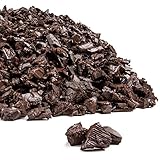
- CREATE A SAFER PLAY AREA - Playsafer rubber mulch is IPEMA Certified and helps reduce the risk of injury on playgrounds and play areas
- EASY TO SPREAD - Rubber mulch will not decompose or compress so you will not need to reapply. Nuggets come packaged in multiple 40 LB bags so you can spread it evenly and easily. Just spread it once and enjoy a safer play area
- ECO FRIENDLY - Playsafer rubber mulch nuggets are made from recycled tires and are 99.9% metal free
- Color Guarantee -Nuggets are produced with the highest quality materials Color is guaranteed to last for 12 years
- Keep your playground always ready to play - rubber mulch nuggets dry quickly and will never freeze in cold weather
Plan Drainage Before Surfacing Goes In
Drainage is a safety feature. Standing water creates slippery surfaces, mosquitoes, rotten wood posts, soft soil, settlement, and muddy fall zones. If the yard has a low spot, do not cover it with mulch and hope for the best. The water will still be there, just hidden.
For a basic play zone, slope the subgrade away from the equipment at about 1 to 2 percent where possible. That means a drop of 1 to 2 inches over 8 feet. Under loose fill or turf, use a compacted base that drains instead of trapping water. Around wood posts, avoid burying untreated lumber or creating pockets where water sits against the post.
If the yard needs a drainage system, 2026 French drain pricing varies widely. Professional installation commonly ranges from about $2,800 to $6,500, with reported lows around $500 and highs up to $18,000 depending on length, depth, soil, access, discharge location, and whether hardscape must be disturbed. For complicated water problems near foundations, slopes, retaining walls, or neighboring properties, bring in a pro before building the play area.
Do these 3 things before closing this tab:
1Scan for outdated or missing drivers - takes under a minute2Clear out junk files and repair common Windows errors3Fix the driver behind crashes, sound loss and screen glitchesBuild Shade Into the Design
Shade is not just comfort. Rubber, synthetic turf, plastic slides, and dark play equipment can get very hot in direct sun. In warm climates, we try to place high-touch surfaces where they receive afternoon shade or where a shade structure can be installed without interfering with fall zones.
Good shade options include existing trees, shade sails, pergolas, covered playhouses, or equipment orientation that keeps slide beds out of harsh afternoon sun. Tree shade is useful, but inspect for dead limbs and avoid placing equipment directly under branches that drop nuts, fruit, sap, or heavy debris.
For shade sails, pay attention to anchors. Posts need proper footings, tension loads are real, and sail corners should not create head-height hazards around active play. Keep shade posts outside fall zones whenever possible. If a post must be near play space, pad or relocate the layout.
Creative Play Zone Ideas That Add Safety Value
The best backyard play ideas are open-ended and low enough to reduce risk. Tall platforms are exciting, but younger children often get more daily use from simple, well-built features that invite climbing, digging, balancing, pretending, and moving.
Low natural balance path
Use flat-topped logs, stepping stones, or ground-contact-rated timbers set 12 to 18 inches high or lower. Keep spacing close enough for your child’s age and surround the path with mulch or turf. Round over sharp edges and check for wobble every season.
Covered sand and digging area
A 4-by-6-foot or 6-by-8-foot sand area is enough for most backyards. Add a fitted cover to keep out debris and animals. Place it where adults can supervise easily and where sand will not wash into drains or planting beds.
Chalk wall or outdoor art fence
A chalkboard panel on a fence or freestanding frame gives kids creative play without taking up much yard. Use exterior-rated materials, countersink fasteners, and avoid mounting it where children stand in a swing path or bike route.
Water table on drainable paving
Temporary water play works best on a small sloped patio, paver pad, or compact hardscape area near a hose. Empty it after use. Permanent standing water attracts mosquitoes and raises the maintenance burden.
Windows Errors? Fix Them Before They Spread
Repair common Windows errors and clear accumulated junk for a smoother, more stable PC - no reinstall needed.Free scan · no reinstallOutdated Drivers Are Slowing You Down
One free scan finds every outdated or missing driver and matches the right update for your exact hardware.Free scan · exact hardware matchToddler loop path
A loop path around a garden bed or play lawn gives toddlers a predictable route for riding toys. Keep curves wide, surfaces firm, and gates latched. Avoid steep slopes where a child can pick up speed toward stairs, driveways, or hard edges.
Garden play bed
Use non-toxic plants and avoid thorny, poisonous, high-allergen, or bee-attracting plants directly beside high-traffic play paths. Herbs, strawberries, sunflowers, snap peas, and child-safe sensory plants can make the yard feel alive without adding complicated equipment.
Rank #3

- CREATE A SAFER PLAY AREA - Playsafer rubber mulch is IPEMA Certified and helps reduce the risk of injury on playgrounds and play areas
- EASY TO SPREAD - Rubber mulch will not decompose or compress so you will not need to reapply. Nuggets come packaged in multiple 40 LB bags so you can spread it evenly and easily. Just spread it once and enjoy a safer play area
- ECO FRIENDLY - Playsafer rubber mulch nuggets are made from recycled tires and are 99.9% metal free
- Color Guarantee -Nuggets are produced with the highest quality materials Color is guaranteed to last for 12 years
- Keep your playground always ready to play - rubber mulch nuggets dry quickly and will never freeze in cold weather
Small playhouse or stage
A low playhouse, puppet stage, or pretend storefront can be safer than a high tower if it is built with rounded edges, proper ventilation, exterior-rated fasteners, and no head-entrapment openings. Keep platforms low unless you are also budgeting for rated surfacing around them.
Fenced side-yard adventure path
Narrow side yards can become useful play routes with stepping pads, a crawl tunnel, chalk panels, a small climbing wall kept low to the ground, or a scavenger trail. Keep access gates secure and maintain a clear adult path through the space.
Fencing, Gates, and Boundaries
A fence can make a play zone safer, but only if the gate, latch, visibility, and layout are right. A fenced yard that hides children from view or creates blind corners is not automatically safer.
HomeAdvisor’s 2026 fence data lists a national average around $3,275, with a broad range from $425 to $13,700. Many U.S. fence projects fall around $20 to $60 per linear foot depending on material, height, gates, terrain, and region. Wood privacy fence estimates for May 2026 commonly start around $33.07 to $53.00 per linear foot before many local add-ons.
For kid-focused yards, use self-closing hardware where appropriate, avoid easy footholds on the outside of gates, and place latches high enough that small children cannot open them. Keep gates away from swing paths and bike routes. If the play zone is near a driveway, pool, alley, street, drainage ditch, or steep slope, fencing is often one of the highest-value safety investments.
Budget the Whole Project, Not Just the Playset
A backyard play zone can be a $500 weekend project or a $25,000 custom outdoor build. The difference is scope: equipment, labor, site prep, drainage, surfacing, fencing, shade, access, and finish carpentry.
Recommended Free Tools
| Project item | Typical 2026 U.S. cost range | What changes the price |
|---|---|---|
| Professional swing set or playset assembly | Average about $505; common range $323 to $717; broader range $150 to $900 | Set size, complexity, anchors, access, and whether old equipment must be worked around |
| Larger or custom playset labor | Standard playsets often $300 to $900; larger/custom builds $900 to $2,500; large multi-deck wood structures can run $700 to $1,400+ in labor before site work | Carpentry, decks, roofs, railings, leveling, and custom details |
| Outdoor play equipment installation with broader scope | Basic national estimates start around $1,683 to $2,668 per structure | Labor assumptions, supplies, anchoring, layout, and site conditions |
| Residential play equipment | A few hundred dollars for basic swing sets; $1,000 to $5,000+ for substantial wood playsets; custom builds can reach five figures | Material, height, brand, accessories, roofing, decks, and finishes |
| Yard leveling and site prep | Commonly $1,200 to $4,200; broader reported ranges $390 to $6,110 | Slope, soil movement, access, drainage, roots, and equipment area size |
| Poured rubber surface | $2,450 to $4,150 typical professional range; 200 sq. ft. zones often $1,000 to $3,000 | Thickness, base, color mix, recycled content, and drainage prep |
| Playground synthetic turf | About $6 to $20 per sq. ft.; some residential installs $13 to $32 per sq. ft. | Shock pad, base prep, drainage, heat-resistant products, seams, and access |
| Fence installation | Average around $3,275; broad range $425 to $13,700; often $20 to $60 per linear foot | Material, height, gates, terrain, demolition, and local labor |
| French drain or drainage correction | Often $2,800 to $6,500; broad range $500 to $18,000 | Length, depth, discharge point, soil, slope, hardscape, and access |
For a practical midrange backyard play area, many homeowners should expect to budget for site prep, equipment, surfacing, and at least some professional help. If the quote only includes assembly, ask what is excluded: leveling, anchors, fall surfacing, borders, drainage, permits, hauling, electrical, fence changes, and restoration.
Permits, HOA Rules, and Utility Checks
Permit rules vary by city and county. Some backyard swing sets are treated as temporary or accessory play equipment. Larger playhouses, roofed structures, decks, platforms, pergolas, shade structures, fences, retaining walls, and electrical work may trigger permits or zoning setbacks.
Before digging or anchoring, call 811 so utilities can be marked. This matters for swing set anchors, shade sail posts, fence posts, drainage trenches, playhouse footings, and landscape lighting. In some neighborhoods, HOA rules also control fence height, equipment height, visibility from the street, roof materials, colors, and setback from property lines.
Check these items before work starts:
- Accessory structure height limits and property-line setbacks
- Fence height, gate, and front-yard visibility rules
- Drainage discharge rules, especially near neighbors or public sidewalks
- Electrical permit requirements for lighting, outlets, fans, or playhouse power
- HOA architectural review requirements
- Manufacturer anchoring requirements and ASTM F1148 compliance language
If your play zone includes a deck, roof, elevated platform, retaining wall, or hardwired electrical feature, get local guidance before building. A small code check at the beginning is cheaper than moving a finished structure.
The Tool Desk
Outbyte PC Repair FREERepair Windows errors before they cause bigger problemsFix Now →Outbyte Driver Updater FREEScan for outdated or missing drivers - takes under a minuteDriver Scan →When to DIY and When to Hire a Pro
DIY makes sense when the work is low-risk, low-height, and easy to inspect. Many homeowners can assemble a small sandbox, install a chalk wall, build a low balance path, place stepping stones, set up a water table pad, or assemble a simple playset if the ground is level and the manufacturer’s instructions are clear.
Hire a pro when the project involves slope correction, drainage problems, major surfacing, fencing, tall equipment, custom carpentry, concrete footings, shade sail posts, retaining walls, electrical work, or tight setbacks. Also hire help if the playset manual requires multiple adults, specialty anchors, or precise leveling that you cannot achieve safely.
On our projects, we are especially cautious with elevated platforms, swing beams, and custom wood features. Exposed edges should be rounded over. Fasteners should be countersunk or capped. Openings should avoid head-entrapment hazards. Lumber and hardware should be exterior-rated and appropriate for ground contact and the local climate. Anchors should be installed as specified, not improvised after the structure wobbles.
Rank #4

- CERTIFIED – 99.9% wire-free recycled rubber and ASTM F3012 tested. Rubber mulch is impervious to both cold and heat. Because it is recycled tire rubber it is hydrophobic, it can absorb water and freeze. Rubber mulch is non-flammable.
- SAFETY – Playgrounds are supposed to be safe places for children to play. These rubber mulch nuggets displace well upon child impact providing a 200%-700% better fall height, head impact and injury protection than other playground surfaces. Our rubber nuggets reduce potential choke hazards due to their small size.
- LONG LASTING – 12 year color guarantee against color loss. Color will not rub off. The weight of these rubber nuggets allows them to stay in the playground area and will not be blown around by winds or leaf blowers. No need to replace annually like wood chips.
- ECOLOGICAL - Made from 100% recycled waste tires. Non-toxic, safe for children, pets and animals. Does not attract animals insects and rodents like other materials. Will not develop fungus or slime. The rubber nuggets are also splinter free, and also act as a weed barrier. 5 attractive colors to choose from.
- COVERAGE – Bag is 1.5 cubic foot of rubber nuggets. Weight of bag is approx. 40 pounds. Recommended depth is 3-4 inches for residential playgrounds. Following is based on 3” depth. 5’ X 5’ Coverage = 5 Bags 10’ X 10’ Coverage = 20 Bags 15’ X 15’ Coverage = 45 Bags 20’ X 20’ Coverage = 80 Bags.
Age-Stage the Yard So It Lasts
A good play zone can adapt for 5 to 8 years if you avoid building everything around one age. For children under 3, prioritize low platforms, crawling, sand, water tables, push toys, sensory play, and shade. For ages 3 to 5, add low climbing, slides, pretend play, chalk, gardening, and short loop paths. For ages 5 to 10, climbing domes, monkey bars, swings, sports walls, larger playhouses, and obstacle courses usually get more use.
Free tools Windows power users keep installed
One-click scans. No signup required.
Keep future conversion in mind. A sandbox can become a raised garden bed. A toddler loop can become a scooter path. A playhouse can become a reading shed or gear storage. A shaded seating area can serve adults long after the playset is gone.
Inclusive access is also worth planning early. A firm, stable path from the patio to the play zone helps strollers, grandparents, and children with mobility differences. Poured rubber and properly installed playground turf can improve access, but only when the base is built correctly and the route is wide enough to use.
Maintenance Schedule for a Safer Play Zone
Backyard play areas are not set-and-forget installations. Weather, use, soil movement, and plant growth change the safety of the space over time. Photograph the completed installation, keep the equipment manual, and put inspections on the calendar.
Use this schedule:
- Weekly during heavy use: rake loose-fill surfacing back under swings and slide exits, remove toys from fall zones, check for standing water, and look for loose hardware.
- Monthly: inspect anchors, bolts, chains, swing hangers, ropes, caps, splinters, cracked plastic, damaged surfacing, gate latches, and trip hazards.
- Spring opening: check settlement, replenish loose fill to the minimum line, pressure-wash washable surfaces, inspect wood for rot, and trim vegetation away from paths.
- Mid-summer: test surface temperatures, adjust shade if needed, check irrigation overspray, and inspect high-wear areas.
- After major storms: look for drainage washouts, loose branches, shifted borders, exposed anchors, and saturated fall zones.
- Annually: review whether the equipment still fits your child’s age, height, and ability.
Most backyard hazards develop slowly: mulch thins out under swings, a gate stops latching, a timber edge rises with frost, a screw backs out, a low spot turns muddy, or a shrub blocks the view from the kitchen. Routine inspection catches those problems before they become injuries.
Windows Errors? Fix Them Before They Spread
Repair common Windows errors and clear accumulated junk for a smoother, more stable PC - no reinstall needed.Free scan · no reinstallCrashes, No Sound, or Screen Glitches?
Random freezes, missing sound and display glitches usually trace back to one bad driver. Find and replace yours safely.Free scan · under a minuteA Contractor’s Bottom Line
The safest backyard play zone is not the one with the biggest tower. It is the one that fits the yard, drains properly, gives children room to move, provides real fall protection, stays visible to adults, and can be maintained without guesswork.
Start with a scaled plan. Separate high-motion, messy, quiet, and wheeled play. Use rated surfacing at the right depth. Keep water moving away from the play area. Add shade before hot surfaces become a problem. Check permits, utilities, and HOA rules before digging. Then choose equipment that matches your children’s age and the space you can maintain.
Done that way, a backyard play zone becomes more than a collection of toys. It becomes a durable, useful part of the home.
Frequently Asked Questions
What is the safest backyard surface under a swing set?
Use a protective playground surface such as engineered wood fiber, wood chips, rubber mulch, poured rubber, or playground turf with a shock pad. Grass is not reliable under swings because it wears thin and becomes slippery. Loose-fill surfacing must be maintained at the required depth and raked back under swings often.
How much clear space does a backyard swing set need?
Plan for at least 6 feet of clear protective surfacing around most elevated play equipment. Swings need more room: a practical rule is to allow clear space in front of and behind the swing equal to about twice the height from the pivot point to the surface. Always follow the manufacturer’s manual if it requires more.
How much does it cost to install a backyard playset in 2026?
Professional swing set or playset assembly commonly averages about $505, with typical ranges around $323 to $717. Larger or custom builds can run $900 to $2,500 or more before surfacing, leveling, fencing, drainage, and site prep.
Do I need a permit for a backyard playset?
Small residential playsets often do not need a permit, but rules vary. Larger playhouses, roofed structures, decks, platforms, fences, retaining walls, shade structures, and electrical work may trigger permits, setbacks, or HOA review. Check local rules before digging or building.
Are synthetic turf and rubber safe for backyard play areas?
They can be good options when properly installed with the right base, drainage, and impact layer. For fall zones, playground turf usually needs a shock pad. Rubber and turf can get hot in direct sun, so use shade, lighter colors, and equipment orientation to reduce heat exposure.
Quick wins for a faster PC:
Repair Windows errors before they cause bigger problemsFix Now →Fix the driver behind crashes, sound loss and screen glitchesFind Drivers →Clear out junk files and repair common Windows errorsFree Scan →What backyard play ideas are safest for toddlers?
For toddlers, choose low, open-ended features: sand play, water tables, crawl tunnels, low stepping stones, balance beams 12 to 18 inches high or lower, garden play, chalk walls, and small shaded playhouses. Avoid tall platforms until the child is ready and the fall surfacing is properly designed.
Quick Recap
Product prices and availability are accurate as of the date/time indicated and are subject to change. Any price and availability information displayed on Amazon at the time of purchase will apply.