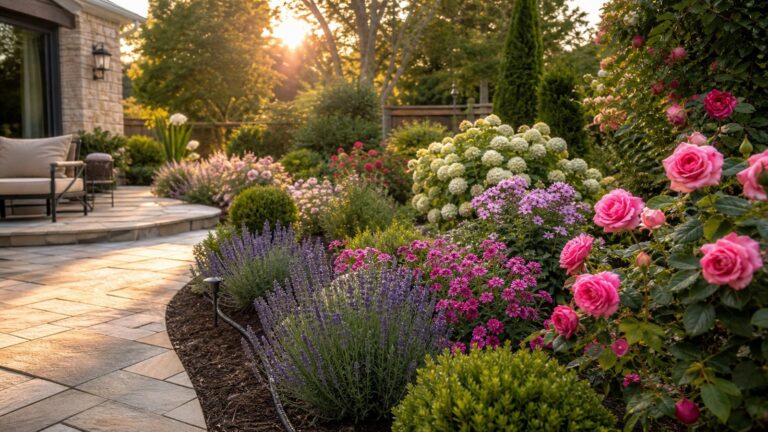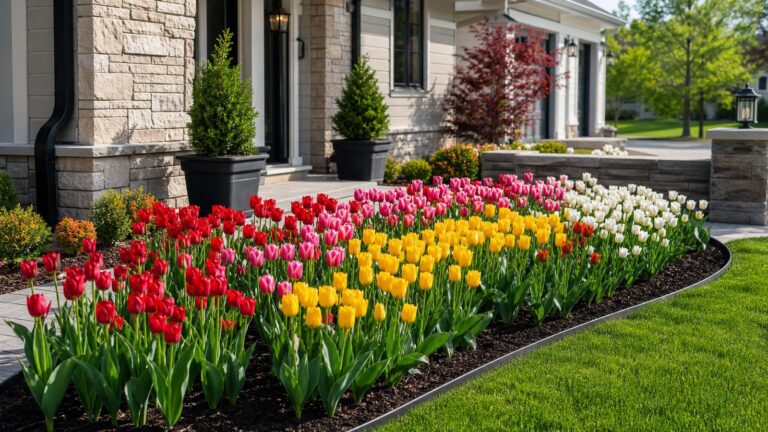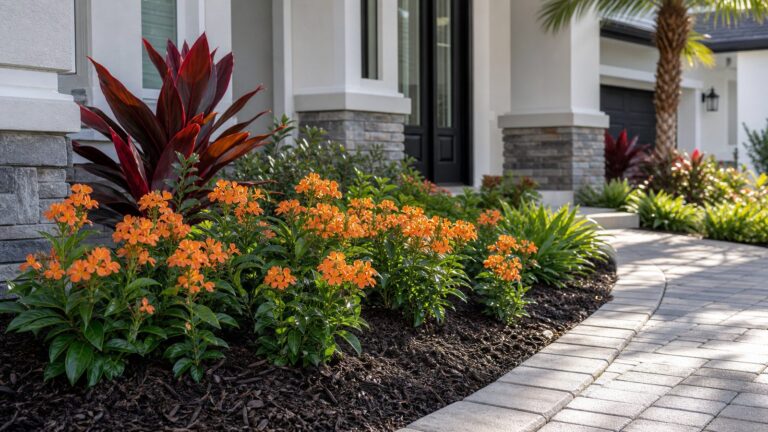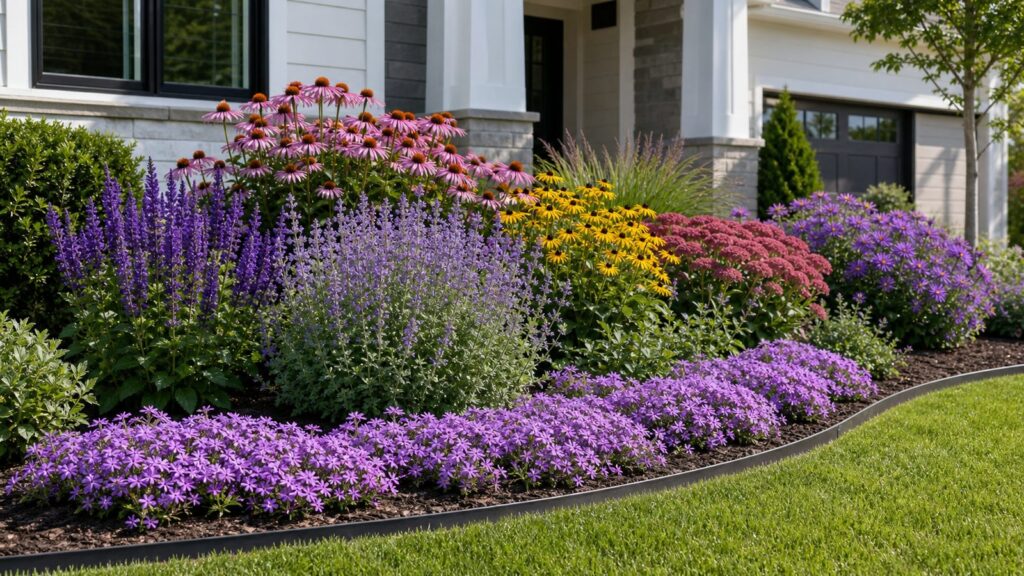
A strong perennial bed does not depend on one miracle plant blooming nonstop from spring through fall. That is not how most perennials work. The reliable way to get color for 7 to 9 months is to build the bed in waves: early spring bloomers, long-blooming summer plants, and late-season finishers that hold color into fall.
On our job sites, the difference between a thin flower strip and a bed that looks intentional is usually not the plant list alone. It is spacing, soil preparation, drainage, edging, mulch depth, and irrigation during the first growing season. A $300 cart of plants can fail in compacted clay. A well-built 100-square-foot bed with 30 to 60 properly spaced perennials can look better every year for a decade.
Below are 18 perennial flowers we would consider for a spring-to-fall planting plan in much of the United States. Use the full list as a menu, not a shopping order. For one normal front-yard bed, choose 6 to 9 varieties, repeat them in groups of 3, 5, or 7, and match them to your sun, soil, water, and USDA hardiness zone.
Start With the Right Expectation: Bloom Waves, Not Nonstop Bloom
Most perennials bloom in windows. Some bloom for 2 to 4 weeks. Strong rebloomers may flower for 8 to 12 weeks with shearing or deadheading. A few, such as Hardy Geranium ‘Rozanne’ or compact catmint, can carry color for a long stretch, but even those perform better when surrounded by other plants coming in and out of bloom.
A balanced bed usually needs:
- 4 spring anchors to start the season before summer plants fill in.
- 8 to 10 summer workhorses for the longest color window.
- 4 to 6 fall finishers so the bed does not collapse visually after August.
For a bed that faces the street, we also plan foliage, height, and structure. Coral bells, sedum, yarrow, catmint, and coneflower can still look useful when they are not in peak bloom. That matters because a homeowner sees the bed every day, not only during the perfect week.
#1 Best Overall

- 524 PREMIUM SEEDS – BRILLIANT COLOR, FAST GROWTH: This large pack includes 524 USA-packed, high-germination Zinnia Dahlia seeds that bloom into stunning double flowers in red, pink, orange, white, and more. Easy to grow, beginner-friendly, and perfect for bouquets, borders, and containers. Blooms in just weeks and lasts all summer!
- A TRUE GARDEN ARISTOCRAT WITH STRIKING FORM: Zinnia Dahlia is a radiant floral showstopper, beloved for its uniquely bold shape and opulent floral structure. Each bloom evokes a sense of floral nobility with plush, layered petals arranged in a near-geometric sphere. This variety of zinnia has earned its place among the top ten most cherished garden flowers, widely appreciated across the United States and beyond.
- RED FOR EXCEPTIONAL COLOR, SHAPE, AND VARIETY: Decades of horticultural development have resulted in this magnificent line of Zinnia Dahlia seeds. Carefully selected to represent the best of modern breeding, this variety offers a visual spectacle of rich tones and impressive structure. The blooms are large and fully double, featuring countless tightly arranged petals that radiate with saturated color. Each flower opens like a celebration—vivid, elegant, and unforgettable.
- EXPLOSION OF COLOR IN EVERY PLANT: This seed mix produces a stunning range of shades including snow white, coral, salmon pink, lavender, purple, bright orange, cream-yellow, cherry red, scarlet, deep crimson, and plum. Two-toned blooms with dramatic edging offer even more visual interest. Whether planted in clusters or as a standout specimen, Zinnia Dahlia puts on a breathtaking display all summer long.
- LARGE PACK FOR FULL GARDEN COVERAGE: Each seed pack includes approximately 524 premium Zinnia Dahlia seeds, giving you enough to plant a wide area—ideal for garden borders, flower beds, or large landscape designs. Enjoy continuous blooms and a high return on planting. This makes them an ideal value choice for mass planting or sharing with friends and family.
The 18 Best Perennial Flowers for Spring, Summer, and Fall Color
The plants below are grouped by the part of the season they help cover, though several overlap. Always check the specific cultivar tag for mature height, spread, hardiness zone, and moisture requirements. A plant that behaves well in one region can be aggressive, disease-prone, or short-lived in another.
1. Creeping Phlox
Bloom window: early to mid-spring. Typical size: 4 to 6 inches tall, 18 to 24 inches wide. Best use: front edges, slopes, walls, and sunny borders.
Creeping phlox is one of the cleanest ways to get a strong spring show at ground level. It works well along a walkway or retaining wall because it softens the hard edge without blocking sight lines. Give it full sun and well-drained soil. Space most plants 18 inches apart so they knit together without becoming a crowded mat in year two or three.
2. Columbine
Bloom window: spring into early summer. Typical size: 12 to 30 inches tall, 12 to 18 inches wide. Best use: part-shade beds, woodland edges, mixed borders.
Columbine brings lighter, more delicate flowers before the heavier summer bloomers arrive. It is useful near bleeding heart, coral bells, and hardy geranium. Many varieties self-seed lightly, which can be welcome in a natural bed but less desirable in a formal border. Plant it where the soil stays reasonably moist but not soggy.
3. Bleeding Heart
Bloom window: mid-spring to early summer. Typical size: 18 to 36 inches tall, 24 to 36 inches wide. Best use: part shade, foundation beds with morning sun, woodland gardens.
Bleeding heart is a spring anchor, not a summer backbone. Traditional types often go dormant when heat arrives, so do not place them where they will leave a bare hole at the front of the bed. We usually pair them with hosta, ferns, coral bells, or hardy geranium so later foliage covers the gap.
4. Coral Bells
Bloom window: late spring to summer, with foliage all season. Typical size: 8 to 18 inches tall, 12 to 24 inches wide. Best use: front to middle of part-shade beds.
Coral bells are valuable because the foliage does real work. Burgundy, bronze, lime, and silver-leaf varieties can keep a bed looking designed even between bloom cycles. In hot regions, afternoon shade is usually better than full sun. Keep mulch away from the crown and avoid burying the plant too deep.
5. Salvia
Bloom window: late spring into summer, often reblooming. Typical size: 12 to 30 inches tall, 18 to 24 inches wide. Best use: full-sun borders, pollinator beds, dry-to-average soil.
Perennial salvia gives upright flower spikes that contrast well with mounded catmint, daisy-shaped coreopsis, and coneflower. After the first heavy bloom, shear spent flower stems back. In many regions, that cleanup triggers a second flush. Salvia is a good choice near walkways because it stays relatively tidy when spaced correctly.
6. Catmint
Bloom window: late spring through summer, with rebloom after shearing. Typical size: 12 to 30 inches tall, 24 to 36 inches wide. Best use: sunny edges, driveway beds, hot dry areas.
Catmint is one of the best long-blooming perennials for full sun. ‘Walker’s Low’ is a common workhorse, though compact newer cultivars are easier where space is tight. Treat it like a small shrub in the plan. A single plant can reach 30 inches wide, so three plants can cover a 6- to 8-foot run along a walk. Shear it after the first flush when it starts to flop.
7. Hardy Geranium ‘Rozanne’
Bloom window: late spring or early summer into fall in many climates. Typical size: 12 to 20 inches tall, 24 to 36 inches wide. Best use: front and middle of mixed beds.
‘Rozanne’ is one of the few perennials we trust for a long color season, especially where summers are not extreme. It spreads as a soft mound and works well as a filler between taller perennials. Give each plant room. Installing them 12 inches apart may look full on day one, but it creates crowding later. In most beds, 24 to 30 inches on center is more realistic.
Free tools Windows power users keep installed
One-click scans. No signup required.
Rank #2

- 100% Pure, Non-GMO Seeds - No fillers, favorites only! Includes 19 easy-to-grow species: Siberian Wallflower, Shasta Daisy, Lance Leaf Coreopsis, Sweet William, Foxglove, Purple Coneflower, Blanket Flower, Blue Flax, Perennial Lupine, Mexican Hat, Gloriosa Daisy, Black Eyed Susan, Candytuft, Gayfeather/Blazing Star, Maltese Cross
- Attracts Pollinators - With up to 1,000 square feet of ground cover, this non-GMO seed mix is sure to bring the bugs and birds to your yard! Easily attract bees, butterflies, and hummingbirds to pollinate blooms.
- Perfect for Zones 3-10 - This bulk outdoor mix is all perennial and suitable for all USDA hardiness zones, 3-10. These animal resistant, low-maintenance varieties prefer full sun and will produce mixed color blooms all summer through fall.
- Give the Gift of Beauty - Flower seeds are a gorgeous, eco-friendly gift that can provide lasting beauty outside your home for years to come! Perfect for birthdays, Mothers' and Fathers' Days, weddings, baby and bridal showers, and so much more, no matter where you live.
- High Germination - Eden Brother seeds are fresh, 100% pure, high germination, and non-GMO. Always. Our germination rates far exceed industry standards when planted according to instructions.
8. Coreopsis
Bloom window: summer, often reblooming with deadheading. Typical size: 12 to 24 inches tall, 12 to 24 inches wide. Best use: full sun, pollinator beds, low-maintenance color blocks.
Coreopsis brings bright yellow, gold, red, or bicolor flowers and handles heat well once established. For a cleaner look, deadhead spent flowers or shear lightly after the first bloom cycle. Avoid overly rich, wet soil. Like many long-blooming perennials, coreopsis performs best when the bed drains well and is not overwatered.
9. Daylily ‘Stella de Oro’
Bloom window: late spring through summer, with rebloom. Typical size: 10 to 18 inches tall, 18 to 24 inches wide. Best use: mass planting, sunny slopes, utility areas, curbside beds.
‘Stella de Oro’ became common for a reason: it is durable, compact, and repeat-blooming. It is not the rarest plant in the nursery, but it solves real job-site problems. Use it where you need toughness near a driveway, mailbox, or sidewalk. Remove old flower stalks for a cleaner appearance and divide clumps every 3 to 5 years when bloom declines or the center gets crowded.
Recommended Free Tools
10. Shasta Daisy
Bloom window: early to midsummer, sometimes longer with deadheading. Typical size: 12 to 36 inches tall, 18 to 24 inches wide. Best use: sunny mixed borders and cottage-style beds.
Shasta daisies give a crisp white flower that reads well from the street. They can get tired-looking if spent blooms stay on too long, so plan on deadheading. Some varieties need division every few years to stay vigorous. Do not use tall, floppy cultivars in narrow foundation beds unless you are willing to stake or cut them back.
11. Yarrow
Bloom window: early summer into fall with deadheading. Typical size: 18 to 36 inches tall, 18 to 30 inches wide. Best use: full sun, dry soil, pollinator plantings, informal borders.
Yarrow is tough, drought-tolerant once established, and useful for flat-topped flower texture. It does not want a wet pocket beside a downspout. If the soil is too rich or the plant gets too much water, it can flop. Use it with catmint, salvia, coneflower, and Russian sage in a water-wise zone of the bed.
Quick wins for a faster PC:
Scan for outdated or missing drivers - takes under a minuteDriver Scan →Clear out junk files and repair common Windows errorsFree Scan →Fix the driver behind crashes, sound loss and screen glitchesFind Drivers →12. Coneflower
Bloom window: summer into fall. Typical size: 24 to 48 inches tall, 18 to 30 inches wide. Best use: middle to back of sunny beds, pollinator gardens.
Coneflower is a reliable summer-to-fall anchor in many regions. Purple coneflower and well-adapted cultivars support pollinators and tolerate heat after establishment. Leave some seed heads standing if you want winter texture and wildlife value. For formal front entries, deadhead more aggressively to keep the bed tidy.
13. Garden Phlox
Bloom window: midsummer to early fall. Typical size: 24 to 48 inches tall, 18 to 30 inches wide. Best use: middle to back of borders with good airflow.
Garden phlox can be outstanding, but it needs room and the right cultivar. Powdery mildew is the common complaint, especially in humid regions or crowded beds. Choose mildew-resistant varieties, avoid overhead watering, and do not wedge plants against a wall with no air movement. Garden phlox likes more consistent moisture than sedum or Russian sage, so group it with plants that want similar conditions.
The Tool Desk
Outbyte PC Repair FREERepair Windows errors before they cause bigger problemsFix Now →Outbyte Driver Updater FREEFix the driver behind crashes, sound loss and screen glitchesFind Drivers →14. Black-Eyed Susan
Bloom window: midsummer into fall. Typical size: 24 to 36 inches tall, 18 to 24 inches wide. Best use: sunny borders, naturalized areas, pollinator beds.
Black-eyed Susan delivers strong late-summer color when spring bloomers are long finished. It pairs well with coneflower, Russian sage, asters, and sedum. Some types self-seed, which can be an advantage in a loose meadow-style planting and a nuisance in a tight formal bed. Ask the nursery about the exact species or cultivar before buying a full flat.
Rank #3

- Fragrant Blooms: English Lavender seeds to plant of Lavandula angustifolia produce purple flower spikes on slender green stems; late spring–summer color with vigorous growth—ideal for fragrant flowers and classic herbs borders. Common name: English Lavender; Scientific name: Lavandula angustifolia
- Simple Sowing: For best results, cold stratify, then sow 1/4 inch deep; growth shows in 14–30 days at 65+°F—great english lavender seeds for planting with reliable starts for your Outdoor & Indoor herb garden
- Hardy Perennial: Common lavender heirloom seeds forms upright, shrub-like plants 20–24 inches tall; space 18 inches; dependable in USDA zones 3–9—perfect english lavender perennial seeds and perennials seeds for long-term gardens.
- Low-Maintenance Care: Thrives in full sun and light, dry, sandy, well-drained soil; low watering—avoid water-logging; resilient, non-GMO english lavender plant for drought tolerant plants and low-effort landscapes.
- Versatile Uses: Aromatic herb for sachets, potpourri, essential oils, and soothing aromatherapy; traditional medicinal qualities — english lavender seeds heirloom suited to lavender herb, fresh herbs or dried herbs and medicinal herb seeds projects.
15. Bee Balm
Bloom window: summer. Typical size: 18 to 48 inches tall, 18 to 36 inches wide. Best use: pollinator gardens, moist sunny beds, back of borders.
Bee balm is a pollinator magnet, especially for bees, butterflies, and hummingbirds. It also needs respect in the plan. Some varieties spread, and older cultivars can develop mildew. We prefer compact, disease-resistant selections for residential beds. Give bee balm consistent moisture and airflow, and do not plant it in the same dry zone as sedum or Russian sage unless irrigation is divided by need.
What’s actually slowing this PC down?
Pick the symptom - the matching free tool is one click away.
16. Russian Sage
Bloom window: midsummer into fall. Typical size: 24 to 48 inches tall, 24 to 48 inches wide. Best use: hot full-sun beds, dry slopes, street-facing borders.
Russian sage is built for heat, sun, and leaner soil. Its silver foliage and lavender-blue flowers help connect brighter yellows and pinks. Mature size is the issue. Do not install it 12 inches from a walkway and expect it to behave. In most designs, it belongs toward the back or center of an island bed with 3 feet or more of room.
17. Sedum or Stonecrop
Bloom window: late summer into fall. Typical size: 6 to 24 inches tall, 12 to 24 inches wide depending on type. Best use: full sun, dry soil, fall structure.
Upright sedum is one of the best fall finishers because the flower heads and succulent foliage hold their shape. It is also useful near hardscape where reflected heat can punish softer plants. Avoid wet soil and heavy irrigation. If sedum flops, the cause is often too much shade, too much fertility, or too much water.
Do these 3 things before closing this tab:
1Clear out junk files and repair common Windows errors2Fix the driver behind crashes, sound loss and screen glitches3Repair Windows errors before they cause bigger problems18. Asters
Bloom window: late summer through fall. Typical size: 12 to 48 inches tall, 18 to 36 inches wide. Best use: fall color, pollinator support, back and middle of sunny beds.
Asters are the fall insurance policy. When summer bloomers fade, asters can bring purple, blue, pink, or white flowers into the cooler part of the season. Choose compact varieties for front-yard beds. Taller types may need cutting back by one-third in late spring or early summer to stay bushier and reduce flopping.
Quick Comparison: Bloom Time, Sun, Spacing, and Maintenance
Use this table as a planning shortcut. Spacing is based on typical mature spread, not how small the plant looks in the nursery pot.
| Perennial | Main Bloom Window | Sun Exposure | Typical Spacing | Maintenance Level |
|---|---|---|---|---|
| Creeping phlox | Spring | Full sun | 18 in. | Low |
| Columbine | Spring to early summer | Part shade to sun | 12-18 in. | Low to medium |
| Bleeding heart | Spring | Part shade | 24-36 in. | Low |
| Coral bells | Late spring to summer | Part shade | 12-24 in. | Low |
| Salvia | Late spring to summer | Full sun | 18-24 in. | Medium |
| Catmint | Late spring to summer | Full sun | 24-36 in. | Medium |
| Hardy geranium ‘Rozanne’ | Early summer to fall | Sun to part shade | 24-30 in. | Low |
| Coreopsis | Summer | Full sun | 12-24 in. | Medium |
| Daylily ‘Stella de Oro’ | Late spring to summer | Full sun | 18-24 in. | Low to medium |
| Shasta daisy | Early to midsummer | Full sun | 18-24 in. | Medium |
| Yarrow | Summer to fall | Full sun | 18-30 in. | Medium |
| Coneflower | Summer to fall | Full sun | 18-30 in. | Low |
| Garden phlox | Midsummer to early fall | Sun to part sun | 18-30 in. | Medium |
| Black-eyed Susan | Midsummer to fall | Full sun | 18-24 in. | Low |
| Bee balm | Summer | Full sun to part sun | 18-36 in. | Medium |
| Russian sage | Midsummer to fall | Full sun | 30-48 in. | Low |
| Sedum | Late summer to fall | Full sun | 12-24 in. | Low |
| Asters | Late summer to fall | Full sun to part sun | 18-36 in. | Medium |
A Practical 100-Square-Foot Perennial Bed Plan
For a 100-square-foot bed, think 5 feet by 20 feet, 8 feet by 12.5 feet, or a curved bed with similar area. That size is large enough to create repetition but small enough for a homeowner to maintain without turning the yard into a second job.
PC Slower Than It Used to Be?
A free scan shows the junk files, broken settings and background clutter dragging Windows down - then fixes them in one click.Free scan · Windows 10 & 11Outdated Drivers Are Slowing You Down
One free scan finds every outdated or missing driver and matches the right update for your exact hardware.Free scan · exact hardware matchA good full-sun layout might use 38 to 45 plants, depending on container size and mature spread:
- Back row: 3 Russian sage, 5 coneflower, 5 black-eyed Susan, 3 asters.
- Middle row: 5 salvia, 5 daylily ‘Stella de Oro’, 5 coreopsis, 3 sedum.
- Front edge: 5 catmint and 5 creeping phlox, staggered rather than lined up like soldiers.
For part shade, swap in coral bells, columbine, bleeding heart, and hardy geranium. In cooler regions with morning sun, garden phlox can work well in the middle or back if you maintain airflow. The key is not to plant one of everything. Repetition is what makes the bed read as designed from 30 to 50 feet away.
For spacing, mark the bed with landscape paint or flags before digging. We normally set plants in place while still in pots, step back from the street or patio, and adjust the pattern before opening a single hole. That 15-minute check prevents most layout mistakes.
What It Costs to Install a Perennial Flower Bed in 2026
For 2026, national cost guides put professional flower bed installation in a broad range because the scope changes fast. Basic beds often land around $4.50 to $13.50 per square foot. Many full flower-bed installs fall around $10 to $20 per square foot. Higher-end landscaper-installed flower projects can reach $15 to $45 per square foot when they include dense planting, stone edging, difficult access, irrigation, grading, or premium plant material.
Do these 3 things before closing this tab:
1Clear out junk files and repair common Windows errors2Scan for outdated or missing drivers - takes under a minute3Repair Windows errors before they cause bigger problemsRank #4

- Easy-Growing Wildflowers: This Early-Blooming, Carefree Wildflower Seeds Mix Includes 14 Of North America’s Most Beautiful Wildflower Varieties; This Gorgeous Blend Will Quickly Delight Pollinators And People Alike
- Pollinator-Friendly: Bees And Butterflies Will Flock To The Colorful Buffet Of Flowers; Good For Your Garden And For The Environment; The Bulk Seed Bag Contains Over A Dozen Wildflower Favorites In One: Cornflower, Zinnia Elegans, And More
- 25,000 NON-GMO Seeds: Easy-To-Sow Perennial Flower Seeds Mix Covers Up To 1,000 Square Feet And Is Ideal For Most Soil Types; Select A Sunny Area To Scatter The Seed Outdoors For Planting After Danger Of Heavy Frost
- Burpee Seeds Grow: Burpee Offers The Highest Quality, NON-GMO Seeds Hand-Picked By Expert Horticulturalists For Growing In The Home Garden; Burpee Has Been Loved By Gardens And Trusted By Gardeners For Over 140 Years
- Since 1876: Generations Of Customers Have Trusted Burpee To Deliver The Highest Quality Products And Service; Gardeners Rely On Burpee For Accurate Plant Information And How-To Tips That Make Gardening Easier And More Successful; Let’s Grow Together
For a 100-square-foot perennial bed, a realistic DIY material budget is often $300 to $1,500+. A professional installation commonly lands around $1,000 to $2,000+ before major drainage work, stone borders, irrigation upgrades, or heavy soil correction.
| 100-Sq.-Ft. Bed Scope | Typical 2026 Budget | What Is Usually Included |
|---|---|---|
| Basic DIY refresh | $300-$700 | Smaller perennial pots, bagged compost, mulch, simple hand tools, no irrigation changes |
| Better DIY build | $700-$1,500+ | 30-60 perennials, bulk mulch, compost, edging, drip or soaker hose supplies |
| Basic professional install | $1,000-$2,000+ | Layout, sod removal, soil prep, planting, mulch, simple edging |
| Upgraded professional install | $2,000-$4,500+ | Premium plants, stone or metal edging, drip irrigation, grading, drainage correction, hauling |
Plant material is a major variable. Common 1-quart to 1-gallon perennial pots often run roughly $6 to $25 each at retail. Premium new introductions, larger containers, native specialty nursery stock, and mail-order plants can cost more. A dense 100-square-foot bed may need 30 to 60 perennials, but we would rather plant fewer at correct mature spacing than overpack the bed for an instant photo.
Independent reader supportYour contribution helps us test, update, and keep practical guides available for everyone.Build the Bed Like a Contractor, Not Just a Plant Shopper
Check drainage before choosing plants
Water should move away from the house, not toward the foundation. For beds along a wall, patio, or basement, we look at slope first. Soil and mulch should not trap water against siding, stucco, brick ledges, basement windows, or hardscape. If the area stays wet for 24 to 48 hours after normal rain, solve drainage before installing perennials that prefer average or dry soil.
Call 811 before digging
Before digging a new bed, call 811 or submit an online locate request. This is not only for deep trenching. Edging stakes, irrigation lines, root balls, and soil knives can all conflict with shallow utilities, low-voltage lighting, cable lines, or old service runs. Give utilities the required notice in your state, often 2 to 3 business days, and keep the marks visible while work is underway.
The Tool Desk
Outbyte PC Repair FREEClear out junk files and repair common Windows errorsFree Scan →Outbyte Driver Updater FREEScan for outdated or missing drivers - takes under a minuteDriver Scan →Prepare the whole bed, not just the holes
One of the most common failures we see is a pot-shaped planting hole in hard clay. The plant roots circle inside the amended pocket and do not move into the surrounding soil. For a new perennial bed, improve the whole planting area. Remove sod, loosen compacted soil, incorporate compost across the bed, and correct grade before planting.
For most residential beds, a practical target is 2 to 3 inches of compost incorporated into the top 6 to 8 inches of soil, adjusted for local soil conditions. Heavy clay, construction fill, and compacted subsoil may need more serious correction. If pH-sensitive plants are involved, test the soil instead of guessing.
Use mulch correctly
Mulch helps reduce weeds, moderate soil temperature, and conserve moisture. For perennial beds, plan on 1 to 3 inches depending on mulch texture and site conditions. Keep mulch pulled back from crowns and stems. Burying crowns is a good way to rot plants that otherwise would have survived.
Plan irrigation for establishment
Even drought-tolerant perennials need water while roots establish. For the first growing season, expect to water deeply about 1 to 2 times per week when rainfall is lacking, adjusting for heat, soil type, and plant needs. Drip line or soaker hose is better than frequent overhead spray because it puts water at the root zone and keeps foliage drier, which helps with mildew-prone plants like phlox and bee balm.
Water-Wise and Pollinator-Smart Planting
Water-wise design is no longer a Southwest-only conversation. Across the country, homeowners are dealing with watering restrictions, heavier rain events, hotter summers, and higher maintenance costs. A perennial bed can help if it is designed for the site instead of forced into it.
Group plants by water need. Russian sage, sedum, yarrow, catmint, salvia, coneflower, and black-eyed Susan can handle drier full-sun conditions after establishment. Bee balm and garden phlox usually want more consistent moisture. Bleeding heart, coral bells, columbine, and some hardy geraniums are better in part shade or cooler exposures.
If your yard has a low area that collects runoff, do not automatically install a standard flower bed there. A rain-garden approach may be better, using plants suited to periodic wet conditions and designing the bed to slow and absorb stormwater. Keep rain gardens away from foundations unless the grading, overflow, and soil infiltration are properly handled.
For pollinator value, prioritize regionally appropriate native or native-adapted plants. Coneflower, black-eyed Susan, bee balm, asters, yarrow, and some phlox selections can support bees, butterflies, and other beneficial insects while still looking like a finished residential landscape.
Free tools Windows power users keep installed
One-click scans. No signup required.
Maintenance Calendar for Spring-to-Fall Color
A perennial bed is lower maintenance than annual replanting, but it is not no maintenance. The work is seasonal and predictable.
Spring
Cut back remaining dead stems from last year if you left seed heads for winter interest. Pull winter weeds before they root deeply. Topdress thin mulch areas, but do not bury crowns. Spring is also a good time to plant many nursery-grown perennials once soil is workable.
Best Value

- PREMIUM VARIETY: 24 perennial wildflowers seeds; High germination rate with non-GMO wild flower seeds; Creates stunning garden flowers with bold colors and textures; Perfect for butterfly garden seeds and pollinator seed mix
- EASY GROWING SUCCESS: Plant seeds directly in your outdoor gardening spaces; Includes spring flower seeds through fall flower varieties; Perennial flower seeds packets designed for beginners; Creates continuous blooms year after year
- BULK VALUE PACKAGE: Contains 90,000+ seeds (3oz) of wild flowers seeds mix; Perfect for meadows or cottage-style beds; Economical bulk wildflower seeds for large and small projects; Drought tolerant wildflower seeds for natural growth
- BIODIVERSITY BOOST: Attracts bees, butterflies, and birds to your garden; Improves soil health naturally; Features popular varieties like Purple Coneflower, Black Eyed Susan, and California Poppy; Creates a thriving pollinator garden
- COMPLETE GROWING GUIDE: Detailed instructions for successful germination; Transform gardens, meadows, or containers with these flower seeds; Includes perennial seeds for planting outdoors; Creates a continuous display of wildflower beauty
Early summer
Shear catmint and salvia after the first flush. Deadhead coreopsis, Shasta daisy, and daylily if you want a tidier bed and better rebloom. Check irrigation before heat arrives. A drip system that fails in July can undo months of planning.
Late summer
Watch for crowding and disease. Garden phlox and bee balm need airflow. Remove diseased foliage instead of leaving it in the bed. Cut back floppy plants where needed, but keep fall bloomers such as sedum and asters intact.
Quick wins for a faster PC:
Scan for outdated or missing drivers - takes under a minuteDriver Scan →Repair Windows errors before they cause bigger problemsFix Now →Fix the driver behind crashes, sound loss and screen glitchesFind Drivers →Fall
Plant spring-blooming perennials early enough for roots to establish before freeze. Divide crowded daylilies or Shasta daisies when appropriate for your region. Leave some coneflower and black-eyed Susan seed heads if you want winter texture, or cut them back for a cleaner formal look.
When to DIY and When to Hire a Pro
DIY makes sense when the bed is small, access is easy, drainage is already good, and you are comfortable spending a weekend on layout, sod removal, soil prep, planting, and mulch. A 50- to 100-square-foot bed is a reasonable homeowner project if utilities are marked and the soil is workable.
Hire a pro when the project involves grading, drainage, irrigation, retaining edges, stone borders, compacted construction soil, steep slopes, or a highly visible front entry where mistakes will be expensive to redo. Professional installation also makes sense when you need the bed to coordinate with hardscape, foundation waterproofing, downspout routing, or an HOA-approved landscape plan.
Permits are not usually required for a simple flower bed, but there are exceptions. Check local rules if the work changes drainage patterns, adds retaining walls, modifies irrigation backflow connections, affects a right-of-way, or sits inside an HOA-controlled frontage. Utility locating through 811 should still happen before digging, even when no permit is needed.
Common Mistakes That Make Perennial Beds Fail
- Buying by flower color only. Hardiness zone, sun, mature spread, soil moisture, deer pressure, and local invasive rules matter more than a pretty tag photo.
- Planting too close. A 1-gallon pot looks small, but many perennials reach 24 to 36 inches wide by year three.
- Mixing wet and dry plants. Bee balm and garden phlox do not want the same dry pocket as Russian sage and sedum.
- Skipping soil prep. Compost in one planting hole does not fix a compacted bed.
- Overmulching crowns. Mulch should cover soil, not bury the growing point.
- Forgetting first-year water. Drought-tolerant does not mean drought-proof the week after planting.
- Ignoring drainage near the house. A beautiful bed is a bad trade if it sends water toward the foundation.
The Bottom Line
The best perennial flowers for spring, summer, and fall are not a single plant category. They are a planned sequence. Use creeping phlox, columbine, bleeding heart, and coral bells for spring. Carry summer with salvia, catmint, hardy geranium ‘Rozanne’, coreopsis, daylily, Shasta daisy, yarrow, coneflower, garden phlox, black-eyed Susan, bee balm, and Russian sage. Finish the season with sedum and asters.
For most homeowners, the winning bed is 100 to 200 square feet, planted with 6 to 9 repeated varieties, spaced for mature size, mulched 1 to 3 inches deep, watered through the first season, and built so drainage moves away from the house. Done that way, a perennial bed should look better in year three than it did on installation day.
Frequently Asked Questions
What perennial flowers bloom the longest?
Catmint, hardy geranium ‘Rozanne’, salvia, coreopsis, daylily ‘Stella de Oro’, yarrow, coneflower, black-eyed Susan, Russian sage, sedum, and asters are among the more reliable long-season choices. Most still bloom in cycles and perform better with deadheading, shearing, or good cultivar selection.
Can one perennial bloom from spring through fall?
Not reliably in a way that carries a whole bed. A better goal is spring-to-fall color from a planned perennial bed. Use spring anchors, summer workhorses, and fall finishers so something is always in bloom.
How much does it cost to install a perennial flower bed in 2026?
A 100-square-foot DIY perennial bed often costs $300 to $1,500+ for plants, compost, mulch, edging, and watering supplies. Professional installation commonly runs $1,000 to $2,000+ for that size, with higher-end projects reaching more when grading, irrigation, stone edging, or premium plants are included.
When is the best time to plant perennials in the US?
Perennials can generally be planted whenever nursery stock is available and the soil is workable. Spring is often easier for late-summer and fall bloomers because they get a full season to root. Many spring bloomers establish well when planted in late summer or early fall.
Should I call 811 before planting perennials?
Yes, call 811 or submit a locate request before digging a new bed. Edging stakes, irrigation work, root balls, and deeper planting holes can conflict with shallow utility, cable, lighting, or service lines.
How many perennials do I need for a 100-square-foot flower bed?
Most 100-square-foot perennial beds need about 30 to 60 plants depending on mature spread and design density. Use fewer large plants such as Russian sage or bleeding heart, and more compact plants such as creeping phlox, coral bells, salvia, or coreopsis.
Quick Recap
Product prices and availability are accurate as of the date/time indicated and are subject to change. Any price and availability information displayed on Amazon at the time of purchase will apply.