Some links on this page are affiliate links: if you buy through them we may earn a commission, at no extra cost to you.
The best thermostat to set and forget depends on whether you want a fixed weekly schedule or a thermostat that adapts automatically. For hands-off learning and broad smart-home control, consider the Google Nest Learning Thermostat (4th gen). For room-sensor comfort and air-quality monitoring, consider ecobee Smart Thermostat Premium. If you want a lower-cost schedule and app control, Emerson Sensi Lite is a practical starting point. If you want no Wi-Fi, account, or cloud service, choose a conventional 7-day programmable thermostat such as the Honeywell Home RTH7600D—after checking that the exact model is available and compatible with your system.
Before buying any model, confirm your HVAC type, wiring, and C-wire requirements. A thermostat can be well reviewed and still be wrong for a heat pump, dual-fuel system, boiler, zone panel, or proprietary communicating system.
Quick picks
| Best for | Model | Why consider it | Check first |
|---|---|---|---|
| Hands-off smart control | Google Nest Learning Thermostat (4th gen) | Learns a schedule, includes one Nest Temperature Sensor (2nd gen), and works with Google Home and Matter-compatible smart-home control. | Google says it works without a C-wire in most homes, not every home; confirm compatibility, especially with communicating HVAC equipment. |
| Room-sensor comfort | ecobee Smart Thermostat Premium | Includes a SmartSensor and indoor-air-quality monitoring, with broad smart-home integrations. | It is a premium-priced choice; sensors influence the thermostat’s reading but do not create HVAC zones. |
| Low-cost smart scheduling | Emerson Sensi Lite | Seven-day scheduling and app control at a lower stated MSRP than premium models. | C-wire needs depend on the system; check the manufacturer’s model-specific guidance. |
| Simple smart thermostat | Emerson Sensi Smart Thermostat | Seven-day programming and app control without paying for as many premium extras. | A C-wire may be needed for heat-pump, heat-only, or cool-only applications. |
| Traditional, no-Wi-Fi schedule | Honeywell Home RTH7600D or Emerson 1F97-1277 | For buyers who want local controls and a fixed program without a cloud account. | Confirm exact model availability, wiring, and compatibility before purchase. Consumer Reports identifies both as relevant programmable options, with setup or manual-operation trade-offs. |
| Alexa household on a budget | Amazon Smart Thermostat | Smart control for an Alexa-centered home at a budget-oriented tier. | Check C-wire or power-adapter requirements and confirm the features fit your HVAC system. |
| Room sensors outside Google or ecobee | Honeywell Home T9 | Seven-day scheduling and optional room sensors for homes with uneven temperatures. | Verify the exact system compatibility, accessory needs, availability, and price. |
Prices and product details change. The manufacturer pages linked above are the best place to confirm current U.S. pricing, bundles, and requirements; the research price observations for Nest, ecobee, and Sensi are not guaranteed current prices.
What “7-day programmable” means—and what it does not
A true seven-day thermostat lets you set a different schedule for each day. Many models divide a day into periods such as wake, away, return, and sleep. Others offer simpler presets: five-plus-two (weekdays and weekends) or five-one-one (weekdays, Saturday, and Sunday separately). A temporary hold overrides the schedule until the next programmed period; a permanent hold keeps a chosen temperature until you cancel it. Vacation or away modes may hold a setting for a defined period.
#1 Best Overall

- PRIVACY PROTECTION*: Sensi won’t sell your personal information to third parties
- EASY DIY INSTALLATION: Use the built-in level and step-by-step app instructions for a quick installation. Works with HVAC equipment found in most homes. Common wire (c-wire) is not required in most applications
- SAVE ABOUT 23% ON HVAC ENERGY*: The ENERGY STAR-certified Sensi smart thermostat can help you save energy with features like flexible scheduling, remote access and usage reports
- SIMPLE CONFIGURATION: Looks and feels like a thermostat. Has buttons and fits the same space as a traditional thermostat so you don’t have to patch and paint your walls
- SMART MAINTENANCE: Sensi can help monitor the performance and efficiency of your HVAC system by delivering valuable usage reports, alerts about your equipment, and maintenance reminders like filter replacement
Smart thermostats can also offer schedules, but a learning thermostat is not simply a conventional programmable thermostat with Wi-Fi. Nest Learning Thermostat can build and adjust a Smart Schedule based on use; lower-priced Nest Thermostat models use guided scheduling and energy-saving suggestions rather than the same learning behavior. See Google’s explanation of temperature schedules.
“Set and forget” should mean that routine control takes little effort—not that you never check the equipment. Look at the schedule and comfort after the first week, then again during the first heating or cooling season. Learning, occupancy detection, or early-start recovery can create changes that are technically expected but not what you intended.
Choose your control style first
| Approach | Best fit | Trade-off |
|---|---|---|
| Fixed weekly schedule | Consistent routines; buyers who want local, predictable operation and minimal data sharing. | It cannot account for a changed workday or an unexpectedly empty home unless you adjust it. |
| Learning schedule | People who often change settings manually or have routines a thermostat can learn. | It can learn a temperature change you did not mean to make permanent, and unusual weeks can confuse the pattern. |
| Occupancy or geofencing | Households that want automatic away adjustments and are comfortable using app location or occupancy features. | Detection can be wrong: someone may be home but inactive, a phone may leave without its owner, or a guest may be in the house. |
| Room sensors | Homes where the thermostat’s location does not reflect the room people care about most. | A sensor can change which room influences the setpoint, but it cannot independently heat or cool that room. |
A fixed schedule is often the lower-maintenance choice for a household with stable hours, pets that need a consistent temperature, or occupants who do not want an app. Learning and occupancy features can suit irregular routines, but remote workers, guests, and homes with frequently changing schedules should check that automation does not work against them. If a system keeps making unwanted changes, turn off learning or away automation and use a fixed schedule.
Check HVAC compatibility before comparing features
Compatibility is the first buying criterion, ahead of screen style, voice assistants, or advertised savings. Identify what you have before ordering:
- System type: conventional furnace and air conditioner, heat pump, dual-fuel/hybrid, boiler or radiant heat, or another setup.
- Power type: most smart thermostats discussed here are for low-voltage 24V systems. Electric baseboard and other line-voltage systems require a compatible line-voltage thermostat—not a standard 24V smart thermostat.
- Stages and backup heat: note the number of heating and cooling stages, auxiliary or emergency heat, and any heat-pump reversing-valve configuration.
- Accessories: record humidifier, dehumidifier, ventilation, or other controls connected to the thermostat.
- Controls and zones: identify zone dampers and their control panel, as well as any proprietary or communicating HVAC controls. A standard smart thermostat may not replace a communicating control.
- Wiring: photograph the existing terminal labels and wiring, and confirm connections at the furnace or air handler. Wire color alone is not a reliable guide.
Google lists the Nest Learning Thermostat (4th gen) for many 24V gas, electric, oil, forced-air, heat-pump, and radiant configurations, but directs buyers to its compatibility checker. Its specifications describe supported terminals and configurations; broad support is not a guarantee for every accessory or proprietary system. If your setup is dual fuel, zoned, multi-transformer, or communicating, confirm the exact configuration with the manufacturer or an HVAC professional.
C-wire: a separate compatibility question
A C-wire supplies continuous low-voltage power to a thermostat. Wi-Fi, always-on displays, sensors, and accessory controls can increase power needs. Some thermostats share or draw power through other wires, but “no C-wire required” is not the same as “works with every system.” Depending on the equipment and installation, unreliable power can lead to resets, connectivity problems, depleted batteries, or HVAC cycling.
- Nest Learning Thermostat (4th gen): designed to work without a C-wire in most homes; Google says a C-wire or Nest Power Connector may be needed in limited cases.
- Sensi: requirements vary by model and HVAC type. Sensi Lite and Sensi Smart may need a C-wire for some systems; Sensi Touch and Touch 2 require one for all applications, according to Sensi’s model comparison.
- Wyze Thermostat: Wyze says the C-wire powers the thermostat. Check the current product guidance and system compatibility before choosing it.
An unused wire at the wall is not necessarily connected at the equipment end. Do not assume it is a usable C-wire until both ends are verified. A manufacturer-approved power adapter can help in supported installations, but it is not a universal fix.
PC Slower Than It Used to Be?
A free scan shows the junk files, broken settings and background clutter dragging Windows down - then fixes them in one click.Free scan · Windows 10 & 11Outdated Drivers Are Slowing You Down
One free scan finds every outdated or missing driver and matches the right update for your exact hardware.Free scan · exact hardware matchThermostat recommendations in detail
Google Nest Learning Thermostat (4th gen): best for learning automation
Best for: Buyers who want a thermostat to adapt its schedule and want an included room sensor. The 4th-gen Nest includes one Nest Temperature Sensor (2nd gen), works through Google Home, and supports Matter-compatible smart-home control. It is a learning product, not just a fixed seven-day programmer.
Rank #2

- An Alexa thermostat - Amazon Smart Thermostat is an easy way to switch from a traditional thermostats for homes and help reduce energy usage.
- Create comfort zones throughout your home by connecting to select Alexa devices to automatically adjust heating and cooling based on temperature readings or presence detection.
- Save money and energy - After purchase, Amazon will send you an email with details about home thermostat rebates that may be available from energy providers in your area.
- Save energy - According to EPA estimates, ENERGY STAR certified thermostats save an average of $90 on yearly energy bills.
- Programmable thermostat and automatic control - Create your own home, away and sleep schedules, or have Alexa automatically control the temperature with Alexa+ advanced features.
Power and compatibility: Google says it is designed to work without a C-wire in most homes, with a C-wire or Nest Power Connector needed in some cases. Use the compatibility checker for your exact wiring and equipment, especially for communicating systems or accessories.
Cost and caveat: Google’s U.S. Store price was observed at $279.99 in the supplied research, while another page showed a temporary $239.99 sale. Treat both as dated price observations, not a current quote. It is hard to justify the premium if you want only a static schedule, do not want a Google Home setup, or do not need learning and sensor features. Google’s advertised savings of up to 31% are a manufacturer claim, not a guaranteed result for an individual home; actual savings depend on climate, equipment, prior settings, occupancy, and use.
Check Nest Learning Thermostat details and current price.
ecobee Smart Thermostat Premium: best for room priorities and added monitoring
Best for: Households that want a bundled SmartSensor, room-priority options, indoor-air-quality monitoring and alerts, and support for several major smart-home ecosystems, including Alexa, Google Assistant, Apple Home, and Samsung SmartThings. Its app supports schedule creation and changes.
Sensor reality: A SmartSensor can let the thermostat use temperature and occupancy information from a selected room when deciding what to prioritize. It does not give that room independent heating or cooling. If the home has real room-to-room imbalance, a sensor may improve what the thermostat responds to, but duct balancing, insulation, airflow, or a zoned HVAC solution may be needed to solve the underlying problem.
Cost and caveat: ecobee’s observed price was $259.99. The company advertises savings of up to 26% or as much as $284 a year; those are manufacturer claims, not promised household savings. It is a poor-value fit if you need only a basic weekly schedule, do not plan to use the sensor or monitoring features, or prefer no cloud account.
Check ecobee Premium features and current price.
Emerson Sensi Lite: best budget smart schedule
Best for: Buyers who want seven-day scheduling and app control without paying for a premium sensor package. Sensi’s homeowner page listed an MSRP of $89.99 for Sensi Lite in the supplied research; check the live listing and local retailer before purchase.
Do these 3 things before closing this tab:
1Scan for outdated or missing drivers - takes under a minute2Repair Windows errors before they cause bigger problems3Fix the driver behind crashes, sound loss and screen glitchesPower and caveat: C-wire requirements depend on the HVAC type. Sensi Lite may need C-wire power in some configurations, so use the manufacturer’s compatibility tool and model comparison rather than assuming the old thermostat’s battery operation proves compatibility. It offers fewer premium sensor and system-management features than Nest Learning or ecobee Premium.
Rank #3

- ENERGY STAR certified smart thermostat for home that helps you save energy and stay comfortable.Product note: You can also check your system’s compatibility before purchasing a Nest thermostat with our online Nest Compatibility Checker on the Google Nest support page.Connectivity Protocol : Wi-Fi.Connectivity Protocol : Wi-Fi
- The Nest Thermostat is designed to work without a C wire in most homes, but for some systems, including heating only, cooling only, zone controlled, and heat pump systems, you’ll need a C wire or other compatible power accessory. Lock feature: No
- Nest Thermostat turns itself down when you leave, so you don’t waste energy heating or cooling an empty home; easily program an energy efficient schedule in the Google home app on your Android or iPhone
- Remote control lets family members change the thermostat temperature from anywhere on a phone, laptop, or tablet[1]
- Savings Finder looks for more ways your thermostat can help you save, and suggests tweaks to your schedule in the app; check with your energy provider to learn more about rebates and more ways to save on a Nest thermostat
Compare Sensi models and current details.
Emerson Sensi Smart Thermostat: straightforward app scheduling
Best for: A household looking for a conventional-looking smart thermostat with individual daily schedules and app control. The observed Sensi homeowner-page MSRP was $129.99.
Power and caveat: Sensi says a C-wire may be required for heat-pump, heat-only, and cool-only systems. Confirm your system and wiring first. It is not the choice for buyers who need an especially rich room-sensor or occupancy-automation setup.
Honeywell Home RTH7600D or Emerson 1F97-1277: best for no-cloud programming
Best for: Buyers who want a fixed weekly program, local operation, and no thermostat account or Wi-Fi dependency. Consumer Reports’ programmable-thermostat coverage identifies the Honeywell Home RTH7600D as a solid performer with weaker manual-operation results, and the Emerson 1F97-1277 as a strong performer despite difficult setup. These models are useful candidates, not a guarantee of current stock or compatibility.
Recommended Free Tools
Trade-off: A conventional thermostat gives up remote changes, app alerts, energy reports, occupancy-based adjustments, and voice control. Verify the exact model’s current availability and instructions; older models may remain in comparison lists even when retailer stock is inconsistent. See Consumer Reports’ programmable thermostat coverage.
Other options: Wyze, Amazon, and Honeywell Home T9
Wyze Thermostat supports daily schedules, Alexa and Google Assistant integration, and—according to Wyze—several 24V system types, including forced air, hydronic, heat pump, and dual fuel. It requires a C-wire and supports up to six Wyze Room Sensors, according to its product information. Check current price, compatibility, and whether its platform and support fit your expectations.
Amazon Smart Thermostat is worth considering for an Alexa household seeking a budget-oriented connected thermostat, but confirm C-wire or power-adapter requirements and ensure its HVAC feature set suits your equipment. It is not a universal substitute for a thermostat designed for complex heat-pump, accessory, or zoning controls.
Honeywell Home T9 combines seven-day scheduling with room sensors, making it a candidate for uneven temperatures. Verify compatibility, accessory needs, and current availability through Resideo’s thermostat product information. Do not assume a price or sensor bundle from older listings is current.
The Tool Desk
Outbyte Driver Updater FREEScan for outdated or missing drivers - takes under a minuteDriver Scan →Outbyte PC Repair FREEClear out junk files and repair common Windows errorsFree Scan →How to program a practical weekly schedule
Start with the household’s actual routine, not a promise of a particular percentage of savings. A four-period schedule is a useful template; adjust it for your work hours, sleep, comfort, and equipment.
Rank #4
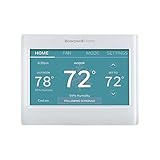
- ENERGY STAR certified to help save energy, track your heating and cooling and send personalized tips on reducing energy use..Includes : Thermostat, Wall Plate, Screws, Anchors, Quick Start Guide, Thermostat ID Card, Wire Labels, User Guide
- SAVE ENERGY AND GET REWARDED by checking with your energy provider about available energy savings rebates to save on your purchase (rebate finder link above). Plus, eligible customers can enroll in ongoing energy savings incentives with their energy provider to keep saving all year long.
- CONTROL FROM ANYWHERE by using the app or compatible smart home partners including AMAZON ALEXA, GOOGLE ASSISTANT, MICROSOFT CORTANA, and more. Flexible programming options are also available if you'd rather set it and forget it but still benefit from energy savings.
- CUSTOMIZABLE COLOR SCREEN: Easily change the high-definition display of the Wi-Fi thermostat to any color you choose.
- ON-SCREEN COMFORT INFORMATION: See indoor and outdoor temperature and humidity information right on the home screen, plus daily weather forecast available on the smart thermostat.
- Wake: Set a comfortable temperature for the time people get up. If you use an early-start or recovery feature, understand that the thermostat may begin heating or cooling before the displayed occupied time.
- Away or work: If the home is usually empty, choose a modest setback or setup rather than an extreme change. If someone works from home, use the occupied setting or a room sensor only if it reflects where people spend time.
- Return: Set the time you want comfort restored. Leave enough lead time for the home and system to respond; the right lead time depends on the building and HVAC equipment.
- Sleep: Use a comfortable overnight setting. Do not assume every household benefits from the same night setback.
- Weekend: Use a separate schedule if weekends differ. For an irregular household, a simpler schedule plus manual temporary holds may be more dependable than extensive programming.
Heat pumps deserve special care: aggressive temperature setbacks can trigger auxiliary heat or reduce efficiency on some systems. Follow the heat-pump manufacturer’s guidance or ask an HVAC professional before setting large setbacks or changing auxiliary-heat controls.
After programming, check the thermostat’s schedule, holds, recovery behavior, and any energy-saving or utility demand-response settings. Add learning, geofencing, or away automation one feature at a time so you can identify which setting causes an unwanted change.
Installation: when DIY is reasonable and when to call a pro
App-guided setup and compatibility tools can make a straightforward replacement easier, but “easy installation” is not universal. Before removing the old thermostat:
- Confirm the new model supports the exact HVAC system using the manufacturer’s compatibility checker.
- Turn off HVAC power at the breaker or service switch. Photograph the old wiring and terminal labels before disconnecting anything.
- Use terminal labels and equipment documentation—not wire colors alone—to identify each connection.
- Verify whether a C-wire is actually connected at both the thermostat and furnace or air handler. Check whether a power adapter is included or approved for your setup.
- Do not connect a low-voltage thermostat to line-voltage baseboard wiring.
- After installation, test heating, cooling, fan, heat-pump changeover, and auxiliary heat as applicable.
Hire an HVAC professional if you have a zone-control panel, proprietary communicating controls, multiple transformers, dual fuel, unusual accessories, unclear wiring, or any uncertainty about voltage. Stop and get help if a fuse blows, the equipment short-cycles, the thermostat repeatedly resets, or heating and cooling behave differently from the old control.
Privacy, subscriptions, rebates, and total cost
A smart thermostat is also an app, account, and cloud-service choice. Compare the features you will actually use: remote access, alerts, energy reports, occupancy detection, room sensors, and voice assistants. Do not assume a paid subscription is required for basic temperature control; requirements are model- and feature-specific. Conversely, cloud-connected features depend on an account and the vendor’s service. If you want no app or cloud dependency, a conventional programmable model is the clearest fit.
Compare total cost, not just the box price. A lower-cost thermostat that fits the equipment may be better value than a premium model if you do not need sensors, air-quality monitoring, or automation. Conversely, a compatible sensor bundle or professional installation may be worth the added cost in a home where comfort is a persistent problem.
Check your utility’s own rebate database before buying. Eligibility can depend on the exact model number, ENERGY STAR status, installation method, purchase date, and utility territory; lists change. Examples of qualified-product lists include Austin Energy’s smart thermostat list and the Golden State Rebates qualified list. A rebate is possible, not guaranteed.
What’s actually slowing this PC down?
Pick the symptom - the matching free tool is one click away.
If “set and forget” stops working
If the home feels wrong or the thermostat keeps changing settings, simplify the system before replacing it:
- Temporarily disable learning, Eco, geofencing, utility demand response, or other automatic overrides.
- Return to a fixed schedule and see whether the problem disappears.
- Recheck the selected equipment type, stages, reversing valve, and wiring configuration in the thermostat app or setup menu.
- Verify C-wire or approved power-adapter connections at both ends.
- Test heating, cooling, fan, auxiliary heat, and changeover separately, where applicable.
- Re-enable advanced features one at a time. Confirm which rooms a remote sensor is prioritizing and whether that matches occupancy.
Recovery mode may start heating or cooling before a scheduled time; an away feature may misread occupancy; and phone geofencing can fail if location permissions or background settings are restricted. If the system short-cycles, blows a fuse, fails to switch modes, or behaves differently from the old thermostat, turn off the new control if safe to do so and contact an HVAC technician.
Quick Recap
Which one should you choose?
- Choose Nest Learning 4th gen if you want the thermostat to adapt to your habits and value the included sensor and Google Home/Matter integration—and your equipment passes Google’s compatibility check.
- Choose ecobee Premium if room-priority sensing, air-quality information, and broader smart-home integrations justify a premium device for your household.
- Choose Sensi Lite if low-cost app-based seven-day scheduling is the goal and your system’s C-wire needs are satisfied.
- Choose Honeywell Home RTH7600D or Emerson 1F97-1277 if you want a local fixed schedule without Wi-Fi, after confirming current availability and exact compatibility.
- Pause before buying if you have line-voltage heat, a communicating HVAC system, zoning, dual fuel, unclear wiring, or no verified C-wire path. Confirm the system with the manufacturer or an HVAC professional first.
Product prices and availability are accurate as of the date/time indicated and are subject to change. Any price and availability information displayed on Amazon at the time of purchase will apply.


Leave a Reply